第14章酸塩基平衡
Relative Strengths of Conjugate Acid-Base Pairs共役酸塩基対の相対的な強さ
Brønsted-Lowry acid-base chemistry is the transfer of protons; thus, logic suggests a relation between the relative strengths of conjugate acid-base pairs. The strength of an acid or base is quantified in its ionization constant, Ka or Kb, which represents the extent of the acid or base ionization reaction. For the conjugate acid-base pair HA / A−, ionization equilibrium equations and ionization constant expressions are
ブレンステッド・ローリーの酸塩基の化学は、プロトンの移動を扱う。そのため、共役酸塩基対の相対的な強さには関係があると考えられる。酸や塩基の強さは電離定数KaまたはKbで数値化され、これらの定数は酸または塩基の電離反応が進む程度を表す。共役酸塩基対HA / A−について、電離平衡の反応式と電離定数の式は、次のとおりである。
Adding these two chemical equations yields the equation for the autoionization for water:
この二つの化学反応式を足し合わせると、水の自己解離の反応式が得られる。
As discussed in another chapter on equilibrium, the equilibrium constant for a summed reaction is equal to the mathematical product of the equilibrium constants for the added reactions, and so
平衡を扱う別の章で述べたように、反応式を足し合わせて得た反応の平衡定数は、元の各反応の平衡定数の積に等しい。したがって、
This equation states the relation between ionization constants for any conjugate acid-base pair, namely, their mathematical product is equal to the ion product of water, Kw. By rearranging this equation, a reciprocal relation between the strengths of a conjugate acid-base pair becomes evident:
英語のヒント
この式は、どの共役酸塩基対の電離定数についても成り立つ関係、すなわち、それらの積が水のイオン積Kwに等しいことを表す。この式を変形すると、共役酸塩基対の強さの間の逆の関係が明らかになる。
The inverse proportional relation between Ka and Kb means the stronger the acid or base, the weaker its conjugate partner. Figure 14.7 illustrates this relation for several conjugate acid-base pairs.
KaとKbの反比例関係は、酸または塩基が強いほど、その共役の相手は弱いことを意味する。図14.7は、いくつかの共役酸塩基対についてこの関係を示している。
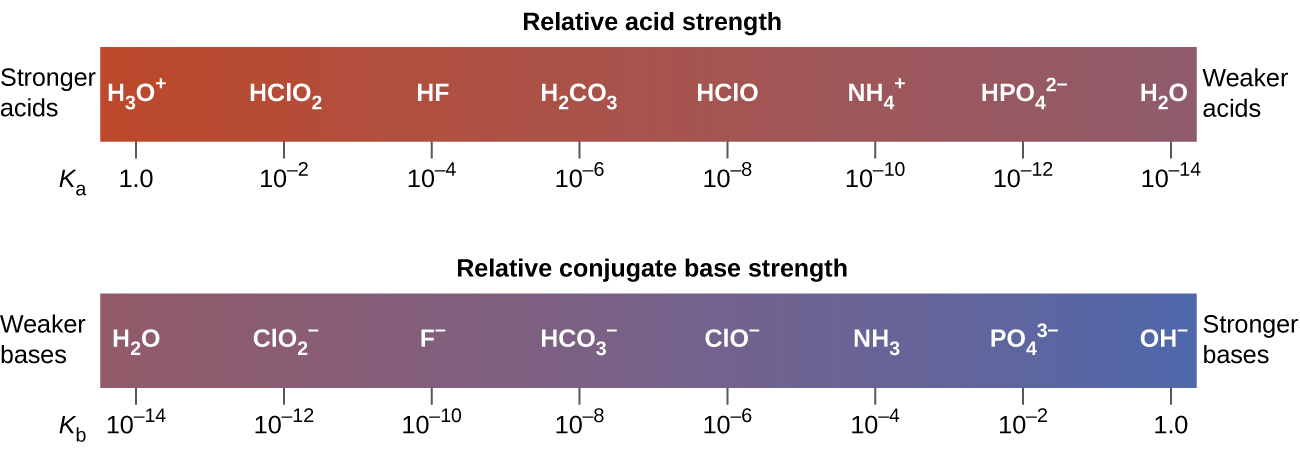
Figure 14.7図 14.7
Relative strengths of several conjugate acid-base pairs are shown.
いくつかの共役酸塩基対の相対的な強さを示す。
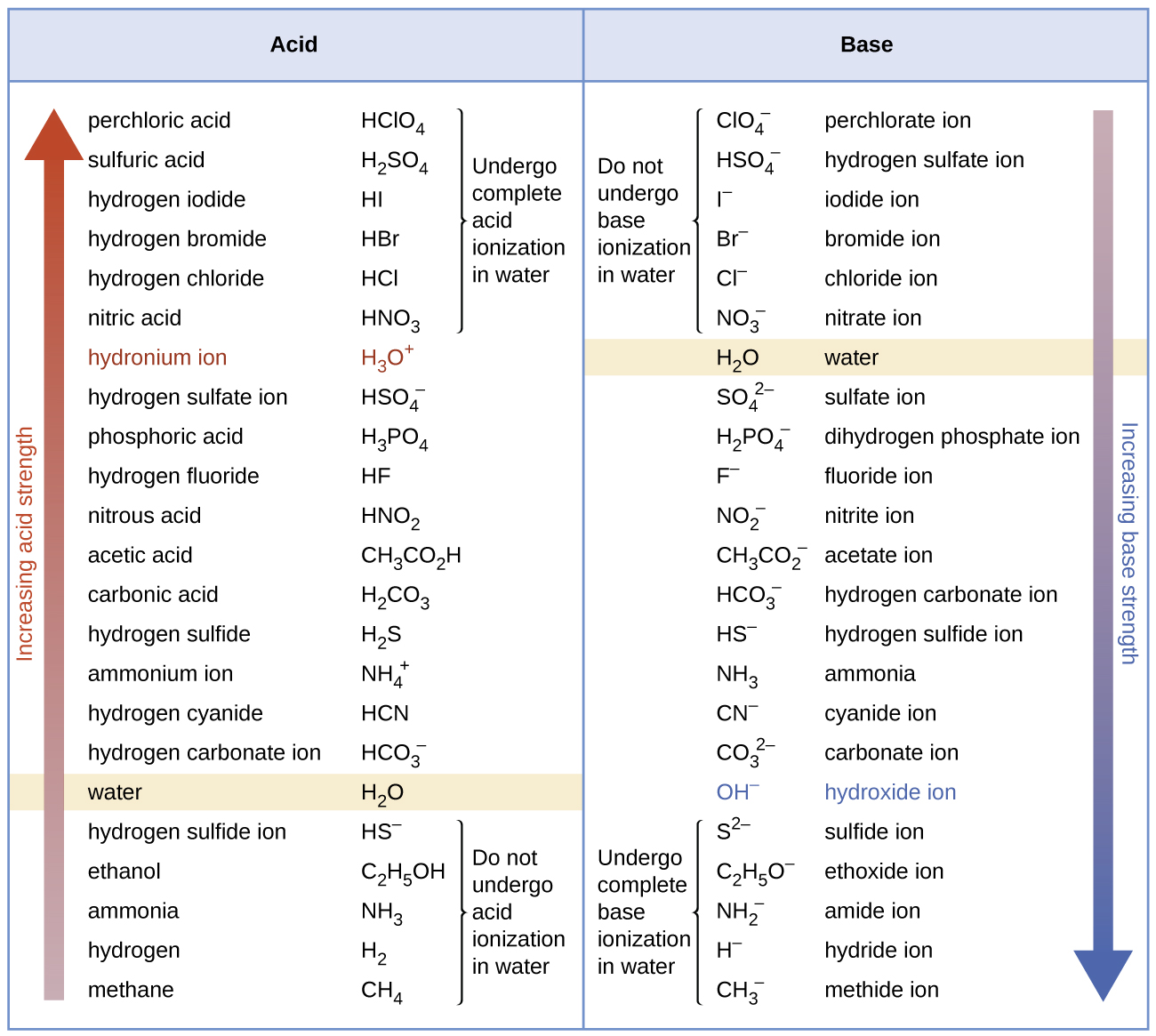


Figure 14.8図 14.8
This figure shows strengths of conjugate acid-base pairs relative to the strength of water as the reference substance.
水を基準物質としたときの、共役酸塩基対の相対的な強さを示す。
The listing of conjugate acid–base pairs shown in Figure 14.8 is arranged to show the relative strength of each species as compared with water, whose entries are highlighted in each of the table’s columns. In the acid column, those species listed below water are weaker acids than water. These species do not undergo acid ionization in water; they are not Brønsted-Lowry acids. All the species listed above water are stronger acids, transferring protons to water to some extent when dissolved in an aqueous solution to generate hydronium ions. Species above water but below hydronium ion are weak acids, undergoing partial acid ionization, wheres those above hydronium ion are strong acids that are completely ionized in aqueous solution.
英語のヒント
図14.8の共役酸塩基対の一覧は、水と比べた各化学種の相対的な強さがわかるように並べてあり、水の項目は表の各列で強調されている。酸の列で水より下にある化学種は、水より弱い酸である。これらは水中で酸として電離せず、ブレンステッド・ローリーの酸ではない。水より上にある化学種は、すべて水より強い酸である。水溶液に溶けると、ある程度プロトンを水へ移してオキソニウムイオンを生じる。水より上でオキソニウムイオンより下の化学種は、一部が酸として電離する弱酸であり、オキソニウムイオンより上の化学種は、水溶液中で完全に電離する強酸である。
If all these strong acids are completely ionized in water, why does the column indicate they vary in strength, with nitric acid being the weakest and perchloric acid the strongest? Notice that the sole acid species present in an aqueous solution of any strong acid is H3O+(aq), meaning that hydronium ion is the strongest acid that may exist in water; any stronger acid will react completely with water to generate hydronium ions. This limit on the acid strength of solutes in a solution is called a leveling effect. To measure the differences in acid strength for “strong” acids, the acids must be dissolved in a solvent that is less basic than water. In such solvents, the acids will be “weak,” and so any differences in the extent of their ionization can be determined. For example, the binary hydrogen halides HCl, HBr, and HI are strong acids in water but weak acids in ethanol (strength increasing HCl < HBr < HI).
英語のヒント
これらの強酸がどれも水中で完全に電離するのなら、なぜこの列では強さが異なり、硝酸が最も弱く過塩素酸が最も強いと示されているのだろうか。どの強酸の水溶液でも、存在する酸の化学種はH3O+(aq)だけであることに注目しよう。つまり、水中に存在できる最も強い酸はオキソニウムイオンである。それより強い酸は、水と完全に反応してオキソニウムイオンになる。溶液中の溶質の酸の強さにこのような限界が生じることを、水平化効果という。「強酸」どうしの強さの違いを測定するには、水より塩基性の弱い溶媒に酸を溶かさなければならない。そのような溶媒中では酸は「弱酸」になるので、電離の程度の違いを測定できる。例えば、二元化合物であるハロゲン化水素HCl、HBr、HIは、水中では強酸だが、エタノール中では弱酸である(強さはHCl < HBr < HIの順に増す)。
The right column of Figure 14.8 lists a number of substances in order of increasing base strength from top to bottom. Following the same logic as for the left column, species listed above water are weaker bases and so they don’t undergo base ionization when dissolved in water. Species listed between water and its conjugate base, hydroxide ion, are weak bases that partially ionize. Species listed below hydroxide ion are strong bases that completely ionize in water to yield hydroxide ions (i.e., they are leveled to hydroxide). A comparison of the acid and base columns in this table supports the reciprocal relation between the strengths of conjugate acid-base pairs. For example, the conjugate bases of the strong acids (top of table) are all of negligible strength. A strong acid exhibits an immeasurably large Ka, and so its conjugate base will exhibit a Kb that is essentially zero:
英語のヒント
図14.8の右の列では、上から下へ塩基の強さが増す順に、いくつかの物質を並べている。左の列と同じ考え方に従うと、水より上にある化学種は水より弱い塩基なので、水に溶けても塩基として電離しない。水とその共役塩基である水酸化物イオンとの間にある化学種は、一部が電離する弱塩基である。水酸化物イオンより下にある化学種は、水中で完全に電離して水酸化物イオンを生じる強塩基である(すなわち、水酸化物イオンの強さに水平化される)。この表の酸の列と塩基の列を比べると、共役酸塩基対の強さの逆の関係が確かめられる。例えば、強酸の共役塩基(表の上部)の強さは、すべて無視できるほど小さい。強酸のKaは測定できないほど大きいため、その共役塩基のKbは実質的にゼロになる。
A similar approach can be used to support the observation that conjugate acids of strong bases (Kb ≈ ∞) are of negligible strength (Ka ≈ 0).
同様の方法で、強塩基(Kb ≈ ∞)の共役酸の強さは無視できるほど小さい(Ka ≈ 0)ことも裏づけられる。
Example 14.8例題 14.8
Calculating Ionization Constants for Conjugate Acid-Base Pairs共役酸塩基対の電離定数を計算する
Use the Kb for the nitrite ion, to calculate the Ka for its conjugate acid.
亜硝酸イオンのKbを使って、その共役酸のKaを計算しなさい。
Solution解法
Kb for is given in this section as 2.17 10−11. The conjugate acid of is HNO2; Ka for HNO2 can be calculated using the relationship:
のKbは、この節で2.17 10−11と与えられている。の共役酸はHNO2である。HNO2のKaは、次の関係を使って計算できる。
Solving for Ka yields
Kaについて解くと、
This answer can be verified by finding the Ka for HNO2 in Appendix H.
付録HでHNO2のKaを調べれば、この答えを確認できる。
Check Your Learning理解度の確認
Determine the relative acid strengths of and HCN by comparing their ionization constants. The ionization constant of HCN is given in Appendix H as 4.9 10−10. The ionization constant of is not listed, but the ionization constant of its conjugate base, NH3, is listed as 1.8 10−5.
電離定数を比較して、とHCNの酸としての相対的な強さを求めなさい。HCNの電離定数は、付録Hに4.9 10−10と示されている。の電離定数は載っていないが、その共役塩基NH3の電離定数は1.8 10−5と示されている。