第4章一次関数Linear Functions
4.1 Linear Functions4.1 一次関数
Learning Objectives 学習目標
In this section, you will:
この節を終えると、次のことができるようになる。
• Represent a linear function.• Determine whether a linear function is increasing, decreasing, or constant.• Interpret slope as a rate of change.• Write and interpret an equation for a linear function.• Graph linear functions.• Determine whether lines are parallel or perpendicular.• Write the equation of a line parallel or perpendicular to a given line.
・一次関数を表す。・一次関数が増加・減少・一定のどれかを判定する。・傾きを変化の割合として読む。・一次関数の方程式を書き、それを読み取る。・一次関数のグラフを描く。・直線どうしが平行か垂直かを判定する。・与えられた直線に平行または垂直な直線の方程式を書く。
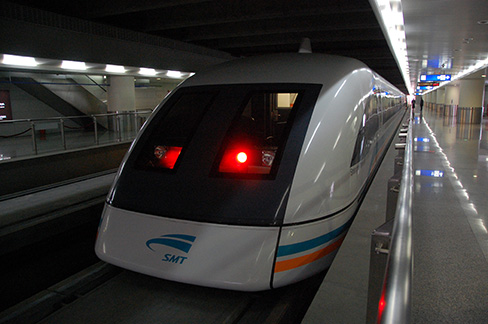
Just as with the growth of a bamboo plant, there are many situations that involve constant change over time. Consider, for example, the first commercial maglev train in the world, the Shanghai MagLev Train (Figure 1). It carries passengers comfortably for a 30-kilometer trip from the airport to the subway station in only eight minutes2.
竹の成長の例のように、時間とともに一定の割合で量が変わる状況は数多くある。交通もその一例である。図1の上海リニアは、空港から地下鉄の駅までの約30キロメートルを、わずか8分で結ぶ。この移動を例に、距離と時間の関係を考えてみよう。
Suppose a maglev train travels a long distance, and maintains a constant speed of 83 meters per second for a period of time once it is 250 meters from the station. How can we analyze the train’s distance from the station as a function of time? In this section, we will investigate a kind of function that is useful for this purpose, and use it to investigate real-world situations such as the train’s distance from the station at a given point in time.
ある磁気浮上列車が長い距離を走り、駅から250メートルの地点からしばらく毎秒83メートルの一定の速さを保つとしよう。駅からの列車の距離を時間の関数としてどう調べればよいか。この節では、この目的に役立つ種類の関数を調べ、それを使って、ある時点での駅からの列車の距離といった現実の場面を調べる。