第3章関数Functions
3.7 Inverse Functions3.7 逆関数
Learning Objectives 学習目標
In this section, you will:
この節を終えると、次のことができるようになる。
• Verify inverse functions.• Determine the domain and range of an inverse function, and restrict the domain of a function to make it one-to-one.• Find or evaluate the inverse of a function.• Use the graph of a one-to-one function to graph its inverse function on the same axes.
・逆関数であることを確かめる。・逆関数の定義域と値域を決め、一対一になるように関数の定義域を制限する。・関数の逆関数を求める、またはその値を求める。・一対一の関数のグラフを使って、その逆関数のグラフを同じ座標軸に描く。
A reversible heat pump is a climate-control system that is an air conditioner and a heater in a single device. Operated in one direction, it pumps heat out of a house to provide cooling. Operating in reverse, it pumps heat into the building from the outside, even in cool weather, to provide heating. As a heater, a heat pump is several times more efficient than conventional electrical resistance heating.
可逆式のヒートポンプは、冷房機と暖房機を一台にまとめた空調装置である。一方の向きに動かせば、家から熱を汲み出して冷やす。逆に動かせば、寒い天気でも外から建物へ熱を汲み入れて暖める。暖房としては、ヒートポンプはふつうの電気抵抗による暖房より何倍も効率がよい。
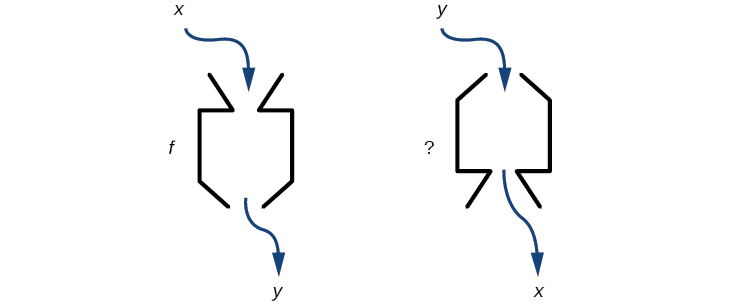
If some physical machines can run in two directions, we might ask whether some of the function “machines” we have been studying can also run backwards. Figure 1 provides a visual representation of this question. In this section, we will consider the reverse nature of functions.
物理の機械の中に二つの向きに動くものがあるなら、これまで調べてきた関数という「機械」にも逆向きに動くものがあるかと問いたくなる。図1にこの問いを絵で示す。この節では、関数の逆向きの性質を考える。
Verifying That Two Functions Are Inverse Functions二つの関数が互いに逆関数であることを確かめる
Betty is traveling to Milan for a fashion show and wants to know what the temperature will be. She is not familiar with the Celsius scale. To get an idea of how temperature measurements are related, Betty wants to convert 75 degrees Fahrenheit to degrees Celsius using the formula
Betty はファッションショーのためにミラノへ行くところで、気温がどれくらいかを知りたい。摂氏の目盛りには慣れていない。温度の測り方どうしの関係をつかむため、Betty は次の公式を使って華氏75度を摂氏に直したい。
and substitutes 75 for to calculate
そして に75を代入して計算する。
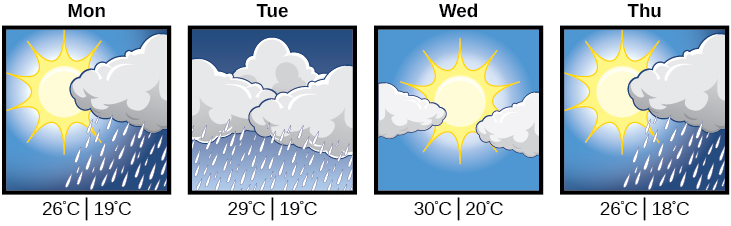
Knowing that a comfortable 75 degrees Fahrenheit is about 24 degrees Celsius, Betty gets the week’s weather forecast from Figure 2 for Milan, and wants to convert all of the temperatures to degrees Fahrenheit.
過ごしやすい華氏75度がおよそ摂氏24度だと分かったので、Betty は図2のミラノの一週間の天気予報を手に入れ、すべての気温を華氏に直したいと思う。
At first, Betty considers using the formula she has already found to complete the conversions. After all, she knows her algebra, and can easily solve the equation for after substituting a value for For example, to convert 26 degrees Celsius, she could write
はじめ Betty は、すでに見つけた公式を使って換算しようと考える。何しろ代数は分かっているので、 に値を代入してから について方程式を解くのは造作もない。たとえば摂氏26度を直すには、次のように書けばよい。
After considering this option for a moment, however, she realizes that solving the equation for each of the temperatures will be awfully tedious. She realizes that since evaluation is easier than solving, it would be much more convenient to have a different formula, one that takes the Celsius temperature and outputs the Fahrenheit temperature.
しかし少し考えて、気温ごとに方程式を解くのはひどく面倒だと気づく。解くより値を求める方が楽なので、摂氏の気温を入れて華氏の気温を出す別の公式があった方がずっと便利だと気づく。
The formula for which Betty is searching corresponds to the idea of an inverse function, which is a function for which the input of the original function becomes the output of the inverse function and the output of the original function becomes the input of the inverse function.
Betty が探している公式は、逆関数という考えに当たる。逆関数とは、もとの関数の入力が逆関数の出力になり、もとの関数の出力が逆関数の入力になる関数である。
Given a function we represent its inverse as read as inverse of The raised is part of the notation. It is not an exponent; it does not imply a power of . In other words, does not mean because is the reciprocal of and not the inverse.
関数 が与えられたとき、その逆関数を と表し、「 逆 」と読む。右肩の は書き方の一部である。これは指数ではなく、 乗を意味しない。言い換えると、 は を意味しない。 は の逆数であって、逆関数ではないからである。
The “exponent-like” notation comes from an analogy between function composition and multiplication: just as (1 is the identity element for multiplication) for any nonzero number so equals the identity function, that is,
「指数のような」この書き方は、関数の合成と乗法のあいだの類比から来ている。0でないどんな数 についても (1は乗法の単位元)であるのと同じように、 は恒等関数に等しい。すなわち、
This holds for all in the domain of Informally, this means that inverse functions “undo” each other. However, just as zero does not have a reciprocal, some functions do not have inverses.
これは の定義域のすべての について成り立つ。くだけていえば、逆関数どうしは互いの働きを「取り消す」ということである。ただし0に逆数が無いのと同じように、逆関数を持たない関数もある。
Given a function we can verify whether some other function is the inverse of by checking if both and are true.
関数 が与えられたとき、別の関数 が の逆関数かどうかは、 と の両方が成り立つかを確かめれば分かる。
For example, and are inverse functions.
たとえば と は互いに逆関数である。
and
そして
A few coordinate pairs from the graph of the function are (−2, −8), (0, 0), and (2, 8). A few coordinate pairs from the graph of the function are (−8, −2), (0, 0), and (8, 2). If we interchange the input and output of each coordinate pair of a function, the interchanged coordinate pairs would appear on the graph of the inverse function.
関数 のグラフ上の座標の組をいくつか挙げると、(−2, −8)、(0, 0)、(2, 8) である。関数 のグラフ上の座標の組をいくつか挙げると、(−8, −2)、(0, 0)、(8, 2) である。ある関数の各座標の組で入力と出力を入れ替えると、入れ替えた組はその逆関数のグラフ上に現れる。
Inverse Function 逆関数
For any one-to-one function a function is an inverse function of if This can also be written as for all in the domain of It also follows that for all in the domain of if is the inverse of
一対一の関数 について、 が成り立つとき、関数 を の逆関数という。これは の定義域のすべての について とも書ける。また が の逆関数なら、 の定義域のすべての について も成り立つ。
The notation is read inverse.” Like any other function, we can use any variable name as the input for so we will often write which we read as inverse of Keep in mind that
書き方 は「 逆」と読む。ほかの関数と同じように の入力にはどんな変数名も使えるので、しばしば と書き、「 の 逆」と読む。次のことを覚えておこう。
and not all functions have inverses.
そして、すべての関数に逆関数があるわけではない。
Example 1例1
Identifying an Inverse Function for a Given Input-Output Pair与えられた入出力の組から逆関数を見分ける
If for a particular one-to-one function and what are the corresponding input and output values for the inverse function?
ある一対一の関数について と のとき、逆関数の入力値と出力値はそれぞれ何か。
Solution 解答
The inverse function reverses the input and output quantities, so if
逆関数は入力と出力の量を入れ替えるので、
Alternatively, if we want to name the inverse function then and
あるいは、逆関数を と名づけたいなら と である。
Analysis 考察
Notice that if we show the coordinate pairs in a table form, the input and output are clearly reversed. See Table 1.
座標の組を表の形で示すと、入力と出力がはっきり入れ替わっていることに注意せよ。表1を見よ。
Try It #1やってみよう1
Given that what are the corresponding input and output values of the original function
のとき、もとの関数 の対応する入力値と出力値は何か。
How To 手順
Given two functions and test whether the functions are inverses of each other.
二つの関数 と が与えられたとき、それらが互いに逆関数かどうかを調べる。
1. Determine whether or 2. If both statements are true, then and If either statement is false, then both are false, and and
1. か かを確かめる。2. 両方が成り立つなら かつ である。どちらかが偽なら両方とも偽であり、 かつ である。
Example 2例2
Testing Inverse Relationships Algebraically逆関数の関係を式の上で調べる
If and is
と のとき、 か。
Solution 解答
We must also verify the other formula.
もう一方の式も確かめなければならない。
so
よって
Analysis 考察
Notice the inverse operations are in reverse order of the operations from the original function.
逆の演算が、もとの関数の演算と逆の順に並んでいることに注意せよ。
Try It #2やってみよう2
If and is
と のとき、 か。
Example 3例3
Determining Inverse Relationships for Power Functions累乗の関数について逆関数の関係を判定する
If (the cube function) and is
(三乗の関数)と のとき、 か。
Solution 解答
No, the functions are not inverses.
いいえ、この二つは互いに逆関数ではない。
Analysis 考察
The correct inverse to the cube is, of course, the cube root that is, the one-third is an exponent, not a multiplier.
三乗の正しい逆関数は、もちろん三乗根 である。つまり三分の一は指数であって、掛ける数ではない。
Try It #3やってみよう3
If is
のとき、 か。
Finding Domain and Range of Inverse Functions逆関数の定義域と値域を求める
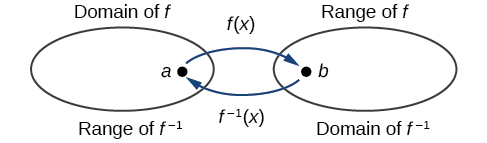
The outputs of the function are the inputs to so the range of is also the domain of Likewise, because the inputs to are the outputs of the domain of is the range of We can visualize the situation as in Figure 3.
関数 の出力は への入力なので、 の値域は の定義域でもある。同じく、 への入力は の出力なので、 の定義域は の値域である。図3のように思い描ける。
When a function has no inverse function, it is possible to create a new function where that new function on a limited domain does have an inverse function. For example, the inverse of is because a square “undoes” a square root; but the square is only the inverse of the square root on the domain since that is the range of
逆関数を持たない関数でも、定義域を狭めれば逆関数を持つ新しい関数を作れることがある。たとえば の逆関数は である。二乗が平方根を「取り消す」からである。ただし二乗が平方根の逆関数になるのは定義域 の上だけである。それが の値域だからである。
We can look at this problem from the other side, starting with the square (toolkit quadratic) function If we want to construct an inverse to this function, we run into a problem, because for every given output of the quadratic function, there are two corresponding inputs (except when the input is 0). For example, the output 9 from the quadratic function corresponds to the inputs 3 and –3. But an output from a function is an input to its inverse; if this inverse input corresponds to more than one inverse output (input of the original function), then the “inverse” is not a function at all! To put it differently, the quadratic function is not a one-to-one function; it fails the horizontal line test, so it does not have an inverse function. In order for a function to have an inverse, it must be a one-to-one function.
この問題を逆の側から、二乗(道具となる二次)の関数 から見てみよう。この関数の逆関数を作ろうとすると問題にぶつかる。二次関数のどの出力にも、対応する入力が二つあるからである(入力が0のときを除く)。たとえば二次関数の出力9は、入力3と–3に対応する。しかし関数の出力はその逆関数への入力である。この逆関数への入力が二つ以上の逆関数の出力(もとの関数の入力)に対応するなら、その「逆関数」はそもそも関数ではない。言い換えると、二次関数は一対一の関数ではない。横線の判定法を通らないので、逆関数を持たない。関数が逆関数を持つには、一対一の関数でなければならない。
In many cases, if a function is not one-to-one, we can still restrict the function to a part of its domain on which it is one-to-one. For example, we can make a restricted version of the square function with its domain limited to which is a one-to-one function (it passes the horizontal line test) and which has an inverse (the square-root function).
関数が一対一でなくても、一対一になる定義域の一部に制限できることが多い。たとえば二乗の関数 の定義域を に限った制限版を作れる。これは一対一の関数であり(横線の判定法を通る)、逆関数(平方根の関数)を持つ。
If on then the inverse function is
上で なら、その逆関数は である。
• The domain of = range of = • The domain of = range of =
・ の定義域 = の値域 = ・ の定義域 = の値域 =
Q&A 疑問と答え
Is it possible for a function to have more than one inverse?
一つの関数が二つ以上の逆関数を持つことはありうるか。
No. If two supposedly different functions, say, and both meet the definition of being inverses of another function then you can prove that We have just seen that some functions only have inverses if we restrict the domain of the original function. In these cases, there may be more than one way to restrict the domain, leading to different inverses. However, on any one domain, the original function still has only one unique inverse.
無い。違うはずの二つの関数、たとえば と が、どちらも別の関数 の逆関数の定義を満たすなら、 であることを証明できる。もとの関数の定義域を制限しないと逆関数を持たない関数があることは見た。そうした場合、定義域の制限の仕方は一通りとは限らず、違う逆関数になりうる。しかし一つの定義域の上では、もとの関数の逆関数はやはりただ一つである。
Domain and Range of Inverse Functions 逆関数の定義域と値域
The range of a function is the domain of the inverse function
関数 の値域は、逆関数 の定義域である。
The domain of is the range of
の定義域は の値域である。
How To 手順
Given a function, find the domain and range of its inverse.
関数が与えられたとき、その逆関数の定義域と値域を求める。
1. If the function is one-to-one, write the range of the original function as the domain of the inverse, and write the domain of the original function as the range of the inverse.2. If the domain of the original function needs to be restricted to make it one-to-one, then this restricted domain becomes the range of the inverse function.
1. その関数が一対一なら、もとの関数の値域を逆関数の定義域として書き、もとの関数の定義域を逆関数の値域として書く。2. 一対一にするためにもとの関数の定義域を制限する必要があるなら、その制限した定義域が逆関数の値域になる。
Example 4例4
Finding the Inverses of Toolkit Functions道具となる関数の逆関数を求める
Identify which of the toolkit functions besides the quadratic function are not one-to-one, and find a restricted domain on which each function is one-to-one, if any. The toolkit functions are reviewed in Table 2. We restrict the domain in such a fashion that the function assumes all y-values exactly once.
二次関数のほかに一対一でない道具となる関数を挙げ、各関数が一対一になる制限された定義域があればそれを求めよ。道具となる関数は表2にまとめてある。関数が y の値をちょうど一度ずつとるように定義域を制限する。
| Constant定数関数 | Identity恒等関数 | Quadratic二次関数 | Cubic三次関数 | Reciprocal逆数 |
|---|---|---|---|---|
| Reciprocal squared逆数の二乗 | Cube root三乗根 | Square root平方根 | Absolute value絶対値 | |
Solution 解答
The constant function is not one-to-one, and there is no domain (except a single point) on which it could be one-to-one, so the constant function has no inverse.
定数関数は一対一ではなく、一対一になりうる定義域も(一点を除いて)無いので、定数関数に逆関数は無い。
The absolute value function can be restricted to the domain where it is equal to the identity function.
絶対値関数は、恒等関数と一致する定義域 に制限できる。
The reciprocal-squared function can be restricted to the domain
逆数の二乗の関数は、定義域 に制限できる。
Analysis 考察
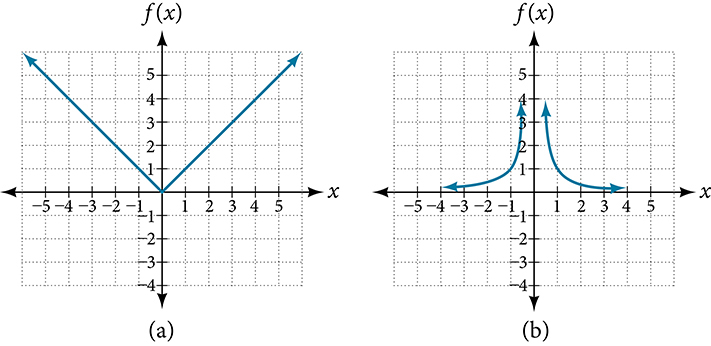
We can see that these functions (if unrestricted) are not one-to-one by looking at their graphs, shown in Figure 4. They both would fail the horizontal line test. However, if a function is restricted to a certain domain so that it passes the horizontal line test, then in that restricted domain, it can have an inverse.
図4のグラフを見れば、これらの関数が(制限しなければ)一対一でないことが分かる。どちらも横線の判定法を通らない。しかし横線の判定法を通るようにある定義域に制限すれば、その制限された定義域の上で逆関数を持ちうる。
Try It #4やってみよう4
The domain of function is and the range of function is Find the domain and range of the inverse function.
関数 の定義域は 、値域は である。 の逆関数の定義域と値域を求めよ。
Finding and Evaluating Inverse Functions逆関数を求め、その値を求める
Once we have a one-to-one function, we can evaluate its inverse at specific inverse function inputs or construct a complete representation of the inverse function in many cases.
一対一の関数があれば、特定の入力での逆関数の値を求められるし、多くの場合は逆関数の完全な表し方を作れる。
Inverting Tabular Functions表で表された関数の逆関数
Suppose we want to find the inverse of a function represented in table form. Remember that the domain of a function is the range of the inverse and the range of the function is the domain of the inverse. So we need to interchange the domain and range.
表の形で表された関数の逆関数を求めたいとしよう。関数の定義域が逆関数の値域であり、関数の値域が逆関数の定義域だったことを思い出そう。よって定義域と値域を入れ替えればよい。
Each row (or column) of inputs becomes the row (or column) of outputs for the inverse function. Similarly, each row (or column) of outputs becomes the row (or column) of inputs for the inverse function.
入力の各行(または列)が、逆関数の出力の行(または列)になる。同じく、出力の各行(または列)が逆関数の入力の行(または列)になる。
Example 5例5
Interpreting the Inverse of a Tabular Function表で表された関数の逆関数を読み取る
A function is given in Table 3, showing distance in miles that a car has traveled in minutes. Find and interpret
表3に関数 が与えられている。これは自動車が 分で進んだ距離(マイル)を示す。 を求め、その意味を述べよ。
| 30 | 50 | 70 | 90 | |
| 20 | 40 | 60 | 70 |
Solution 解答
The inverse function takes an output of and returns an input for So in the expression 70 is an output value of the original function, representing 70 miles. The inverse will return the corresponding input of the original function 90 minutes, so The interpretation of this is that, to drive 70 miles, it took 90 minutes.
逆関数は の出力を受け取って の入力を返す。よって式 の70は、もとの関数の出力値であり、70マイルを表す。逆関数は、もとの関数の対応する入力 、すなわち90分を返すので である。これは、70マイル走るのに90分かかったという意味である。
Alternatively, recall that the definition of the inverse was that if then By this definition, if we are given then we are looking for a value so that In this case, we are looking for a so that which is when
あるいは、逆関数の定義が「 なら 」であったことを思い出そう。この定義によれば、 が与えられたとき、 となる値 を探していることになる。この場合、 となる を探しており、それは のときである。
Try It #5やってみよう5
Using Table 4, find and interpret ⓐ and ⓑ
表4を使って、ⓐ と ⓑ を求め、その意味を述べよ。
| 30 | 50 | 60 | 70 | 90 | |
| 20 | 40 | 50 | 60 | 70 |
Evaluating the Inverse of a Function, Given a Graph of the Original Functionもとの関数のグラフが与えられたとき、逆関数の値を求める
We saw in Functions and Function Notation that the domain of a function can be read by observing the horizontal extent of its graph. We find the domain of the inverse function by observing the vertical extent of the graph of the original function, because this corresponds to the horizontal extent of the inverse function. Similarly, we find the range of the inverse function by observing the horizontal extent of the graph of the original function, as this is the vertical extent of the inverse function. If we want to evaluate an inverse function, we find its input within its domain, which is all or part of the vertical axis of the original function’s graph.
「関数とその表記」で、関数の定義域はそのグラフの横の広がりを見れば読み取れることを学んだ。逆関数の定義域は、もとの関数のグラフの縦の広がりを見れば分かる。それが逆関数の横の広がりに当たるからである。同じく、逆関数の値域は、もとの関数のグラフの横の広がりを見れば分かる。それが逆関数の縦の広がりだからである。逆関数の値を求めたいときは、その定義域の中にある入力を探す。それはもとの関数のグラフの縦の軸の全体または一部である。
How To 手順
Given the graph of a function, evaluate its inverse at specific points.
関数のグラフが与えられたとき、決まった点での逆関数の値を求める。
1. Find the desired input on the y-axis of the given graph.2. Read the inverse function’s output from the x-axis of the given graph.
1. 与えられたグラフの y軸で、求めたい入力を見つける。2. 与えられたグラフの x軸から、逆関数の出力を読み取る。
Example 6例6
Evaluating a Function and Its Inverse from a Graph at Specific Pointsグラフから、決まった点での関数とその逆関数の値を求める
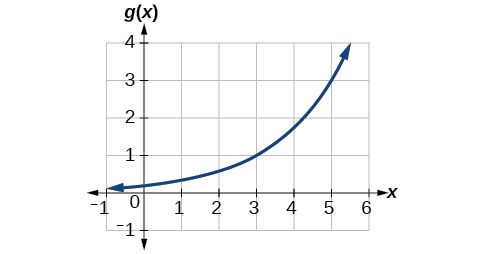
A function is given in Figure 5. Find and
図5に関数 が与えられている。 と を求めよ。
Solution 解答
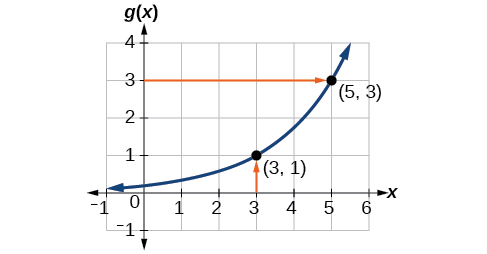
To evaluate we find 3 on the x-axis and find the corresponding output value on the y-axis. The point tells us that
を求めるには、x軸で3を見つけ、y軸で対応する出力値を見つける。点 から が分かる。
To evaluate recall that by definition means the value of x for which By looking for the output value 3 on the vertical axis, we find the point on the graph, which means so by definition, See Figure 6.
を求めるには、定義により が となる x の値を意味することを思い出そう。縦の軸で出力値3を探すと、グラフ上の点 が見つかる。これは を意味するので、定義により である。図6を見よ。
Try It #6やってみよう6
Using the graph in Figure 5, ⓐ find and ⓑ estimate
図5のグラフを使って、ⓐ を求め、ⓑ を見積もれ。
Finding Inverses of Functions Represented by Formulas式で表された関数の逆関数を求める
Sometimes we will need to know an inverse function for all elements of its domain, not just a few. If the original function is given as a formula—for example, as a function of we can often find the inverse function by solving to obtain as a function of
定義域のいくつかの点だけでなく、すべての要素について逆関数を知る必要があることもある。もとの関数が式で——たとえば の関数としての として——与えられていれば、 の関数としての を得るように解くことで、逆関数を求められることが多い。
How To 手順
Given a function represented by a formula, find the inverse.
式で表された関数が与えられたとき、その逆関数を求める。
1. Make sure is a one-to-one function.2. Solve for 3. Interchange and 4. Replace with . (Variables may be different in different cases, but the principle is the same.)
1. が一対一の関数であることを確かめる。2. について解く。3. と を入れ替える。4. を に置き換える(場合によって変数は違うが、考え方は同じである)。
Example 7例7
Inverting the Fahrenheit-to-Celsius Function華氏から摂氏への関数の逆関数を求める
Find a formula for the inverse function that gives Fahrenheit temperature as a function of Celsius temperature.
摂氏の気温の関数として華氏の気温を与える逆関数の式を求めよ。
Solution 解答
By solving in general, we have uncovered the inverse function. If
一般に解くことで、逆関数が明らかになった。
then
すると
In this case, we introduced a function to represent the conversion because the input and output variables are descriptive, and writing could get confusing.
この場合、入力と出力の変数が中身を思わせるものになっており、 と書くと紛らわしいので、換算を表す関数 を導いた。
Try It #7やってみよう7
Solve for in terms of given
が与えられたとき、 を使って について解け。
Example 8例8
Solving to Find an Inverse Function解いて逆関数を求める
Find the inverse of the function
関数 の逆関数を求めよ。
Solution 解答
So or
よって すなわち である。
Analysis 考察
The domain and range of exclude the values 3 and 4, respectively. and are equal at two points but are not the same function, as we can see by creating Table 5.
の定義域と値域は、それぞれ3と4を除く。 と は二点で等しくなるが、表5を作れば分かるとおり同じ関数ではない。
| 1 | 2 | 5 | ||
| 3 | 2 | 5 |
Example 9例9
Solving to Find an Inverse with Radicals解いて、根号を含む逆関数を求める
Find the inverse of the function
関数 の逆関数を求めよ。
Solution 解答
So
よって である。
The domain of is Notice that the range of is so this means that the domain of the inverse function is also
の定義域は である。 の値域が であることに注意せよ。つまり逆関数 の定義域も である。
Analysis 考察
The formula we found for looks like it would be valid for all real However, itself must have an inverse (namely, ) so we have to restrict the domain of to in order to make a one-to-one function. This domain of is exactly the range of
求めた の式は、すべての実数 について成り立つように見える。しかし 自身も逆関数(すなわち )を持たなければならないので、 を一対一の関数にするために の定義域を に制限しなければならない。この定義域 は、ちょうど の値域である。
Try It #8やってみよう8
What is the inverse of the function State the domains of both the function and the inverse function.
関数 の逆関数は何か。もとの関数と逆関数の両方の定義域を述べよ。
Finding Inverse Functions and Their Graphs逆関数とそのグラフを求める
Now that we can find the inverse of a function, we will explore the graphs of functions and their inverses. Let us return to the quadratic function restricted to the domain on which this function is one-to-one, and graph it as in Figure 7.
関数の逆関数を求められるようになったので、関数とその逆関数のグラフを調べよう。二次関数 に戻り、この関数が一対一になる定義域 に制限して、図7のようにグラフを描く。
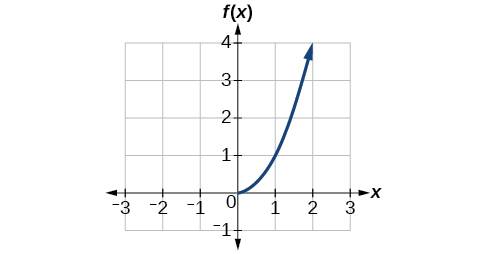
Restricting the domain to makes the function one-to-one (it will obviously pass the horizontal line test), so it has an inverse on this restricted domain.
定義域を に制限するとこの関数は一対一になる(明らかに横線の判定法を通る)ので、この制限された定義域の上で逆関数を持つ。
We already know that the inverse of the toolkit quadratic function is the square root function, that is, What happens if we graph both and on the same set of axes, using the axis for the input to both
道具となる二次関数の逆関数が平方根の関数、すなわち であることはすでに知っている。 と の両方を同じ座標軸に、 のどちらの入力にも 軸を使って描くとどうなるか。
We notice a distinct relationship: The graph of is the graph of reflected about the diagonal line which we will call the identity line, shown in Figure 8.
はっきりした関係に気づく。 のグラフは、 のグラフを斜めの直線 に関して折り返したものである。この直線を恒等の直線と呼ぶことにする。図8を見よ。
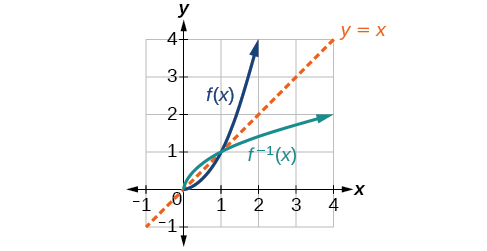
This relationship will be observed for all one-to-one functions, because it is a result of the function and its inverse swapping inputs and outputs. This is equivalent to interchanging the roles of the vertical and horizontal axes.
この関係はすべての一対一の関数で見られる。関数とその逆関数が入力と出力を入れ替えることから生じるからである。これは縦の軸と横の軸の役割を入れ替えることと同じである。
Example 10例10
Finding the Inverse of a Function Using Reflection about the Identity Line恒等の直線に関する対称移動を使って逆関数を求める
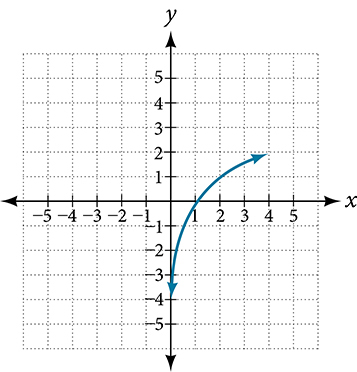
Given the graph of in Figure 9, sketch a graph of
図9の のグラフが与えられたとき、 のグラフの概形を描け。
Solution 解答
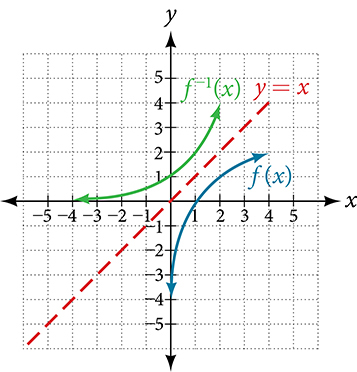
This is a one-to-one function, so we will be able to sketch an inverse. Note that the graph shown has an apparent domain of and range of so the inverse will have a domain of and range of
これは一対一の関数なので、逆関数の概形を描ける。示したグラフの定義域は見たところ 、値域は なので、逆関数の定義域は 、値域は になる。
If we reflect this graph over the line the point reflects to and the point reflects to Sketching the inverse on the same axes as the original graph gives Figure 10.
このグラフを直線 に関して折り返すと、点 は へ、点 は へ移る。もとのグラフと同じ座標軸に逆関数の概形を描くと図10になる。
Try It #9やってみよう9
Draw graphs of the functions and from Example 8.
例8の関数 と のグラフを描け。
Q&A 疑問と答え
Is there any function that is equal to its own inverse?
自分自身と等しい逆関数を持つ関数はあるか。
Yes. If then and we can think of several functions that have this property. The identity function does, and so does the reciprocal function, because
ある。 なら であり、この性質を持つ関数はいくつか思いつく。恒等関数がそうであり、逆数の関数もそうである。なぜなら
Any function where is a constant, is also equal to its own inverse.
定数 を使った の形の関数も、どれも自分自身と等しい逆関数を持つ。
Media 教材
Access these online resources for additional instruction and practice with inverse functions.
逆関数についての説明と練習をさらに求めるなら、次のオンライン教材にあたるとよい。
• Inverse Functions• One-to-one Functions• Inverse Function Values Using Graph• Restricting the Domain and Finding the Inverse
・逆関数・一対一の関数・グラフを使った逆関数の値・定義域を制限して逆関数を求める
Verbal言葉で答える問題
2. Why do we restrict the domain of the function to find the function’s inverse?
2. 関数 の逆関数を求めるために、その定義域を制限するのはなぜか。
4. Are one-to-one functions either always increasing or always decreasing? Why or why not?
4. 一対一の関数は、つねに増加するかつねに減少するかのどちらかか。そうである、あるいはそうでない理由は何か。
Algebraic代数の問題
6. Show that the function is its own inverse for all real numbers
6. 関数 が、すべての実数 について自分自身の逆関数であることを示せ。
For the following exercises, find for each function.
次の各問について、各関数の を求めよ。
For the following exercises, find a domain on which each function is one-to-one and non-decreasing. Write the domain in interval notation. Then find the inverse of restricted to that domain.
次の各問について、各関数 が一対一かつ非減少になる定義域を求めよ。定義域を区間の書き方で書け。そのうえで、その定義域に制限した の逆関数を求めよ。
ⓐFind and ⓑWhat does the answer tell us about the relationship between and
ⓐ と を求めよ。ⓑその答えは、 と の関係について何を教えてくれるか。
For the following exercises, use function composition to verify that and are inverse functions.
次の各問について、関数の合成を使って と が互いに逆関数であることを確かめよ。
18. and
18. と
Graphicalグラフの問題
For the following exercises, use a graphing utility to determine whether each function is one-to-one.
次の各問について、グラフ作成ツールを使って各関数が一対一かどうかを判定せよ。
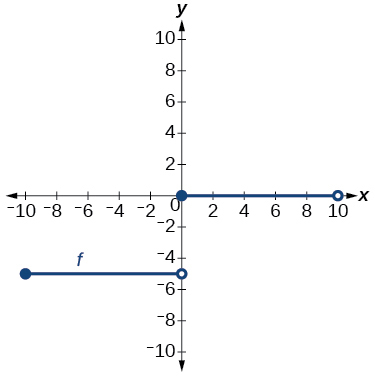
For the following exercises, determine whether the graph represents a one-to-one function.
次の各問について、そのグラフが一対一の関数を表しているかどうかを判定せよ。
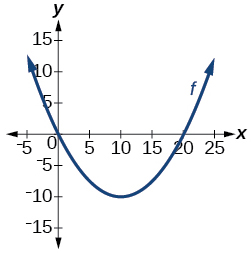
For the following exercises, use the graph of shown in Figure 11.
次の各問では、図11に示した のグラフを使え。
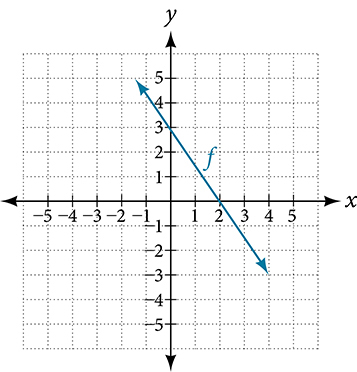
26. Solve
26. を解け。
28. Solve
28. を解け。
For the following exercises, use the graph of the one-to-one function shown in Figure 12.
次の各問では、図12に示した一対一の関数のグラフを使え。
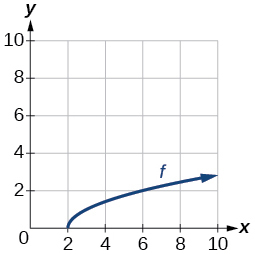
30. Find
30. を求めよ。
32. If the complete graph of is shown, find the range of
32. これが のグラフの全体だとして、 の値域を求めよ。
Numeric数値の問題
For the following exercises, evaluate or solve, assuming that the function is one-to-one.
次の各問について、関数 が一対一であるとして、値を求めるか方程式を解け。
34. If find
34. のとき、 を求めよ。
36. If find
36. のとき、 を求めよ。
For the following exercises, use the values listed in Table 6 to evaluate or solve.
次の各問では、表6に並べた値を使って、値を求めるか方程式を解け。
| 0 | 1 | 2 | 3 | 4 | 5 | 6 | 7 | 8 | 9 | |
| 8 | 0 | 7 | 4 | 2 | 6 | 5 | 3 | 9 | 1 |
38. Solve
38. を解け。
40. Solve
40. を解け。
Technology機器を使う問題
For the following exercises, find the inverse function. Then, graph the function and its inverse.
次の各問について、逆関数を求めよ。そのうえで、その関数と逆関数のグラフを描け。
44. Find the inverse function of Use a graphing utility to find its domain and range. Write the domain and range in interval notation.
44. の逆関数を求めよ。グラフ作成ツールを使ってその定義域と値域を求めよ。定義域と値域を区間の書き方で書け。
Real-World Applications応用問題
46. The circumference of a circle is a function of its radius given by Express the radius of a circle as a function of its circumference. Call this function Find and interpret its meaning.
46. 円周 はその半径の関数で、 で与えられる。円の半径をその円周の関数として表せ。この関数を と呼べ。 を求め、その意味を述べよ。
47. A car travels at a constant speed of 50 miles per hour. The distance the car travels in miles is a function of time, in hours given by Find the inverse function by expressing the time of travel in terms of the distance traveled. Call this function Find and interpret its meaning.
47. ある自動車が時速50マイルの一定の速さで走る。走った距離(マイル)は時間 (時)の関数で、 で与えられる。走った距離を使って走行時間を表すことで、逆関数を求めよ。この関数を と呼べ。 を求め、その意味を述べよ。