第19章電気回路Electrical Circuits原書 p.623–668
19.3 Parallel Circuits19.3 並列回路
SECTION LEARNING OBJECTIVES By the end of this section, you will be able to do the following:
この節の学習目標 この節を終えると、次のことができるようになる。
• Interpret circuit diagrams with parallel resistors• Calculate equivalent resistance of resistor combinations containing series and parallel resistors
・並列の抵抗を含む回路図を読む・直列と並列の抵抗を含む抵抗の組み合わせの合成抵抗を計算する
Section Key Termsこの節の重要語
in parallel
並列に
Resistors in Parallel並列の抵抗
In the previous section, we learned that resistors in series are resistors that are connected one after the other. If we instead combine resistors by connecting them next to each other, as shown in Figure 19.16, then the resistors are said to be connected in parallel. Resistors are in parallel when both ends of each resistor are connected directly together.
前の節で、直列の抵抗とは一つずつ順につながれた抵抗であることを学んだ。かわりに図19.16のように抵抗を横に並べてつなげば、抵抗は並列につながれているという。それぞれの抵抗の両端が直接つながれているとき、抵抗は並列である。
Note that the tops of the resistors are all connected to the same wire, so the voltage at the top of the each resistor is the same. Likewise, the bottoms of the resistors are all connected to the same wire, so the voltage at the bottom of each resistor is the same. This means that the voltage drop across each resistor is the same. In this case, the voltage drop is the voltage rating V of the battery, because the top and bottom wires connect to the positive and negative terminals of the battery, respectively.
抵抗の上端がすべて同じ導線につながれているので、それぞれの抵抗の上端の電圧は同じであることに注意しよう。同じように、抵抗の下端もすべて同じ導線につながれているので、それぞれの抵抗の下端の電圧も同じである。これは、それぞれの抵抗にかかる電圧の降下が同じだということである。この場合、上と下の導線がそれぞれ電池の正と負の端子につながっているので、電圧の降下は電池の定格電圧Vである。
Although the voltage drop across each resistor is the same, we cannot say the same for the current running through each resistor. Thus, are not necessarily the same, because the resistors do not necessarily have the same resistance.
それぞれの抵抗にかかる電圧の降下は同じだが、それぞれの抵抗を流れる電流について同じことは言えない。したがっては必ずしも同じではない。抵抗が必ずしも同じ抵抗値を持たないからである。
Note that the three resistors in Figure 19.16 provide three different paths through which the current can flow. This means that the equivalent resistance for these three resistors must be less than the smallest of the three resistors. To understand this, imagine that the smallest resistor is the only path through which the current can flow. Now add on the alternate paths by connecting other resistors in parallel. Because the current has more paths to go through, the overall resistance (i.e., the equivalent resistance) will decrease. Therefore, the equivalent resistance must be less than the smallest resistance of the parallel resistors.
図19.16の三つの抵抗は、電流が流れうる三つの違う道を与えることに注意しよう。これは、この三つの抵抗の合成抵抗が、三つのうち最も小さい抵抗より小さくなければならないという意味である。これを理解するために、最も小さい抵抗が電流の流れうる唯一の道だと想像しよう。ここで他の抵抗を並列につないで別の道を加える。電流の通る道が増えるので、全体の抵抗(すなわち合成抵抗)は減る。したがって合成抵抗は、並列の抵抗のうち最も小さい抵抗より小さくなければならない。

To find the equivalent resistance of the three resistors , we apply Ohm’s law to each resistor.
三つの抵抗の合成抵抗を求めるために、それぞれの抵抗にオームの法則を当てはめる。
Because the voltage drop across each resistor is V, we obtain
それぞれの抵抗にかかる電圧の降下はVなので、
19.2119.21
or
あるいは
We also know from conservation of charge that the three currents must add up to give the current I that goes through the battery. If this were not true, current would have to be mysteriously created or destroyed somewhere in the circuit, which is physically impossible. Thus, we have
また電荷の保存から、三つの電流を足すと電池を流れる電流Iになることも分かる。もしそうでなければ、回路のどこかで電流が謎めいて生まれたり消えたりせねばならず、それは物理的に不可能である。したがって
Inserting the expressions for into this equation gives
となる。この式にの表し方を入れると
or
あるいは
This formula is just Ohm’s law, with the factor in parentheses being the equivalent resistance.
となる。この式はまさにオームの法則であり、括弧の中の因子が合成抵抗である。
Thus, the equivalent resistance for three resistors in parallel is
したがって、並列の三つの抵抗の合成抵抗は
The same logic works for any number of resistors in parallel, so the general form of the equation that gives the equivalent resistance of N resistors connected in parallel is
となる。同じ理屈が何個の並列の抵抗にも成り立つので、並列につないだN個の抵抗の合成抵抗を与える式の一般形は次のとおりである。
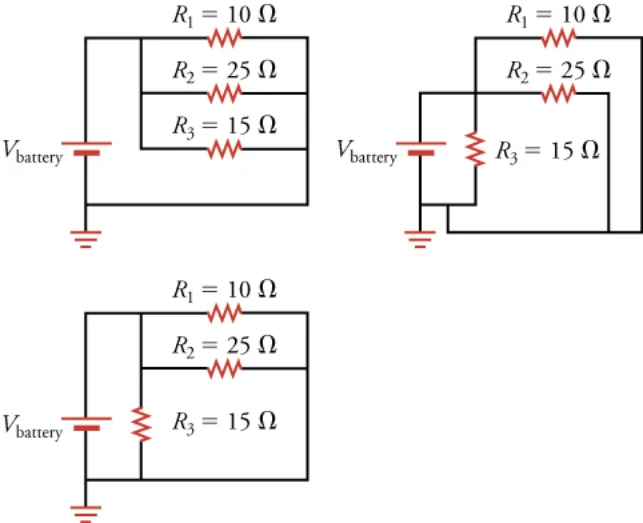
Find the Current through Parallel Resistors The three circuits below are equivalent. If the voltage rating of the battery is , what is the equivalent resistance of the circuit and what current runs through the circuit?
並列の抵抗を流れる電流を求める 下の三つの回路は同等である。電池の定格電圧がのとき、この回路の合成抵抗はいくらで、どんな電流が回路を流れるか。
Strategy方針
The three resistors are connected in parallel and the voltage drop across them is Vbattery. Thus, we can apply the equation for the equivalent resistance of resistors in parallel, which takes the form
三つの抵抗は並列につながれており、それにかかる電圧の降下はVbatteryである。したがって並列の抵抗の合成抵抗の式を当てはめられる。それは次の形になる。
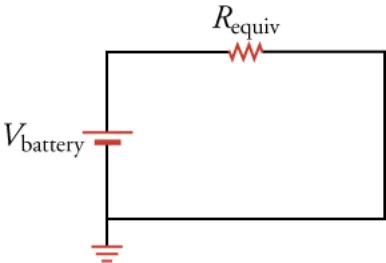
The circuit with the equivalent resistance is shown below. Once we know the equivalent resistance, we can use Ohm’s law to find the current in the circuit.
合成抵抗を持つ回路を下に示す。合成抵抗が分かれば、オームの法則で回路の電流を求められる。
Solution解答
Inserting the given values for the resistance into the equation for equivalent resistance gives
与えられた抵抗の値を合成抵抗の式に入れると
The current through the circuit is thus
したがって回路を流れる電流は
Discussion考察
Although 0.62 A flows through the entire circuit, note that this current does not flow through each resistor. However, because electric charge must be conserved in a circuit, the sum of the currents going through each branch of the circuit must add up to the current going through the battery. In other words, we cannot magically create charge somewhere in the circuit and add this new charge to the current. Let’s check this reasoning by using Ohm’s law to find the current through each resistor.
0.62 Aが回路全体を流れるが、この電流がそれぞれの抵抗を流れるわけではないことに注意しよう。ただし回路では電荷が保存されねばならないので、回路のそれぞれの枝を流れる電流の和は、電池を流れる電流に等しくなければならない。言い換えれば、回路のどこかで魔法のように電荷を作り出して電流に加えることはできない。オームの法則でそれぞれの抵抗を流れる電流を求めて、この理屈を確かめよう。
As expected, these currents add up to give 0.62 A, which is the total current found going through the equivalent resistor. Also, note that the smallest resistor has the largest current flowing through it, and vice versa.
予想どおり、これらの電流を足すと0.62 Aになる。これは等価な抵抗を流れる全電流である。また、最も小さい抵抗に最も大きな電流が流れ、その逆も成り立つことに注意しよう。
Reasoning with Parallel Resistors Without doing any calculation, what is the equivalent resistance of three identical resistors R in parallel? Strategy
並列の抵抗を推論する 計算をせずに、同じ抵抗Rを三つ並列にした合成抵抗はいくらか。 方針
Three identical resistors R in parallel make three identical paths through which the current can flow. Thus, it is three times easier for the current to flow through these resistors than to flow through a single one of them.
同じ抵抗Rを三つ並列にすると、電流の流れうる同じ道が三つできる。したがって、電流はそのうち一つだけを流れるより3倍流れやすくなる。
Solution解答
If it is three times easier to flow through three identical resistors R than to flow through a single one of them, the equivalent resistance must be three times less: R/3.
同じ抵抗Rの三つを流れるほうが、そのうち一つだけを流れるより3倍流れやすいなら、合成抵抗は3分の1でなければならない。すなわちR/3である。
Discussion考察
Let’s check our reasoning by calculating the equivalent resistance of three identical resistors R in parallel. The equation for the equivalent resistance of resistors in parallel gives
同じ抵抗Rを三つ並列にした合成抵抗を計算して、この推論を確かめよう。並列の抵抗の合成抵抗の式から
Thus, our reasoning was correct. In general, when more paths are available through which the current can flow, the equivalent resistance decreases. For example, if we have identical resistors R in parallel, the equivalent resistance would be R/10.
が得られる。したがって推論は正しかった。一般に、電流の流れうる道が増えるほど合成抵抗は減る。たとえば同じ抵抗Rを10個並列にすれば、合成抵抗はR/10になる。
Practice Problems練習問題
10Three resistors, 10, 20, and 30 Ω, are connected in parallel. What is the equivalent resistance?a. The equivalent resistance is 5.5 Ωb. The equivalent resistance is 60 Ω
1010、20、30 Ωの三つの抵抗を並列につなぐ。合成抵抗はいくらか。a. 合成抵抗は5.5 Ωb. 合成抵抗は60 Ω
c. The equivalent resistance is 6 × 10³ Ωd. The equivalent resistance is 6 × 10⁴ Ω
c. 合成抵抗は6 × 10³ Ωd. 合成抵抗は6 × 10⁴ Ω
11Watch Physics: Resistors in Parallel. This video introduces and explains how resistors work when parallel. Access multimedia content (http://openstax.org/books/physics/pages/19-3-parallel-circuits) If a drop occurs across , and is connected in parallel to , what is the voltage drop across ?a. Voltage drop across is .b. Voltage drop across is .c. Voltage drop across is .d. Voltage drop across is .
11物理を見る:並列の抵抗。この動画は、並列のときに抵抗がどう働くかを導き、説明する。マルチメディア教材はこちら(http://openstax.org/books/physics/pages/19-3-parallel-circuits) にかかる電圧の降下がで、がと並列につながれているとき、にかかる電圧の降下はいくらか。a. にかかる電圧の降下はである。b. にかかる電圧の降下はである。c. にかかる電圧の降下はである。d. にかかる電圧の降下はである。
Resistors in Parallel and in Series並列と直列の抵抗
645More complex connections of resistors are sometimes just combinations of series and parallel. Combinations of series and parallel resistors can be reduced to a single equivalent resistance by using the technique illustrated in Figure 19.17. Various parts are identified as either series or parallel, reduced to their equivalents, and further reduced until a single resistance is left. The process is more time consuming than difficult.
もっと複雑な抵抗のつなぎ方も、直列と並列を組み合わせただけのことがある。直列と並列を組み合わせた抵抗は、図19.17に示す手口を使って一つの合成抵抗にまとめられる。いろいろな部分を直列か並列かに見きわめ、それぞれの等価なものに縮め、一つの抵抗が残るまでさらに縮めていく。この作業は難しいというより手間がかかる。
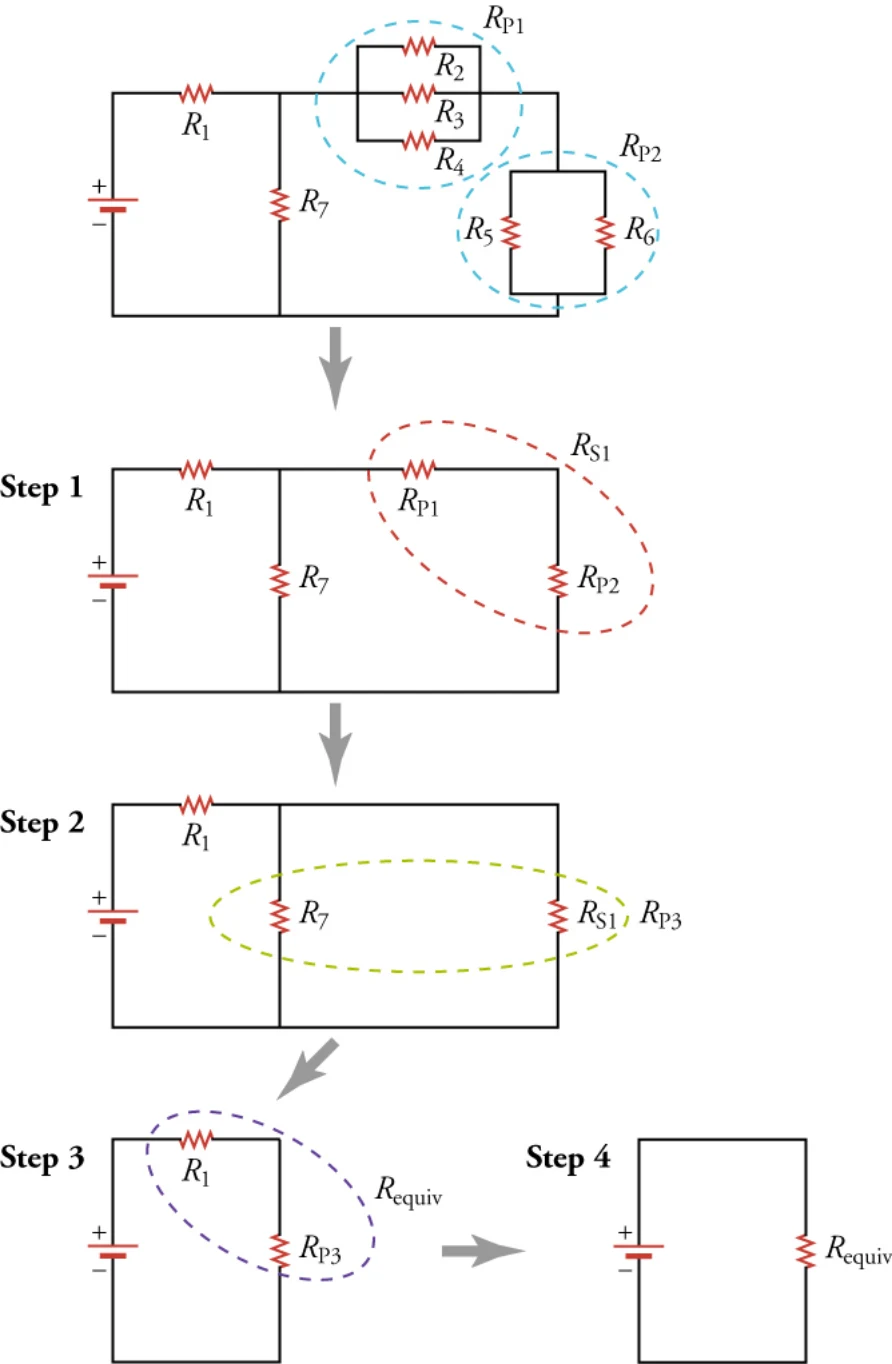
Let’s work through the four steps in Figure 19.17 to reduce the seven resistors to a single equivalent resistor. To avoid distracting algebra, we’ll assume each resistor is 10 . In step 1, we reduce the two sets of parallel resistors circled by the blue dashed loop. The upper set has three resistors in parallel and will be reduced to a single equivalent resistor . The lower set has two resistors in parallel and will be reduced to a single equivalent resistor . Using the equation for the equivalent resistance of resistors in parallel, we obtain
図19.17の四つの段階を追って、七つの抵抗を一つの等価な抵抗に縮めよう。ややこしい代数を避けるため、それぞれの抵抗を10 とする。段階1では、青い破線の輪で囲まれた並列の抵抗の二組を縮める。上の組には並列の三つの抵抗があり、一つの等価な抵抗に縮められる。下の組には並列の二つの抵抗があり、一つの等価な抵抗に縮められる。並列の抵抗の合成抵抗の式を使うと
These two equivalent resistances are encircled by the red dashed loop following step 1. They are in series, so we can use the equation for the equivalent resistance of resistors in series to reduce them to a single equivalent resistance . This is done in step 2, with the result being
が得られる。この二つの等価な抵抗は、段階1のあとで赤い破線の輪に囲まれている。両者は直列なので、直列の抵抗の合成抵抗の式を使って一つの等価な抵抗に縮められる。これを段階2で行い、結果は
The equivalent resistor appears in the green dashed loop following step 2. This resistor is in parallel with resistor , so the pair can be replaced by the equivalent resistor , which is given by
となる。等価な抵抗は、段階2のあとの緑の破線の輪の中に現れる。この抵抗は抵抗と並列なので、この対は等価な抵抗で置き換えられる。それは次で与えられる。
This is done in step 3. The resistor is in series with the resistor , as shown in the purple dashed loop following step 3. These two resistors are combined in the final step to form the final equivalent resistor ,
これを段階3で行う。抵抗は、段階3のあとの紫の破線の輪に示すように、抵抗と直列である。この二つの抵抗を最後の段階で合わせて、最終の等価な抵抗を作る。
which is
それは次のようになる。
Thus, the entire combination of seven resistors may be replaced by a single resistor with a resistance of about 14.5 .
したがって、七つの抵抗の組み合わせ全体を、抵抗およそ14.5 の一つの抵抗で置き換えられる。
That was a lot of work, and you might be asking why we do it. It’s important for us to know the equivalent resistance of the entire circuit so that we can calculate the current flowing through the circuit. Ohm’s law tells us that the current flowing through a circuit depends on the resistance of the circuit and the voltage across the circuit. But to know the current, we must first know the equivalent resistance.
ずいぶん手間がかかったが、なぜこんなことをするのかと思うかもしれない。回路全体の合成抵抗を知ることは、回路を流れる電流を計算するために大切である。オームの法則は、回路を流れる電流が回路の抵抗と回路にかかる電圧によることを教える。しかし電流を知るには、まず合成抵抗を知らねばならない。
Here is a general approach to find the equivalent resistor for any arbitrary combination of resistors:
勝手な抵抗の組み合わせについて等価な抵抗を求める一般のやり方は次のとおりである。
1. Identify a group of resistors that are only in parallel or only in series.2. For resistors in series, use the equation for the equivalent resistance of resistors in series to reduce them to a single equivalent resistance. For resistors in parallel, use the equation for the equivalent resistance of resistors in parallel to reduce them to a single equivalent resistance.3. Draw a new circuit diagram with the resistors from step 1 replaced by their equivalent resistor.4. If more than one resistor remains in the circuit, return to step 1 and repeat. Otherwise, you are finished.
1. 並列だけ、あるいは直列だけになっている抵抗の組を見きわめる。2. 直列の抵抗には、直列の抵抗の合成抵抗の式を使って一つの合成抵抗に縮める。並列の抵抗には、並列の抵抗の合成抵抗の式を使って一つの合成抵抗に縮める。3. 段階1の抵抗をその等価な抵抗で置き換えた新しい回路図を描く。4. 回路に二つ以上の抵抗が残っていれば段階1に戻って繰り返す。そうでなければ終わりである。
Robot Robots have captured our collective imagination for over a century. Now, this dream of creating clever machines to do our dirty work, or sometimes just to keep us company, is becoming a reality. Robotics has become a huge field of research and development, with some technology already being commercialized. Think of the small autonomous vacuum cleaners, for example.
ロボット ロボットは一世紀以上にわたって私たちの想像力をとらえてきた。いまや、汚れ仕事をさせるため、あるいはただ話し相手にするために賢い機械を作るというこの夢が、現実になりつつある。ロボット工学は研究開発の巨大な分野になり、一部の技術はすでに商品化されている。たとえば小さな自律型の掃除機を思い浮かべてみよう。
Figure 19.18 shows just a few of the multitude of different forms robots can take. The most advanced humanoid robots can walk, pour drinks, even dance (albeit not very gracefully). Other robots are bio-inspired, such as the dogbot shown in the middle photograph of Figure 19.18. This robot can carry hundreds of pounds of load over rough terrain. The photograph on the right in Figure 19.18 shows the inner workings of an M-block, developed by the Massachusetts Institute of Technology. These simple-looking blocks contain inertial wheels and electromagnets that allow them to spin and flip into the air and snap together in a variety of shapes. By communicating wirelessly between themselves, they self-assemble into a variety of shapes, such as desks, chairs, and someday maybe even buildings.
図19.18は、ロボットが取りうる無数の形のごく一部を示す。最も進んだ人型ロボットは歩き、飲み物を注ぎ、踊ることさえできる(あまり優雅ではないが)。図19.18の真ん中の写真の犬型ロボットのように、生物に着想を得たロボットもある。このロボットは荒れた地形を何百ポンドもの荷を運んで進める。図19.18の右の写真は、マサチューセッツ工科大学が開発したMブロックの内部を示す。この単純に見えるブロックには慣性のホイールと電磁石が入っており、それによって回転して空中で反転し、いろいろな形にかみ合える。互いに無線で通信し、机・椅子、そしていつかは建物のようないろいろな形へ自ら組み上がる。
All robots involve an immense amount of physics and engineering. The simple act of pouring a drink has only recently been mastered by robots, after over 30 years of research and development! The balance and timing that we humans take for granted is in fact a very tricky act to follow, requiring excellent balance, dexterity, and feedback. To master this requires sensors to detect balance, computing power to analyze the data and communicate the appropriate compensating actions, and joints and actuators to implement the required actions.
どんなロボットにも膨大な量の物理と工学が関わる。飲み物を注ぐという単純な動作でさえ、30年以上の研究開発を経て、ようやくロボットが習得した。私たち人間が当たり前と思っている平衡と間の取り方は、実のところ真似るのがとても難しく、優れた平衡感覚・器用さ・帰還制御を要する。これを習得するには、平衡を感じ取るセンサー、データを解析して適切な補正の動作を伝える計算能力、そして必要な動作を実行する関節と作動器が要る。
In addition to sensing gravity or acceleration, robots can contain multiple different sensors to detect light, sound, temperature, smell, taste, etc. These devices are all based on the physical principles that you are studying in this text. For example, the optics used for robotic vision are similar to those used in your digital cameras: pixelated semiconducting detectors in which light is converted into electrical signals. To detect temperature, simple thermistors may be used, which are resistors whose resistance changes depending on temperature.
重力や加速度を感じ取ることに加え、ロボットは光・音・温度・匂い・味などを感じ取る複数の違うセンサーを持ちうる。これらの装置はすべて、この本で学んでいる物理の原理にもとづく。たとえばロボットの視覚に使われる光学は、デジタルカメラのものと似ている。光が電気の信号へ変えられる、画素に分かれた半導体の検出器である。温度を感じ取るには単純なサーミスタが使える。サーミスタとは、温度によって抵抗が変わる抵抗器である。
Building a robot today is much less arduous than it was a few years ago. Numerous companies now offer kits for building robots. These range in complexity something suitable for elementary school children to something that would challenge the best professional engineers. If interested, you may find these easily on the Internet and start making your own robot today.
今日ロボットを作るのは、数年前よりずっと骨が折れなくなった。いまでは多くの会社がロボットを作るキットを売っている。それらは、小学生に向くものから、最高の職業技術者にも歯ごたえのあるものまで、複雑さの幅が広い。興味があれば、インターネットで簡単に見つかるので、今日から自分のロボットを作り始められる。

Resistors in Parallel This video shows a lecturer discussing a simple circuit with a battery and a pair of resistors in parallel. He emphasizes that electrons flow in the direction opposite to that of the positive current and also makes use of the fact that the voltage is the same at all points on an ideal wire. The derivation is quite similar to what is done in this text, but the lecturer goes through it well, explaining each step.
並列の抵抗 この動画では、講師が電池と一対の並列の抵抗からなる単純な回路を論じる。彼は電子が正の電流と逆向きに流れることを強調し、また理想的な導線ではどの点でも電圧が同じであるという事実も使う。導出はこの本で行ったものとよく似ているが、講師はそれぞれの段階を説明しながらうまく進めていく。
Access multimedia content (http://openstax.org/books/physics/pages/19-3-parallel-circuits)
マルチメディア教材はこちら(http://openstax.org/books/physics/pages/19-3-parallel-circuits)
GRASP CHECK True or false—In a circuit diagram, we can assume that the voltage is the same at every point in a given wire.a. falseb. true
理解の確認 正誤問題——回路図では、決まった一本の導線のどの点でも電圧は同じだとみなしてよい。a. 誤b. 正
Resistors in Series and in Parallel This video shows how to calculate the equivalent resistance of a circuit containing resistors in parallel and in series. The lecturer uses the same approach as outlined above for finding the equivalent resistance.
直列と並列の抵抗 この動画は、並列と直列の抵抗を含む回路の合成抵抗をどう計算するかを示す。講師は、上で述べたのと同じやり方で合成抵抗を求める。
Access multimedia content (http://openstax.org/books/physics/pages/19-3-parallel-circuits)
マルチメディア教材はこちら(http://openstax.org/books/physics/pages/19-3-parallel-circuits)
GRASP CHECK Imagine connected N identical resistors in parallel. Each resistor has a resistance of R. What is the equivalent resistance for this group of parallel resistors?a. The equivalent resistance is (R)N.b. The equivalent resistance is NR.
理解の確認 同じ抵抗をN個並列につないだとしよう。それぞれの抵抗の抵抗値はRである。この並列の抵抗の組の合成抵抗はいくらか。a. 合成抵抗は(R)Nである。b. 合成抵抗はNRである。
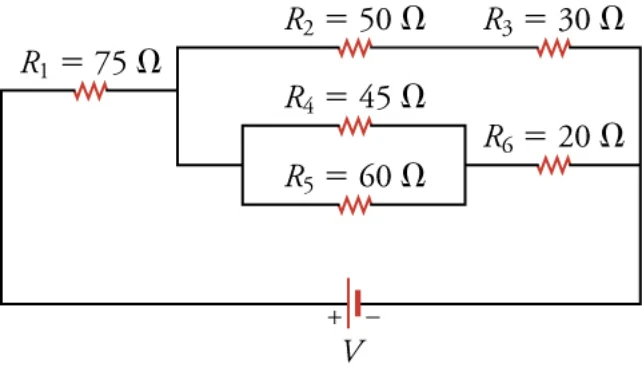
Find the Current through a Complex Resistor Circuit The battery in the circuit below has a voltage rating of 10 V. What current flows through the circuit and in what direction?
複雑な抵抗の回路を流れる電流を求める 下の回路の電池の定格電圧は10 Vである。どんな電流がどの向きに回路を流れるか。
Strategy方針
Apply the Strategy for finding equivalent resistance to replace all the resistors with a single equivalent resistance, then use Ohm’s law to find the current through the equivalent resistor.
合成抵抗を求めるやり方を当てはめて、すべての抵抗を一つの合成抵抗で置き換え、それからオームの法則で等価な抵抗を流れる電流を求める。
Solution解答
The resistor combination and can be reduced to an equivalent resistance of
抵抗の組み合わせとは、次の合成抵抗に縮められる。
Replacing and with this equivalent resistance gives the circuit below.
とをこの合成抵抗で置き換えると下の回路になる。
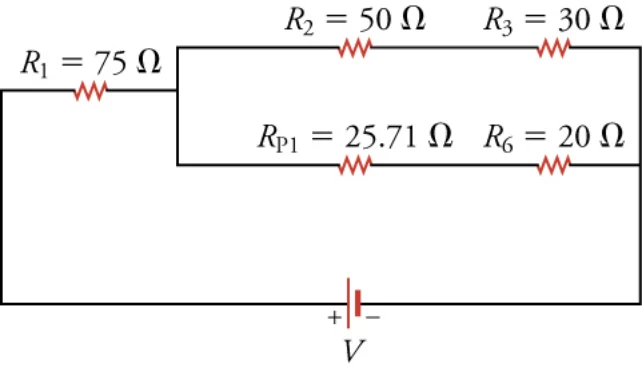
We now replace the two upper resistors and by the equivalent resistor and the two lower resistors and by their equivalent resistor . These resistors are in series, so we add them together to find the equivalent resistance.
ここで上の二つの抵抗とを等価な抵抗で、下の二つの抵抗とをその等価な抵抗で置き換える。これらの抵抗は直列なので、足し合わせて合成抵抗を求める。
Replacing the relevant resistors with their equivalent resistor gives the circuit below.
関係する抵抗をその等価な抵抗で置き換えると下の回路になる。
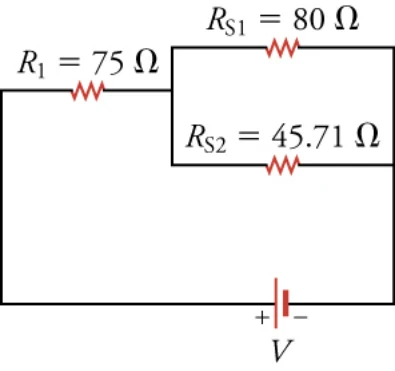
Now replace the two resistors , which are in parallel, with their equivalent resistor . The resistance of is
次に、並列になっている二つの抵抗をその等価な抵抗で置き換える。の抵抗値は
Updating the circuit diagram by replacing with this equivalent resistance gives the circuit below.
である。をこの合成抵抗で置き換えて回路図を更新すると下の回路になる。
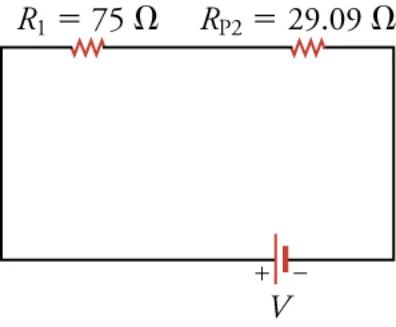
Finally, we combine resistors , which are in series. The equivalent resistance is The final circuit is shown below.
最後に、直列になっている抵抗を合わせる。合成抵抗はである。最終の回路を下に示す。
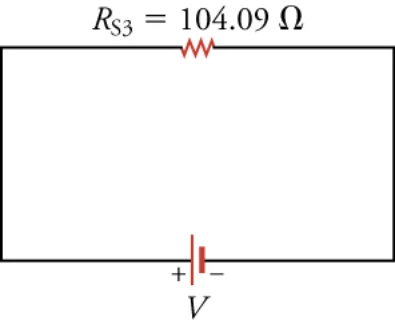
We now use Ohm’s law to find the current through the circuit.
ここでオームの法則を使って回路を流れる電流を求める。
The current goes from the positive terminal of the battery to the negative terminal of the battery, so it flows clockwise in this circuit.
電流は電池の正の端子から負の端子へ行くので、この回路では時計回りに流れる。
Discussion考察
650This calculation may seem rather long, but with a little practice, you can combine some steps. Note also that extra significant digits were carried through the calculation. Only at the end was the final result rounded to two significant digits.
この計算はずいぶん長く思えるかもしれないが、少し慣れればいくつかの段階をまとめられる。また、余分な桁を計算のあいだ持ち越したことにも注意しよう。最後にはじめて、最終の結果を有効数字2桁に丸めた。
Strange-Looking Circuit Diagrams Occasionally, you may encounter circuit diagrams that are not drawn very neatly, such as the diagram shown below. This circuit diagram looks more like how a real circuit might appear on the lab bench. What is the equivalent resistance for the resistors in this diagram, assuming each resistor is 10 and the voltage rating of the battery is 12 V.
奇妙に見える回路図 ときには、下の図のようにあまりきれいに描かれていない回路図に出会うことがある。この回路図は、実験台の上の実物の回路がどう見えるかにより近い。それぞれの抵抗を10 、電池の定格電圧を12 Vとして、この図の抵抗の合成抵抗はいくらか。
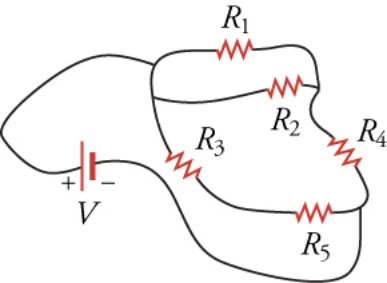
Strategy方針
Let’s redraw this circuit diagram to make it clearer. Then we’ll apply the Strategy outlined above to calculate the equivalent resistance.
この回路図をより分かりやすく描き直そう。それから上で述べたやり方を当てはめて合成抵抗を計算する。
Solution解答
To redraw the diagram, consider the figure below. In the upper circuit, the blue resistors constitute a path from the positive terminal of the battery to the negative terminal. In parallel with this circuit are the red resistors, which constitute another path from the positive to negative terminal of the battery. The blue and red paths are shown more cleanly drawn in the lower circuit diagram. Note that, in both the upper and lower circuit diagrams, the blue and red paths connect the positive terminal of the battery to the negative terminal of the battery.
図を描き直すために下の図を考えよう。上の回路では、青い抵抗が電池の正の端子から負の端子への道をなしている。この回路と並列に赤い抵抗があり、それが電池の正の端子から負の端子へのもう一つの道をなしている。青と赤の道を、下の回路図でよりすっきり描いてある。上下どちらの回路図でも、青と赤の道が電池の正の端子と負の端子をつないでいることに注意しよう。
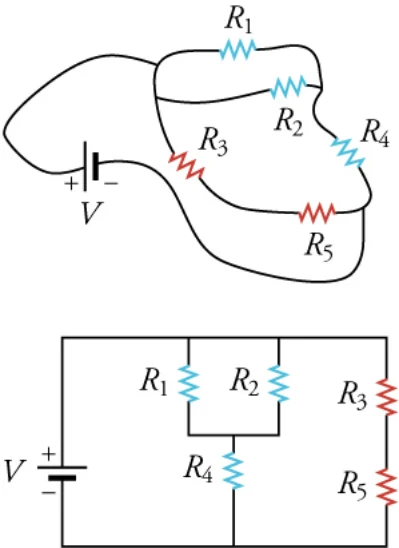
Now it is easier to see that are in parallel, and the parallel combination is in series with . This combination in turn is in parallel with the series combination of . First, we calculate the blue branch, which contains . The equivalent resistance is
これで、が並列で、その並列の組み合わせがと直列であることが見やすくなった。この組み合わせはさらに、の直列の組み合わせと並列である。まずを含む青い枝を計算する。合成抵抗は
where we show the contribution from the parallel combination of resistors and from the series combination of resistors. We now calculate the equivalent resistance of the red branch, which is
となる。ここでは、抵抗の並列の組み合わせからの寄与と直列の組み合わせからの寄与を示している。次に赤い枝の合成抵抗を計算すると
Inserting these equivalent resistors into the circuit gives the circuit below.
となる。これらの等価な抵抗を回路に入れると下の回路になる。
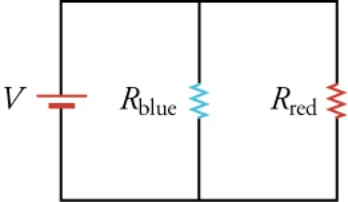
These two resistors are in parallel, so they can be replaced by a single equivalent resistor with a resistance of
この二つの抵抗は並列なので、次の抵抗値を持つ一つの等価な抵抗で置き換えられる。
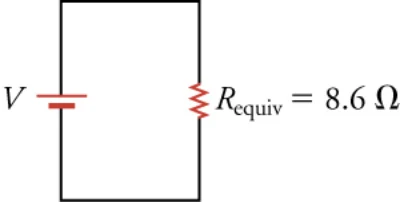
The final equivalent circuit is show below.
最終の等価な回路を下に示す。
Discussion考察
Finding the equivalent resistance was easier with a clear circuit diagram. This is why we try to make clear circuit diagrams, where the resistors in parallel are lined up parallel to each other and at the same horizontal position on the diagram.
はっきりした回路図があると合成抵抗を求めるのが簡単だった。だから私たちははっきりした回路図を描くようにする。並列の抵抗を互いに平行に並べ、図の同じ水平の位置に置くのである。
We can now use Ohm’s law to find the current going through each branch to this circuit. Consider the circuit diagram with and . The voltage across each of these branches is 12 V (i.e., the voltage rating of the battery). The current in the blue branch is
これでオームの法則を使って、この回路のそれぞれの枝を流れる電流を求められる。との回路図を考えよう。これらの枝それぞれにかかる電圧は12 V(すなわち電池の定格電圧)である。青い枝の電流は
The current across the red branch is
赤い枝の電流は
The current going through the battery must be the sum of these two currents (can you see why?), or 1.4 A.
電池を流れる電流はこの二つの電流の和(なぜか分かるだろうか)、すなわち1.4 Aでなければならない。
Practice Problems練習問題
12What is the formula for the equivalent resistance of two parallel resistors with resistance R1 and R2? a. Equivalent resistance of two parallel resistors
12抵抗R1とR2の二つの並列の抵抗の合成抵抗の式はどれか。 a. 二つの並列の抵抗の合成抵抗
d. Equivalent resistance of two parallel resistors
d. 二つの並列の抵抗の合成抵抗
b. Equivalent resistance of two parallel resistors
b. 二つの並列の抵抗の合成抵抗
c. Equivalent resistance of two parallel resistors
c. 二つの並列の抵抗の合成抵抗
13 .
13
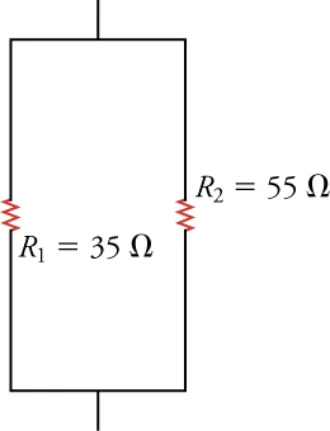
What is the equivalent resistance for the two resistors shown?a. The equivalent resistance is 20 Ωb. The equivalent resistance is 21 Ω
図の二つの抵抗の合成抵抗はいくらか。a. 合成抵抗は20 Ωb. 合成抵抗は21 Ω
c. The equivalent resistance is 90 Ωd. The equivalent resistance is 1,925 Ω
c. 合成抵抗は90 Ωd. 合成抵抗は1,925 Ω
Check Your Understanding理解の確認
14The voltage drop across parallel resistors is ________.a. the same for all resistorsb. greater for the larger resistors
14並列の抵抗にかかる電圧の降下は________。a. どの抵抗でも同じb. 大きい抵抗ほど大きい
c. less for the larger resistorsd. greater for the smaller resistors
c. 大きい抵抗ほど小さいd. 小さい抵抗ほど大きい
15Consider a circuit of parallel resistors. The smallest resistor is 25 Ω . What is the upper limit of the equivalent resistance?
15並列の抵抗の回路を考える。最も小さい抵抗は25 Ωである。合成抵抗の上限はいくらか。
a. The upper limit of the equivalent resistance is 2.5 Ω.b. The upper limit of the equivalent resistance is 25 Ω.
a. 合成抵抗の上限は2.5 Ωである。b. 合成抵抗の上限は25 Ωである。
c. The upper limit of the equivalent resistance is 100 Ω.d. There is no upper limit.
c. 合成抵抗の上限は100 Ωである。d. 上限はない。