第19章電気回路Electrical Circuits原書 p.623–668
19.4 Electric Power19.4 電力
SECTION LEARNING OBJECTIVES By the end of this section, you will be able to do the following:
この節の学習目標 この節を終えると、次のことができるようになる。
• Define electric power and describe the electric power equation• Calculate electric power in circuits of resistors in series, parallel, and complex arrangements
・電力を定義し、電力の式を述べる・直列・並列・複雑な配置の抵抗の回路で電力を計算する
Section Key Termsこの節の重要語
Power is associated by many people with electricity. Every day, we use electric power to run our modern appliances. Electric power transmission lines are visible examples of electricity providing power. We also use electric power to start our cars, to run our computers, or to light our homes. Power is the rate at which energy of any type is transferred; electric power is the rate at which electric energy is transferred in a circuit. In this section, we’ll learn not only what this means, but also what factors determine electric power.
多くの人にとって、power(仕事率・電力)は電気と結びついている。私たちは日々、現代の器具を動かすのに電力を使う。送電線は電気が電力を与える目に見える例である。また電力を使って車を始動させ、コンピューターを動かし、家を照らす。仕事率とは、どんな型のエネルギーであれそれが移る速さである。電力とは、回路で電気エネルギーが移る速さである。この節では、それが何を意味するかだけでなく、何が電力を決めるのかも学ぶ。
electric power
電力
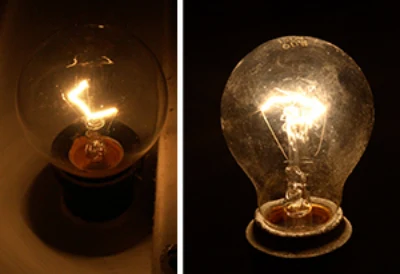
To get started, let’s think of light bulbs, which are often characterized in terms of their power ratings in watts. Let us compare a 25-W bulb with a 60-W bulb (see Figure 19.20). Although both operate at the same voltage, the 60-W bulb emits more light intensity than the 25-W bulb. This tells us that something other than voltage determines the power output of an electric circuit.
まず、ワットで表した定格電力でよく特徴づけられる電球を考えよう。25 Wの電球と60 Wの電球を比べてみよう(図19.20を見よ)。どちらも同じ電圧で動くが、60 Wの電球のほうが25 Wの電球より強い光を出す。これは、電圧以外の何かが電気回路の電力の出力を決めていることを教える。
Incandescent light bulbs, such as the two shown in Figure 19.20, are essentially resistors that heat up when current flows through them and they get so hot that they emit visible and invisible light. Thus the two light bulbs in the photo can be considered as two different resistors. In a simple circuit such as a light bulb with a voltage applied to it, the resistance determines the current by Ohm’s law, so we can see that current as well as voltage must determine the power.
図19.20の二つのような白熱電球は、本質的に、電流が流れると熱くなり、あまりに熱くなって目に見える光と見えない光を出す抵抗器である。したがって写真の二つの電球は、二つの違う抵抗器とみなせる。電圧をかけた電球のような単純な回路では、オームの法則によって抵抗が電流を決めるので、電圧だけでなく電流も電力を決めているに違いないと分かる。
The formula for power may be found by dimensional analysis. Consider the units of power. In the SI system, power is given in watts (W), which is energy per unit time, or J/s
仕事率の式は次元解析で見つけられる。仕事率の単位を考えよう。SIでは仕事率はワット(W)で表され、それは単位時間あたりのエネルギー、すなわちJ/sである。
Recall now that a voltage is the potential energy per unit charge, which means that voltage has units of J/C
電圧が単位電荷あたりの位置エネルギーであることを思い出そう。これは電圧がJ/Cの単位を持つということである。
We can rewrite this equation as and substitute this into the equation for watts to get
この式をと書き直し、これをワットの式に代入すると
But a Coulomb per second (C/s) is an electric current, which we can see from the definition of electric current,
となる。しかし毎秒クーロン(C/s)は電流であり、それは電流の定義
, where Q is the charge in coulombs and t is time in seconds. Thus, equation above tells us that electric power is voltage times current, or
から分かる。ここでQはクーロンで表した電荷、tは秒で表した時間である。したがって上の式は、電力が電圧かける電流であることを教える。すなわち
This equation gives the electric power consumed by a circuit with a voltage drop of V and a current of I.
となる。この式は、電圧の降下がVで電流がIの回路が消費する電力を与える。
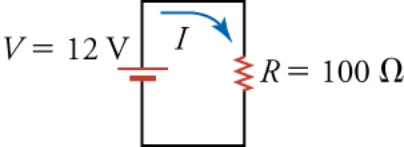
For example, consider the circuit in Figure 19.21. From Ohm’s law, the current running through the circuit is
たとえば図19.21の回路を考えよう。オームの法則から、この回路を流れる電流は
Thus, the power consumed by the circuit is
である。したがってこの回路が消費する電力は
Where does this power go? In this circuit, the power goes primarily into heating the resistor in this circuit.
となる。この電力はどこへ行くのか。この回路では、電力はおもにこの回路の抵抗を熱くするのに使われる。
In calculating the power in the circuit of Figure 19.21, we used the resistance and Ohm’s law to find the current. Ohm’s law gives the current: , which we can insert into the equation for electric power to obtain
図19.21の回路の電力を計算するのに、抵抗とオームの法則を使って電流を求めた。オームの法則は電流をと与え、これを電力の式に入れると
This gives the power in terms of only the voltage and the resistance.
が得られる。これは電圧と抵抗だけで電力を与える。
We can also use Ohm’s law to eliminate the voltage in the equation for electric power and obtain an expression for power in terms of just the current and the resistance. If we write Ohm’s law as and use this to eliminate V in the equation , we obtain
オームの法則を使って電力の式から電圧を消し、電流と抵抗だけで電力を表すこともできる。オームの法則をと書き、これを使って式からVを消すと
This gives the power in terms of only the current and the resistance.
が得られる。これは電流と抵抗だけで電力を与える。
Thus, by combining Ohm’s law with the equation for electric power, we obtain two more expressions for power: one in terms of voltage and resistance and one in terms of current and resistance. Note that only resistance (not capacitance or anything else), current, and voltage enter into the expressions for electric power. This means that the physical characteristic of a circuit that determines how much power it dissipates is its resistance. Any capacitors in the circuit do not dissipate electric power—on the contrary, capacitors either store electric energy or release electric energy back to the circuit.
したがって、オームの法則を電力の式と組み合わせることで、電力の表し方がさらに二つ得られた。一つは電圧と抵抗による表し方、もう一つは電流と抵抗による表し方である。電力の式に入るのは抵抗(電気容量その他ではなく)・電流・電圧だけであることに注意しよう。これは、どれだけ電力を消散させるかを決める回路の物理的な特徴が、その抵抗だということである。回路のコンデンサーは電力を消散させない。それどころか、コンデンサーは電気エネルギーを蓄えるか、電気エネルギーを回路へ戻すかである。
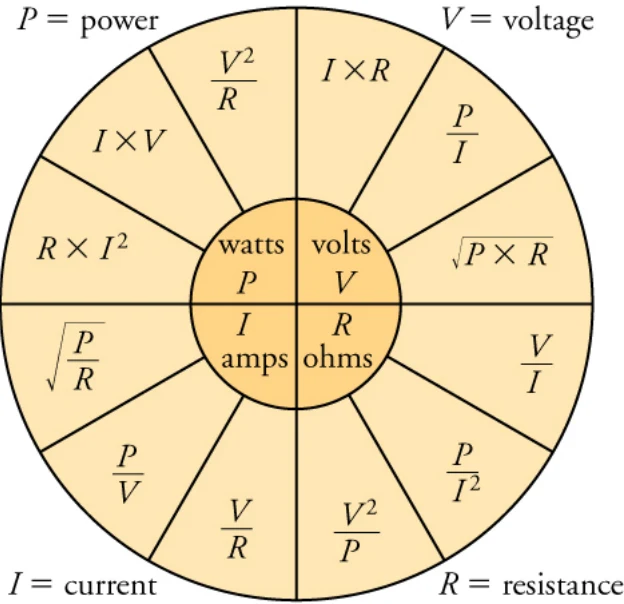
To clarify how voltage, resistance, current, and power are all related, consider Figure 19.22, which shows the formula wheel. The quantities in the center quarter circle are equal to the quantities in the corresponding outer quarter circle. For example, to express a potential V in terms of power and current, we see from the formula wheel that .
電圧・抵抗・電流・電力がすべてどう関係するかをはっきりさせるために、公式の輪を示す図19.22を見よう。中央の四分円の量は、対応する外の四分円の量に等しい。たとえば電位Vを電力と電流で表すには、公式の輪からと分かる。
Find the Resistance of a Lightbulb A typical older incandescent lightbulb was 60 W. Assuming that 120 V is applied across the lightbulb, what is the current through the lightbulb? Strategy
電球の抵抗を求める 昔の典型的な白熱電球は60 Wだった。電球に120 Vがかかっているとして、電球を流れる電流はいくらか。 方針
We are given the voltage and the power output of a simple circuit containing a lightbulb, so we can use the equation to find the current I that flows through the lightbulb.
電球を含む単純な回路の電圧と電力の出力が与えられているので、式を使って電球を流れる電流Iを求められる。
Solution解答
Solving for the current and inserting the given values for voltage and power gives
を電流について解き、与えられた電圧と電力を入れると
Thus, a half ampere flows through the lightbulb when 120 V is applied across it.
となる。したがって120 Vをかけると電球には0.5アンペアが流れる。
Discussion考察
This is a significant current. Recall that household power is AC and not DC, so the 120 V supplied by household sockets is an alternating power, not a constant power. The 120 V is actually the time-averaged power provided by such sockets. Thus, the average current going through the light bulb over a period of time longer than a few seconds is 0.50 A.
これはかなり大きな電流である。家庭の電力は直流でなく交流なので、家庭のコンセントが与える120 Vは一定の電力ではなく交流の電力であることを思い出そう。120 Vは実際には、そうしたコンセントが与える時間平均の電力である。したがって、数秒より長い時間にわたって電球を流れる平均の電流は0.50 Aである。
Boot Warmers To warm your boots on cold days, you decide to sew a circuit with some resistors into the insole of your boots. You want 10 W of heat output from the resistors in each insole, and you want to run them from two 9-V batteries (connected in series). What total resistance should you put in each insole?Strategy
ブーツの温め器 寒い日にブーツを温めるために、抵抗を入れた回路をブーツの中敷きに縫い込むことにする。片方の中敷きの抵抗から10 Wの熱の出力がほしく、それを(直列につないだ)9 Vの電池二つで動かしたい。それぞれの中敷きに入れる全抵抗はいくらにすべきか。方針
We know the desired power and the voltage (18 V, because we have two 9-V batteries connected in series), so we can use the equation to find the requisite resistance.
望みの電力と電圧(9 Vの電池を二つ直列につないだので18 V)が分かっているので、式を使って必要な抵抗を求められる。
Solution解答
Solving for the resistance and inserting the given voltage and power, we obtain
を抵抗について解き、与えられた電圧と電力を入れると
Thus, the total resistance in each insole should be 32
したがって、それぞれの中敷きの全抵抗は32
Discussion考察
Let’s see how much current would run through this circuit. We have 18 V applied across a resistance of 32 , so Ohm’s law gives
この回路にどれだけの電流が流れるか見てみよう。32 の抵抗に18 Vがかかっているので、オームの法則から
All batteries have labels that say how much charge they can deliver (in terms of a current multiplied by a time). A typical 9-V alkaline battery can deliver a charge of 565 (so two 9 V batteries deliver 1,130 ), so this heating system would function for a time of
どの電池にも、どれだけの電荷を送り出せるかを(電流かける時間で)示す表示がある。典型的な9 Vのアルカリ電池は565 の電荷を送り出せる(したがって9 Vの電池二つで1,130 )ので、この暖房の仕組みは次の時間だけ働くことになる。
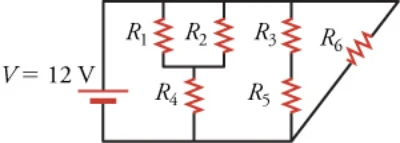
Power through a Branch of a Circuit Each resistor in the circuit below is 30 . What power is dissipated by the middle branch of the circuit?
回路の一つの枝を通る電力 下の回路のそれぞれの抵抗は30 である。この回路の真ん中の枝で消散される電力はいくらか。
Strategy方針
The middle branch of the circuit contains resistors in series. The voltage across this branch is 12 V. We will first find the equivalent resistance in this branch, and then use to find the power dissipated in the branch.
回路の真ん中の枝には抵抗が直列に入っている。この枝にかかる電圧は12 Vである。まずこの枝の合成抵抗を求め、それからを使ってこの枝で消散される電力を求める。
Solution解答
The equivalent resistance is . The power dissipated by the middle branch of the circuit is
合成抵抗はである。回路の真ん中の枝で消散される電力は
Discussion考察
Let’s see if energy is conserved in this circuit by comparing the power dissipated in the circuit to the power supplied by the battery. First, the equivalent resistance of the left branch is
回路で消散される電力と電池が供給する電力を比べて、この回路でエネルギーが保存されるかを見よう。まず、左の枝の合成抵抗は
The power through the left branch is
である。左の枝を通る電力は
The right branch contains only , so the equivalent resistance is . The power through the right branch is
右の枝にはしかないので、合成抵抗はである。右の枝を通る電力は
The total power dissipated by the circuit is the sum of the powers dissipated in each branch.
回路で消散される全電力は、それぞれの枝で消散される電力の和である。
The power provided by the battery is
電池が供給する電力は
where I is the total current flowing through the battery. We must therefore add up the currents going through each branch to obtain I. The branches contributes currents of
である。ここでIは電池を流れる全電流である。したがってIを得るには、それぞれの枝を流れる電流を足し合わせねばならない。それぞれの枝が与える電流は
The total current is
全電流は
and the power provided by the battery is
であり、電池が供給する電力は
This is the same power as is dissipated in the resistors of the circuit, which shows that energy is conserved in this circuit.
となる。これは回路の抵抗で消散される電力と同じであり、この回路でエネルギーが保存されることを示す。
Practice Problems練習問題
16What is the formula for the power dissipated in a resistor?
16抵抗で消散される電力の式はどれか。
b. The formula for the power dissipated in a resistor is
b. 抵抗で消散される電力の式は
a. The formula for the power dissipated in a resistor is
a. 抵抗で消散される電力の式は
c. The formula for the power dissipated in a resistor is P = IV.d. The formula for the power dissipated in a resistor is P = I2V.
c. 抵抗で消散される電力の式はP = IVである。d. 抵抗で消散される電力の式はP = I2Vである。
17What is the formula for power dissipated by a resistor given its resistance and the voltage across it? a. The formula for the power dissipated in a resistor is
17抵抗値とそれにかかる電圧が与えられたとき、抵抗で消散される電力の式はどれか。 a. 抵抗で消散される電力の式は
d. The formula for the power dissipated in a resistor is
d. 抵抗で消散される電力の式は
b. The formula for the power dissipated in a resistor is
b. 抵抗で消散される電力の式は
c. The formula for the power dissipated in a resistor is
c. 抵抗で消散される電力の式は
Check your Understanding理解の確認
18Which circuit elements dissipate power?a. capacitorsb. inductors
18電力を消散させる回路の素子はどれか。a. コンデンサーb. コイル
c. ideal switchesd. resistors
c. 理想のスイッチd. 抵抗器
19Explain in words the equation for power dissipated by a given resistance.a. Electric power is proportional to the current through the resistor multiplied by the square of the voltage across the resistor.b. Electric power is proportional to the square of current through the resistor multiplied by the voltage across the resistor.c. Electric power is proportional to the current through the resistor divided by the voltage across the resistor.d. Electric power is proportional to the current through the resistor multiplied by the voltage across the resistor.
19決まった抵抗で消散される電力の式を言葉で説明せよ。a. 電力は、抵抗を流れる電流に、抵抗にかかる電圧の2乗をかけたものに比例する。b. 電力は、抵抗を流れる電流の2乗に、抵抗にかかる電圧をかけたものに比例する。c. 電力は、抵抗を流れる電流を、抵抗にかかる電圧で割ったものに比例する。d. 電力は、抵抗を流れる電流に、抵抗にかかる電圧をかけたものに比例する。