第19章電気回路Electrical Circuits原書 p.623–668
Test Prep実力テスト
Multiple Choice選択問題
19.1 Ohm's law 30What are the SI units for electric current?a. b.
19.1 オームの法則 30電流のSI単位はどれか。a. b.
31What quantity is used to describe the ability of a material to limit current flow?
31材料が電流の流れを制限する能力を表すのに使われる量はどれか。
a. C/mb. C/sc. Ωd. V
a. C/mb. C/sc. Ωd. V
32The equivalent unit for an ohm is a ________.a. V/Ab. C/m
32オームと同じ単位は________である。a. V/Ab. C/m
d. V/s
d. V/s
33You put DC across resistor and measure the current through it. With the same voltage across resistor , you measure twice the current. What is the ratio ?
33抵抗にの直流をかけ、それを流れる電流を測る。同じ電圧を抵抗にかけると、2倍の電流が測られる。比はいくらか。
a. 1b.
a. 1b.
c. 4d. 2
c. 4d. 2
19.2 Series Circuits 34What does the circuit element shown represent?
19.2 直列回路 34図の回路の素子は何を表すか。

a. a batteryb. a capacitorc. the groundd. a switch
a. 電池b. コンデンサーc. 接地d. スイッチ
35How many 10-Ω resistors must be connected in series to make an equivalent resistance of 80 Ω?a. 80b. 8
35合成抵抗を80 Ωにするには、10 Ωの抵抗を何個直列につながねばならないか。a. 80b. 8
c. 20d. 40
c. 20d. 40
36Which two circuit elements are represented in the circuit diagram?
36この回路図に描かれている二つの回路の素子はどれか。
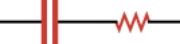
a. a battery connected in series with an inductorb. a capacitor connected in series with a resistorc. a resistor connected in series with a batteryd. an inductor connected in series with a resistor
a. 電池とコイルを直列につないだものb. コンデンサーと抵抗を直列につないだものc. 抵抗と電池を直列につないだものd. コイルと抵抗を直列につないだもの
37How much current will flow through a 10-V battery with a 100-Ω resistor connected across its terminals?
37端子に100 Ωの抵抗をつないだ10 Vの電池には、どれだけの電流が流れるか。
a. 0.1 Ab. 1.0 A
a. 0.1 Ab. 1.0 A
c. 0d. 1,000 A
c. 0d. 1,000 A
19.3 Parallel Circuits 38A 10-Ω resistor is connected in parallel to another resistor R . The equivalent resistance of the pair is 8 Ω. What is the resistance R?
19.3 並列回路 3810 Ωの抵抗を別の抵抗Rと並列につなぐ。この対の合成抵抗は8 Ωである。抵抗Rはいくらか。
a. 10 Ωb. 20 Ωc. 30 Ωd. 40 Ω
a. 10 Ωb. 20 Ωc. 30 Ωd. 40 Ω
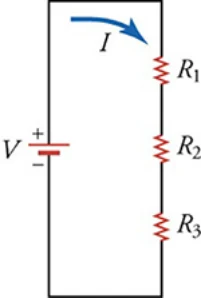
39Are the resistors shown connected in parallel or in series? Explain.
39図の抵抗は並列につながれているか、直列につながれているか。説明せよ。
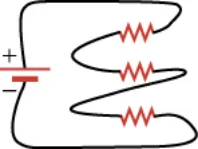
a. The resistors are connected in parallel because the same current flows through all three resistors.b. The resistors are connected in parallel because different current flows through all three resistors.c. The resistors are connected in series because the same current flows through all three resistors.
a. 三つの抵抗すべてを同じ電流が流れるので、抵抗は並列につながれている。b. 三つの抵抗すべてを違う電流が流れるので、抵抗は並列につながれている。c. 三つの抵抗すべてを同じ電流が流れるので、抵抗は直列につながれている。
d. The resistors are connected in series because different current flows through all three resistors.
d. 三つの抵抗すべてを違う電流が流れるので、抵抗は直列につながれている。
19.4 Electric Power 40Which equation below for electric power is incorrect?
19.4 電力 40電力について、次のうち間違っている式はどれか。
41What power is dissipated in a circuit through which flows across a potential drop of ?a. b.
41電位の降下をが流れる回路で消散される電力はいくらか。a. b.
c. Voltage drop across is .
c. にかかる電圧の降下はである。
Short Answer記述式
19.1 Ohm's law 44True or false—it is possible to produce nonzero DC current by adding together AC currents.
19.1 オームの法則 44正誤問題——交流を足し合わせて0でない直流を作ることができる。
a. falseb. true
a. 誤b. 正
45What type of current is used in cars?a. alternating currentb. indirect current
45自動車で使われるのはどの型の電流か。a. 交流b. 間接電流
c. direct currentd. straight current
c. 直流d. 直線電流
46If current were represented by , voltage by , and resistance by , what would the mathematical expression be for Ohm’s law?
46電流を、電圧を、抵抗をで表すとしたら、オームの法則の数式はどうなるか。
47Give a verbal expression for Ohm’s law.a. Ohm’s law says that the current through a resistor equals the voltage across the resistor multiplied by the resistance of the resistor.b. Ohm’s law says that the voltage across a resistor equals the current through the resistor multiplied by the resistance of the resistor.c. Ohm’s law says that the resistance of the resistor equals the current through the
47オームの法則を言葉で述べよ。a. オームの法則は、抵抗を流れる電流が、抵抗にかかる電圧に抵抗の抵抗値をかけたものに等しいと言う。b. オームの法則は、抵抗にかかる電圧が、抵抗を流れる電流に抵抗の抵抗値をかけたものに等しいと言う。c. オームの法則は、抵抗の抵抗値が、抵抗を流れる
42How does a resistor dissipate power?a. A resistor dissipates power in the form of heat.b. A resistor dissipates power in the form of sound.c. A resistor dissipates power in the form of light.d. A resistor dissipates power in the form of charge.
42抵抗はどうやって電力を消散させるか。a. 抵抗は熱の形で電力を消散させる。b. 抵抗は音の形で電力を消散させる。c. 抵抗は光の形で電力を消散させる。d. 抵抗は電荷の形で電力を消散させる。
43What power is dissipated in a circuit through which 0.12 A flows across a potential drop of 3.0 V?
43電位の降下3.0 Vを0.12 Aが流れる回路で消散される電力はいくらか。
a. 0.36 Wb. 0.011 Wc. 5 Vd. 2.5 W
a. 0.36 Wb. 0.011 Wc. 5 Vd. 2.5 W
resistor multiplied by the voltage across a resistor.d. Ohm’s law says that the voltage across a resistor equals the square of the current through the resistor multiplied by the resistance of the resistor.
電流に、抵抗にかかる電圧をかけたものに等しいと言う。d. オームの法則は、抵抗にかかる電圧が、抵抗を流れる電流の2乗に抵抗の抵抗値をかけたものに等しいと言う。
48What is the current through a 100-Ω resistor with 12 V across it?
4812 Vがかかった100 Ωの抵抗を流れる電流はいくらか。
a. 0b. 0.12 A
a. 0b. 0.12 A
c. 8.33 Ad. 1,200 A
c. 8.33 Ad. 1,200 A
49What resistance is required to produce from a battery?a. b. 1
49の電池からそれを得るには、どんな抵抗が必要か。a. b. 1
c. 60d. 120
c. 60d. 120
19.2 Series Circuits 50Given a circuit with one 9-V battery and with its negative terminal connected to ground. The two paths are connected to ground from the positive terminal: the right path with a 20-Ω and a 100-Ω resistor and the left path with a 50-Ω resistor. How much current will flow in the right branch?
19.2 直列回路 509 Vの電池が一つあり、その負の端子が接地された回路がある。正の端子から接地へ二つの道がつながっている。右の道には20 Ωと100 Ωの抵抗、左の道には50 Ωの抵抗がある。右の枝にはどれだけの電流が流れるか。
51Through which branch in the circuit below does the most current flow?
51下の回路で、最も多くの電流が流れるのはどの枝か。
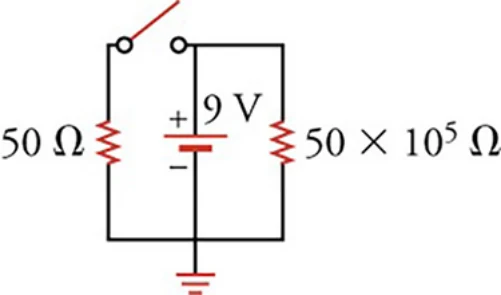
a. All of the current flows through the left branch due to the open switch.b. All of the current flows through the right branch due to the open switch in the left branch.c. All of the current flows through the middle branch due to the open switch in the left branchd. There will be no current in any branch of the circuit due to the open switch.
a. スイッチが開いているので、電流はすべて左の枝を流れる。b. 左の枝のスイッチが開いているので、電流はすべて右の枝を流れる。c. 左の枝のスイッチが開いているので、電流はすべて真ん中の枝を流れる。d. スイッチが開いているので、回路のどの枝にも電流は流れない。
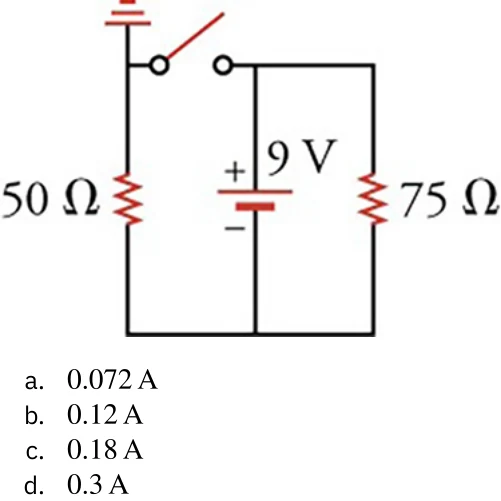
52What current flows through the resistor in the circuit below?
52下の回路で、の抵抗にはどんな電流が流れるか。
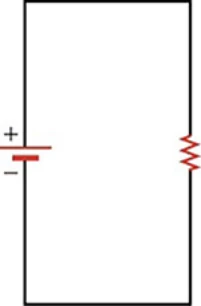
53What is the resistance in the circuit below if the voltage source is a 9.0 V battery and the current is 0.25 A?
53下の回路で、電源が9.0 Vの電池、電流が0.25 Aのとき、抵抗はいくらか。
a. 0.028 Ωb. 2.25 Ω
a. 0.028 Ωb. 2.25 Ω
c. 36 Ωd. 72 Ω
c. 36 Ωd. 72 Ω
19.3 Parallel Circuits 54Ten 100-Ω resistors are connected in series. How can you increase the total resistance of the circuit by about 40 percent?
19.3 並列回路 54100 Ωの抵抗を10個直列につなぐ。回路の全抵抗をおよそ40パーセント増やすにはどうすればよいか。
a. Adding two 10-Ω resistors increases the total resistance of the circuit by about 40 percent.b. Removing two 10-Ω resistors increases the total resistance of the circuit by about 40 percent.c. Adding four 10-Ω resistors increases the total resistance of the circuit by about 40 percent.d. Removing four 10-Ω resistors increases the total resistance of the circuit by about 40 percent.
a. 10 Ωの抵抗を二つ加えれば、回路の全抵抗はおよそ40パーセント増える。b. 10 Ωの抵抗を二つ取り除けば、回路の全抵抗はおよそ40パーセント増える。c. 10 Ωの抵抗を四つ加えれば、回路の全抵抗はおよそ40パーセント増える。d. 10 Ωの抵抗を四つ取り除けば、回路の全抵抗はおよそ40パーセント増える。
55Two identical resistors are connected in parallel across the terminals of a battery. If you increase the resistance of one of the resistors, what happens to the current through and the voltage across the other resistor?
55同じ二つの抵抗を電池の端子に並列につなぐ。一方の抵抗の抵抗値を大きくすると、もう一方の抵抗を流れる電流とそれにかかる電圧はどうなるか。
a. The current and the voltage remain the same.b. The current decreases and the voltage remains the same.c. The current and the voltage increases.d. The current increases and the voltage remains the same.
a. 電流も電圧も変わらない。b. 電流は減り、電圧は変わらない。c. 電流も電圧も増える。d. 電流は増え、電圧は変わらない。
56 .
56
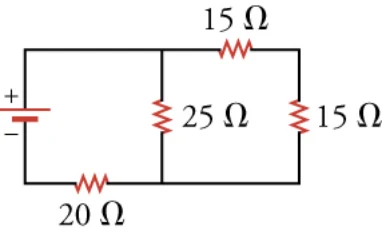
In the circuit shown, through which resistor(s) does the most current flow? Through which does the least flow? Explain.
図の回路で、最も多くの電流が流れるのはどの抵抗か。最も少ないのはどれか。説明せよ。
a. The most current flows through the 15-Ω resistor because all the current must pass through this resistor.b. The most current flows through the 20-Ω resistor because all the current must pass through this resistor.c. The most current flows through the 25-Ω resistor because it is the highest resistance.d. The same current flows through the all the resistor because all the current must pass through each of the resistors.
a. すべての電流がこの抵抗を通らねばならないので、15 Ωの抵抗に最も多くの電流が流れる。b. すべての電流がこの抵抗を通らねばならないので、20 Ωの抵抗に最も多くの電流が流れる。c. 最も抵抗値が大きいので、25 Ωの抵抗に最も多くの電流が流れる。d. すべての電流がそれぞれの抵抗を通らねばならないので、どの抵抗にも同じ電流が流れる。
19.4 Electric Power 57You want to increase the power dissipated in a circuit. You have the choice between doubling the current or doubling the resistance, with the voltage remaining constant. Which one would you choose?
19.4 電力 57回路で消散される電力を増やしたい。電圧を一定にしたまま、電流を2倍にするか抵抗を2倍にするかを選べる。どちらを選ぶか。
a. doubling the resistanceb. doubling the current
a. 抵抗を2倍にするb. 電流を2倍にする
58You want to increase the power dissipated in a
58回路で消散される電力を
Extended Response論述式
19.1 Ohm's law 61Explain how current and charge are related, including how direction is defined.
19.1 オームの法則 61電流と電荷がどう関係するかを、向きがどう定められるかを含めて説明せよ。
a. Electric current is the charge that passes through a conductor per unit time. The direction of the current is defined to be the direction in which positive charge would flow.b. Electric current is the charges that move in a conductor. The direction of the current is defined to be the direction in which positive charge would flow.c. Electric current is the charge that passes through a conductor per unit time. The direction of the current is defined to be the direction in which negative charge would flow.d. Electric current is the charges that move in a conductor. The direction of the current is defined to be the direction in which negative charge would flow.
a. 電流とは、単位時間に導体を通り過ぎる電荷である。電流の向きは、正の電荷が流れるであろう向きと定められる。b. 電流とは、導体の中を動く電荷である。電流の向きは、正の電荷が流れるであろう向きと定められる。c. 電流とは、単位時間に導体を通り過ぎる電荷である。電流の向きは、負の電荷が流れるであろう向きと定められる。d. 電流とは、導体の中を動く電荷である。電流の向きは、負の電荷が流れるであろう向きと定められる。
62What could cause Ohm's law to break down? a. If small amount of current flows through a resistor, the resistor will heat up so much that it will change state, in violation of
62オームの法則が破れる原因になりうるのは何か。 a. わずかな電流が抵抗を流れると、抵抗はあまりに熱くなって状態を変え、
circuit. You have the choice between reducing the voltage or reducing the resistance, with the current remaining constant. Which one would you choose?
増やしたい。電流を一定にしたまま、電圧を下げるか抵抗を下げるかを選べる。どちらを選ぶか。
a. reduce the voltage to increase the powerb. reduce the resistance to increase the power
a. 電力を増やすには電圧を下げるb. 電力を増やすには抵抗を下げる
59What power is dissipated in the circuit consisting of 310-Ω resistors connected in series across a 9.0-V battery?a. The power dissipated is 2430 W.b. The power dissipated is 270 W.
599.0 Vの電池に直列につないだ10 Ωの抵抗三つからなる回路で消散される電力はいくらか。a. 消散される電力は2430 Wである。b. 消散される電力は270 Wである。
c. The power dissipated is 2.7 W.d. The power dissipated is 0.37 W.
c. 消散される電力は2.7 Wである。d. 消散される電力は0.37 Wである。
60What power is dissipated in a circuit consisting of three 10-Ω resistors connected in parallel across a 9.0-V battery?
609.0 Vの電池に並列につないだ10 Ωの抵抗三つからなる回路で消散される電力はいくらか。
a. The power dissipated is 270 W.b. The power dissipated is 30 W.
a. 消散される電力は270 Wである。b. 消散される電力は30 Wである。
c. The power dissipated is 24 W.d. The power dissipated is 1/24 W.
c. 消散される電力は24 Wである。d. 消散される電力は1/24 Wである。
Ohm’s law.b. If excessive amount of current flows through a resistor, the resistor will heat up so much that it will change state, in violation of Ohm’s law.c. If small amount of current flows through a resistor, the resistor will not heat up so much and it will not change its state, in violation of Ohm’s law.d. If excessive amount of current flows through a resistor, the resistor will heat up so much that it will not change its state, in violation of Ohm’s law.
オームの法則を破るから。b. 過大な電流が抵抗を流れると、抵抗はあまりに熱くなって状態を変え、オームの法則を破るから。c. わずかな電流が抵抗を流れると、抵抗はさほど熱くならず状態も変えず、オームの法則を破るから。d. 過大な電流が抵抗を流れると、抵抗はあまりに熱くなるが状態は変えず、オームの法則を破るから。
63You connect a single resistor across a battery and find that flows through the circuit. You add another resistor after the first resistor and find that flows through the circuit. If you have resistors connected in a line one after the other, what would be their total resistance?
63一つの抵抗をの電池につなぐと、回路にが流れる。最初の抵抗のあとにもう一つの抵抗を加えると、回路にが流れる。の抵抗を個、一列に順につないだとき、その全抵抗はいくらになるか。
19.2 Series Circuits 64Explain why the current is the same at all points in the circuit below.
19.2 直列回路 64下の回路で、どの点でも電流が同じである理由を説明せよ。
a. If the current were not constant, the mobile charges would bunch up in places, which means that the voltage would decrease at that point. A lower voltage at some point would push the current in the direction that further decreases the voltage.b. If the current were not constant, the mobile charges would bunch up in places, which means that the voltage would increase at that point. But a higher voltage at some point would push the current in the direction that decreases the voltage.c. If the current were not constant, the mobile charges would bunch up in places, which mean that the voltage would increase at that point. A higher voltage at some point would push the current in the direction that further increases the voltage.d. If the current were not constant, the mobile charges would bunch up in places, which mean that the voltage would decrease at that point. But a lower voltage at some point would push the current in the direction that increases the voltage.
a. 電流が一定でなければ、動ける電荷が場所によって溜まってしまい、そこで電圧が下がることになる。ある点で電圧が低ければ、電圧をさらに下げる向きへ電流を押しやる。b. 電流が一定でなければ、動ける電荷が場所によって溜まってしまい、そこで電圧が上がることになる。しかしある点で電圧が高ければ、電圧を下げる向きへ電流を押しやる。c. 電流が一定でなければ、動ける電荷が場所によって溜まってしまい、そこで電圧が上がることになる。ある点で電圧が高ければ、電圧をさらに上げる向きへ電流を押しやる。d. 電流が一定でなければ、動ける電荷が場所によって溜まってしまい、そこで電圧が下がることになる。しかしある点で電圧が低ければ、電圧を上げる向きへ電流を押しやる。
65What is the current through each resistor in the circuit?
65この回路で、それぞれの抵抗を流れる電流はいくらか。
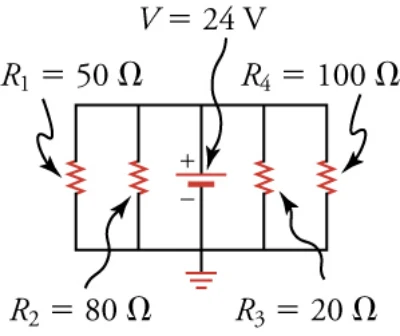
a. Current through resistors R1, R2, R3, and
a. 抵抗R1、R2、R3、
R4 is 0.48 A, 0.30 A, 1.2 A, and 0.24 A, respectively. b. Current through resistors R1, R2, R3, and
R4を流れる電流はそれぞれ0.48 A、0.30 A、1.2 A、0.24 Aである。 b. 抵抗R1、R2、R3、
R4 is 1200 A, 1920 A, 480 A, and 2400 A, respectively. c. Current through resistors R1, R2, R3, and is
R4を流れる電流はそれぞれ1200 A、1920 A、480 A、2400 Aである。 c. 抵抗R1、R2、R3、
R4 2.08 A, 3.34 A, 0.833 A, and 4.17 A, respectively. d. The same amount of current, 0.096 A, flows through all of the resistors.
R4を流れる電流はそれぞれ2.08 A、3.34 A、0.833 A、4.17 Aである。 d. すべての抵抗に同じ0.096 Aの電流が流れる。
19.3 Parallel Circuits 66In a house, a single incoming wire at a high potential with respect to the ground provides electric power. How are the appliances connected between this wire and the ground, in parallel or in series? Explain.
19.3 並列回路 66ある家では、地面に対して高い電位にある一本の引き込み線が電力を供給している。この線と地面の間で、器具は並列につながれているか、直列につながれているか。説明せよ。
a. The appliances are connected in parallel to provide different voltage differences across each appliance.b. The appliances are connected in parallel to provide the same voltage difference across each appliance.c. The appliances are connected in series to provide the same voltage difference across each appliance.d. The appliances are connected in series to provide different voltage differences across each appliance.
a. それぞれの器具に違う電圧差をかけるために、器具は並列につながれている。b. それぞれの器具に同じ電圧差をかけるために、器具は並列につながれている。c. それぞれの器具に同じ電圧差をかけるために、器具は直列につながれている。d. それぞれの器具に違う電圧差をかけるために、器具は直列につながれている。
19.4 Electric Power 67A single resistor is connected across the terminals of a battery When you attach a second resistor in parallel with the first, does the power dissipated by the system change?
19.4 電力 67一つの抵抗を電池の端子につなぐ。二つ目の抵抗を最初のものと並列につないだとき、この系が消散させる電力は変わるか。
a. No, the power dissipated remain same.b. Yes, the power dissipated increases.
a. いいえ。消散される電力は変わらない。b. はい。消散される電力は増える。
c. Yes, the power dissipated decreases.
c. はい。消散される電力は減る。
68In a flashlight, the batteries are normally connected in series. Why are they not connected in parallel?
68懐中電灯では、電池はふつう直列につながれる。並列につながないのはなぜか。
a. Batteries are connected in series for higher voltage and power output.b. Batteries are connected in series for lower voltage and power output.c. Batteries are connected in series so that power output is a much lower for the same amount of voltage.d. Batteries are connected in series to reduce the overall loss of energy from the circuit.
a. より高い電圧と電力の出力を得るために電池は直列につながれる。b. より低い電圧と電力の出力を得るために電池は直列につながれる。c. 同じ電圧に対して電力の出力がずっと小さくなるように電池は直列につながれる。d. 回路からのエネルギーの損失を全体として減らすために電池は直列につながれる。