第19章電気回路Electrical Circuits原書 p.623–668
Chapter Review章のまとめ
Concept Items概念の問題
19.1 Ohm's law 1You connect a resistor across a battery. In which direction do the electrons flow?
19.1 オームの法則 1電池に抵抗をつなぐ。電子はどちら向きに流れるか。
a. The electrons flow from the negative terminal of the battery to the positive terminal of the battery.b. The electrons flow from the positive terminal of the battery to the negative terminal of the battery.
a. 電子は電池の負の端子から正の端子へ流れる。b. 電子は電池の正の端子から負の端子へ流れる。
2How does current depend on resistance in Ohm’s law?
2オームの法則で、電流は抵抗にどうよるか。
a. Current is directly proportional to the resistance.b. Current is inversely proportional to the resistance.c. Current is proportional to the square of the resistance.d. Current is inversely proportional to the square of the resistance.
a. 電流は抵抗に正比例する。b. 電流は抵抗に反比例する。c. 電流は抵抗の2乗に比例する。d. 電流は抵抗の2乗に反比例する。
3In the context of electricity, what is resistivity?
3電気の文脈で、抵抗率とは何か。
19.2 Series Circuits19.2 直列回路
the equivalent resistance of N resistors connected in series
直列につないだN個の抵抗の合成抵抗
19.3 Parallel Circuits19.3 並列回路
the equivalent resistance of N resistors connected in parallel
並列につないだN個の抵抗の合成抵抗
19.4 Electric Power19.4 電力
for a given current I flowing through a potential difference V, the electric power dissipated for a given current I flowing through a resistance R, the electric power dissipated for a given voltage difference V across a resistor R, the electric power dissipated
電位差Vを電流Iが流れるときに消散される電力抵抗Rを電流Iが流れるときに消散される電力抵抗Rに電圧差Vがかかるときに消散される電力
a. Resistivity is the property of materials to resist the passage of voltage.b. Resistivity is the property of materials to resist the passage of electric current.c. Resistivity is the property of materials to increase the passage of voltage.d. Resistivity is the property of materials to increase the passage of electric current.
a. 抵抗率とは、材料が電圧の通過を妨げる性質である。b. 抵抗率とは、材料が電流の通過を妨げる性質である。c. 抵抗率とは、材料が電圧の通過を増やす性質である。d. 抵抗率とは、材料が電流の通過を増やす性質である。
4What is the mathematical formula for Ohm’s law?
4オームの法則の数式はどれか。
19.2 Series Circuits 5In which circuit are all the resistors connected in series?
19.2 直列回路 5すべての抵抗が直列につながれているのはどの回路か。
a.
a.
6What is the voltage and current through the capacitor in the circuit below a long time after the switch is closed?
6下の回路で、スイッチを閉じてから十分に長い時間がたったとき、コンデンサーにかかる電圧と流れる電流はいくらか。
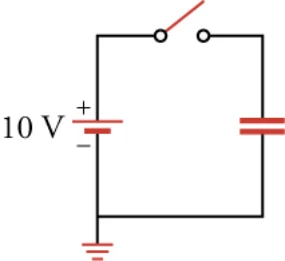
a. 0 V, 0 Ab. 0 V, 10 A
a. 0 V、0 Ab. 0 V、10 A
c. 10 V, 0 Ad. 10 V, 10 A
c. 10 V、0 Ad. 10 V、10 A
19.3 Parallel Circuits 7If you remove resistance from a circuit, does the total resistance of the circuit always decrease? Explain.
19.3 並列回路 7回路から抵抗を取り除けば、回路の全抵抗はつねに減るか。説明せよ。
a. No, because for a parallel combination of
a. いいえ。並列の抵抗の組み合わせでは、
Critical Thinking Items批判的に考える問題
19.1 Ohm's law 11An accelerator accelerates He nuclei (charge = 2e) to a speed of v = 2 × 10⁶ m/s. What is the current if the linear density of He nuclei is λ = 108 m–1?a. I = 9.6 × 10⁻⁵ Ab. I = 3.2 × 10⁻⁵ A
19.1 オームの法則 11ある加速器がヘリウムの原子核(電荷 = 2e)を速さv = 2 × 10⁶ m/sまで加速する。ヘリウムの原子核の線密度がλ = 108 m-1のとき、電流はいくらか。a. I = 9.6 × 10⁻⁵ Ab. I = 3.2 × 10⁻⁵ A
resistors, the resistance through the remaining circuit increases. b. Yes, because for a parallel combination of resistors, the resistance through the remaining circuit increases.
残った回路の抵抗は増えるから。 b. はい。並列の抵抗の組み合わせでは、残った回路の抵抗は増えるから。
8Explain why the equivalent resistance of a parallel combination of resistors is always less than the smallest of the parallel resistors.
8並列の抵抗の組み合わせの合成抵抗が、つねに並列の抵抗のうち最も小さいものより小さい理由を説明せよ。
a. Adding resistors in parallel gives the current a shorter path through which it can flow, hence decreasing the overall resistance.b. Adding resistors in parallel gives the current another path through which it can flow, hence decreasing the overall resistance.c. Adding resistors in parallel reduce the number of paths through which the current can flow, hence decreasing the overall resistance.d. Adding resistors in parallel gives the current a longer path through which it can flow, hence decreasing the overall resistance.
a. 抵抗を並列に加えると電流の流れる道が短くなるので、全体の抵抗が減るから。b. 抵抗を並列に加えると電流の流れる別の道ができるので、全体の抵抗が減るから。c. 抵抗を並列に加えると電流の流れる道の数が減るので、全体の抵抗が減るから。d. 抵抗を並列に加えると電流の流れる道が長くなるので、全体の抵抗が減るから。
19.4 Electric Power 9To draw the most power from a battery, should you connect a small or a large resistance across its terminals? Explain.
19.4 電力 9電池から最大の電力を引き出すには、端子に小さい抵抗をつなぐべきか、大きい抵抗をつなぐべきか。説明せよ。
a. Small resistance, because smaller resistance will lead to the largest powerb. Large resistance, because smaller resistance will lead to the largest power
a. 小さい抵抗。抵抗が小さいほど電力が大きくなるからb. 大きい抵抗。抵抗が小さいほど電力が大きくなるから
10If you double the current through a resistor, by what factor does the power dissipated by the resistor change?
10抵抗を流れる電流を2倍にすると、抵抗で消散される電力は何倍になるか。
a. Power increases by a factor of two.b. Power increases by a factor of four.
a. 電力は2倍になる。b. 電力は4倍になる。
c. Power increases by a factor of eight.d. Power increases by a factor of 16.
c. 電力は8倍になる。d. 電力は16倍になる。
c. I = 12.8 × 10⁻⁵ Ad. I = 6.4 × 10⁻⁵ A
c. I = 12.8 × 10⁻⁵ Ad. I = 6.4 × 10⁻⁵ A
12How can you verify whether a certain material is ohmic?
12ある材料がオーム性かどうかをどう確かめられるか。
a. Make a resistor from this material and measure the current going through this
a. この材料で抵抗器を作り、いくつもの違う電圧について
resistor for several different voltages. If the current is proportional to the voltage, then the material is ohmic.b. Make a resistor from this material and measure the current going through this resistor for several different voltages. If the current is inversely proportional to the voltage, then the material is ohmic.c. Make a resistor from this material and measure the current going through this resistor for several different voltages. If the current is proportional to the square of the voltage, then the material is ohmic.d. Make a resistor from this material and measure the current going through this resistor for several different voltages. If the current is inversely proportional to the square of the voltage, then the material is ohmic.
その抵抗器を流れる電流を測る。電流が電圧に比例すれば、その材料はオーム性である。b. この材料で抵抗器を作り、いくつもの違う電圧についてその抵抗器を流れる電流を測る。電流が電圧に反比例すれば、その材料はオーム性である。c. この材料で抵抗器を作り、いくつもの違う電圧についてその抵抗器を流れる電流を測る。電流が電圧の2乗に比例すれば、その材料はオーム性である。d. この材料で抵抗器を作り、いくつもの違う電圧についてその抵抗器を流れる電流を測る。電流が電圧の2乗に反比例すれば、その材料はオーム性である。
19.2 Series Circuits 13Given three batteries (5V, 9V, 12V) and five resistors (10, 20, 30, 40, 50Ω) to choose from, what can you choose to form a circuit diagram with a current of 0.175A? You do not need to use all of the components.
19.2 直列回路 13三つの電池(5V、9V、12V)と五つの抵抗(10、20、30、40、50Ω)から選べるとき、電流0.175Aの回路図を作るには何を選べばよいか。すべての部品を使う必要はない。
a. Batteries (5V, 9V) and resistors (30Ω,
a. 電池(5V、9V)と抵抗(30Ω、
50Ω) connected in seriesb. Batteries (5V4, 12V) and resistors (10Ω, 20Ω, 40Ω, and 50Ω) connected in series.c. Batteries (5V, 9V, and 12V) and resistors
50Ω)を直列につなぐb. 電池(5V、12V)と抵抗(10Ω、20Ω、40Ω、50Ω)を直列につなぐ。c. 電池(5V、9V、12V)と抵抗
(10Ω, 20Ω, and 30Ω) connected in series.
(10Ω、20Ω、30Ω)を直列につなぐ。
14What is the maximum resistance possible given a resistor of and a resistor of ?a. b.
14の抵抗との抵抗があるとき、作れる最大の抵抗はいくらか。a. b.
15Rank the points A, B, C, and D in the circuit diagram from lowest voltage to highest voltage.
15回路図の点A、B、C、Dを電圧の低いものから高いものへ並べよ。
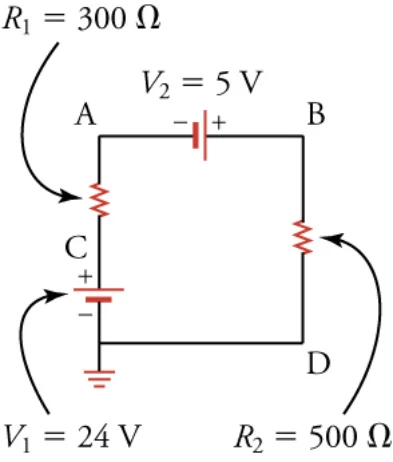
a. A, B, C, Db. B, C, A, Dc. C, B, A, Dd. D, A, B, C
a. A, B, C, Db. B, C, A, Dc. C, B, A, Dd. D, A, B, C
19.3 Parallel Circuits 16Can all resistor combinations be reduced to series and parallel combinations?
19.3 並列回路 16どんな抵抗の組み合わせも直列と並列の組み合わせに帰着できるか。
a. No, all practical resistor circuits cannot be reduced to series and parallel combinations.b. Yes, all practical resistor circuits can be reduced to series and parallel combinations.
a. いいえ。実用的な抵抗の回路がすべて直列と並列の組み合わせに帰着できるわけではない。b. はい。実用的な抵抗の回路はすべて直列と並列の組み合わせに帰着できる。
17What is the equivalent resistance of the circuit shown below?
17下に示す回路の合成抵抗はいくらか。
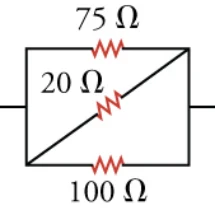
a. The equivalent resistance of the circuit 14 Ω.b. The equivalent resistance of the circuit
a. この回路の合成抵抗は14 Ω。b. この回路の合成抵抗は
167 Ω.c. The equivalent resistance of the circuit 140 Ω.d. The equivalent resistance of the circuit 195 Ω.
167 Ω。c. この回路の合成抵抗は140 Ω。d. この回路の合成抵抗は195 Ω。
19.4 Electric Power 18Two lamps have different resistances. (a) If the lamps are connected in parallel, which one is brighter, the lamp with greater resistance or the lamp with less resistance? (b) If the lamps are connected in series, which one is brighter? Note that the brighter lamp dissipates more power.
19.4 電力 18二つのランプの抵抗が違う。(a)ランプを並列につないだとき、抵抗の大きいランプと小さいランプでは、どちらが明るいか。(b)ランプを直列につないだとき、どちらが明るいか。明るいランプのほうが多くの電力を消散させることに注意しよう。
a. (a) lamp with greater resistance; (b) lamp with less resistanceb. (a) lamp with greater resistance; (b) lamp with greater resistancec. (a) lamp with less resistance; (b) lamp with less resistanced. (a) lamp with less resistance; (b) lamp with greater resistance
a. (a)抵抗の大きいランプ。(b)抵抗の小さいランプb. (a)抵抗の大きいランプ。(b)抵抗の大きいランプc. (a)抵抗の小さいランプ。(b)抵抗の小さいランプd. (a)抵抗の小さいランプ。(b)抵抗の大きいランプ
19To measure the power consumed by your laptop computer, you place an ammeter (a device that
19ノートパソコンが消費する電力を測るために、
Problems問題
19.1 Ohm's law 20What voltage is needed to make 6 C of charge traverse a 100-Ω resistor in 1 min?a. The required voltage is 1 × 10⁻³ V.b. The required voltage is 10 V.
19.1 オームの法則 206 Cの電荷を1分で100 Ωの抵抗に通すには、どんな電圧が要るか。a. 必要な電圧は1 × 10⁻³ Vである。b. 必要な電圧は10 Vである。
c. The required voltage is 1,000 V.d. The required voltage is 10,000 V.
c. 必要な電圧は1,000 Vである。d. 必要な電圧は10,000 Vである。
21Resistors typically obey Ohm’s law at low currents, but show deviations at higher currents because of heating. Suppose you were to conduct an experiment measuring the voltage, V, across a resistor as a function of current, I, including currents whose deviations from Ohm’s law start to become apparent. For a data plot of V versus I, which of the following functions would be best to fit the data? Assume that a, b, and c are nonzero constants adjusted to fit the data.
21抵抗器はふつう小さな電流ではオームの法則に従うが、大きな電流では発熱のためにずれを示す。オームの法則からのずれが目立ち始める電流も含めて、電流Iの関数として抵抗器にかかる電圧Vを測る実験を行うとしよう。VをIに対して描いたデータについて、次のどの関数がデータによく合うか。a、b、cはデータに合うよう調整した0でない定数とする。
22A battery of unknown voltage is attached across a resistor . You add a second battery with in series with so that the voltage across is now and measure of current through resistor . You add a third battery with in series with the first two batteries so that the voltage across is and measure of current through . What is the resistance of ?a.b.
22未知の電圧の電池を抵抗につなぐ。の二つ目の電池を直列に加えて、にかかる電圧がになるようにし、抵抗を流れる電流を測る。の三つ目の電池を初めの二つと直列に加えて、にかかる電圧がになるようにし、流れる電流を測る。の抵抗はいくらか。a.b.
measures electric current) in series with its DC power supply. When the screen is off, the computer draws 0.40 A of current.When the screen is on at full brightness, it draws 0.90 A of current. Knowing the DC power supply delivers 16 V, how much power is used by the screen?
直流電源と直列に電流計(電流を測る装置)を入れる。画面を消しているとき、コンピューターは0.40 Aの電流を引く。画面を最大の明るさでつけているときは0.90 Aを引く。直流電源が16 Vを与えるとして、画面が使う電力はいくらか。
a. The power used by the screen is −8.0 W.b. The power used by the screen is 0.3 W.
a. 画面が使う電力は−8.0 Wである。b. 画面が使う電力は0.3 Wである。
c. The power used by the screen is 3.2 W.d. The power used by the screen is 8.0 W.
c. 画面が使う電力は3.2 Wである。d. 画面が使う電力は8.0 Wである。
19.2 Series Circuits 23What is the voltage drop across two 80-Ω resistors connected in series with 0.15 A flowing through them?
19.2 直列回路 230.15 Aが流れる、直列につないだ二つの80 Ωの抵抗にかかる電圧の降下はいくらか。
a. 12 Vb. 24 Vc. 36 Vd. 48 V
a. 12 Vb. 24 Vc. 36 Vd. 48 V
24In this circuit, the voltage drop across the upper resistor is 4.5 V. What is the battery voltage?
24この回路で、上の抵抗にかかる電圧の降下は4.5 Vである。電池の電圧はいくらか。
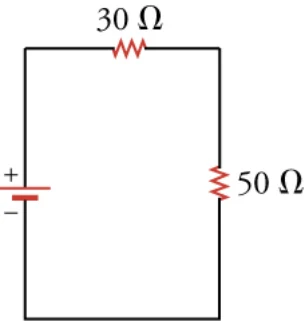
a. 4.5Vb. 7.5Vc. 12Vd. 18V
a. 4.5Vb. 7.5Vc. 12Vd. 18V
19.3 Parallel Circuits 25What is the equivalent resistance of this circuit?
19.3 並列回路 25この回路の合成抵抗はいくらか。
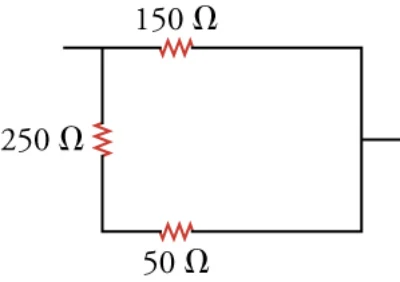
a. The equivalent resistance of the circuit is
a. この回路の合成抵抗は
327 Ω.b. The equivalent resistance of the circuit is 100 Ω.c. The equivalent resistance of the circuit is 327 Ω.d. The equivalent resistance of the circuit is 450 Ω.
327 Ωである。b. この回路の合成抵抗は100 Ωである。c. この回路の合成抵抗は327 Ωである。d. この回路の合成抵抗は450 Ωである。
26What is the equivalent resistance of the circuit shown below?
26下に示す回路の合成抵抗はいくらか。
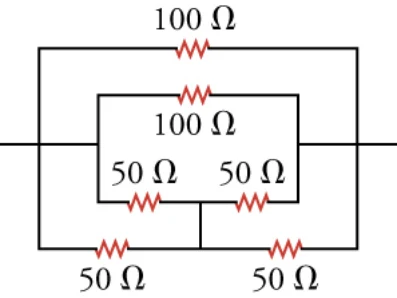
a. The equivalent resistance is 25 Ω.b. The equivalent resistance is 50 Ω.
a. 合成抵抗は25 Ωである。b. 合成抵抗は50 Ωである。
Performance Task実践課題
19.4 Electric Power 291. An incandescent light bulb (i.e., an old-fashioned light bulb with a little wire in it) 2. A lightbulb socket to hold the light bulb 3. A variable voltage source 4. An ammeter
19.4 電力 291. 白熱電球(すなわち中に細い線の入った昔ながらの電球) 2. 電球を保持するソケット 3. 電圧を変えられる電源 4. 電流計
Procedure手順
• Screw the lightbulb into its socket. Connect the positive terminal of the voltage source to the input of the ammeter. Connect the output of the ammeter to one connection of the socket. Connect the other connection of the socket to the negative terminal of the voltage source. Ensure that the voltage source is set to supply DC voltage and that the ammeter is set to measure DC amperes. The desired circuit is shown below.
・電球をソケットにねじ込む。電源の正の端子を電流計の入力につなぐ。電流計の出力をソケットの一方の接点につなぐ。ソケットのもう一方の接点を電源の負の端子につなぐ。電源が直流電圧を出す設定に、電流計が直流アンペアを測る設定になっていることを確かめる。望みの回路を下に示す。
c. The equivalent resistance is 75 Ω.d. The equivalent resistance is 100 Ω.
c. 合成抵抗は75 Ωである。d. 合成抵抗は100 Ωである。
19.4 Electric Power 27When 12 V are applied across a resistor, it dissipates 120 W of power. What is the current through the resistor?
19.4 電力 27抵抗に12 Vをかけると120 Wの電力を消散させる。抵抗を流れる電流はいくらか。
a. The current is 1,440 A.b. The current is 10 A.
a. 電流は1,440 Aである。b. 電流は10 Aである。
c. The current is 0.1 A.d. The current is 0.01 A.
c. 電流は0.1 Aである。d. 電流は0.01 Aである。
28Warming 1 g of water requires 4.18 J of energy per °C. How long would it take to warm 1 L of water from 20 to 40 °C if you immerse in the water a 1-kW resistor connected across a 9.0-V battery?
28水1 gを1 ℃温めるには4.18 Jのエネルギーが要る。9.0 Vの電池につないだ1 kWの抵抗を水に沈めるとき、水1 Lを20 ℃から40 ℃へ温めるにはどれだけかかるか。
a. 10 minb. 20 minc. 30 mind. 40 min
a. 10分b. 20分c. 30分d. 40分
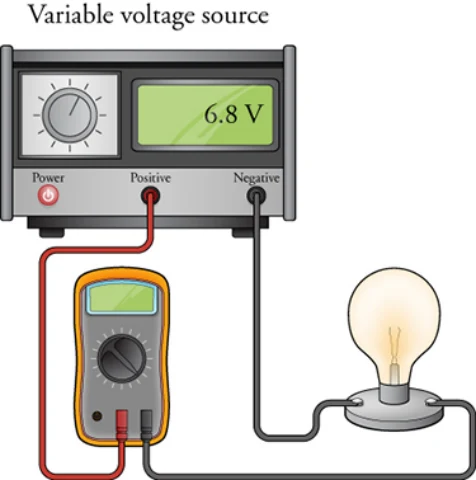
• On a piece of paper, make a two-column table with 10 rows. Label the left column volts and the right column current. Adjust the voltage source so that it supplies from between 1 and 10 volts DC. For each voltage, write the voltage in the volts column and the corresponding amperage measured by the ammeter in the current column. Make a plot of volts versus current, that is, a plot with volts on the vertical axis and current on the horizontal axis. Use this data and the plot to answer the following questions:
・紙に10行の二列の表を作る。左の列を「ボルト」、右の列を「電流」とする。電源を1から10ボルトの直流を出すように調節する。それぞれの電圧について、電圧を「ボルト」の列に、電流計が測った対応する電流を「電流」の列に書く。ボルト対電流のグラフ、すなわち縦軸にボルト、横軸に電流をとったグラフを描く。このデータとグラフを使って次の問いに答えよ。
1. What is the resistance of the lightbulb?2. What is the range of possible error in your
1. 電球の抵抗はいくらか。2. 測定で起こりうる誤差の範囲は