第19章電気回路Electrical Circuits原書 p.623–668
19.1 Ohm's law19.1 オームの法則
SECTION LEARNING OBJECTIVES By the end of this section, you will be able to do the following:
この節の学習目標 この節を終えると、次のことができるようになる。
• Describe how current is related to charge and time, and distinguish between direct current and alternating current• Define resistance and verbally describe Ohm’s law• Calculate current and solve problems involving Ohm’s law
・電流が電荷と時間にどう関係するかを述べ、直流と交流を区別する・抵抗を定義し、オームの法則を言葉で述べる・電流を計算し、オームの法則に関する問題を解く
Section Key Termsこの節の重要語
alternating currentampereconventional currentdirect currentelectric currentnonohmicohmicOhm’s lawresistance
交流アンペア慣用電流直流電流非オーム性のオーム性のオームの法則抵抗
Direct and Alternating Current直流と交流
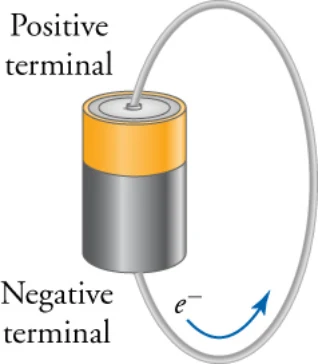
Just as water flows from high to low elevation, electrons that are free to move will travel from a place with low potential to a place with high potential. A battery has two terminals that are at different potentials. If the terminals are connected by a conducting wire, an electric current (charges) will flow, as shown in Figure 19.2. Electrons will then move from the low-potential terminal of the battery (the negative end) through the wire and enter the high-potential terminal of the battery (the positive end).
水が高い場所から低い場所へ流れるように、電荷も電位の違いによって動く。ただし、負の電荷を持つ電子は、電位の低い側から高い側へ移動する。電池の2つの端子には電位差があり、導線で回路をつなぐと電流が流れる(図19.2)。外部の導線では、電子は電位の低い負極から、電位の高い正極へ移動する。
Electric current is the rate at which electric charge moves. A large current, such as that used to start a truck engine, moves a large amount very quickly, whereas a small current, such as that used to operate a hand-held calculator, moves a small amount of charge more slowly. In equation form, electric current I is defined as
電流は、単位時間に、ある断面を通過する電荷の量である。トラックのエンジンを始動するような大きな電流では、短時間に多量の電荷が通過する。電卓を動かすような小さな電流では、同じ時間に通過する電荷の量は少ない。電流 I は、次の式で定義される。
where is the amount of charge that flows past a given area and is the time it takes for the charge to move past the area. The SI unit for electric current is the ampere (A), which is named in honor of the French physicist André- Marie Ampère (1775–1836). One ampere is one coulomb per second, or
ここではある面積を通り過ぎる電荷の量、はその電荷がその面積を通り過ぎるのにかかる時間である。電流のSI単位はアンペア(A)で、フランスの物理学者アンドレ=マリ・アンペール(1775–1836)にちなむ。1アンペアは毎秒1クーロン、すなわち
Electric current moving through a wire is in many ways similar to water current moving through a pipe. To define the flow of water through a pipe, we can count the water molecules that flow past a given section of the pipe. As shown in Figure 19.3, electric current is very similar. We count the number of electrical charges that flow past a section of a conductor; in this case, a wire.
である。導線を通って動く電流は、多くの点で管を通って流れる水の流れに似ている。管を通る水の流れを定めるには、管のある断面を通り過ぎる水の分子を数えればよい。図19.3に示すように、電流もよく似ている。導体——この場合は導線——のある断面を通り過ぎる電荷の数を数えるのである。
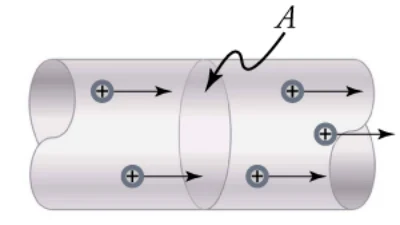
Assume each particle q in Figure 19.3 carries a charge , in which case the total charge shown would be . If these charges move past the area A in a time , then the current would be
図19.3のそれぞれの粒子qが電荷を運ぶとすると、示されている全電荷はになる。これらの電荷が時間で面積Aを通り過ぎるなら、電流は
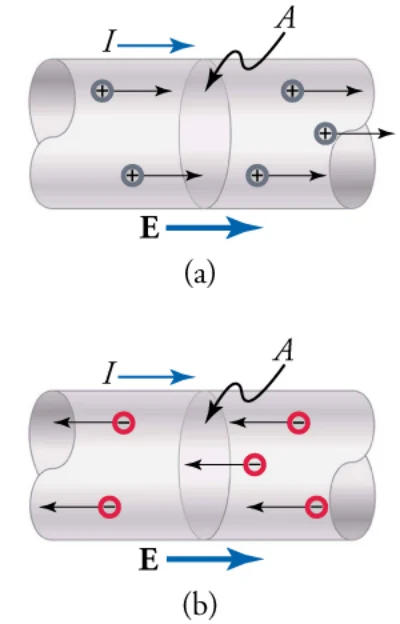
Note that we assigned a positive charge to the charges in Figure 19.3. Normally, negative charges—electrons—are the mobile charge in wires, as indicated in Figure 19.2. Positive charges are normally stuck in place in solids and cannot move freely. However, because a positive current moving to the right is the same as a negative current of equal magnitude moving to the left, as shown in Figure 19.4, we define conventional current to flow in the direction that a positive charge would flow if it could move. Thus, unless otherwise specified, an electric current is assumed to be composed of positive charges.
となる。図19.3では電荷に正の符号を与えたことに注意しよう。ふつうは、図19.2に示すとおり、導線の中で動く電荷は負の電荷——電子——である。正の電荷はふつう固体の中でその場に留まり、自由に動けない。しかし、図19.4に示すように、右へ動く正の電流は、同じ大きさの左へ動く負の電流と同じなので、慣用電流を、正の電荷が動けるとしたら動くであろう向きに流れるものと定める。したがって、とくに断らない限り、電流は正の電荷からなるものとみなす。
Also note that one Coulomb is a significant amount of electric charge, so 5 A is a very large current. Most often you will see current on the order of milliamperes (mA).
また、1クーロンはかなり大きな電荷なので、5 Aはとても大きな電流であることにも注意しよう。ふつうはミリアンペア(mA)程度の電流を目にする。
SNAP LAB身近な実験Vegetable Current野菜の電流
This lab helps students understand how current works. Given that particles confined in a pipe cannot occupy the same space, pushing more particles into one end of the pipe will force the same number of particles out of the opposite end. This creates a current of particles.
この実験は電流の働きを理解する助けになる。管に閉じ込められた粒は同じ場所を占められないので、管の一方の端に粒をもっと押し込めば、同じ数の粒が反対の端から出てくる。これが粒の流れを作る。
Find a straw and dried peas that can move freely in the straw. Place the straw flat on a table and fill the straw with peas. When you push one pea in at one end, a different pea should come out of the other end. This demonstration is a model for an electric current. Identify the part of the model that represents electrons and the part of the model that represents the supply of electrical energy. For a period of 30 s, count the number of peas you can push through the straw. When finished, calculate the pea current by dividing the number of peas by the time in seconds.
ストローと、その中を自由に動ける乾燥豆を用意する。ストローを机の上に平らに置き、豆で満たす。一方の端で豆を一つ押し込むと、もう一方の端から別の豆が出てくるはずである。この実演は電流のモデルである。このモデルのどの部分が電子を表し、どの部分が電気エネルギーの供給を表すかを見きわめよう。30秒間で、ストローに何個の豆を押し通せるかを数える。終わったら、豆の数を秒で表した時間で割って豆の電流を計算しよう。
Note that the flow of peas is based on the peas physically bumping into each other; electrons push each other along due to mutually repulsive electrostatic forces.
豆の流れは豆が物理的に互いにぶつかることによる。電子は互いに反発する静電気の力によって互いを押し進める点に注意しよう。
Suppose you have a reservoir of peas, each charged to 1 nC. If you pass the peas through a straw at a rate of four peas per second, how would you calculate the electrical current carried by your charged peas?
それぞれ1 nCに帯電した豆の貯えがあるとしよう。毎秒4個の割合で豆をストローに通すとき、帯電した豆が運ぶ電流をどう計算すればよいか。
a. Measure the length of the straw, then divide by the rate of pea flow and multiply by charge per pea.b. Multiply the rate of pea flow by the charge per pea.
a. ストローの長さを測り、それを豆の流れの割合で割って、豆1個あたりの電荷をかける。b. 豆の流れの割合に豆1個あたりの電荷をかける。
c. Measure the length of the straw, then multiply by the rate of pea flow and divide by charge per pea.d. Divide the rate of pea flow by the charge per pea.
c. ストローの長さを測り、それに豆の流れの割合をかけて、豆1個あたりの電荷で割る。d. 豆の流れの割合を豆1個あたりの電荷で割る。
The direction of conventional current is the direction that positive charge would flow. Depending on the situation, positive charges, negative charges, or both may move. In metal wires, as we have seen, current is carried by electrons, so the negative charges move. In ionic solutions, such as salt water, both positively charged and negatively charged ions move. This is also true in nerve cells. Pure positive currents are relatively rare but do occur. History credits American politician and scientist Benjamin Franklin with describing current as the direction that positive charges flow through a wire. He named the type of charge associated with electrons negative long before they were known to carry current in so many situations.
慣用電流の向きは、正の電荷が流れるであろう向きである。場面によって、正の電荷が動くことも、負の電荷が動くことも、両方が動くこともある。見てきたとおり金属の導線では電流は電子が運ぶので、負の電荷が動く。塩水のようなイオンの溶液では、正に帯電したイオンも負に帯電したイオンも動く。神経細胞でも同じである。純粋に正の電流はわりあい稀だが、実際に起こる。歴史は、電流を正の電荷が導線を流れる向きとして述べたのはアメリカの政治家であり科学者であるベンジャミン・フランクリンだとしている。彼は、電子がこれほど多くの場面で電流を運ぶと知られるずっと前に、電子に結びつく電荷の型を負と名づけた。
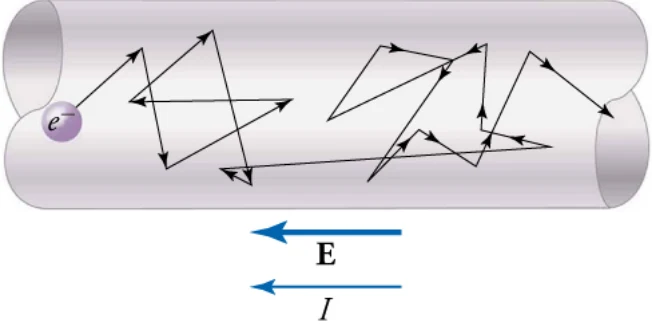
As electrons move through a metal wire, they encounter obstacles such as other electrons, atoms, impurities, etc. The electrons scatter from these obstacles, as depicted in Figure 19.5. Normally, the electrons lose energy with each interaction. 1 To keep the electrons moving thus requires a force, which is supplied by an electric field. The electric field in a wire points from the end of the wire at the higher potential to the end of the wire at the lower potential. Electrons, carrying a negative charge, move on average (or drift) in the direction opposite the electric field, as shown in Figure 19.5.
電子が金属の導線の中を動くとき、他の電子・原子・不純物といった障害物に出会う。図19.5に描くように、電子はこれらの障害物で散乱される。ふつう電子は相互作用のたびにエネルギーを失う。1したがって電子を動かし続けるには力が要り、それは電場が与える。導線の中の電場は、導線の電位の高い端から低い端へ向かう。負の電荷を運ぶ電子は、図19.5に示すとおり、平均して電場と逆向きに動く(ドリフトする)。
So far, we have discussed current that moves constantly in a single direction. This is called direct current, because the electric charge flows in only one direction. Direct current is often called DC current.
ここまでは、一つの向きに一定して動く電流を論じてきた。電荷が一方向にしか流れないので、これを直流という。直流はしばしばDC電流と呼ばれる。
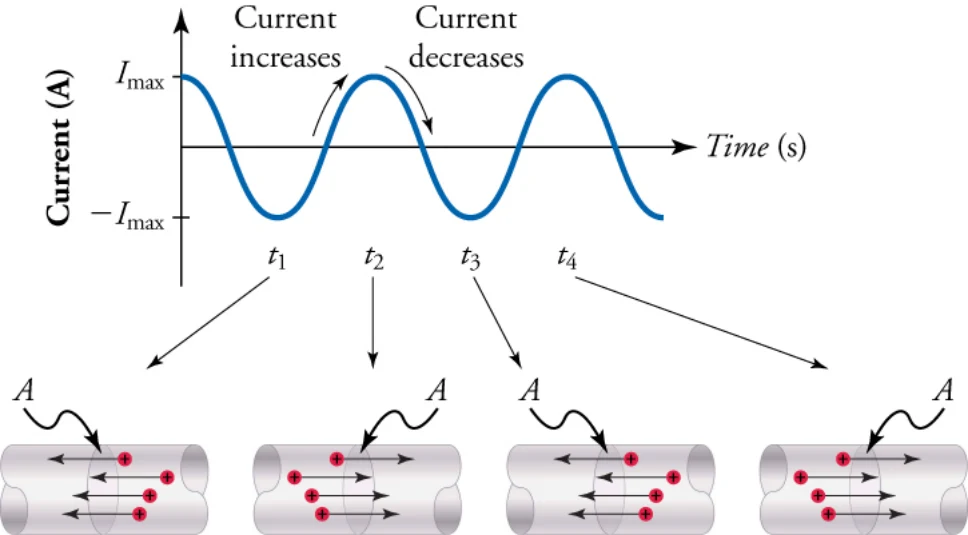
Many sources of electrical power, such as the hydroelectric dam shown at the beginning of this chapter, produce alternating current, in which the current direction alternates back and forth. Alternating current is often called AC current. Alternating current moves back and forth at regular time intervals, as shown in Figure 19.6. The alternating current that comes from a normal wall socket does not suddenly switch directions. Rather, it increases smoothly up to a maximum current and then smoothly decreases back to zero. It then grows again, but in the opposite direction until it has reached the same maximum value. After that, it decreases smoothly back to zero, and the cycle starts over again.
この章の冒頭に示した水力発電のダムのように、多くの電力源は交流を作る。交流では電流の向きが行ったり来たり入れ替わる。交流はしばしばAC電流と呼ばれる。図19.6に示すように、交流は規則正しい時間の間隔で行ったり来たりする。ふつうの壁のコンセントから来る交流は、急に向きを変えるのではない。なめらかに最大の電流まで増え、それからなめらかに0まで減る。それからまた増えるが、こんどは逆向きに同じ最大の値まで増える。そのあとなめらかに0まで減り、また周期が始まる。
1 This energy is transferred to the wire and becomes thermal energy, which is what makes wires hot when they carry a lot of current.
1 このエネルギーは導線へ移り熱エネルギーになる。それが、大きな電流を流したときに導線が熱くなる理由である。
Devices that use AC include vacuum cleaners, fans, power tools, hair dryers, and countless others. These devices obtain the power they require when you plug them into a wall socket. The wall socket is connected to the power grid that provides an alternating potential (AC potential). When your device is plugged in, the AC potential pushes charges back and forth in the circuit of the device, creating an alternating current.
交流を使う装置には掃除機、扇風機、電動工具、ヘアドライヤーなど数えきれないものがある。これらの装置は、壁のコンセントに差し込むと必要な電力を得る。壁のコンセントは、交流の電位(AC電位)を与える送電網につながっている。装置を差し込むと、AC電位が装置の回路の中で電荷を行ったり来たり押しやり、交流を作る。
Many devices, however, use DC, such as computers, cell phones, flashlights, and cars. One source of DC is a battery, which provides a constant potential (DC potential) between its terminals. With your device connected to a battery, the DC potential pushes charge in one direction through the circuit of your device, creating a DC current. Another way to produce DC current is by using a transformer, which converts AC potential to DC potential. Small transformers that you can plug into a wall socket are used to charge up your laptop, cell phone, or other electronic device. People generally call this a charger or a battery, but it is a transformer that transforms AC voltage into DC voltage. The next time someone asks to borrow your laptop charger, tell them that you don’t have a laptop charger, but that they may borrow your converter.
しかしコンピューター、携帯電話、懐中電灯、自動車など、直流を使う装置も多い。直流の一つの源が電池で、端子の間に一定の電位(DC電位)を与える。装置を電池につなぐと、DC電位が装置の回路の中で電荷を一方向に押し、直流を作る。直流を作るもう一つのやり方が、AC電位をDC電位へ変える変圧器を使うことである。壁のコンセントに差し込める小さな変圧器が、ノートパソコン・携帯電話その他の電子機器の充電に使われている。人はふつうこれを「充電器」や「電池」と呼ぶが、それはAC電圧をDC電圧へ変える変圧器である。こんど誰かがノートパソコンの充電器を貸してくれと言ったら、充電器は持っていないが変換器なら貸せる、と言ってやろう。
Current in a Lightning Strike A lightning strike can transfer as many as electrons from the cloud to the ground. If the strike lasts 2 ms, what is the average electric current in the lightning?Strategy
落雷の電流 落雷は雲から地面へ最大個の電子を移しうる。落雷が2 ms続くとき、雷の中の平均の電流はいくらか。方針
The time is the duration of the lightning strike.
時間は落雷が続く長さである。
Solution解答
The current in the lightning strike is
落雷の中の電流は
Discussion
考察
The negative sign reflects the fact that electrons carry the negative charge. Thus, although the electrons flow from the cloud to the ground, the positive current is defined to flow from the ground to the cloud.
マイナス符号は、電子が負の電荷を運ぶという事実を表す。したがって、電子は雲から地面へ流れるが、正の電流は地面から雲へ流れると定められる。
Average Current to Charge a Capacitor In a circuit containing a capacitor and a resistor, it takes 1 min to charge a 16 μF capacitor by using a 9-V battery. What is the average current during this time?Strategy
コンデンサーを充電する平均の電流 コンデンサーと抵抗を含む回路で、9 Vの電池を使って16 μFのコンデンサーを充電するのに1分かかる。この間の平均の電流はいくらか。方針
We can determine the charge on the capacitor by using the definition of capacitance: . When the capacitor is charged by a 9-V battery, the voltage across the capacitor will be . This gives a charge of
電気容量の定義を使ってコンデンサーの電荷を求められる。コンデンサーを9 Vの電池で充電すると、コンデンサーにかかる電圧はになる。これから電荷は次のようになる。
By inserting this expression for charge into the equation for current, , we can find the average current.
この電荷の式を電流の式に入れれば、平均の電流を求められる。
Solution解答
The average current is
平均の電流は
Discussion
考察
This small current is typical of the current encountered in circuits such as this.
この小さな電流は、このような回路で出会う電流として典型的である。
Practice Problems練習問題
110 nC of charge flows through a circuit in 3.0 × 10⁻⁶ s . What is the current during this time?a. The current passes through the circuit is 3.3 × 10⁻³ A.b. The current passes through the circuit is 30 A.
110 nCの電荷が3.0 × 10⁻⁶ sで回路を流れる。この間の電流はいくらか。a. 回路を流れる電流は3.3 × 10⁻³ Aである。b. 回路を流れる電流は30 Aである。
c. The current passes through the circuit is 33 A.d. The current passes through the circuit is 0.3 A.
c. 回路を流れる電流は33 Aである。d. 回路を流れる電流は0.3 Aである。
2How long would it take a current to charge a capacitor with ?a. b.
2の電流がのコンデンサーを充電するには、どれだけ時間がかかるか。a. b.
Resistance and Ohm’s Law抵抗とオームの法則
As mentioned previously, electrical current in a wire is in many ways similar to water flowing through a pipe. The water current that can flow through a pipe is affected by obstacles in the pipe, such as clogs and narrow sections in the pipe. These obstacles slow down the flow of current through the pipe. Similarly, electrical current in a wire can be slowed down by many factors, including impurities in the metal of the wire or collisions between the charges in the material. These factors create a resistance to the electrical current. Resistance is a description of how much a wire or other electrical component opposes the flow of charge through it. In the 19th century, the German physicist Georg Simon Ohm (1787–1854) found experimentally that current through a conductor is proportional to the voltage drop across a current-carrying conductor.
先に述べたとおり、導線の中の電流は多くの点で管を流れる水に似ている。管を流れうる水の流れは、詰まりや管の細くなった部分といった管の中の障害物の影響を受ける。この障害物は管を通る流れを遅くする。同じように、導線の中の電流も、導線の金属の不純物や材料の中の電荷どうしの衝突など、多くの要因によって遅くされる。これらの要因が電流への抵抗を作る。抵抗とは、導線その他の電気の部品が、それを通る電荷の流れをどれだけ妨げるかを表すものである。19世紀に、ドイツの物理学者ゲオルク・ジーモン・オーム(1787–1854)は、導体を通る電流が、電流の流れる導体にかかる電圧の降下に比例することを実験で見いだした。
The constant of proportionality is the resistance R of the material, which leads to
比例定数はその材料の抵抗Rであり、これから
This relationship is called Ohm’s law. It can be viewed as a cause-and-effect relationship, with voltage being the cause and the current being the effect. Ohm’s law is an empirical law like that for friction, which means that it is an experimentally observed phenomenon. The units of resistance are volts per ampere, or V/A. We call a V/A an ohm, which is represented by the uppercase Greek letter omega ( ). Thus,
が得られる。この関係をオームの法則という。これは、電圧が原因で電流が結果という因果の関係と見ることができる。オームの法則は摩擦の法則と同じく経験則であり、実験で観測される現象だということである。抵抗の単位はアンペアあたりのボルト、すなわちV/Aである。V/Aをオームと呼び、ギリシャ大文字のオメガ()で表す。したがって
Ohm’s law holds for most materials and at common temperatures. At very low temperatures, resistance may drop to zero (superconductivity). At very high temperatures, the thermal motion of atoms in the material inhibits the flow of electrons, increasing the resistance. The many substances for which Ohm’s law holds are called ohmic. Ohmic materials include good conductors like copper, aluminum, and silver, and some poor conductors under certain circumstances. The resistance of ohmic materials remains essentially the same for a wide range of voltage and current.
である。オームの法則はたいていの材料でふつうの温度のもとで成り立つ。とても低い温度では抵抗が0になることがある(超伝導)。とても高い温度では、材料の中の原子の熱運動が電子の流れを妨げ、抵抗が増える。オームの法則が成り立つ多くの物質はオーム性であると呼ばれる。オーム性の材料には、銅・アルミニウム・銀のようなよい導体と、条件によっては悪い導体も含まれる。オーム性の材料の抵抗は、広い範囲の電圧と電流にわたってほぼ同じままである。
Introduction to Electricity, Circuits, Current, and Resistance This video presents Ohm’s law and shows a simple electrical circuit. The speaker uses the analogy of pressure to describe how electric potential makes charge move. He refers to electric potential as electric pressure. Another way of thinking about electric potential is to imagine that lots of particles of the same sign are crowded in a small, confined space. Because these charges have the same sign (they are all positive or all negative), each charge repels the others around it. This means that lots of charges are constantly being pushed towards the outside of the space. A complete electric circuit is like opening a door in the small space: Whichever particles are pushed towards the door now have a way to escape. The higher the electric potential, the harder each particle pushes against the others.
電気・回路・電流・抵抗の導入 この動画はオームの法則を示し、単純な電気回路を見せる。話し手は、電位が電荷を動かす様子を圧力の類比で述べる。彼は電位を「電気の圧力」と呼ぶ。電位を考えるもう一つのやり方は、同じ符号の粒子が小さな閉じた空間にぎっしり詰まっているところを想像することである。これらの電荷は同じ符号(すべて正かすべて負)なので、それぞれが周りの電荷を反発する。これは、多くの電荷がたえず空間の外へ押しやられているという意味である。完全な電気回路は、この小さな空間に扉を開けるようなものである。扉のほうへ押しやられた粒子はいまや逃げ道を得る。電位が高いほど、それぞれの粒子は他の粒子を強く押す。
If, instead of a single resistor , two resistors each with resistance are drawn in the circuit diagram shown in the video, what can you say about the current through the circuit?
動画に描かれた回路図で、一つの抵抗のかわりに、抵抗値がの抵抗を二つ描いたら、回路を流れる電流について何が言えるか。
a. The amount of current through the circuit must decrease by half.b. The amount of current through the circuit must increase by half.c. The current must remain the same through the circuit.d. The amount of current through the circuit would be doubled.
a. 回路を流れる電流の量は半分に減るはずである。b. 回路を流れる電流の量は1.5倍に増えるはずである。c. 回路を流れる電流は変わらないはずである。d. 回路を流れる電流の量は2倍になるはずである。
VIRTUAL PHYSICSシミュレーションOhm’s Lawオームの法則
Access multimedia content (http://openstax.org/books/physics/pages/19-1-ohms-law) This simulation mimics a simple circuit with batteries providing the voltage source and a resistor connected across the batteries. See how the current is affected by modifying the resistance and/or the voltage. Note that the resistance is modeled as an element containing small scattering centers. These represent impurities or other obstacles that impede the passage of the current.
マルチメディア教材はこちら(http://openstax.org/books/physics/pages/19-1-ohms-law) このシミュレーションは、電圧源となる電池と、それにつながれた抵抗からなる単純な回路をまねている。抵抗や電圧を変えると電流がどう変わるかを見よう。抵抗は、小さな散乱の中心を含む素子としてモデル化されていることに注意しよう。これは、電流の通過を妨げる不純物その他の障害物を表している。
PhET Explorations: Ohm's Law. See how the equation form of Ohm's law relates to a simple circuit. Adjust the voltage and resistance, and see the current change according to Ohm's law. The sizes of the symbols in the equation change to match the circuit diagram.Access multimedia content (http://openstax.org/books/physics/pages/19-1-ohms-law) In a circuit, if the resistance is left constant and the voltage is doubled (for example, from to ), how does the current change? Does this conform to Ohm’s law?
PhET探究:オームの法則。オームの法則の式が単純な回路とどう関係するかを見よう。電圧と抵抗を調節し、オームの法則に従って電流が変わるのを見よう。式の中の記号の大きさが回路図に合わせて変わる。マルチメディア教材はこちら(http://openstax.org/books/physics/pages/19-1-ohms-law) 回路で抵抗を一定にしたまま電圧を(たとえばからへ)2倍にすると、電流はどう変わるか。これはオームの法則にかなうか。
a. The current will get doubled. This conforms to Ohm’s law as the current is proportional to the voltage.b. The current will double. This does not conform to Ohm’s law as the current is proportional to the voltage.
a. 電流は2倍になる。電流は電圧に比例するので、これはオームの法則にかなう。b. 電流は2倍になる。電流は電圧に比例するので、これはオームの法則にかなわない。
c. The current will increase by half. This conforms to Ohm’s law as the current is proportional to the voltage.d. The current will decrease by half. This does not conform to Ohm’s law as the current is proportional to the voltage.
c. 電流は1.5倍になる。電流は電圧に比例するので、これはオームの法則にかなう。d. 電流は半分になる。電流は電圧に比例するので、これはオームの法則にかなわない。
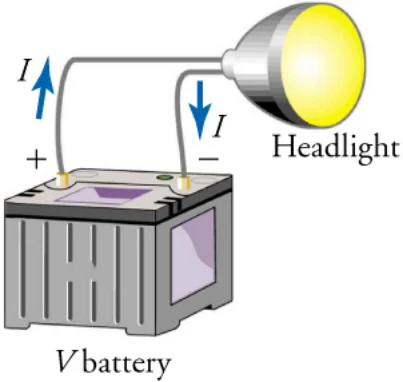
Resistance of a Headlight What is the resistance of an automobile headlight through which 2.50 A flows when 12.0 V is applied to it?
ヘッドライトの抵抗 12.0 Vをかけたときに2.50 Aが流れる自動車のヘッドライトの抵抗はいくらか。
Strategy方針
Ohm’s law tells us . The voltage drop in going through the headlight is just the voltage rise supplied by the battery, . We can use this equation and rearrange Ohm’s law to find the resistance of the headlight.
オームの法則はと教える。ヘッドライトを通るときの電圧の降下は、電池が与える電圧の上昇にちょうど等しい。この式を使い、オームの法則を変形してヘッドライトの抵抗を求められる。
Solution解答
Solving Ohm’s law for the resistance of the headlight gives
オームの法則をヘッドライトの抵抗について解くと
Discussion
考察
This is a relatively small resistance. As we will see below, resistances in circuits are commonly measured in kΩ or MΩ.
これはわりあい小さな抵抗である。下で見るように、回路の抵抗はふつうkΩやMΩで測られる。
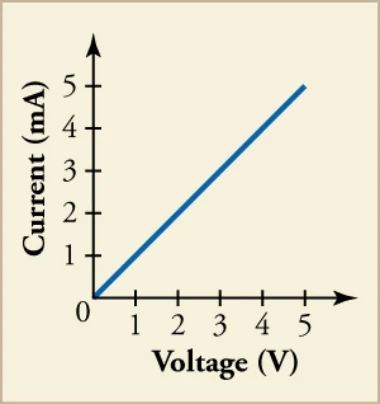
Determine Resistance from Current-Voltage Graph Suppose you apply several different voltages across a circuit and measure the current that runs through the circuit. A plot of your results is shown in Figure 19.7. What is the resistance of the circuit?
電流-電圧のグラフから抵抗を決める ある回路にいくつもの違う電圧をかけ、回路を流れる電流を測るとしよう。その結果を図19.7に示す。この回路の抵抗はいくらか。
Strategy方針
The plot shows that current is proportional to voltage, which is Ohm’s law. In Ohm’s law ( ), the constant of proportionality is the resistance R. Because the graph shows current as a function of voltage, we have to rearrange
このグラフは電流が電圧に比例することを示しており、これがオームの法則である。オームの法則()では、比例定数は抵抗Rである。グラフは電圧の関数として電流を示しているので、
Ohm’s law in that form: . This shows that the slope of the line of I versus V is . Thus, if we find the slope of the line in Figure 19.7, we can calculate the resistance R.
オームの法則をその形に変形せねばならない。。これは、IとVのグラフの傾きがであることを示す。したがって、図19.7の線の傾きを求めれば、抵抗Rを計算できる。
Solution解答
The slope of the line is the rise divided by the run. Looking at the lower-left square of the grid, we see that the line rises by 1 mA (0.001 A) and runs over a voltage of 1 V. Thus, the slope of the line is
線の傾きは、縦の伸びを横の走りで割ったものである。格子の左下の一マスを見ると、線は1 mA(0.001 A)上がり、1 Vの電圧にわたって進んでいる。したがって線の傾きは
Equating the slope with and solving for R gives
となる。傾きをと等しいとおいてRについて解くと
or 1 k-ohm.
すなわち1キロオームである。
Discussion
考察
This resistance is greater than what we found in the previous example. Resistances such as this are common in electric circuits, as we will discover in the next section. Note that if the line in Figure 19.7 were not straight, then the material would not be ohmic and we would not be able to use Ohm’s law. Materials that do not follow Ohm’s law are called nonohmic.
この抵抗は前の例で求めたものより大きい。次の節で分かるように、このような抵抗は電気回路でよく見られる。図19.7の線がまっすぐでなければ、その材料はオーム性ではなく、オームの法則は使えないことに注意しよう。オームの法則に従わない材料は非オーム性と呼ばれる。
Practice Problems練習問題
3If you double the voltage across an ohmic resistor, how does the current through the resistor change?a. The current will double.b. The current will increase by half.
3オーム性の抵抗にかかる電圧を2倍にすると、抵抗を流れる電流はどう変わるか。a. 電流は2倍になる。b. 電流は1.5倍になる。
c. The current will decrease by half.d. The current will decrease by a factor of two.
c. 電流は半分になる。d. 電流は2分の1に減る。
4The current through a resistor is . What is the voltage drop across the resistor?a. b.
4の抵抗を流れる電流がである。抵抗にかかる電圧の降下はいくらか。a. b.
Check Your Understanding理解の確認
5What is electric current?a. Electric current is the electric charge that is at rest.b. Electric current is the electric charge that is moving.
5電流とは何か。a. 電流とは、静止している電荷である。b. 電流とは、動いている電荷である。
c. Electric current is the electric charge that moves only from the positive terminal of a battery to the negative terminal.d. Electric current is the electric charge that moves only from a region of lower potential to higher potential.
c. 電流とは、電池の正の端子から負の端子へだけ動く電荷である。d. 電流とは、電位の低い領域から高い領域へだけ動く電荷である。
6What is an ohmic material?a. An ohmic material is a material that obeys Ohm’s law.b. An ohmic material is a material that does not obey Ohm’s law.c. An ohmic material is a material that has high resistance.d. An ohmic material is a material that has low resistance.
6オーム性の材料とは何か。a. オーム性の材料とは、オームの法則に従う材料である。b. オーム性の材料とは、オームの法則に従わない材料である。c. オーム性の材料とは、抵抗の大きい材料である。d. オーム性の材料とは、抵抗の小さい材料である。
7What is the difference between direct current and alternating current?
7直流と交流の違いは何か。
a. Direct current flows continuously in every direction whereas alternating current flows in one direction.b. Direct current flows continuously in one direction whereas alternating current reverses its direction at regular time intervals.c. Both direct and alternating current flow in one direction; the magnitude of direct current is fixed whereas the magnitude of alternating current changes at regular intervals of time.d. Both direct and alternating current change their direction of flow; the magnitude of direct current is fixed whereas the magnitude of alternating current changes at regular intervals of time.
a. 直流はあらゆる向きに絶えず流れ、交流は一方向に流れる。b. 直流は一方向に絶えず流れ、交流は規則正しい時間の間隔で向きを反転する。c. 直流も交流も一方向に流れる。直流の大きさは決まっており、交流の大きさは規則正しい時間の間隔で変わる。d. 直流も交流も流れる向きを変える。直流の大きさは決まっており、交流の大きさは規則正しい時間の間隔で変わる。