第5章二次元の運動Motion in Two Dimensions原書 p.151–204
5.5 Simple Harmonic Motion5.5 単振動
SECTION LEARNING OBJECTIVES By the end of this section, you will be able to do the following:
この節の学習目標 この節を終えると、次のことができるようになる。
• Describe Hooke’s law and Simple Harmonic Motion• Describe periodic motion, oscillations, amplitude, frequency, and period• Solve problems in simple harmonic motion involving springs and pendulums
・フックの法則と単振動を説明する・周期運動、振動、振幅、振動数、周期を述べる・ばねと振り子に関する単振動の問題を解く
Section Key Termsこの節の重要語
amplitudedeformationequilibrium positionfrequencyHooke’s lawoscillateperiodperiodic motionrestoring forcesimple harmonic motionsimple pendulum
振幅変形つり合いの位置振動数フックの法則振動する周期周期運動復元力単振動単振り子
Hooke’s Law and Simple Harmonic Motionフックの法則と単振動
Imagine a car parked against a wall. If a bulldozer pushes the car into the wall, the car will not move but it will noticeably change shape. A change in shape due to the application of a force is a deformation. Even very small forces are known to cause some deformation. For small deformations, two important things can happen. First, unlike the car and bulldozer example, the object returns to its original shape when the force is removed. Second, the size of the deformation is proportional to the force. This second property is known as Hooke’s law. In equation form, Hooke’s law is
壁に向けて止めてある車を想像してほしい。ブルドーザーがその車を壁へ押しつければ、車は動かないが、目に見えて形を変える。力を加えたことによる形の変化を変形という。ごく小さな力でも、いくらかの変形を起こすことが知られている。小さな変形については、大切なことが二つ起こる。第一に、車とブルドーザーの例とは違って、力を取り去れば物体はもとの形に戻る。第二に、変形の大きさは力に比例する。この二つ目の性質がフックの法則である。式で書けば、フックの法則は次のとおりである。
where x is the amount of deformation (the change in length, for example) produced by the restoring force F, and k is a constant that depends on the shape and composition of the object. The restoring force is the force that brings the object back to its equilibrium position; the minus sign is there because the restoring force acts in the direction opposite to the displacement. Note that the restoring force is proportional to the deformation x. The deformation can also be thought of as a displacement from equilibrium. It is a change in position due to a force. In the absence of force, the object would rest at its equilibrium position. The force constant k is related to the stiffness of a system. The larger the force constant, the stiffer the system. A stiffer system is more difficult to deform and requires a greater restoring force. The units of k are newtons per meter (N/m). One of the most common uses of Hooke’s law is solving problems involving springs and pendulums, which we will cover at the end of this section.
ここでxは復元力Fが生む変形の量(たとえば長さの変化)であり、kは物体の形と組成によって決まる定数である。復元力とは、物体をつり合いの位置へ戻す力である。マイナスの符号があるのは、復元力が変位と逆向きにはたらくからである。復元力が変形xに比例することに注意しよう。変形は、つり合いの位置からの変位と考えることもできる。それは力による位置の変化である。力がなければ、物体はつり合いの位置で静止しているはずである。力の定数kは、系の硬さと結びついている。力の定数が大きいほど系は硬い。硬い系は変形させにくく、より大きな復元力を要する。kの単位は毎メートルニュートン(N/m)である。フックの法則の最もよくある使い道の一つが、ばねと振り子に関する問題を解くことであり、これはこの節の終わりで扱う。
Oscillations and Periodic Motion振動と周期運動
What do an ocean buoy, a child in a swing, a guitar, and the beating of hearts all have in common? They all oscillate. That is, they move back and forth between two points, like the ruler illustrated in Figure 5.37. All oscillations involve force. For example, you push a child in a swing to get the motion started.
海のブイ、ブランコに乗った子ども、ギター、そして心臓の鼓動に共通するものは何か。どれも振動している。すなわち、図5.37の定規のように、二つの点の間を行ったり来たりしている。あらゆる振動には力が関わる。たとえばブランコの子どもは、押してやって初めて動き出す。
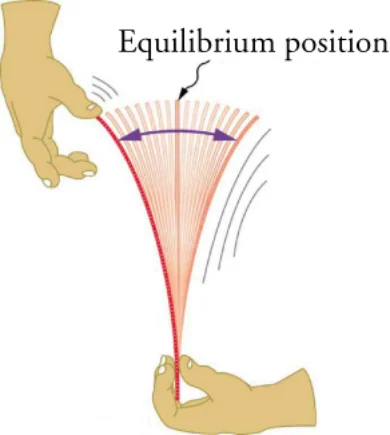
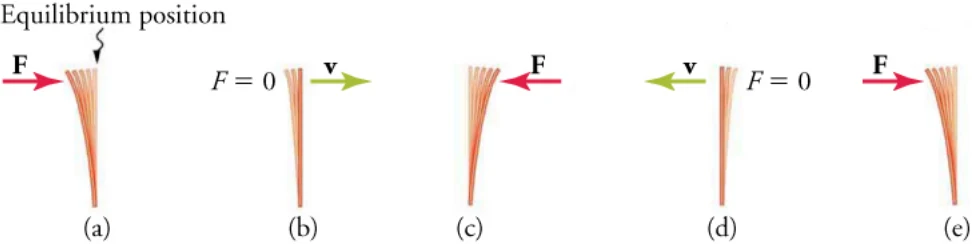
Newton’s first law implies that an object oscillating back and forth is experiencing forces. Without force, the object would move in a straight line at a constant speed rather than oscillate. Consider, for example, plucking a plastic ruler to the left as shown in Figure 5.38. The deformation of the ruler creates a force in the opposite direction, known as a restoring force. Once released, the restoring force causes the ruler to move back toward its stable equilibrium position, where the net force on it is zero. However, by the time the ruler gets there, it gains momentum and continues to move to the right, producing the opposite deformation. It is then forced to the left, back through equilibrium, and the process is repeated until it gradually loses all of its energy. The simplest oscillations occur when the restoring force is directly proportional to displacement. Recall that Hooke’s law describes this situation with the equation F = −kx. Therefore, Hooke’s law describes and applies to the simplest case of oscillation, known as simple harmonic motion.
ニュートンの第一法則によれば、行ったり来たりして振動している物体は力を受けている。力がなければ、物体は振動せずに一定の速さで一直線に動くはずである。たとえば図5.38のように、プラスチックの定規を左へはじくところを考えよう。定規の変形は逆向きの力を生む。これが復元力である。手を離すと、復元力によって定規は、はたらく力の和が0になる安定なつり合いの位置へ戻ろうとする。しかし定規はそこへ着くころには勢いを得ており、右へ動き続けて、逆向きの変形を生む。すると今度は左へ押し戻され、つり合いの位置を通り過ぎ、次第にすべてのエネルギーを失うまでこの過程を繰り返す。最も単純な振動は、復元力が変位に比例するときに起こる。フックの法則が式 F = −kx でこの状況を記述することを思い出そう。したがってフックの法則は、単振動として知られる最も単純な振動を記述し、それに当てはまる。
When you pluck a guitar string, the resulting sound has a steady tone and lasts a long time. Each vibration of the string takes the same time as the previous one. Periodic motion is a motion that repeats itself at regular time intervals, such as with an object bobbing up and down on a spring or a pendulum swinging back and forth. The time to complete one oscillation (a complete cycle of motion) remains constant and is called the period T. Its units are usually seconds.
ギターの弦をはじくと、生まれる音は一定の高さを保ち、長く続く。弦の一回一回の振動は、前の振動と同じ時間で起こる。周期運動とは、ばねの上で上下する物体や、行ったり来たりする振り子のように、一定の時間間隔で繰り返される運動である。一回の振動(運動の一巡)を終えるのにかかる時間は一定で、周期Tと呼ばれる。単位はふつう秒である。
Frequency f is the number of oscillations per unit time. The SI unit for frequency is the hertz (Hz), defined as the number of oscillations per second. The relationship between frequency and period is
振動数fは、単位時間あたりの振動の回数である。振動数のSI単位はヘルツ(Hz)で、毎秒の振動回数として定義される。振動数と周期の関係は次のとおりである。
As you can see from the equation, frequency and period are different ways of expressing the same concept. For example, if you get a paycheck twice a month, you could say that the frequency of payment is two per month, or that the period between checks is half a month.
式から分かるとおり、振動数と周期は同じ概念の違う言い表し方である。たとえば給料が月に2回支払われるなら、支払いの振動数は月あたり2回だと言ってもよいし、支払いの間隔(周期)は半月だと言ってもよい。
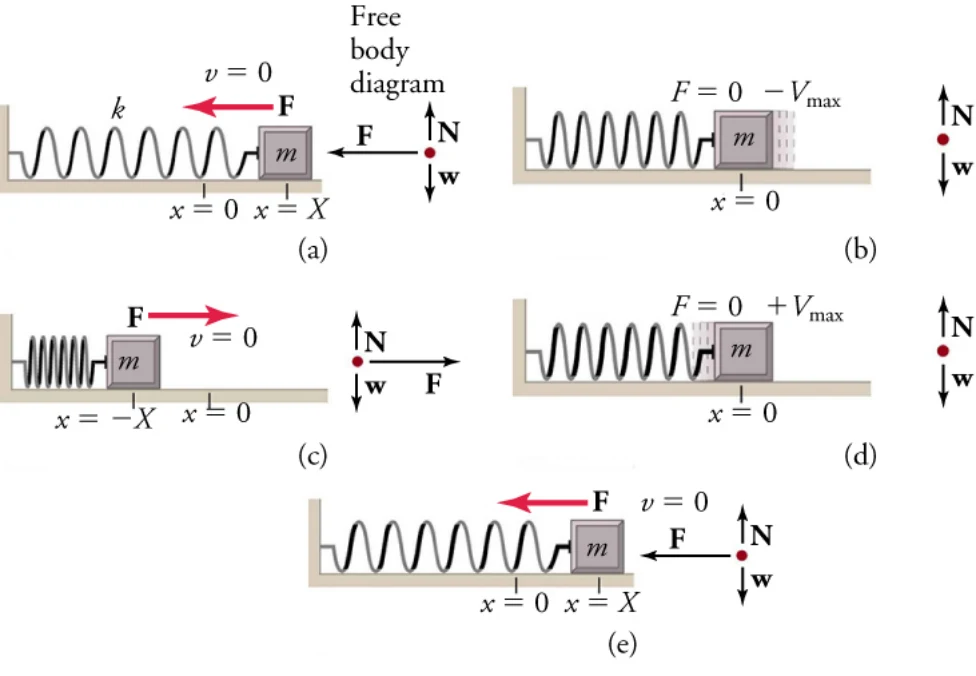
If there is no friction to slow it down, then an object in simple motion will oscillate forever with equal displacement on either side of the equilibrium position. The equilibrium position is where the object would naturally rest in the absence of force. The maximum displacement from equilibrium is called the amplitude X. The units for amplitude and displacement are the same, but depend on the type of oscillation. For the object on the spring, shown in Figure 5.39, the units of amplitude and displacement are meters.
遅くさせる摩擦がなければ、単振動をする物体は、つり合いの位置の両側に等しい変位をとりながら永遠に振動し続ける。つり合いの位置とは、力がなければ物体が自然に静止する場所である。つり合いの位置からの最大の変位を振幅Xという。振幅と変位の単位は同じだが、振動の種類による。図5.39に示すばねにつながれた物体では、振幅と変位の単位はメートルである。
The mass m and the force constant k are the only factors that affect the period and frequency of simple harmonic motion. The period of a simple harmonic oscillator is given by
単振動の周期と振動数に効くのは、質量mと力の定数kだけである。単振動子の周期は次で与えられる。
and, because f = 1/T, the frequency of a simple harmonic oscillator is
そして f = 1/T なので、単振動子の振動数は次のようになる。
Introduction to Harmonic Motion This video shows how to graph the displacement of a spring in the x-direction over time, based on the period. Watch the first 10 minutes of the video (you can stop when the narrator begins to cover calculus).
調和振動の入門 この動画は、周期をもとにして、ばねのx方向の変位を時間に対してどうグラフに描くかを示す。動画の最初の10分を見ればよい(語り手が微積分の話を始めたところで止めてよい)。
Introduction to harmonic motion | Oscillatory motion | Physics | Khan Academy (https://openstax.org/l/ 02harmmotion)
調和振動の入門|振動運動|物理|カーンアカデミー(https://openstax.org/l/02harmmotion)
If the amplitude of the displacement of a spring were larger, how would this affect the graph of displacement over time? What would happen to the graph if the period was longer?
ばねの変位の振幅がもっと大きければ、変位を時間に対して描いたグラフはどう変わるか。周期がもっと長ければ、グラフはどうなるか。
a. Larger amplitude would result in taller peaks and troughs and a longer period would result in greater separation in time between peaks.b. Larger amplitude would result in smaller peaks and troughs and a longer period would result in greater distance between peaks.c. Larger amplitude would result in taller peaks and troughs and a longer period would result in shorter distance between peaks.d. Larger amplitude would result in smaller peaks and troughs and a longer period would result in shorter distance between peaks.
a. 振幅が大きいほど山と谷が高くなり、周期が長いほど山どうしの時間の隔たりが大きくなる。b. 振幅が大きいほど山と谷が小さくなり、周期が長いほど山どうしの隔たりが大きくなる。c. 振幅が大きいほど山と谷が高くなり、周期が長いほど山どうしの隔たりが小さくなる。d. 振幅が大きいほど山と谷が小さくなり、周期が長いほど山どうしの隔たりが小さくなる。
Solving Spring and Pendulum Problems with Simple Harmonic Motion単振動でばねと振り子の問題を解く
Before solving problems with springs and pendulums, it is important to first get an understanding of how a pendulum works. Figure 5.40 provides a useful illustration of a simple pendulum.
ばねと振り子の問題を解く前に、まず振り子がどう働くのかを理解しておくことが大切である。図5.40は単振り子の分かりやすい図解である。
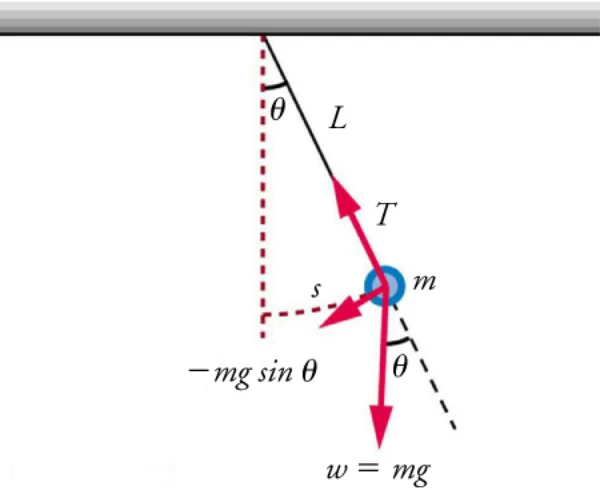
Everyday examples of pendulums include old-fashioned clocks, a child’s swing, or the sinker on a fishing line. For small displacements of less than 15 degrees, a pendulum experiences simple harmonic oscillation, meaning that its restoring force is directly proportional to its displacement. A pendulum in simple harmonic motion is called a simple pendulum. A pendulum has an object with a small mass, also known as the pendulum bob, which hangs from a light wire or string. The equilibrium position for a pendulum is where the angle is zero (that is, when the pendulum is hanging straight down). It makes sense that without any force applied, this is where the pendulum bob would rest.
振り子の日常の例には、昔ながらの時計、子どものブランコ、釣り糸のおもりなどがある。15度未満の小さな変位では、振り子は単振動をする。すなわち復元力が変位に比例する。単振動をする振り子を単振り子という。振り子は、軽い針金や糸からぶら下がる質量の小さい物体(振り子のおもり)を持つ。振り子のつり合いの位置は、角が0のところ、すなわち振り子がまっすぐ下に垂れているところである。力が加わらなければ振り子のおもりがここで静止するのは、もっともなことである。
The displacement of the pendulum bob is the arc length s. The weight mg has components mg cos along the string and mg sin tangent to the arc. Tension in the string exactly cancels the component mg cos parallel to the string. This leaves a net restoring force back toward the equilibrium position that runs tangent to the arc and equals −mg sin .
振り子のおもりの変位は弧の長さsである。重さmgは、糸に沿った成分 mg cos と、弧に接する成分 mg sin を持つ。糸の張力は、糸に平行な成分 mg cos をちょうど打ち消す。残るのは、弧に接してつり合いの位置へ戻る向きの正味の復元力で、その大きさは −mg sin である。
For small angle oscillations of a simple pendulum, the period is
単振り子の小さな角の振動について、周期は次のとおりである。
The only things that affect the period of a simple pendulum are its length and the acceleration due to gravity. The period is completely independent of other factors, such as mass or amplitude. However, note that T does depend on g. This means that if we know the length of a pendulum, we can actually use it to measure gravity! This will come in useful in Measuring Acceleration due to Gravity: The Period of a Pendulum.
単振り子の周期に効くのは、その長さと重力加速度だけである。周期は質量や振幅といった他の要因にはまったく依存しない。ただしTがgに依存することに注意しよう。これは、振り子の長さが分かっていれば、それを使って重力を測れるということである。これは「重力加速度を測る:振り子の周期」で役に立つ。
TIPS FOR SUCCESS Tension is represented by the variable T, and period is represented by the variable T. It is important not to confuse the two, since tension is a force and period is a length of time.
学習のポイント 張力は変数Tで表され、周期も変数Tで表される。張力は力、周期は時間の長さなので、この二つを取り違えないことが大切である。
Measuring Acceleration due to Gravity: The Period of a Pendulum What is the acceleration due to gravity in a region where a simple pendulum having a length 75.000 cm has a period of 1.7357 s?Strategy
重力加速度を測る:振り子の周期 長さ75.000 cmの単振り子の周期が1.7357秒である地域では、重力加速度はいくらか。方針
We are asked to find g given the period T and the length L of a pendulum. We can solve for g, assuming that the angle of deflection is less than 15 degrees. Recall that when the angle of deflection is less than 15 degrees, the pendulum is considered to be in simple harmonic motion, allowing us to use this equation.
振り子の周期Tと長さLが与えられて、gを求めよと言われている。振れの角が15度未満だとして、をgについて解けばよい。振れの角が15度未満なら振り子は単振動をするとみなせ、だからこの式を使えるのだった。
Solution解答
1. Square and solve for g.
1. を2乗し、gについて解く。
2. Substitute known values into the new equation.
2. 新しい式に分かっている値を代入する。
3. Calculate to find g.
3. 計算してgを求める。
Discussion考察
This method for determining g can be very accurate. This is why length and period are given to five digits in this example.
gを求めるこの方法は、きわめて正確になりうる。この例で長さと周期を5桁で与えているのはそのためである。
Hooke’s Law: How Stiff Are Car Springs? What is the force constant for the suspension system of a car, like that shown in Figure 5.41, that settles 1.20 cm when an 80.0-kg person gets in?
フックの法則:車のばねはどれくらい硬いか 図5.41のような車の懸架装置に、質量80.0 kgの人が乗ると1.20 cm沈むとき、その力の定数はいくらか。

Strategy方針
Consider the car to be in its equilibrium position x = 0 before the person gets in. The car then settles down 1.20 cm, which means it is displaced to a position x = −1.20×10⁻² m.
人が乗る前の車を、つり合いの位置 x = 0 にあると考える。人が乗ると車は1.20 cm沈むので、位置 x = −1.20×10⁻² m へ変位する。
At that point, the springs supply a restoring force F equal to the person’s weight w = mg = (80.0 kg)(9.80 m/s2) = 784 N. We take this force to be F in Hooke’s law.
その位置で、ばねは人の重さに等しい復元力Fを与える。w = mg = (80.0 kg)(9.80 m/s2) = 784 N。この力をフックの法則のFとする。
Knowing F and x, we can then solve for the force constant k.
Fとxが分かれば、力の定数kについて解ける。
Solution解答
Solve Hooke’s law, F = −kx, for k.
フックの法則 F = −kx をkについて解く。
Substitute known values and solve for k.
分かっている値を代入してkを求める。
Discussion考察
Note that F and x have opposite signs because they are in opposite directions—the restoring force is up, and the displacement is down. Also, note that the car would oscillate up and down when the person got in, if it were not for the shock absorbers. Bouncing cars are a sure sign of bad shock absorbers.
Fとxは向きが逆なので符号も逆であることに注意しよう。復元力は上向き、変位は下向きである。また、緩衝器(ショックアブソーバー)がなければ、人が乗ったとき車は上下に振動するだろうことにも注意しよう。跳ねる車は、緩衝器が傷んでいる確かな印である。
Practice Problems練習問題
20A force of applied to a spring causes it to be displaced by . What is the force constant of the spring?
20あるばねにの力を加えると変位した。このばねの力の定数はいくらか。
21What is the force constant for the suspension system of a car that settles when a person gets in? a.
21の人が乗ると沈む車の懸架装置の力の定数はいくらか。 a.
SNAP LAB身近な実験Finding Gravity Using a Simple Pendulum単振り子で重力を求める
Use a simple pendulum to find the acceleration due to gravity g in your home or classroom.
単振り子を使って、自宅や教室での重力加速度gを求めよ。
• 1 string• 1 stopwatch• 1 small dense object
・糸1本・ストップウォッチ1個・小さくて密度の大きい物1個
1. Cut a piece of a string or dental floss so that it is about 1 m long.2. Attach a small object of high density to the end of the string (for example, a metal nut or a car key).3. Starting at an angle of less than 10 degrees, allow the pendulum to swing and measure the pendulum’s period for 10 oscillations using a stopwatch.4. Calculate g.
1. 糸かデンタルフロスを約1 mに切る。2. 密度の大きい小さな物(たとえば金属のナットや車の鍵)を糸の端に結ぶ。3. 10度未満の角から振り子を揺らし、ストップウォッチで10回の振動の時間を測って周期を求める。4. gを計算する。
GRASP CHECK How accurate is this measurement for g? How might it be improved?
理解の確認 このgの測定はどれくらい正確か。どうすれば改善できるか。
a. Accuracy for value of g will increase with an increase in the mass of a dense object.b. Accuracy for the value of g will increase with increase in the length of the pendulum.c. The value of g will be more accurate if the angle of deflection is more than 15°.d. The value of g will be more accurate if it maintains simple harmonic motion.
a. 密度の大きい物の質量を増やせば、gの値の精度は上がる。b. 振り子の長さを長くすれば、gの値の精度は上がる。c. 振れの角が15°より大きいほうが、gの値は正確になる。d. 単振動を保っていれば、gの値はより正確になる。
Check Your Understanding理解の確認
22What is deformation?a. Deformation is the magnitude of the restoring force.b. Deformation is the change in shape due to the application of force.
22変形とは何か。a. 変形とは復元力の大きさである。b. 変形とは、力を加えたことによる形の変化である。
c. Deformation is the maximum force that can be applied on a spring.d. Deformation is regaining the original shape upon the removal of an external force.
c. 変形とは、ばねに加えられる最大の力である。d. 変形とは、外力を取り去ったときにもとの形に戻ることである。
23According to Hooke’s law, what is deformation proportional to?a. Forceb. Velocity
23フックの法則によれば、変形は何に比例するか。a. 力b. 速度
c. Displacementd. Force constant
c. 変位d. 力の定数
24What are oscillations?a. Motion resulting in small displacementsb. Motion which repeats itself periodically
24振動とは何か。a. 小さな変位を生む運動b. 周期的に繰り返す運動
c. Periodic, repetitive motion between two pointsd. motion that is the opposite to the direction of the restoring force
c. 二つの点の間を周期的に繰り返す運動d. 復元力と逆向きの運動
25True or False—Oscillations can occur without force.a. Trueb. False
25正誤問題——振動は力なしに起こりうる。a. 正b. 誤