第5章二次元の運動Motion in Two Dimensions原書 p.151–204
5.4 Inclined Planes5.4 斜面
SECTION LEARNING OBJECTIVES By the end of this section, you will be able to do the following:• Distinguish between static friction and kinetic friction• Solve problems involving inclined planes
この節の学習目標 この節を終えると、次のことができるようになる。・静止摩擦と動摩擦を区別する・斜面に関する問題を解く
Section Key Termsこの節の重要語
kinetic frictionstatic friction
動摩擦静止摩擦
Static Friction and Kinetic Friction静止摩擦と動摩擦
Recall from the previous chapter that friction is a force that opposes relative motion parallel to the contact surface of the interacting objects and is around us all the time. Friction allows us to move, which you have discovered if you have ever tried to walk on ice.
前の章で学んだとおり、摩擦は、触れ合う物体の接触面に平行な相対運動を妨げる力であり、つねに私たちのまわりにある。摩擦があるから私たちは動ける。氷の上を歩こうとしたことがあるなら、それに気づいているだろう。
There are different types of friction—kinetic and static. Kinetic friction acts on an object in relative motion, while static friction acts on an object or system at rest relative to each other. The maximum static friction is usually greater than the kinetic friction between the objects.
摩擦には種類がある。動摩擦と静止摩擦である。動摩擦は相対運動をしている物体にはたらき、静止摩擦は互いに静止している物体や系にはたらく。物体どうしの静止摩擦の最大値は、ふつう動摩擦より大きい。
Imagine, for example, trying to slide a heavy crate across a concrete floor. You may push harder and harder on the crate and not move it at all. This means that the static friction responds to what you do—it increases to be equal to and in the opposite direction of your push. But if you finally push hard enough, the crate seems to slip suddenly and starts to move. Once in motion, it is easier to keep it in motion than it was to get it started because the kinetic friction force is less than the static friction force. If you were to add mass to the crate, (for example, by placing a box on top of it) you would need to push even harder to get it started and also to keep it moving. If, on the other hand, you oiled the concrete you would find it easier to get the crate started and keep it going.
たとえば、重い木箱をコンクリートの床の上で滑らせようとするところを想像してほしい。どんどん強く押しても、箱はまったく動かないかもしれない。これは、静止摩擦があなたのすることに応じていることを意味する。すなわち、あなたの押す力と大きさが等しく向きが逆になるまで増していくのである。しかしついに十分強く押すと、箱は急に滑るように見え、動き出す。いったん動き出せば、動かし始めるときより動かし続けるほうが楽である。動摩擦力が静止摩擦力より小さいからである。箱に(たとえば上に別の箱を載せて)質量を足せば、動かし始めるにも動かし続けるにも、もっと強く押さねばならない。逆にコンクリートに油を塗れば、箱を動かし始めるのも動かし続けるのも楽になる。
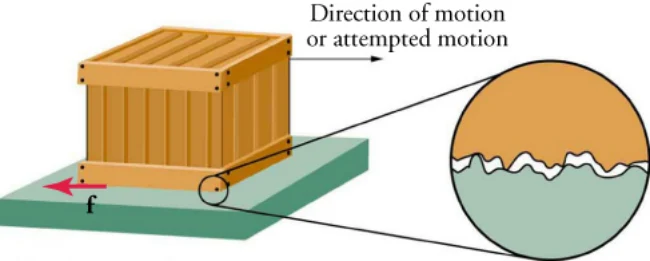
Figure 5.33 shows how friction occurs at the interface between two objects. Magnifying these surfaces shows that they are rough on the microscopic level. So when you push to get an object moving (in this case, a crate), you must raise the object until it can skip along with just the tips of the surface hitting, break off the points, or do both. The harder the surfaces are pushed together (such as if another box is placed on the crate), the more force is needed to move them.
図5.33は、二つの物体の境目で摩擦がどう生じるかを示している。これらの面を拡大して見ると、微視的な尺度ではざらざらしていることが分かる。だから物(この場合は木箱)を動かそうと押すときには、面の突起の先だけがぶつかりながら跳ねていけるように物を持ち上げるか、突起を折るか、その両方をせねばならない。面どうしを強く押し付けるほど(たとえば木箱の上にもう一つ箱を載せるほど)、動かすのに大きな力が要る。
The magnitude of the frictional force has two forms: one for static friction, the other for kinetic friction. When there is no motion between the objects, the magnitude of static friction fs is
摩擦力の大きさには二つの形がある。一つは静止摩擦、もう一つは動摩擦のものである。物体どうしに運動がないとき、静止摩擦fsの大きさは次のとおりである。
where is the coefficient of static friction and N is the magnitude of the normal force. Recall that the normal force acts perpendicular to the surface and prevents the crate from falling through the floor. It opposes the force of gravity in this example, but that will not always be the case.
ここでは静止摩擦係数、Nは垂直抗力の大きさである。垂直抗力は面に垂直にはたらき、木箱が床を突き抜けるのを防いでいることを思い出そう。この例では重力に逆らっているが、いつもそうとは限らない。
Since the symbol means less than or equal to, this equation says that static friction can have a maximum value of That is,
記号は「以下」を意味するので、この式は、静止摩擦がという最大値をとりうることを述べている。すなわち、
Static friction is a responsive force that increases to be equal and opposite to whatever force is exerted, up to its maximum limit. Once the applied force exceeds fs(max), the object will move. Once an object is moving, the magnitude of kinetic friction fk is given by
静止摩擦は応答する力であり、加えられた力がどれだけであっても、最大の限界までは、それと大きさが等しく向きが逆になるまで増える。加えた力がfs(max)を超えると、物体は動き出す。物体が動き出すと、動摩擦fkの大きさは次で与えられる。
where is the coefficient of kinetic friction.
ここでは動摩擦係数である。
Friction varies from surface to surface because different substances are rougher than others. Table 5.2 compares values of static and kinetic friction for different surfaces. The coefficient of the friction depends on the two surfaces that are in contact.
物質によってざらつきが違うので、摩擦は面ごとに異なる。表5.2に、さまざまな面についての静止摩擦と動摩擦の値を比べて示す。摩擦係数は、接触している二つの面によって決まる。
Since friction always opposes relative motion, the direction of friction is upward along the plane if the object is at rest or sliding down the incline. For example, if the crate you try to push (with a force parallel to the floor) has a mass of 100 kg, then the normal force would be equal to its weight
摩擦はつねに相対運動を妨げるので、物体が静止しているか斜面を滑り下りているとき、摩擦の向きは斜面に沿って上向きである。たとえば、あなたが(床に平行な力で)押そうとする木箱の質量が100 kgなら、垂直抗力はその重さに等しく、
perpendicular to the floor. If the coefficient of static friction is 0.45, you would have to exert a force parallel to the floor greater than
床に垂直にはたらく。静止摩擦係数が0.45なら、木箱を動かすには床に平行に
to move the crate. Once there is motion, friction is less and the coefficient of kinetic friction might be 0.30, so that a force of only 290 N
より大きな力を加えねばならない。いったん動き出せば摩擦は小さくなり、動摩擦係数はたとえば0.30になりうるので、
would keep it moving at a constant speed. If the floor were lubricated, both coefficients would be much smaller than they would be without lubrication. The coefficient of friction is unitless and is a number usually between 0 and 1.0, but there is no theoretical upper limit to its value.
290 Nの力だけで一定の速さを保てる。床に潤滑剤を塗れば、どちらの係数も塗らない場合よりずっと小さくなる。摩擦係数には単位がなく、ふつう0から1.0の間の数だが、理論上の上限があるわけではない。
Working with Inclined Planes斜面を扱う
We discussed previously that when an object rests on a horizontal surface, there is a normal force supporting it equal in magnitude to its weight. Up until now, we dealt only with normal force in one dimension, with gravity and normal force acting perpendicular to the surface in opposing directions (gravity downward, and normal force upward). Now that you have the skills to work with forces in two dimensions, we can explore what happens to weight and the normal force on a tilted surface such as an inclined plane. For inclined plane problems, it is easier breaking down the forces into their components if we rotate the coordinate system, as illustrated in Figure 5.34. The first step when setting up the problem is to break down the force of weight into components.
物体が水平な面の上に置かれているとき、それを支える垂直抗力があり、その大きさは物体の重さに等しいことを先に論じた。ここまでは垂直抗力を一次元でしか扱わず、重力と垂直抗力が面に垂直に逆向きにはたらく(重力は下向き、垂直抗力は上向き)場合だけを見てきた。二次元の力を扱う技が身についた今、斜面のような傾いた面の上で重さと垂直抗力がどうなるかを調べられる。斜面の問題では、図5.34のように座標系を回すと、力を成分に分けるのが楽になる。問題を立てるときの第一歩は、重さの力を成分に分けることである。
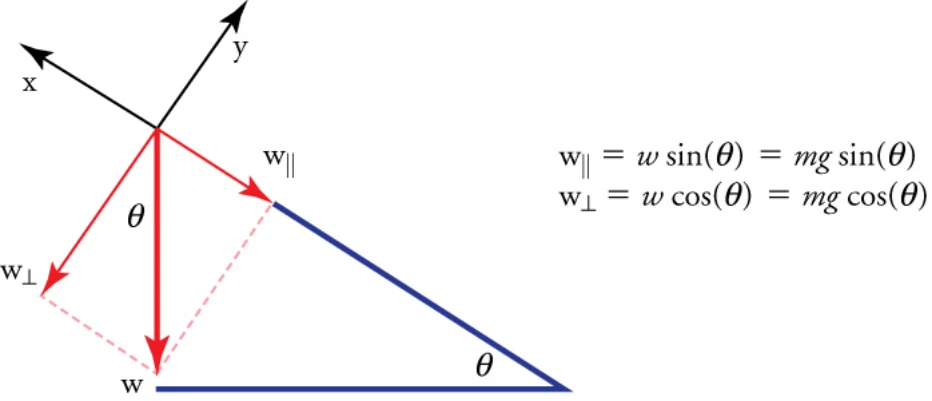
When an object rests on an incline that makes an angle with the horizontal, the force of gravity acting on the object is divided into two components: A force acting perpendicular to the plane, , and a force acting parallel to the plane, . The perpendicular force of weight, , is typically equal in magnitude and opposite in direction to the normal force, The force acting parallel to the plane, , causes the object to accelerate down the incline. The force of friction, , opposes the motion of the object, so it acts upward along the plane.
物体が水平と角をなす斜面の上に置かれているとき、物体にはたらく重力は二つの成分に分けられる。面に垂直にはたらく力と、面に平行にはたらく力である。重さの垂直成分は、ふつう垂直抗力と大きさが等しく向きが逆である。面に平行にはたらく力が、物体を斜面に沿って加速させる。摩擦力は物体の運動を妨げるので、斜面に沿って上向きにはたらく。
It is important to be careful when resolving the weight of the object into components. If the angle of the incline is at an angle to the horizontal, then the magnitudes of the weight components are
物体の重さを成分に分けるときは注意が要る。斜面が水平と角をなすなら、重さの成分の大きさは次のとおりである。
Instead of memorizing these equations, it is helpful to be able to determine them from reason. To do this, draw the right triangle formed by the three weight vectors. Notice that the angle of the incline is the same as the angle formed between and . Knowing this property, you can use trigonometry to determine the magnitude of the weight components
これらの式を暗記するより、筋道から導けるようになるほうがよい。そのためには、三つの重さのベクトルが作る直角三角形を描く。斜面の角が、との間にできる角と同じであることに注意しよう。この性質が分かれば、三角比を使って重さの成分の大きさを決められる。
Inclined Plane Force Components This video (https://openstax.org/l/28inclinedplane) shows how the weight of an object on an inclined plane is broken down into components perpendicular and parallel to the surface of the plane. It explains the geometry for finding the angle in more detail.
斜面での力の成分 この動画(https://openstax.org/l/28inclinedplane)は、斜面の上の物体の重さが、面に垂直な成分と平行な成分にどう分けられるかを示す。角を求めるための幾何をより詳しく説明している。
Access multimedia content (http://openstax.org/books/physics/pages/5-4-inclined-planes) This video shows how the weight of an object on an inclined plane is broken down into components perpendicular and parallel to the surface of the plane. It explains the geometry for finding the angle in more detail.
マルチメディア教材はこちら(http://openstax.org/books/physics/pages/5-4-inclined-planes) この動画は、斜面の上の物体の重さが、面に垂直な成分と平行な成分にどう分けられるかを示す。角を求めるための幾何をより詳しく説明している。
When the surface is flat, you could say that one of the components of the gravitational force is zero; Which one? As the angle of the incline gets larger, what happens to the magnitudes of the perpendicular and parallel components of gravitational force?
面が平らなとき、重力の成分の一方が0だと言える。どちらか。斜面の角が大きくなるにつれて、重力の垂直成分と平行成分の大きさはどうなるか。
a. When the angle is zero, the parallel component is zero and the perpendicular component is at a maximum. As the angle increases, the parallel component decreases and the perpendicular component increases. This is because the cosine of the angle shrinks while the sine of the angle increases.b. When the angle is zero, the parallel component is zero and the perpendicular component is at a maximum. As the angle increases, the parallel component decreases and the perpendicular component increases. This is because the cosine of the angle increases while the sine of the angle shrinks.c. When the angle is zero, the parallel component is zero and the perpendicular component is at a maximum. As the angle increases, the parallel component increases and the perpendicular component decreases. This is because the cosine of the angle shrinks while the sine of the angle increases.d. When the angle is zero, the parallel component is zero and the perpendicular component is at a maximum. As the angle increases, the parallel component increases and the perpendicular component decreases. This is because the cosine of the angle increases while the sine of the angle shrinks.
a. 角が0のとき、平行成分は0、垂直成分は最大である。角が大きくなると平行成分は小さくなり、垂直成分は大きくなる。角の余弦が縮み、角の正弦が増えるからである。b. 角が0のとき、平行成分は0、垂直成分は最大である。角が大きくなると平行成分は小さくなり、垂直成分は大きくなる。角の余弦が増え、角の正弦が縮むからである。c. 角が0のとき、平行成分は0、垂直成分は最大である。角が大きくなると平行成分は大きくなり、垂直成分は小さくなる。角の余弦が縮み、角の正弦が増えるからである。d. 角が0のとき、平行成分は0、垂直成分は最大である。角が大きくなると平行成分は大きくなり、垂直成分は小さくなる。角の余弦が増え、角の正弦が縮むからである。
TIPS FOR SUCCESS Normal force is represented by the variable This should not be confused with the symbol for the newton, which is also represented by the letter N. It is important to tell apart these symbols, especially since the units for normal force ( ) happen to be newtons (N). For example, the normal force, , that the floor exerts on a chair might be One important difference is that normal force is a vector, while the newton is simply a unit.
学習のポイント 垂直抗力は変数で表す。これは、同じくNの文字で表されるニュートンの記号と混同してはならない。垂直抗力の単位()がたまたまニュートン(N)であるだけに、この記号を見分けることが大切である。たとえば床が椅子に及ぼす垂直抗力はかもしれない。大きな違いの一つは、垂直抗力がベクトルであるのに対し、ニュートンは単なる単位だということである。
Be careful not to confuse these letters in your calculations!
計算のとき、これらの文字を取り違えないよう気をつけること。
To review, the process for solving inclined plane problems is as follows:
復習すると、斜面の問題を解く手順は次のとおりである。
1. Draw a sketch of the problem.2. Identify known and unknown quantities, and identify the system of interest.3. Draw a free-body diagram (which is a sketch showing all of the forces acting on an object) with the coordinate system rotated at the same angle as the inclined plane. Resolve the vectors into horizontal and vertical components and draw them on the free-body diagram.4. Write Newton’s second law in the horizontal and vertical directions and add the forces acting on the object. If the object does not accelerate in a particular direction (for example, the x -direction) then Fnet x = 0. If the object does accelerate in that direction, Fnet x = ma.5. Check your answer. Is the answer reasonable? Are the units correct?
1. 問題の図を描く。2. 分かっている量と分からない量を洗い出し、関心のある系を定める。3. 座標系を斜面と同じ角だけ回して、自由物体図(物体にはたらくすべての力を描いた図)を描く。ベクトルを水平成分と鉛直成分に分け、自由物体図に描き入れる。4. 水平方向と鉛直方向についてニュートンの第二法則を書き、物体にはたらく力を足し合わせる。ある向き(たとえばx方向)に物体が加速していないなら Fnet x = 0 である。その向きに加速しているなら Fnet x = ma である。5. 答えを確かめる。妥当か。単位は正しいか。
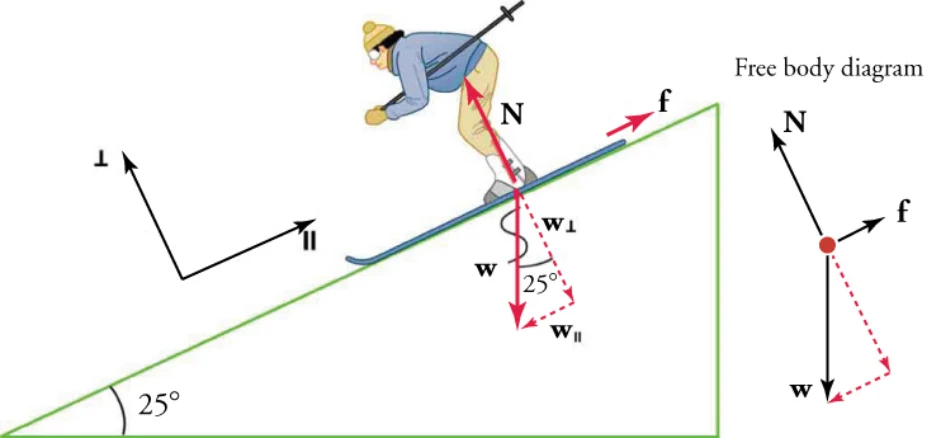
Finding the Coefficient of Kinetic Friction on an Inclined Plane A skier, illustrated in Figure 5.35(a), with a mass of 62 kg is sliding down a snowy slope at an angle of 25 degrees. Find the coefficient of kinetic friction for the skier if friction is known to be 45.0 N.
斜面での動摩擦係数を求める 図5.35(a)に示す、質量62 kgのスキーヤーが25度の雪の斜面を滑り下りている。摩擦が45.0 Nと分かっているとき、このスキーヤーについての動摩擦係数を求めよ。
Strategy方針
The magnitude of kinetic friction was given as 45.0 N. Kinetic friction is related to the normal force N as . Therefore, we can find the coefficient of kinetic friction by first finding the normal force of the skier on a slope. The normal force is always perpendicular to the surface, and since there is no motion perpendicular to the surface, the normal force should equal the component of the skier’s weight perpendicular to the slope.
動摩擦の大きさは45.0 Nと与えられている。動摩擦は垂直抗力Nとの関係にある。したがって、まず斜面上のスキーヤーにはたらく垂直抗力を求めれば、動摩擦係数を求められる。垂直抗力はつねに面に垂直であり、面に垂直な方向には運動がないので、垂直抗力はスキーヤーの重さの、斜面に垂直な成分に等しいはずである。
That is,
すなわち、
Substituting this into our expression for kinetic friction, we get
これを動摩擦の式に代入すると、次が得られる。
which can now be solved for the coefficient of kinetic friction μk.
これで動摩擦係数μkについて解ける。
Solution解答
Solving for gives
について解くと、次が得られる。
Substituting known values on the right-hand side of the equation,
式の右辺に分かっている値を代入すると、
Discussion考察
This result is a little smaller than the coefficient listed in Table 5.2 for waxed wood on snow, but it is still reasonable since values of the coefficients of friction can vary greatly. In situations like this, where an object of mass m slides down a slope that makes an angle θ with the horizontal, friction is given by
この結果は、表5.2に載っているワックスを塗った木と雪の係数より少し小さいが、摩擦係数の値は大きくばらつきうるので、なお妥当である。このように、質量mの物体が水平と角θをなす斜面を滑り下りる場合、摩擦はで与えられる。
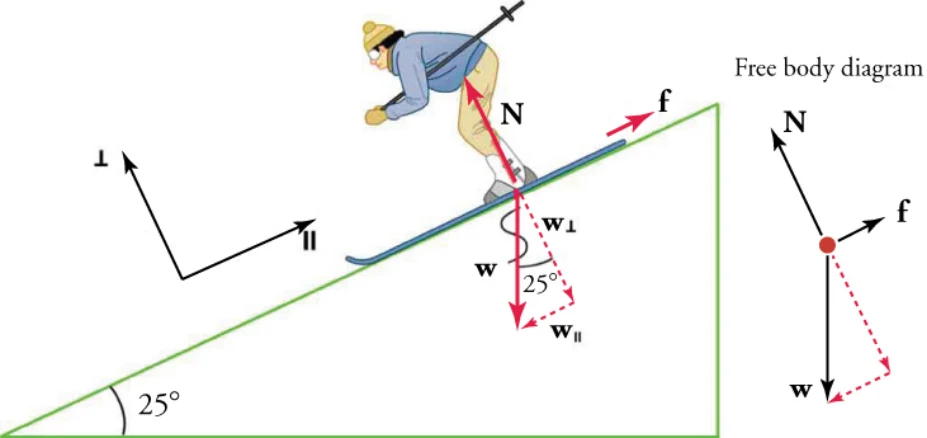
Weight on an Incline, a Two-Dimensional Problem The skier’s mass, including equipment, is 60.0 kg. (See Figure 5.36(b).) (a) What is her acceleration if friction is negligible? (b) What is her acceleration if the frictional force is 45.0 N?
斜面上の重さ、二次元の問題 スキーヤーの質量は装備を含めて60.0 kgである(図5.36(b)を見よ)。(a)摩擦が無視できるとき、彼女の加速度はいくらか。(b)摩擦力が45.0 Nのとき、加速度はいくらか。
Strategy方針
The most convenient coordinate system for motion on an incline is one that has one coordinate parallel to the slope and one perpendicular to the slope. Remember that motions along perpendicular axes are independent. We use the symbol to mean perpendicular, and to mean parallel.
斜面上の運動に最も都合のよい座標系は、一方の座標軸を斜面に平行に、他方を斜面に垂直にとったものである。互いに垂直な軸に沿った運動は独立であることを思い出そう。を「垂直」、を「平行」の意味で使う。
The only external forces acting on the system are the skier’s weight, friction, and the normal force exerted by the ski slope, labeled , , and in the free-body diagram. is always perpendicular to the slope and is parallel to it. But is not in the direction of either axis, so we must break it down into components along the chosen axes. We define to be the component of weight parallel to the slope and the component of weight perpendicular to the slope. Once this is done, we can consider the two separate problems of forces parallel to the slope and forces perpendicular to the slope.
系にはたらく外力は、スキーヤーの重さ、摩擦、そしてスキー斜面が及ぼす垂直抗力だけであり、自由物体図ではそれぞれ、、と記してある。はつねに斜面に垂直、は斜面に平行である。しかしはどちらの軸の向きでもないので、選んだ軸に沿った成分に分けねばならない。を重さの斜面に平行な成分、を重さの斜面に垂直な成分と定める。こうすれば、斜面に平行な力と斜面に垂直な力という、二つの別々の問題として考えられる。
Solution解答
The magnitude of the component of the weight parallel to the slope is , and the magnitude of the component of the weight perpendicular to the slope is
重さの斜面に平行な成分の大きさはであり、重さの斜面に垂直な成分の大きさは次のとおりである。
(a) Neglecting friction: Since the acceleration is parallel to the slope, we only need to consider forces parallel to the slope. Forces perpendicular to the slope add to zero, since there is no acceleration in that direction. The forces parallel to the slope are the amount of the skier’s weight parallel to the slope and friction . Assuming no friction, by Newton’s second law the acceleration parallel to the slope is
(a)摩擦を無視する場合。加速度は斜面に平行なので、斜面に平行な力だけを考えればよい。斜面に垂直な方向には加速度がないので、その向きの力は足し合わせて0になる。斜面に平行な力は、スキーヤーの重さの斜面に平行な成分と摩擦である。摩擦がないとすると、ニュートンの第二法則から、斜面に平行な加速度は次のようになる。
Where the net force parallel to the slope , so that
ここで斜面に平行な合力はなので、
is the acceleration.
が加速度である。
(b) Including friction: Here we now have a given value for friction, and we know its direction is parallel to the slope and it opposes motion between surfaces in contact. So the net external force is now
(b)摩擦を含める場合。ここでは摩擦の値が与えられており、その向きは斜面に平行で、接触する面どうしの運動を妨げる向きだと分かっている。したがって外力の合力は次のようになる。
and substituting this into Newton’s second law, gives
これをニュートンの第二法則に代入すると、次が得られる。
We substitute known values to get
分かっている値を代入すると、
or
すなわち、
which is the acceleration parallel to the incline when there is 45 N opposing friction.
これが、45 Nの摩擦が逆らっているときの、斜面に平行な加速度である。
Discussion考察
Since friction always opposes motion between surfaces, the acceleration is smaller when there is friction than when there is not.
摩擦はつねに面どうしの運動を妨げるので、摩擦があるときの加速度は、ないときより小さい。
Practice Problems練習問題
15When an object sits on an inclined plane that makes an angle θ with the horizontal, what is the expression for the component of the objects weight force that is parallel to the incline?
15物体が水平と角θをなす斜面の上に置かれているとき、その物体の重さの力の、斜面に平行な成分の式はどうなるか。
16An object with a mass of rests on a plane inclined from horizontal. What is the component of the weight force that is parallel to the incline?
16質量の物体が、水平から傾いた斜面の上に置かれている。重さの力の、斜面に平行な成分はいくらか。
SNAP LAB身近な実験Friction at an Angle: Sliding a Coin斜面での摩擦:硬貨を滑らせる
An object will slide down an inclined plane at a constant velocity if the net force on the object is zero. We can use this fact to measure the coefficient of kinetic friction between two objects. As shown in the first Worked Example, the kinetic friction on a slope , and the component of the weight down the slope is equal to . These forces act in opposite directions, so when they have equal magnitude, the acceleration is zero. Writing these out
物体にはたらく合力が0なら、その物体は斜面を一定の速度で滑り下りる。この事実を使えば、二つの物体の間の動摩擦係数を測れる。最初の計算例で示したとおり、斜面上の動摩擦はであり、重さの斜面下向きの成分はに等しい。この二つの力は逆向きにはたらくので、大きさが等しいとき加速度は0になる。これを書き下すと、
Solving for , since we find that
なのでについて解くと、次が得られる。
• 1 coin• 1 book• 1 protractor1. Put a coin flat on a book and tilt it until the coin slides at a constant velocity down the book. You might need to tap the book lightly to get the coin to move.2. Measure the angle of tilt relative to the horizontal and find .
・硬貨1枚・本1冊・分度器1個1. 硬貨を本の上に平らに置き、硬貨が本の上を一定の速度で滑り下りるまで本を傾ける。硬貨を動かすには、本を軽く叩く必要があるかもしれない。2. 水平に対する傾きの角を測り、を求める。
GRASP CHECK True or False—If only the angles of two vectors are known, we can find the angle of their resultant addition vector.
理解の確認 正誤問題——二つのベクトルの角だけが分かっていれば、それらを足した合成ベクトルの角を求められる。
a. Trueb. False
a. 正b. 誤
Check Your Understanding理解の確認
17What is friction?a. Friction is an internal force that opposes the relative motion of an object.b. Friction is an internal force that accelerates an object’s relative motion.
17摩擦とは何か。a. 摩擦とは、物体の相対運動を妨げる内力である。b. 摩擦とは、物体の相対運動を加速させる内力である。
c. Friction is an external force that opposes the relative motion of an object.d. Friction is an external force that increases the velocity of the relative motion of an object.
c. 摩擦とは、物体の相対運動を妨げる外力である。d. 摩擦とは、物体の相対運動の速度を増す外力である。
18What are the two varieties of friction? What does each one act upon?a. Kinetic and static friction both act on an object in motion.b. Kinetic friction acts on an object in motion, while static friction acts on an object at rest.c. Kinetic friction acts on an object at rest, while static friction acts on an object in motion.d. Kinetic and static friction both act on an object at rest.
18摩擦の二つの種類は何か。それぞれ何にはたらくか。a. 動摩擦も静止摩擦も、動いている物体にはたらく。b. 動摩擦は動いている物体に、静止摩擦は静止している物体にはたらく。c. 動摩擦は静止している物体に、静止摩擦は動いている物体にはたらく。d. 動摩擦も静止摩擦も、静止している物体にはたらく。
19Given static and kinetic friction between two surfaces, which has a greater value? Why?a. The kinetic friction has a greater value because the friction between the two surfaces is more when the two surfaces are in relative motion.b. The static friction has a greater value because the friction between the two surfaces is more when the two surfaces are in relative motion.c. The kinetic friction has a greater value because the friction between the two surfaces is less when the two surfaces are in relative motion.d. The static friction has a greater value because the friction between the two surfaces is less when the two surfaces are in relative motion.
19二つの面の間の静止摩擦と動摩擦では、どちらの値が大きいか。それはなぜか。a. 動摩擦のほうが大きい。二つの面が相対運動しているときのほうが、面どうしの摩擦が大きいから。b. 静止摩擦のほうが大きい。二つの面が相対運動しているときのほうが、面どうしの摩擦が大きいから。c. 動摩擦のほうが大きい。二つの面が相対運動しているときのほうが、面どうしの摩擦が小さいから。d. 静止摩擦のほうが大きい。二つの面が相対運動しているときのほうが、面どうしの摩擦が小さいから。