第5章二次元の運動Motion in Two Dimensions原書 p.151–204
5.3 Projectile Motion5.3 放物運動
SECTION LEARNING OBJECTIVES By the end of this section, you will be able to do the following:
この節の学習目標 この節を終えると、次のことができるようになる。
• Describe the properties of projectile motion• Apply kinematic equations and vectors to solve problems involving projectile motion
・放物運動の性質を述べる・運動学の式とベクトルを使って、放物運動に関する問題を解く
Section Key Termsこの節の重要語
air resistancemaximum height (of a projectile)projectileprojectile motionrangetrajectory
空気抵抗(放物体の)最高点の高さ放物体放物運動水平到達距離軌道
Properties of Projectile Motion放物運動の性質
Projectile motion is the motion of an object thrown (projected) into the air when, after the initial force that launches the object, air resistance is negligible and the only other force that object experiences is the force of gravity. The object is called a projectile, and its path is called its trajectory. Air resistance is a frictional force that slows its motion and can significantly alter the trajectory of the motion. Due to the difficulty in calculation, only situations in which the deviation from projectile motion is negligible and air resistance can be ignored are considered in introductory physics. That approximation is often quite accurate.
ここで扱う放物運動は、空中に投げ出された物体が、打ち出された後は重力だけを受けて動く運動である。物体を放物体、その通る道筋を軌道という。実際には空気抵抗も働き、速さや軌道が大きく変わる場合がある。しかし、その影響を含めた計算は複雑になる。この節では、空気抵抗の影響が十分小さく、無視してよい場合を扱う。この近似で、実際の運動をかなり正確に表せることも多い。
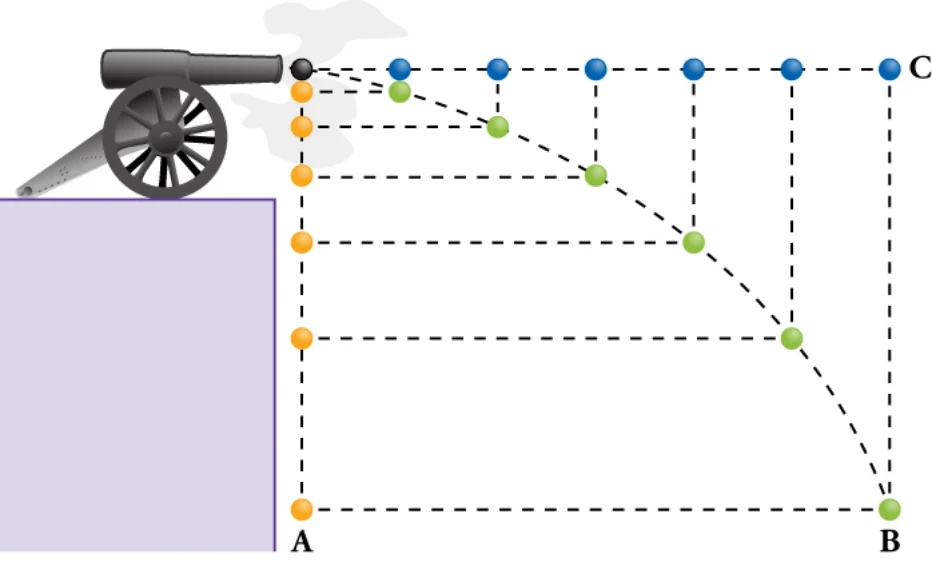
The most important concept in projectile motion is that when air resistance is ignored, horizontal and vertical motions are independent, meaning that they don’t influence one another. Figure 5.27 compares a cannonball in free fall (in blue) to a cannonball launched horizontally in projectile motion (in red). You can see that the cannonball in free fall falls at the same rate as the cannonball in projectile motion. Keep in mind that if the cannon launched the ball with any vertical component to the velocity, the vertical displacements would not line up perfectly.
放物運動で最も重要な概念は、空気抵抗を無視するとき、水平方向の運動と鉛直方向の運動が独立であり、互いに影響しないということである。図5.27は、自由落下する砲弾(青)と、水平に打ち出されて放物運動をする砲弾(赤)を比べている。自由落下する砲弾が、放物運動する砲弾と同じ割合で落ちることが見て取れる。もし大砲が速度に鉛直成分を持たせて球を打ち出したなら、鉛直方向の変位はぴったり揃わないことを心に留めておこう。
Since vertical and horizontal motions are independent, we can analyze them separately, along perpendicular axes. To do this, we separate projectile motion into the two components of its motion, one along the horizontal axis and the other along the vertical.
鉛直方向と水平方向の運動は独立なので、互いに垂直な軸に沿って別々に分析できる。そのために、放物運動を運動の二つの成分、すなわち水平軸に沿ったものと鉛直軸に沿ったものに分ける。
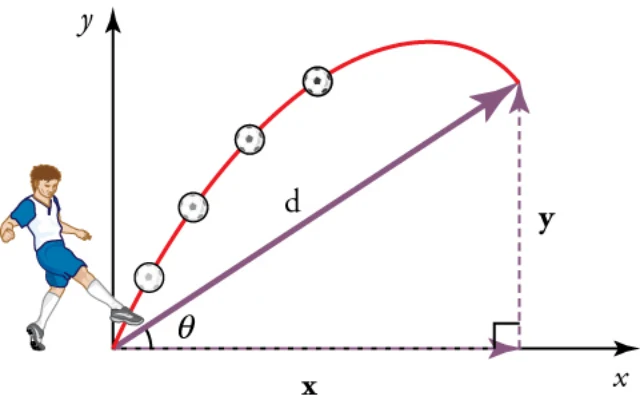
We’ll call the horizontal axis the x-axis and the vertical axis the y-axis. For notation, d is the total displacement, and x and y are its components along the horizontal and vertical axes. The magnitudes of these vectors are x and y, as illustrated in Figure 5.28.
水平軸をx軸、鉛直軸をy軸と呼ぶことにする。記号としては、dが全変位、xとyがその水平軸方向と鉛直軸方向の成分である。これらのベクトルの大きさは図5.28のようにxとyである。
As usual, we use velocity, acceleration, and displacement to describe motion. We must also find the components of these variables along the x- and y-axes. The components of acceleration are then very simple ay = –g = –9.80 m/s2. Note that this definition defines the upwards direction as positive. Because gravity is vertical, ax = 0. Both accelerations are constant, so we can use the kinematic equations. For review, the kinematic equations from a previous chapter are summarized in Table 5.1.
いつものように、運動を記述するのに速度・加速度・変位を使う。これらの変数のx軸方向とy軸方向の成分も求めねばならない。加速度の成分はきわめて簡単で、ay = −g = −9.80 m/s2である。この定義では上向きを正としていることに注意しよう。重力は鉛直方向なので、ax = 0である。どちらの加速度も一定なので、運動学の式が使える。復習のため、前の章の運動学の式を表5.1にまとめておく。
Where x is position, x0 is initial position, v is velocity, vavg is average velocity, t is time and a is acceleration.
ここでxは位置、x0は初めの位置、vは速度、vavgは平均速度、tは時間、aは加速度である。
Solve Problems Involving Projectile Motion放物運動に関する問題を解く
The following steps are used to analyze projectile motion:
放物運動の分析には次の手順を使う。
1. Separate the motion into horizontal and vertical components along the x- and y-axes. These axes are perpendicular, so and are used. The magnitudes of the displacement along x-and y-axes are called and The magnitudes of the components of the velocity are and
1. 運動をx軸方向とy軸方向、すなわち水平成分と鉛直成分に分ける。これらの軸は互いに垂直なので、とを使う。変位のx軸方向とy軸方向の成分の大きさを、と呼ぶ。速度の成分の大きさは と
, where is the magnitude of the velocity and is its direction. Initial values are denoted with a subscript 0. 2. Treat the motion as two independent one-dimensional motions, one horizontal and the other vertical. The kinematic equations for horizontal and vertical motion take the following forms
である。ここでは速度の大きさ、はその向きである。初めの値には添字0を付ける。 2. この運動を、水平方向と鉛直方向の二つの独立した一次元の運動として扱う。水平方向と鉛直方向の運動学の式は次の形になる。
Vertical motion (assuming positive is up )
鉛直方向の運動(上向きを正とする)
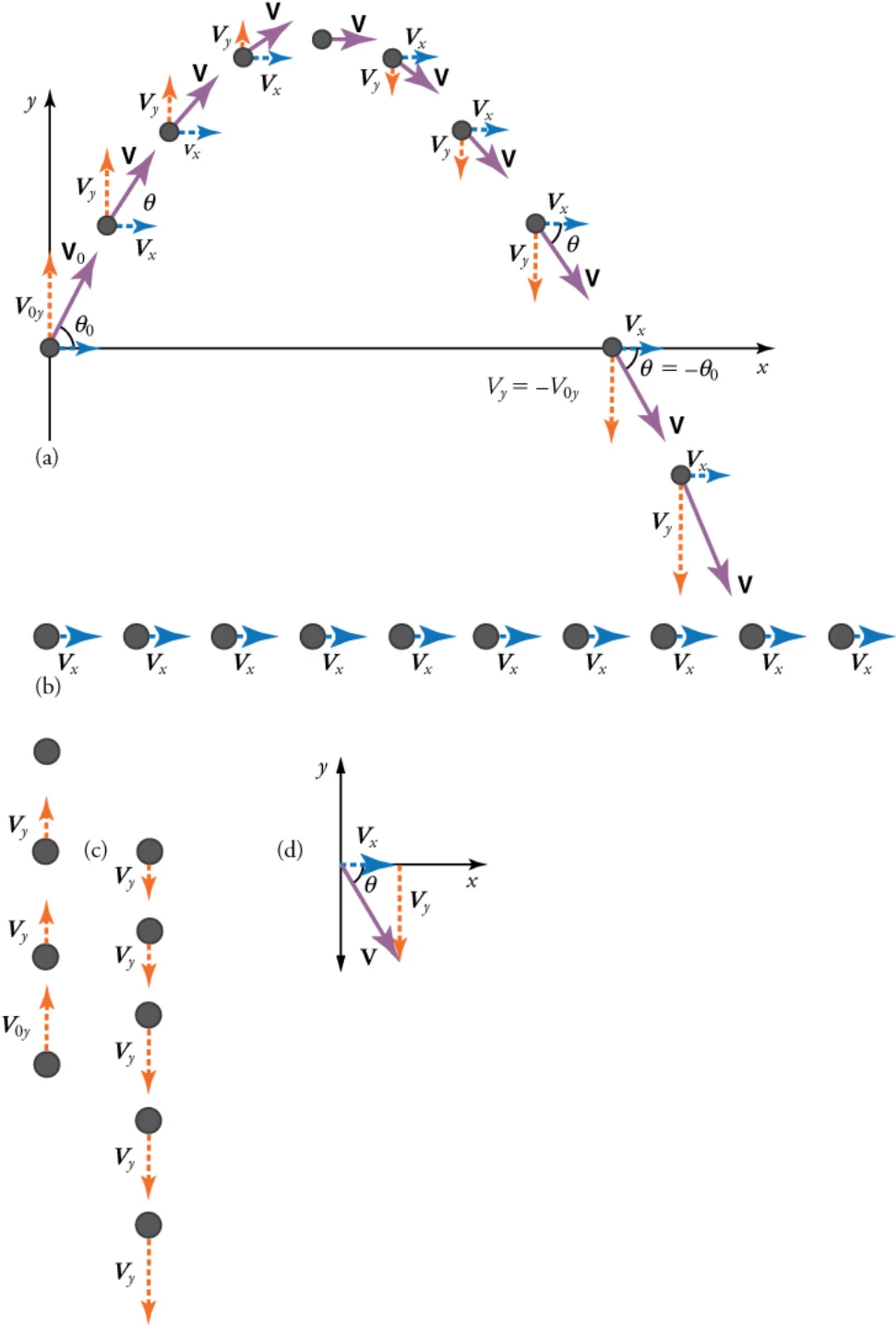
3. Solve for the unknowns in the two separate motions (one horizontal and one vertical). Note that the only common variable between the motions is time . The problem solving procedures here are the same as for one-dimensional kinematics.4. Recombine the two motions to find the total displacement and velocity . We can use the analytical method
3. 二つの別々の運動(一方は水平、他方は鉛直)について、分からない量を求める。二つの運動に共通する変数は時間だけであることに注意しよう。ここでの問題の解き方は、一次元の運動学と同じである。4. 二つの運動を合成し直して、全変位と速度を求める。ベクトルの加法の
of vector addition, which uses and to find the magnitude and direction of the total displacement and velocity.
解析的な方法が使える。すなわちとを使って、全変位と速度の大きさと向きを求める。
is the direction of the displacement , and is the direction of the velocity . (See Figure 5.29
は変位の向き、は速度の向きである。(図5.29を見よ)
TIPS FOR SUCCESS For problems of projectile motion, it is important to set up a coordinate system. The first step is to choose an initial position for and . Usually, it is simplest to set the initial position of the object so that and .
学習のポイント 放物運動の問題では、座標系を定めることが大切である。第一歩はとの初めの位置を選ぶことである。ふつうは、かつとなるように物体の初めの位置をとるのがいちばん簡単である。
Projectile at an Angle This video presents an example of finding the displacement (or range) of a projectile launched at an angle. It also reviews basic trigonometry for finding the sine, cosine and tangent of an angle.
角をつけた放物体 この動画は、角をつけて打ち出された放物体の変位(水平到達距離)を求める例を示す。角の正弦・余弦・正接を求める基本的な三角比も復習できる。
Projectile at an angle | Two-dimensional motion | Physics | Khan Academy (https://openstax.org/l/02projectang)
角をつけた放物体|二次元の運動|物理|カーンアカデミー(https://openstax.org/l/02projectang)
Assume the ground is uniformly level. If the horizontal component of a projectile's velocity is doubled, but the vertical component is unchanged, what is the effect on the time of flight?
地面は一様に平らだとする。ある放物体の速度の水平成分を2倍にし、鉛直成分は変えないとき、飛行時間はどうなるか。
a. The time to reach the ground would remain the same since the vertical component is unchanged.b. The time to reach the ground would remain the same since the vertical component of the velocity also gets doubled.c. The time to reach the ground would be halved since the horizontal component of the velocity is doubled.d. The time to reach the ground would be doubled since the horizontal component of the velocity is doubled.
a. 鉛直成分が変わらないので、地面に達するまでの時間は変わらない。b. 速度の鉛直成分も2倍になるので、地面に達するまでの時間は変わらない。c. 速度の水平成分が2倍になるので、地面に達するまでの時間は半分になる。d. 速度の水平成分が2倍になるので、地面に達するまでの時間は2倍になる。
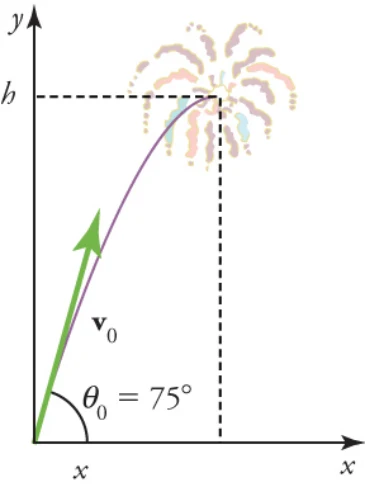
A Fireworks Projectile Explodes High and Away During a fireworks display like the one illustrated in Figure 5.30, a shell is shot into the air with an initial speed of 70.0 m/s at an angle of 75° above the horizontal. The fuse is timed to ignite the shell just as it reaches its highest point above the ground. (a) Calculate the height at which the shell explodes. (b) How much time passed between the launch of the shell and the explosion? (c) What is the horizontal displacement of the shell when it explodes?
花火の弾が高く遠くで開く 図5.30のような花火の打ち上げで、弾が初速70.0 m/s、水平から75°の角で空中へ打ち出される。導火線は、弾が地上からの最高点に達するちょうどそのときに点火するよう時間が合わせてある。(a)弾が破裂する高さを計算せよ。(b)打ち上げから破裂までに何秒経ったか。(c)破裂したときの弾の水平方向の変位はいくらか。
Strategy方針
The motion can be broken into horizontal and vertical motions in which and . We can then define and to be zero and solve for the maximum height.
運動は、である水平方向と鉛直方向の運動に分けられる。そのうえでを0と定め、最高点の高さについて解く。
Solution for (a)(a)の解答
By height we mean the altitude or vertical position above the starting point. The highest point in any trajectory, the maximum height, is reached when ; this is the moment when the vertical velocity switches from positive (upwards) to negative (downwards). Since we know the initial velocity, initial position, and the value of vy when the firework reaches its maximum height, we use the following equation to find
高さとは、出発点より上の高度、すなわち鉛直方向の位置のことである。どんな軌道でも最高点、すなわち最高点の高さに達するのはのときである。これは鉛直方向の速度が正(上向き)から負(下向き)へ切り替わる瞬間である。初速度、初めの位置、そして花火が最高点に達したときのvyの値が分かっているので、次の式を使ってを求める。
Because and are both zero, the equation simplifies to
とがどちらも0なので、この式は次のように簡単になる。
Solving for gives
について解くと、次が得られる。
Now we must find , the component of the initial velocity in the y-direction. It is given by , where
次に、初速度のy方向の成分を求めねばならない。これはで与えられる。ここで
is the initial velocity of 70.0 m/s, and is the initial angle. Thus,
は初速度70.0 m/s、は初めの角である。したがって、
and is
そしては、
so that
となるので、
Discussion for (a)(a)の考察
Since up is positive, the initial velocity and maximum height are positive, but the acceleration due to gravity is negative. The maximum height depends only on the vertical component of the initial velocity. The numbers in this example are reasonable for large fireworks displays, the shells of which do reach such heights before exploding.
上向きを正としているので、初速度と最高点の高さは正だが、重力加速度は負である。最高点の高さは、初速度の鉛直成分だけで決まる。この例の数値は大規模な花火大会として妥当であり、実際に花火の弾はこれほどの高さに達してから破裂する。
Solution for (b)(b)の解答
There is more than one way to solve for the time to the highest point. In this case, the easiest method is to use . Because is zero, this equation reduces to
最高点までの時間を求めるやり方は一つではない。この場合、いちばん簡単なのはを使うことである。が0なので、この式は次のようになる。
Note that the final vertical velocity, , at the highest point is zero. Therefore,
最高点における終わりの鉛直方向の速度が0であることに注意しよう。したがって、
Discussion for (b)(b)の考察
This time is also reasonable for large fireworks. When you are able to see the launch of fireworks, you will notice several seconds pass before the shell explodes. Another way of finding the time is by using ,
この時間も大規模な花火として妥当である。花火の打ち上げを見られるときは、弾が破裂するまでに数秒経つのに気づくだろう。時間を求める別のやり方は、を使い、
and solving the quadratic equation for .
についての二次方程式を解くことである。
Solution for (c)(c)の解答
Because air resistance is negligible, and the horizontal velocity is constant. The horizontal displacement is horizontal velocity multiplied by time as given by , where is equal to zero
空気抵抗が無視できるのでであり、水平方向の速度は一定である。水平方向の変位は、水平方向の速度に時間を掛けたもので、で与えられる。ここでは0である。
where is the x-component of the velocity, which is given by Now,
ここでは速度のx成分で、で与えられる。すると、
The time for both motions is the same, and so is
二つの運動の時間は同じなので、は次のようになる。
Discussion for (c)(c)の考察
176The horizontal motion is a constant velocity in the absence of air resistance. The horizontal displacement found here could be useful in keeping the fireworks fragments from falling on spectators. Once the shell explodes, air resistance has a major effect, and many fragments will land directly below, while some of the fragments may now have a velocity in the –x direction due to the forces of the explosion.
空気抵抗がなければ、水平方向の運動は等速である。ここで求めた水平方向の変位は、花火の破片が観客の上に落ちないようにするのに役立つだろう。弾が破裂すると、空気抵抗が大きく効くようになり、多くの破片は真下に落ちるが、爆発の力によって−x方向の速度を持つ破片もありうる。
The expression we found for while solving part (a) of the previous problem works for any projectile motion problem where air resistance is negligible. Call the maximum height ; then,
前の問題の(a)を解く中で求めたの式は、空気抵抗が無視できるどんな放物運動の問題でも使える。最高点の高さをと書けば、次のようになる。
This equation defines the maximum height of a projectile. The maximum height depends only on the vertical component of the initial velocity.
この式が放物体の最高点の高さを定める。最高点の高さは、初速度の鉛直成分だけで決まる。
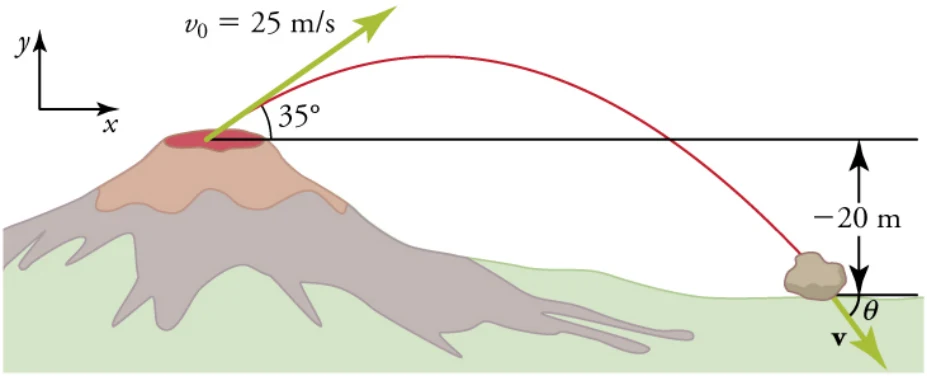
Calculating Projectile Motion: Hot Rock Projectile Suppose a large rock is ejected from a volcano, as illustrated in Figure 5.31, with a speed of and at an angle above the horizontal. The rock strikes the side of the volcano at an altitude 20.0 m lower than its starting point. (a) Calculate the time it takes the rock to follow this path.
放物運動を計算する:熱い岩の放物運動 図5.31のように、ある大きな岩が火山から速さ、水平からの角で噴き出されたとしよう。岩は、出発点より20.0 m低い高度で火山の斜面に当たる。(a)岩がこの道筋をたどるのにかかる時間を計算せよ。
Strategy方針
Breaking this two-dimensional motion into two independent one-dimensional motions will allow us to solve for the time. The time a projectile is in the air depends only on its vertical motion.
この二次元の運動を二つの独立した一次元の運動に分ければ、時間について解ける。放物体が空中にある時間は、その鉛直方向の運動だけで決まる。
Solution解答
While the rock is in the air, it rises and then falls to a final position 20.0 m lower than its starting altitude. We can find the time for this by using
岩は空中にある間、上昇してから、出発点の高度より20.0 m低い最終位置へ落ちる。この時間は次を使って求められる。
If we take the initial position to be zero, then the final position is Now the initial vertical velocity is the vertical component of the initial velocity, found from
初めの位置を0にとれば、最終位置はである。初めの鉛直方向の速度は初速度の鉛直成分であり、次から求まる。
Substituting known values yields
分かっている値を代入すると、次が得られる。
Rearranging terms gives a quadratic equation in
項を整理すると、についての二次方程式になる。
This expression is a quadratic equation of the form , where the constants are a = 4.90, b = –14.3,
この式はの形の二次方程式であり、定数は a = 4.90、b = −14.3、
and c = –20.0. Its solutions are given by the quadratic formula
c = −20.0 である。その解は二次方程式の解の公式で与えられる。
This equation yields two solutions t = 3.96 and t = –1.03. You may verify these solutions as an exercise. The time is t = 3.96 s or –1.03 s. The negative value of time implies an event before the start of motion, so we discard it. Therefore,
この式は t = 3.96 と t = −1.03 という二つの解を与える。これらの解は練習として確かめてよい。時間は t = 3.96 秒か −1.03 秒である。負の時間は運動が始まる前の出来事を意味するので捨てる。したがって、
Discussion考察
The time for projectile motion is completely determined by the vertical motion. So any projectile that has an initial vertical velocity of and lands 20.0 m below its starting altitude will spend 3.96 s in the air.
放物運動の時間は、鉛直方向の運動だけで完全に決まる。だから初めの鉛直方向の速度がで、出発点の高度より20.0 m低いところに落ちる放物体は、どれも3.96秒間空中にある。
Practice Problems練習問題
11If an object is thrown horizontally, travels with an average x-component of its velocity equal to , and does not hit the ground, what will be the x-component of the displacement after ?a. b.
11ある物体が水平に投げられ、速度のx成分の平均がで、地面に当たらないとすると、後の変位のx成分はいくらか。a. b.
12If a ball is thrown straight up with an initial velocity of upward, what is the maximum height it will reach?
12ボールを初速度でまっすぐ上に投げるとき、達する最高点の高さはいくらか。
The fact that vertical and horizontal motions are independent of each other lets us predict the range of a projectile. The range is the horizontal distance R traveled by a projectile on level ground, as illustrated in Figure 5.32.Throughout history, people have been interested in finding the range of projectiles for practical purposes, such as aiming cannons.
鉛直方向と水平方向の運動が互いに独立であるという事実から、放物体の水平到達距離を予測できる。水平到達距離とは、図5.32のように、平らな地面の上で放物体が進む水平距離Rのことである。歴史を通じて人々は、大砲の照準を合わせるといった実用の目的から、放物体の到達距離を求めることに関心を寄せてきた。
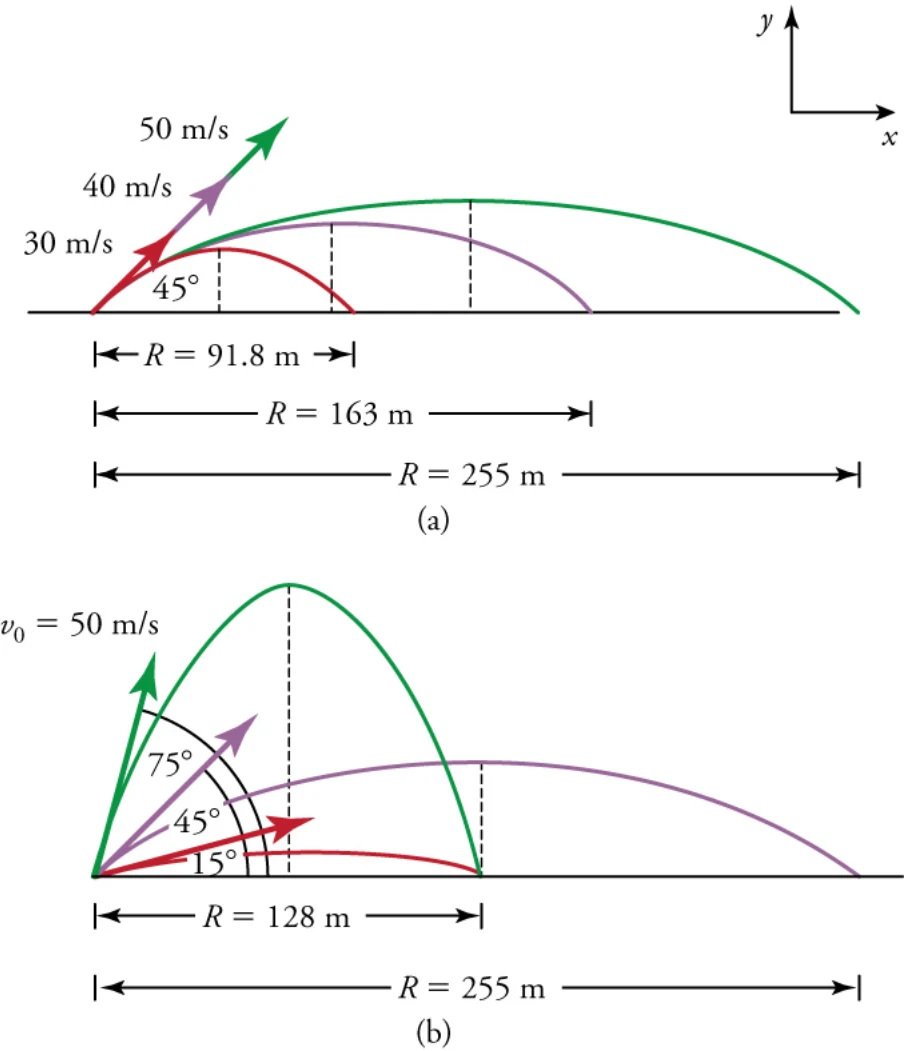
How does the initial velocity of a projectile affect its range? Obviously, the greater the initial speed , the greater the range, as shown in the figure above. The initial angle also has a dramatic effect on the range. When air resistance is negligible, the range of a projectile on level ground is
放物体の初速度は到達距離にどう効くか。上の図に示すとおり、初速が大きいほど到達距離は大きい。これは当然である。初めの角も到達距離に劇的に効く。空気抵抗が無視できるとき、平らな地面の上での放物体の到達距離は次のようになる。
where is the initial speed and is the initial angle relative to the horizontal. It is important to note that the range doesn’t apply to problems where the initial and final y position are different, or to cases where the object is launched perfectly horizontally.
ここでは初速、は水平に対する初めの角である。この到達距離の式は、初めと終わりのyの位置が違う問題や、物体が完全に水平に打ち出される場合には当てはまらないことに注意が必要である。
VIRTUAL PHYSICSシミュレーションProjectile Motion放物運動
In this simulation (https://openstax.org/l/28prjctilemtion) you will learn about projectile motion by blasting objects out of a cannon. You can choose between objects such as a tank shell, a golf ball or even a Buick. Experiment with changing the angle, initial speed, and mass, and adding in air resistance. Make a game out of this simulation by trying to hit the target.
このシミュレーション(https://openstax.org/l/28prjctilemtion)では、大砲から物を打ち出して放物運動を学ぶ。戦車の砲弾、ゴルフボール、さらにはビュイックの車まで選べる。角、初速、質量を変えたり、空気抵抗を加えたりして試してみよう。的に当てることを目指せば、ゲームとしても遊べる。
Consider the simulation (https://phet.colorado.edu/sims/html/projectile-motion/latest/projectile-motion_en.html). If a projectile is launched on level ground, what launch angle maximizes the range of the
シミュレーション(https://phet.colorado.edu/sims/html/projectile-motion/latest/projectile-motion_en.html)を考えよう。平らな地面の上で放物体を打ち出すとき、到達距離を最大にする
projectile?a. b.
打ち出しの角はいくらか。a. b.
Check Your Understanding理解の確認
13What is projectile motion?a. Projectile motion is the motion of an object projected into the air and moving under the influence of gravity.b. Projectile motion is the motion of an object projected into the air and moving independently of gravity.c. Projectile motion is the motion of an object projected vertically upward into the air and moving under the influence of gravity.d. Projectile motion is the motion of an object projected horizontally into the air and moving independently of gravity.
13放物運動とは何か。a. 放物運動とは、空中へ投げ出され、重力の影響のもとで動く物体の運動である。b. 放物運動とは、空中へ投げ出され、重力とは無関係に動く物体の運動である。c. 放物運動とは、鉛直に真上へ投げ上げられ、重力の影響のもとで動く物体の運動である。d. 放物運動とは、水平に投げ出され、重力とは無関係に動く物体の運動である。
14What is the force experienced by a projectile after the initial force that launched it into the air in the absence of air resistance?
14空気抵抗がないとき、放物体は打ち出す最初の力のあと、どんな力を受けるか。
a. The nuclear forceb. The gravitational force
a. 核力b. 重力
c. The electromagnetic forced. The contact force
c. 電磁気力d. 接触力