第19章遷移金属と錯体化学
19.3 Spectroscopic and Magnetic Properties of Coordination Compounds19.3 配位化合物の分光学的性質と磁気的性質
Learning Objectives学習目標
By the end of this section, you will be able to:
この節を学び終えると、次のことができるようになる。
- Outline the basic premise of crystal field theory (CFT)結晶場理論(CFT)の基本的な前提を概説する。
- Identify molecular geometries associated with various d-orbital splitting patternsさまざまなd軌道分裂パターンに対応する分子の形状を特定する。
- Predict electron configurations of split d orbitals for selected transition metal atoms or ions指定された遷移金属原子またはイオンについて、分裂したd軌道の電子配置を予測する。
- Explain spectral and magnetic properties in terms of CFT conceptsCFTの概念に基づいて、スペクトルと磁気的性質を説明する。
The behavior of coordination compounds cannot be adequately explained by the same theories used for main group element chemistry. The observed geometries of coordination complexes are not consistent with hybridized orbitals on the central metal overlapping with ligand orbitals, as would be predicted by valence bond theory. The observed colors indicate that the d orbitals often occur at different energy levels rather than all being degenerate, that is, of equal energy, as are the three p orbitals. To explain the stabilities, structures, colors, and magnetic properties of transition metal complexes, a different bonding model has been developed. Just as valence bond theory explains many aspects of bonding in main group chemistry, crystal field theory is useful in understanding and predicting the behavior of transition metal complexes.
英語のヒント
配位化合物の挙動は、主族元素の化学で用いるのと同じ理論では、十分に説明できない。観測される配位錯体の形状は、原子価結合理論から予測されるような、中心金属の混成軌道が配位子軌道と重なるという考え方とは一致しない。観測される色は、d軌道がしばしば異なるエネルギー準位を持つことを示しており、三つのp軌道のようにすべてが縮退している、すなわち等しいエネルギーを持つわけではない。遷移金属錯体の安定性、構造、色、磁気的性質を説明するために、異なる結合モデルが開発された。原子価結合理論が主族元素の化学における結合の多くの側面を説明するのと同じように、結晶場理論は、遷移金属錯体の挙動を理解し予測するのに役立つ。
Crystal Field Theory結晶場理論
To explain the observed behavior of transition metal complexes (such as how colors arise), a model involving electrostatic interactions between the electrons from the ligands and the electrons in the unhybridized d orbitals of the central metal atom has been developed. This electrostatic model is crystal field theory (CFT). It allows us to understand, interpret, and predict the colors, magnetic behavior, and some structures of coordination compounds of transition metals.
英語のヒント
遷移金属錯体で観測される挙動(色がどのように生じるかなど)を説明するために、配位子に由来する電子と、中心金属原子の混成していないd軌道内の電子との間の、静電相互作用を取り入れたモデルが開発された。この静電的モデルが結晶場理論(CFT)である。これによって、遷移金属の配位化合物の色、磁気的挙動、一部の構造を、理解し、解釈し、予測できる。
CFT focuses on the nonbonding electrons on the central metal ion in coordination complexes not on the metal-ligand bonds. Like valence bond theory, CFT tells only part of the story of the behavior of complexes. However, it tells the part that valence bond theory does not. In its pure form, CFT ignores any covalent bonding between ligands and metal ions. Both the ligand and the metal are treated as infinitesimally small point charges.
英語のヒント
CFTは、配位錯体の金属と配位子の結合ではなく、中心金属イオン上の非結合電子に注目する。原子価結合理論と同様に、CFTが説明するのも、錯体の挙動の一部にすぎない。しかし、原子価結合理論では説明しない部分を説明する。純粋な形のCFTは、配位子と金属イオンの間の共有結合をすべて無視する。配位子と金属は、どちらも無限に小さい点電荷として扱われる。
All electrons are negative, so the electrons donated from the ligands will repel the electrons of the central metal. Let us consider the behavior of the electrons in the unhybridized d orbitals in an octahedral complex. The five d orbitals consist of lobe-shaped regions and are arranged in space, as shown in Figure 19.33. In an octahedral complex, the six ligands coordinate along the axes.
英語のヒント
すべての電子は負の電荷を持つので、配位子から供与される電子は、中心金属の電子を反発する。八面体錯体の混成していないd軌道内での、電子の挙動を考えよう。五つのd軌道は葉状の領域からなり、図19.33に示すように空間内に配置されている。八面体錯体では、六つの配位子が軸に沿って配位する。
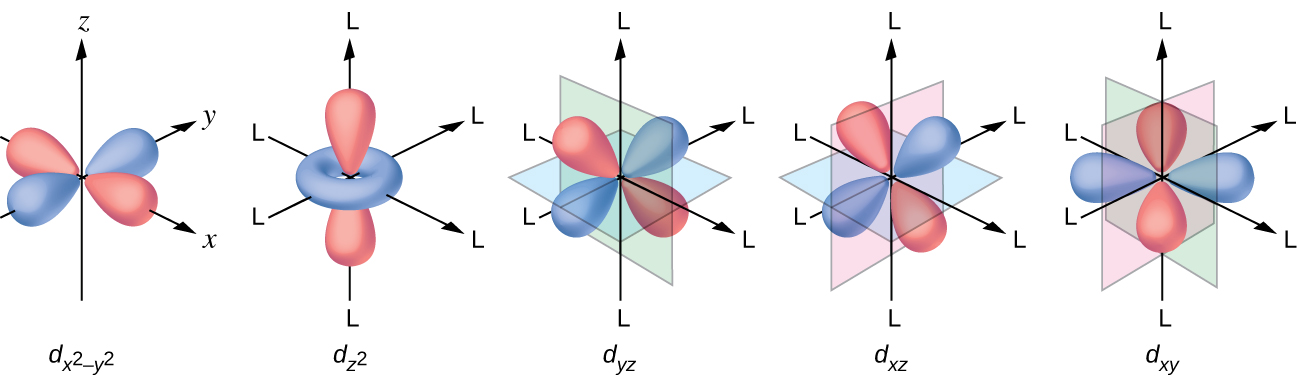
Figure 19.33図 19.33
The directional characteristics of the five d orbitals are shown here. The shaded portions indicate the phase of the orbitals. The ligands (L) coordinate along the axes. For clarity, the ligands have been omitted from the orbital so that the axis labels could be shown.
ここには、五つのd軌道の方向に関する特徴を示している。着色部分は軌道の位相を示す。配位子(L)は軸に沿って配位する。分かりやすくするため、軌道からは配位子を省略し、軸の表示が見えるようにしてある。
In an uncomplexed metal ion in the gas phase, the electrons are distributed among the five d orbitals in accord with Hund's rule because the orbitals all have the same energy. However, when ligands coordinate to a metal ion, the energies of the d orbitals are no longer the same.
英語のヒント
気相中の錯体を作っていない金属イオンでは、五つのd軌道がすべて同じエネルギーを持つため、電子はフントの規則に従ってそれらの軌道に分布する。しかし、配位子が金属イオンに配位すると、d軌道のエネルギーはもはや同じではなくなる。
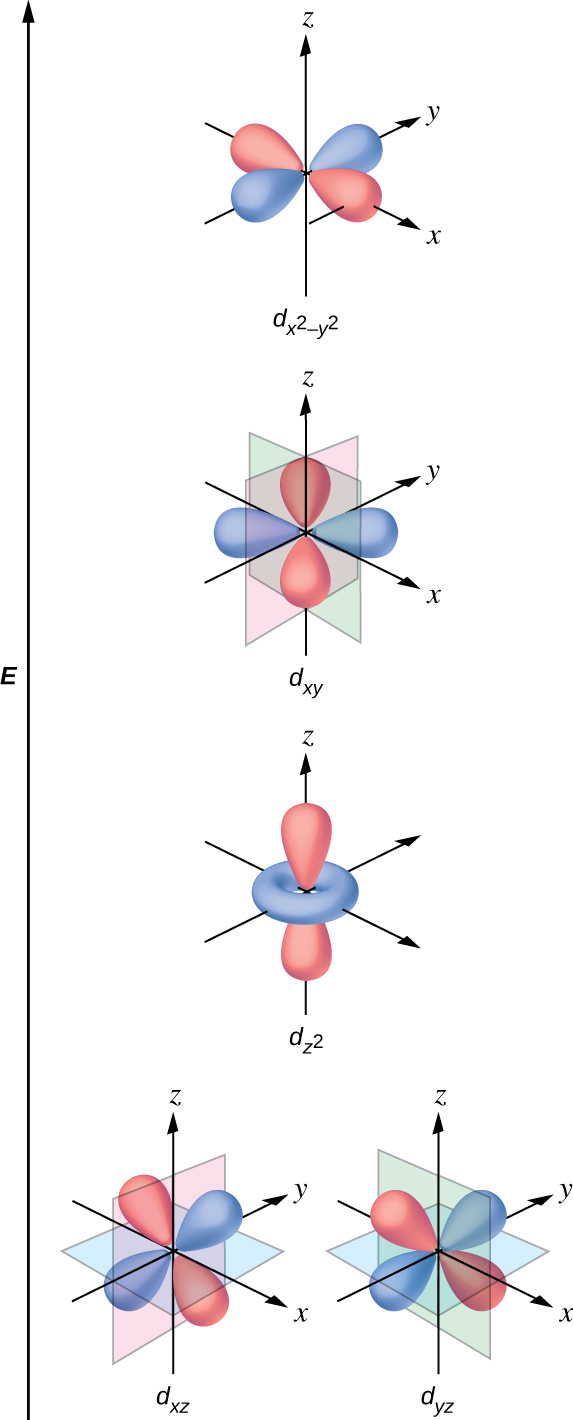
In octahedral complexes, the lobes in two of the five d orbitals, the and orbitals, point toward the ligands (Figure 19.33). These two orbitals are called the eg orbitals (the symbol actually refers to the symmetry of the orbitals, but we will use it as a convenient name for these two orbitals in an octahedral complex). The other three orbitals, the dxy, dxz, and dyz orbitals, have lobes that point between the ligands and are called the t2g orbitals (again, the symbol really refers to the symmetry of the orbitals). As six ligands approach the metal ion along the axes of the octahedron, their point charges repel the electrons in the d orbitals of the metal ion. However, the repulsions between the electrons in the eg orbitals (the and orbitals) and the ligands are greater than the repulsions between the electrons in the t2g orbitals (the dzy, dxz, and dyz orbitals) and the ligands. This is because the lobes of the eg orbitals point directly at the ligands, whereas the lobes of the t2g orbitals point between them. Thus, electrons in the eg orbitals of the metal ion in an octahedral complex have higher potential energies than those of electrons in the t2g orbitals. The difference in energy may be represented as shown in Figure 19.34.
英語のヒント
八面体錯体では、五つのd軌道のうち二つ、軌道と軌道の葉状部分が、配位子の方向を向く(図19.33)。この二つの軌道をeg軌道と呼ぶ(実際にはこの記号は軌道の対称性を表すが、ここでは八面体錯体内のこの二つの軌道の便利な名前として使う)。残る三つの軌道、dxy、dxz、dyz軌道の葉状部分は、配位子の間を向き、t2g軌道と呼ばれる(ここでも実際には記号は軌道の対称性を表している)。六つの配位子が八面体の軸に沿って金属イオンに近づくと、その点電荷は金属イオンのd軌道内の電子を反発する。ただし、eg軌道(軌道と軌道)の電子と配位子の間の反発は、t2g軌道(dzy、dxz、dyz軌道)の電子と配位子の間の反発より大きい。これは、eg軌道の葉状部分が配位子を直接向く一方、t2g軌道の葉状部分は配位子の間を向くためである。したがって、八面体錯体の金属イオンのeg軌道内の電子は、t2g軌道内の電子より高いポテンシャルエネルギーを持つ。エネルギーの差は、図19.34のように表すことができる。
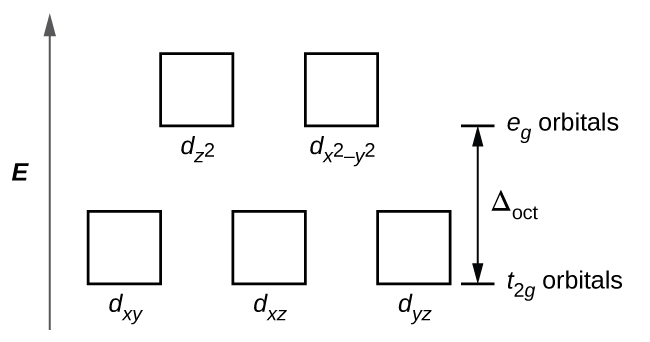
Figure 19.34図 19.34
In octahedral complexes, the eg orbitals are destabilized (higher in energy) compared to the t2g orbitals because the ligands interact more strongly with the d orbitals at which they are pointed directly.
英語のヒント
八面体錯体では、配位子が直接向いているd軌道との相互作用がより強いため、eg軌道はt2g軌道に比べて不安定化される(エネルギーが高くなる)。
The difference in energy between the eg and the t2g orbitals is called the crystal field splitting and is symbolized by Δoct, where oct stands for octahedral.
英語のヒント
eg軌道とt2g軌道のエネルギー差を結晶場分裂と呼び、Δoctで表す。ここでoctは八面体を表す。
The magnitude of Δoct depends on many factors, including the nature of the six ligands located around the central metal ion, the charge on the metal, and whether the metal is using 3d, 4d, or 5d orbitals. Different ligands produce different crystal field splittings. The increasing crystal field splitting produced by ligands is expressed in the spectrochemical series, a short version of which is given here:
英語のヒント
Δoctの大きさは、中心金属イオンの周囲の六つの配位子の性質、金属の電荷、金属が3d、4d、5dのどの軌道を使うかなど、多くの因子に依存する。配位子が異なれば、異なる結晶場分裂を生じる。配位子が生じさせる結晶場分裂の増大する順序は、分光化学系列で表される。その短い形を以下に示す。
In this series, ligands on the left cause small crystal field splittings and are weak-field ligands, whereas those on the right cause larger splittings and are strong-field ligands. Thus, the Δoct value for an octahedral complex with iodide ligands (I−) is much smaller than the Δoct value for the same metal with cyanide ligands (CN−).
英語のヒント
この系列では、左側の配位子は小さな結晶場分裂を生じさせる弱い場の配位子であり、右側の配位子は、より大きな分裂を生じさせる強い場の配位子である。したがって、ヨウ化物配位子(I−)を持つ八面体錯体のΔoct値は、同じ金属でシアン化物配位子(CN−)を持つ場合のΔoct値より、はるかに小さい。
Electrons in the d orbitals follow the aufbau (“filling up”) principle, which says that the orbitals will be filled to give the lowest total energy, just as in main group chemistry. When two electrons occupy the same orbital, the like charges repel each other. The energy needed to pair up two electrons in a single orbital is called the pairing energy (P). Electrons will always singly occupy each orbital in a degenerate set before pairing. P is similar in magnitude to Δoct. When electrons fill the d orbitals, the relative magnitudes of Δoct and P determine which orbitals will be occupied.
英語のヒント
d軌道内の電子は、主族元素の化学と同じように、構成(「積み上げ」)原理に従う。これは、全エネルギーが最小になるように軌道が満たされるという原理である。二個の電子が同じ軌道を占めると、同符号の電荷が互いに反発する。一つの軌道内で二個の電子を対にするために必要なエネルギーを、電子対形成エネルギー(P)という。電子は常に、対を作る前に、縮退した軌道の組の各軌道を一個ずつ占める。Pの大きさはΔoctに近い。電子がd軌道を満たすとき、ΔoctとPの相対的な大きさによって、どの軌道が占有されるかが決まる。
In [Fe(CN)6]4−, the strong field of six cyanide ligands produces a large Δoct. Under these conditions, the electrons require less energy to pair than they require to be excited to the eg orbitals (Δoct > P). The six 3d electrons of the Fe2+ ion pair in the three t2g orbitals (Figure 19.35). Complexes in which the electrons are paired because of the large crystal field splitting are called low-spin complexes because the number of unpaired electrons (spins) is minimized.
英語のヒント
[Fe(CN)6]4−では、六つのシアン化物配位子の強い場が、大きなΔoctを生じさせる。この条件では、電子が対を作るために必要なエネルギーは、eg軌道へ励起されるために必要なエネルギーより小さい(Δoct > P)。Fe2+イオンの六個の3d電子は、三つのt2g軌道内で対を作る(図19.35)。大きな結晶場分裂によって電子が対を作る錯体は、不対電子(スピン)の数が最小になるため、低スピン錯体と呼ばれる。
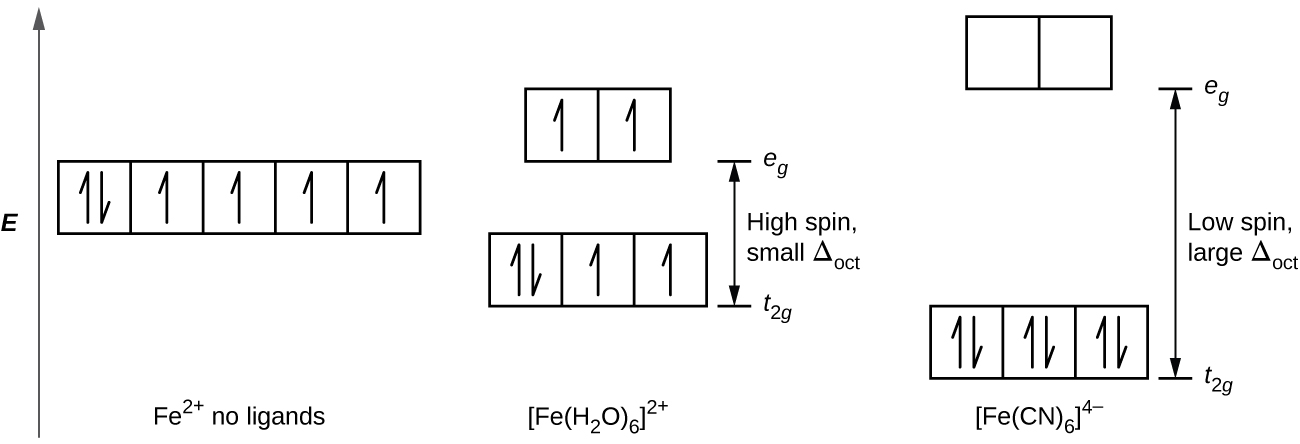
Figure 19.35図 19.35
Iron(II) complexes have six electrons in the 5d orbitals. In the absence of a crystal field, the orbitals are degenerate. For coordination complexes with strong-field ligands such as [Fe(CN)6]4−, Δoct is greater than P, and the electrons pair in the lower energy t2g orbitals before occupying the eg orbitals. With weak-field ligands such as H2O, the ligand field splitting is less than the pairing energy, Δoct less than P, so the electrons occupy all d orbitals singly before any pairing occurs.
鉄(II)錯体は5d軌道に六個の電子を持つ。結晶場がないとき、軌道は縮退している。[Fe(CN)6]4−のように強い場の配位子を持つ配位錯体では、ΔoctがPより大きく、電子はeg軌道を占める前に、エネルギーの低いt2g軌道内で対を作る。H2Oのような弱い場の配位子では、配位子場分裂が電子対形成エネルギーより小さく、ΔoctはP未満であるため、電子は対を作る前に、すべてのd軌道を一個ずつ占める。
In [Fe(H2O)6]2+, on the other hand, the weak field of the water molecules produces only a small crystal field splitting (Δoct < P). Because it requires less energy for the electrons to occupy the eg orbitals than to pair together, there will be an electron in each of the five 3d orbitals before pairing occurs. For the six d electrons on the iron(II) center in [Fe(H2O)6]2+, there will be one pair of electrons and four unpaired electrons (Figure 19.35). Complexes such as the [Fe(H2O)6]2+ ion, in which the electrons are unpaired because the crystal field splitting is not large enough to cause them to pair, are called high-spin complexes because the number of unpaired electrons (spins) is maximized.
英語のヒント
一方、[Fe(H2O)6]2+では、水分子の弱い場が生じさせる結晶場分裂は小さい(Δoct < P)。電子がeg軌道を占めるために必要なエネルギーは、対を作るために必要なエネルギーより小さいので、対を作る前に、五つの3d軌道のそれぞれに電子が一個ずつ入る。[Fe(H2O)6]2+の鉄(II)中心の六個のd電子は、一対の電子と四個の不対電子になる(図19.35)。[Fe(H2O)6]2+イオンなど、結晶場分裂が電子を対にするほど大きくないために不対電子が存在する錯体は、不対電子(スピン)の数が最大になるため、高スピン錯体と呼ばれる。
A similar line of reasoning shows why the [Fe(CN)6]3− ion is a low-spin complex with only one unpaired electron, whereas both the [Fe(H2O)6]3+ and [FeF6]3− ions are high-spin complexes with five unpaired electrons.
英語のヒント
同様に考えると、[Fe(CN)6]3−イオンが、不対電子を一個しか持たない低スピン錯体である一方、[Fe(H2O)6]3+イオンと[FeF6]3−イオンが、どちらも五個の不対電子を持つ高スピン錯体である理由が分かる。
Example 19.7例題 19.7
High- and Low-Spin Complexes高スピン錯体と低スピン錯体
Predict the number of unpaired electrons.
不対電子の数を予測しなさい。
(a) K3[CrI6]
(a) K3[CrI6]
(b) [Cu(en)2(H2O)2]Cl2
(b) [Cu(en)2(H2O)2]Cl2
(c) Na3[Co(NO2)6]
(c) Na3[Co(NO2)6]
Solution解き方
The complexes are octahedral.
これらの錯体は八面体である。
(a) Cr3+ has a d3 configuration. These electrons will all be unpaired.
(a) Cr3+はd3配置を持つ。これらの電子はすべて不対電子になる。
(b) Cu2+ is d9, so there will be one unpaired electron.
(b) Cu2+はd9なので、不対電子は一個である。
(c) Co3+ has d6 valence electrons, so the crystal field splitting will determine how many are paired. Nitrite is a strong-field ligand, so the complex will be low spin. Six electrons will go in the t2g orbitals, leaving 0 unpaired.
英語のヒント
(c) Co3+はd6の価電子を持つので、対を作る電子の数は結晶場分裂で決まる。亜硝酸イオンは強い場の配位子なので、錯体は低スピンになる。六個の電子がt2g軌道に入り、不対電子は0個になる。
Check Your Learning理解度の確認
The size of the crystal field splitting only influences the arrangement of electrons when there is a choice between pairing electrons and filling the higher-energy orbitals. For which d-electron configurations will there be a difference between high- and low-spin configurations in octahedral complexes?
英語のヒント
結晶場分裂の大きさが電子の配置に影響するのは、電子を対にするか、よりエネルギーの高い軌道に入れるかを選べる場合だけである。八面体錯体では、どのd電子配置で高スピン配置と低スピン配置の違いが生じるか。
Example 19.8例題 19.8
CFT for Other Geometries他の形状に対する結晶場理論
CFT is applicable to molecules in geometries other than octahedral. In octahedral complexes, remember that the lobes of the eg set point directly at the ligands. For tetrahedral complexes, the d orbitals remain in place, but now we have only four ligands located between the axes (Figure 19.36). None of the orbitals points directly at the tetrahedral ligands. However, the eg set (along the Cartesian axes) overlaps with the ligands less than does the t2g set. By analogy with the octahedral case, predict the energy diagram for the d orbitals in a tetrahedral crystal field. To avoid confusion, the octahedral eg set becomes a tetrahedral e set, and the octahedral t2g set becomes a t2 set.
英語のヒント
CFTは、八面体以外の形状の分子にも適用できる。八面体錯体では、egの組の葉状部分が配位子を直接向くことを思い出そう。四面体錯体では、d軌道は同じ位置にあるが、配位子は四つだけで、軸の間に位置する(図19.36)。四面体の配位子を直接向く軌道はない。しかし、egの組(直交座標軸に沿う)は、t2gの組より、配位子との重なりが少ない。八面体の場合との類推によって、四面体結晶場内のd軌道のエネルギー図を予測しなさい。混乱を避けるため、八面体のegの組は四面体のeの組となり、八面体のt2gの組はt2の組となる。
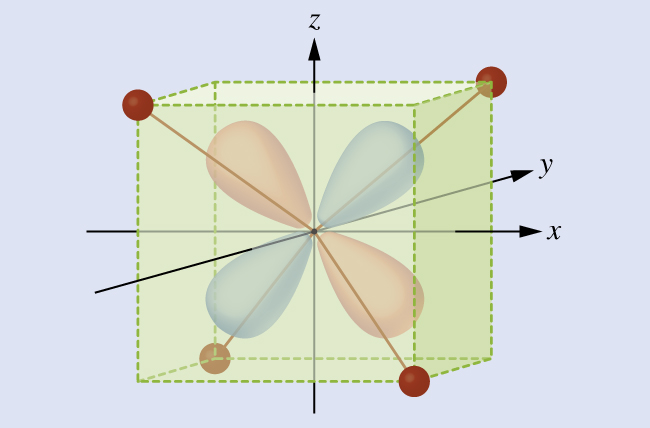
Figure 19.36図 19.36
This diagram shows the orientation of the tetrahedral ligands with respect to the axis system for the orbitals.
この図は、軌道の座標軸系に対する四面体配位子の向きを示している。
Solution解き方
Since CFT is based on electrostatic repulsion, the orbitals closer to the ligands will be destabilized and raised in energy relative to the other set of orbitals. The splitting is less than for octahedral complexes because the overlap is less, so Δtet is usually small
CFTは静電反発に基づくため、配位子に近い軌道は不安定化され、他の組の軌道に比べてエネルギーが上がる。重なりが少ないので、分裂は八面体錯体の場合より小さく、したがってΔtetは通常小さい。
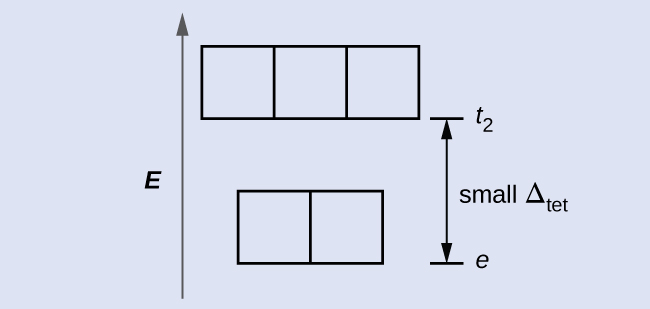
Check Your Learning理解度の確認
Explain how many unpaired electrons a tetrahedral d4 ion will have.
四面体のd4イオンが持つ不対電子の数を説明しなさい。
The other common geometry is square planar. It is possible to consider a square planar geometry as an octahedral structure with a pair of trans ligands removed. The removed ligands are assumed to be on the z-axis. This changes the distribution of the d orbitals, as orbitals on or near the z-axis become more stable, and those on or near the x- or y-axes become less stable. This results in the octahedral t2g and the eg sets splitting and gives a more complicated pattern, as depicted below:
英語のヒント
もう一つの一般的な形状は平面正方形である。平面正方形は、八面体構造からトランス位の配位子を一対取り除いたものと考えることができる。取り除く配位子はz軸上にあるとする。これによって、z軸上またはその近くの軌道はより安定になり、x軸やy軸上またはその近くの軌道はより不安定になるため、d軌道の分布が変わる。その結果、八面体のt2gの組とegの組が分裂し、以下に示すような、より複雑なパターンになる。