第19章遷移金属と錯体化学
Key Concepts and Summary重要概念とまとめ
Crystal field theory treats interactions between the electrons on the metal and the ligands as a simple electrostatic effect. The presence of the ligands near the metal ion changes the energies of the metal d orbitals relative to their energies in the free ion. Both the color and the magnetic properties of a complex can be attributed to this crystal field splitting. The magnitude of the splitting (Δoct) depends on the nature of the ligands bonded to the metal. Strong-field ligands produce large splitting and favor low-spin complexes, in which the t2g orbitals are completely filled before any electrons occupy the eg orbitals. Weak-field ligands favor formation of high-spin complexes. The t2g and the eg orbitals are singly occupied before any are doubly occupied.
結晶場理論は、金属上の電子と配位子の間の相互作用を、単純な静電的効果として扱う。金属イオンの近くに配位子が存在すると、金属のd軌道のエネルギーは、自由なイオンにおけるエネルギーに対して変化する。錯体の色と磁気的性質は、どちらもこの結晶場分裂に帰することができる。分裂の大きさ(Δoct)は、金属に結合する配位子の性質に依存する。強い場の配位子は大きな分裂を生じさせ、低スピン錯体の形成を有利にする。低スピン錯体では、電子がeg軌道を占める前に、t2g軌道が完全に満たされる。弱い場の配位子は、高スピン錯体の形成を有利にする。t2g軌道とeg軌道は、いずれかに二個入る前に、それぞれ一個ずつ電子に占有される。
Chemistry End of Chapter Exercises章末問題
Exercises 36–48練習問題 36–48
Exercise 36問題 36
Determine the number of unpaired electrons expected for [Fe(NO2)6]3−and for [FeF6]3− in terms of crystal field theory.
結晶場理論に基づいて、[Fe(NO2)6]3−および[FeF6]3−に予想される不対電子の数を求めなさい。
Exercise 37問題 37
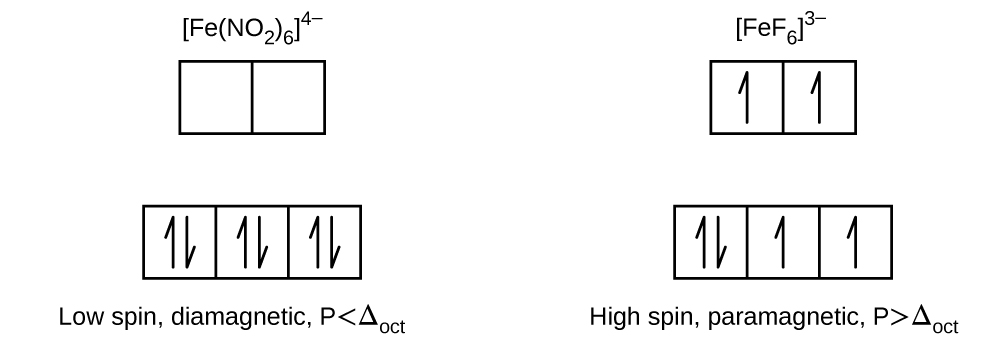
Draw the crystal field diagrams for [Fe(NO2)6]4− and [FeF6]3−. State whether each complex is high spin or low spin, paramagnetic or diamagnetic, and compare Δoct to P for each complex.
[Fe(NO2)6]4−と[FeF6]3−の結晶場の図を描きなさい。各錯体が高スピンか低スピンか、常磁性か反磁性かを述べ、各錯体についてΔoctとPを比較しなさい。

Exercise 38問題 38
Give the oxidation state of the metal, number of d electrons, and the number of unpaired electrons predicted for [Co(NH3)6]Cl3.
[Co(NH3)6]Cl3について、金属の酸化状態、d電子の数、予測される不対電子の数を示しなさい。
Exercise 39問題 39
The anhydrous solid CoCl2 is blue in color. Because it readily absorbs water from the air, it is used as a humidity indicator to monitor if equipment (such as a cell phone) has been exposed to excessive levels of moisture. Predict what product is formed by this reaction, and how many unpaired electrons this complex will have.
英語のヒント
無水の固体CoCl2は青色である。空気中の水を容易に吸収するため、装置(携帯電話など)が過剰な湿気にさらされたかどうかを監視する湿度指示薬として使われる。この反応で生じる生成物と、その錯体が持つ不対電子の数を予測しなさい。
Solution解き方
[Co(H2O)6]Cl2 with three unpaired electrons.
[Co(H2O)6]Cl2、不対電子は三個。
Exercise 40問題 40
Is it possible for a complex of a metal in the transition series to have six unpaired electrons? Explain.
遷移系列の金属の錯体が、六個の不対電子を持つことは可能か。説明しなさい。
Exercise 41問題 41
How many unpaired electrons are present in each of the following?
次のそれぞれに、不対電子はいくつあるか。
(a) [CoF6]3− (high spin)
(a) [CoF6]3−(高スピン)
(b) [Mn(CN)6]3− (low spin)
(b) [Mn(CN)6]3−(低スピン)
(c) [Mn(CN)6]4− (low spin)
(c) [Mn(CN)6]4−(低スピン)
(d) [MnCl6]4− (high spin)
(d) [MnCl6]4−(高スピン)
(e) [RhCl6]3− (low spin)
(e) [RhCl6]3−(低スピン)
Solution解き方
(a) 4; (b) 2; (c) 1; (d) 5; (e) 0
(a) 4; (b) 2; (c) 1; (d) 5; (e) 0
Exercise 42問題 42
Explain how the diphosphate ion, [O3P−O−PO3]4−, can function as a water softener that prevents the precipitation of Fe2+ as an insoluble iron salt.
英語のヒント
二リン酸イオン[O3P−O−PO3]4−が、Fe2+を不溶性の鉄塩として沈殿させない、水の軟化剤として働く仕組みを説明しなさい。
Exercise 43問題 43
For complexes of the same metal ion with no change in oxidation number, the stability increases as the number of electrons in the t2g orbitals increases. Which complex in each of the following pairs of complexes is more stable?
酸化数の変化がない同じ金属イオンの錯体では、t2g軌道内の電子の数が増すほど、安定性が高くなる。次の各対では、どちらの錯体の方が安定か。
(a) [Fe(H2O)6]2+ or [Fe(CN)6]4−
(a) [Fe(H2O)6]2+または[Fe(CN)6]4−
(b) [Co(NH3)6]3+ or [CoF6]3−
(b) [Co(NH3)6]3+または[CoF6]3−
(c) [Mn(CN)6]4− or [MnCl6]4−
(c) [Mn(CN)6]4−または[MnCl6]4−
Solution解き方
(a) [Fe(CN)6]4−; (b) [Co(NH3)6]3+; (c) [Mn(CN)6]4−
(a) [Fe(CN)6]4−; (b) [Co(NH3)6]3+; (c) [Mn(CN)6]4−
Exercise 44問題 44
Trimethylphosphine, P(CH3)3, can act as a ligand by donating the lone pair of electrons on the phosphorus atom. If trimethylphosphine is added to a solution of nickel(II) chloride in acetone, a blue compound that has a molecular mass of approximately 270 g and contains 21.5% Ni, 26.0% Cl, and 52.5% P(CH3)3 can be isolated. This blue compound does not have any isomeric forms. What are the geometry and molecular formula of the blue compound?
英語のヒント
トリメチルホスフィンP(CH3)3は、リン原子上の孤立電子対を供与することで、配位子として働くことができる。塩化ニッケル(II)のアセトン溶液にトリメチルホスフィンを加えると、分子質量が約270 gで、Niを21.5%、Clを26.0%、P(CH3)3を52.5%含む青色化合物を単離できる。この青色化合物には、異性体がまったく存在しない。青色化合物の形状と分子式は何か。
Exercise 45問題 45
Would you expect the complex [Co(en)3]Cl3 to have any unpaired electrons? Any isomers?
錯体[Co(en)3]Cl3には、不対電子があると予想するか。異性体はあるか。
Solution解き方
The complex does not have any unpaired electrons. The complex does not have any geometric isomers, but the mirror image is nonsuperimposable, so it has an optical isomer.
この錯体には不対電子はない。幾何異性体もないが、鏡像は重ね合わせられないので、光学異性体を持つ。
Exercise 46問題 46
Would you expect the Mg3[Cr(CN)6]2 to be diamagnetic or paramagnetic? Explain your reasoning.
Mg3[Cr(CN)6]2は、反磁性と常磁性のどちらであると予想するか。その推論を説明しなさい。
Exercise 47問題 47
Would you expect salts of the gold(I) ion, Au+, to be colored? Explain.
金(I)イオンAu+の塩は、色を持つと予想するか。説明しなさい。
Solution解き方
No. Au+ has a complete 5d sublevel.
いいえ。Au+の5d副殻は満たされている。
Exercise 48問題 48
[CuCl4]2− is green. [Cu(H2O)6]2+is blue. Which absorbs higher-energy photons? Which is predicted to have a larger crystal field splitting?
[CuCl4]2−は緑色で、[Cu(H2O)6]2+は青色である。どちらが、よりエネルギーの高い光子を吸収するか。どちらの結晶場分裂が、より大きいと予測されるか。
crystal field splitting (Δoct)
結晶場分裂(Δoct)
difference in energy between the t2g and eg sets or t and e sets of orbitals
t2gとegの軌道の組、またはtとeの軌道の組の間のエネルギー差。
crystal field theory
結晶場理論
model that explains the energies of the orbitals in transition metals in terms of electrostatic interactions with the ligands but does not include metal ligand bonding
配位子との静電相互作用に基づいて、遷移金属の軌道エネルギーを説明するが、金属と配位子の結合は含めないモデル。
eg orbitals
eg軌道
set of two d orbitals that are oriented on the Cartesian axes for coordination complexes; in octahedral complexes, they are higher in energy than the t2g orbitals
配位錯体で、直交座標軸に沿う向きの二つのd軌道の組。八面体錯体では、t2g軌道よりエネルギーが高い。
geometric isomers
幾何異性体
isomers that differ in the way in which atoms are oriented in space relative to each other, leading to different physical and chemical properties
空間内での原子どうしの相対的な向きが異なり、その結果、異なる物理的・化学的性質を持つ異性体。
high-spin complex
高スピン錯体
complex in which the electrons maximize the total electron spin by singly populating all of the orbitals before pairing two electrons into the lower-energy orbitals
エネルギーの低い軌道内で二個の電子を対にする前に、すべての軌道に一個ずつ電子が入ることにより、全電子スピンを最大にする錯体。
low-spin complex
低スピン錯体
complex in which the electrons minimize the total electron spin by pairing in the lower-energy orbitals before populating the higher-energy orbitals
エネルギーの高い軌道に電子を入れる前に、エネルギーの低い軌道内で電子が対を作ることにより、全電子スピンを最小にする錯体。
pairing energy (P)
電子対形成エネルギー(P)
energy required to place two electrons with opposite spins into a single orbital
逆向きのスピンを持つ二個の電子を、一つの軌道内に入れるために必要なエネルギー。
spectrochemical series
分光化学系列
ranking of ligands according to the magnitude of the crystal field splitting they induce
配位子が引き起こす結晶場分裂の大きさによって、配位子を順に並べたもの。
strong-field ligand
強い場の配位子
ligand that causes larger crystal field splittings
より大きい結晶場分裂を引き起こす配位子。
t2g orbitals
t2g軌道
set of three d orbitals aligned between the Cartesian axes for coordination complexes; in octahedral complexes, they are lowered in energy compared to the eg orbitals according to CFT
配位錯体で、直交座標軸の間に配向した三つのd軌道の組。CFTによれば、八面体錯体では、eg軌道と比べてエネルギーが低くなる。
weak-field ligand
弱い場の配位子
ligand that causes small crystal field splittings
小さい結晶場分裂を引き起こす配位子。