第19章遷移金属と錯体化学
Preparation of the Transition Elements遷移元素の製法
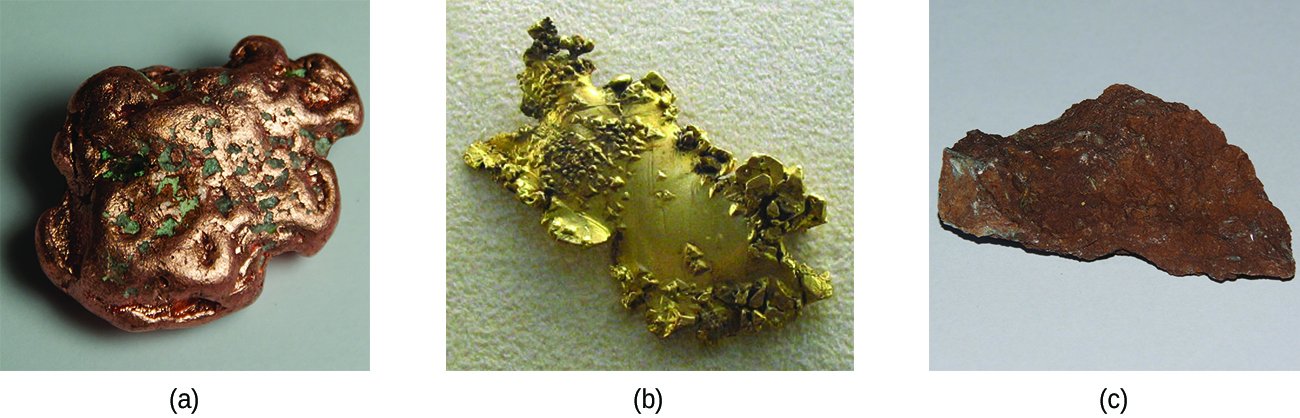
Ancient civilizations knew about iron, copper, silver, and gold. The time periods in human history known as the Bronze Age and Iron Age mark the advancements in which societies learned to isolate certain metals and use them to make tools and goods. Naturally occurring ores of copper, silver, and gold can contain high concentrations of these metals in elemental form (Figure 19.5). Iron, on the other hand, occurs on earth almost exclusively in oxidized forms, such as rust (Fe2O3). The earliest known iron implements were made from iron meteorites. Surviving iron artifacts dating from approximately 4000 to 2500 BC are rare, but all known examples contain specific alloys of iron and nickel that occur only in extraterrestrial objects, not on earth. It took thousands of years of technological advances before civilizations developed iron smelting, the ability to extract a pure element from its naturally occurring ores and for iron tools to become common.
英語のヒント
古代文明は、鉄、銅、銀、金を知っていた。青銅器時代や鉄器時代として知られる人類史の時期は、社会が特定の金属を単離し、道具や物品の製作に使うことを学んだ進歩を示している。天然の銅、銀、金の鉱石には、これらの金属が単体の形で高濃度に含まれることがある(図19.5)。一方、地球上の鉄は、さびFe2O3など、ほぼもっぱら酸化された形で存在する。知られている最古の鉄製道具は、鉄隕石から作られた。紀元前約4000~2500年の、現存する鉄製品はまれだが、知られている例はすべて、地球上ではなく地球外の物体だけに存在する、特定の鉄・ニッケル合金を含んでいる。文明が鉄の製錬、すなわち天然の鉱石から純粋な元素を抽出する能力を発達させ、鉄の道具が一般的になるまでには、何千年もの技術的進歩を要した。
OpenStax, Rice University, Chemistry 2e. Original caption credit: (credit a: modification of work by http://images-of-elements.com/copper-2.jpg; credit c: modification of work by http://images-of-elements.com/iron-ore.jpg) · CC BY 3.0; OpenStax composition CC BY 4.0 · Source出典
Figure 19.5図 19.5
Transition metals occur in nature in various forms. Examples include (a) a nugget of copper, (b) a deposit of gold, and (c) an ore containing oxidized iron. (credit a: modification of work by http://images-of-elements.com/copper-2.jpg; credit c: modification of work by http://images-of-elements.com/iron-ore.jpg)
遷移金属は、自然界にさまざまな形で存在する。例として、(a) 銅の塊、(b) 金の鉱床、(c) 酸化された鉄を含む鉱石を示す。(クレジットa:http://images-of-elements.com/copper-2.jpgの作品を改変。クレジットc:http://images-of-elements.com/iron-ore.jpgの作品を改変。)
Generally, the transition elements are extracted from minerals found in a variety of ores. However, the ease of their recovery varies widely, depending on the concentration of the element in the ore, the identity of the other elements present, and the difficulty of reducing the element to the free metal.
一般に、遷移元素は、さまざまな鉱石に含まれる鉱物から抽出される。しかし、回収のしやすさは、鉱石中の元素濃度、共存する他の元素の種類、および元素を単体金属へ還元する難しさによって、大きく異なる。
In general, it is not difficult to reduce ions of the d-block elements to the free element. Carbon is a sufficiently strong reducing agent in most cases. However, like the ions of the more active main group metals, ions of the f-block elements must be isolated by electrolysis or by reduction with an active metal such as calcium.
一般に、dブロック元素のイオンを単体に還元することは難しくない。大部分の場合、炭素は十分に強い還元剤である。しかし、活性の高い主族金属のイオンと同様に、fブロック元素のイオンは、電気分解、またはカルシウムなどの活性金属による還元で単離しなければならない。
We shall discuss the processes used for the isolation of iron, copper, and silver because these three processes illustrate the principal means of isolating most of the d-block metals. In general, each of these processes involves three principal steps: preliminary treatment, smelting, and refining.
英語のヒント
鉄、銅、銀の単離に使う過程を説明する。この三つの過程によって、dブロック金属の大部分を単離する主要な方法が示されるためである。一般に、各過程は、予備処理、溶融製錬、精製の三つの主要な段階を含む。
- Preliminary treatment. In general, there is an initial treatment of the ores to make them suitable for the extraction of the metals. This usually involves crushing or grinding the ore, concentrating the metal-bearing components, and sometimes treating these substances chemically to convert them into compounds that are easier to reduce to the metal.
英語のヒント
予備処理。一般に、鉱石を金属の抽出に適したものにするため、最初の処理を行う。通常は、鉱石の破砕または粉砕、金属を含む成分の濃縮、場合によっては、それらを金属へ還元しやすい化合物に変えるための化学処理を含む。 - Smelting. The next step is the extraction of the metal in the molten state, a process called smelting, which includes reduction of the metallic compound to the metal. Impurities may be removed by the addition of a compound that forms a slag—a substance with a low melting point that can be readily separated from the molten metal.
英語のヒント
溶融製錬。次の段階は、金属を溶融状態で抽出する、溶融製錬と呼ばれる過程であり、金属化合物を金属に還元することを含む。スラグを作る化合物を加えることで、不純物を除ける場合がある。スラグとは、融点が低く、溶融金属から容易に分離できる物質である。 - Refining. The final step in the recovery of a metal is refining the metal. Low boiling metals such as zinc and mercury can be refined by distillation. When fused on an inclined table, low melting metals like tin flow away from higher-melting impurities. Electrolysis is another common method for refining metals.
英語のヒント
精製。金属を回収する最終段階は、金属の精製である。亜鉛や水銀などの低沸点金属は、蒸留によって精製できる。傾斜した台の上で溶融させると、スズのような低融点金属は、融点の高い不純物から流れ去る。電気分解も、金属を精製する一般的な方法である。
Isolation of Iron鉄の単離
The early application of iron to the manufacture of tools and weapons was possible because of the wide distribution of iron ores and the ease with which iron compounds in the ores could be reduced by carbon. For a long time, charcoal was the form of carbon used in the reduction process. The production and use of iron became much more widespread about 1620, when coke was introduced as the reducing agent. Coke is a form of carbon formed by heating coal in the absence of air to remove impurities.
鉄を早い時代から道具や武器の製造に使えたのは、鉄鉱石が広く分布し、鉱石中の鉄化合物が炭素で容易に還元できたためである。長い間、還元過程で使われる炭素の形は木炭であった。約1620年に還元剤としてコークスが導入されると、鉄の生産と利用ははるかに広範になった。コークスは、空気のない状態で石炭を加熱して不純物を除き、形成される炭素の一形態である。
The first step in the metallurgy of iron is usually roasting the ore (heating the ore in air) to remove water, decomposing carbonates into oxides, and converting sulfides into oxides. The oxides are then reduced in a blast furnace that is 80–100 feet high and about 25 feet in diameter (Figure 19.6) in which the roasted ore, coke, and limestone (impure CaCO3) are introduced continuously into the top. Molten iron and slag are withdrawn at the bottom. The entire stock in a furnace may weigh several hundred tons.
英語のヒント
鉄の冶金の最初の段階は、通常、鉱石を焙焼すること(空気中で加熱すること)である。これによって水を除き、炭酸塩を酸化物へ分解し、硫化物を酸化物へ変える。その後、酸化物は、高さ80~100フィート、直径約25フィートの高炉(図19.6)で還元される。焙焼した鉱石、コークス、石灰岩(不純なCaCO3)を、上部から連続的に投入する。溶融鉄とスラグは底部から抜き出される。炉内の装入物全体の質量は、数百トンに達することがある。
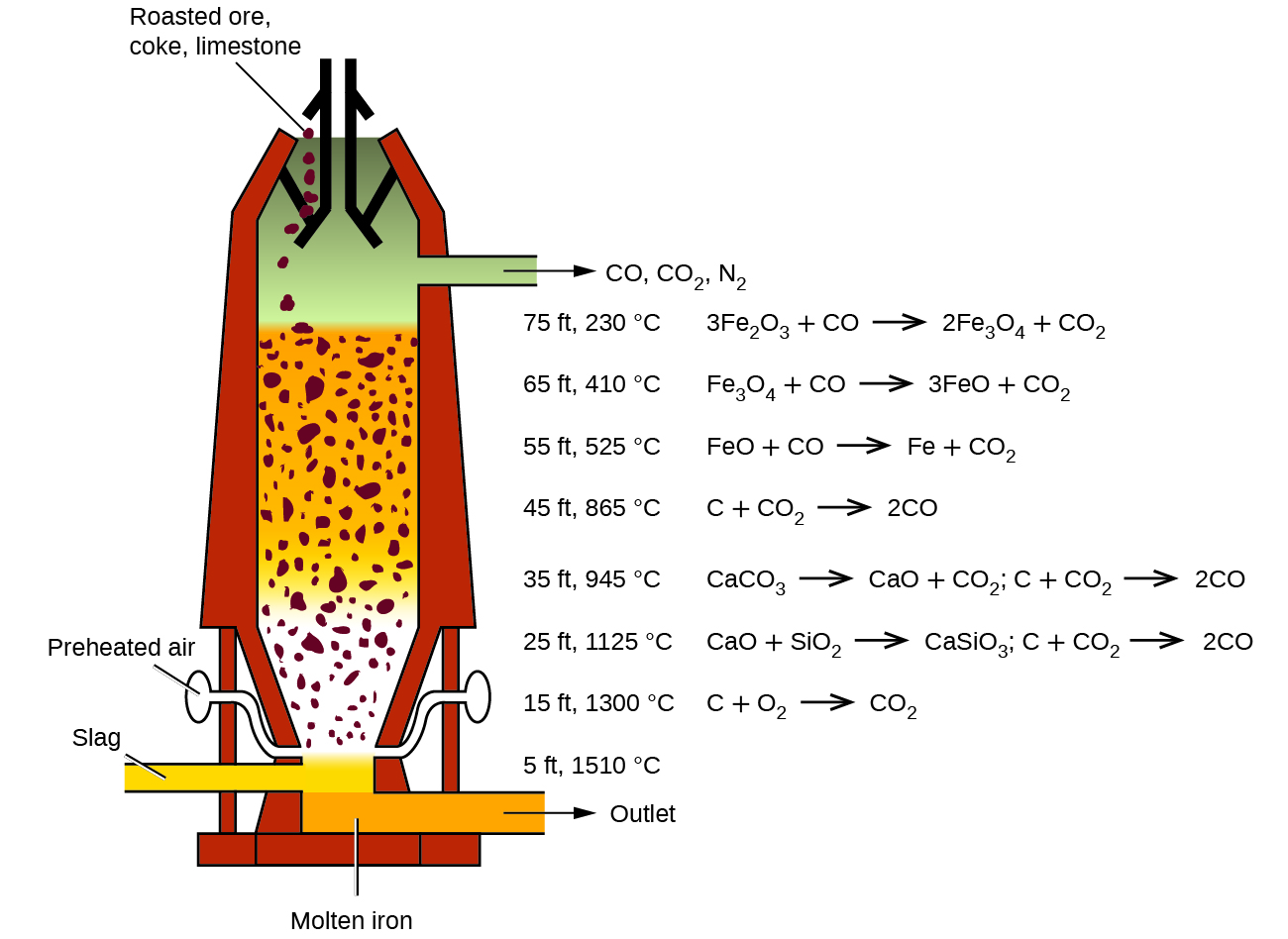

Figure 19.6図 19.6
Within a blast furnace, different reactions occur in different temperature zones. Carbon monoxide is generated in the hotter bottom regions and rises upward to reduce the iron oxides to pure iron through a series of reactions that take place in the upper regions.
高炉内では、温度帯ごとに異なる反応が起こる。温度の高い底部で一酸化炭素が生じ、上へ昇り、上部で起こる一連の反応を通じて、鉄酸化物を純粋な鉄へ還元する。
Near the bottom of a furnace are nozzles through which preheated air is blown into the furnace. As soon as the air enters, the coke in the region of the nozzles is oxidized to carbon dioxide with the liberation of a great deal of heat. The hot carbon dioxide passes upward through the overlying layer of white-hot coke, where it is reduced to carbon monoxide:
英語のヒント
炉の底付近にはノズルがあり、予熱した空気がそこから炉内へ吹き込まれる。空気が入るとすぐに、ノズル付近のコークスが二酸化炭素へ酸化され、多量の熱が放出される。高温の二酸化炭素は、その上にある白熱したコークス層を通って上昇し、そこで一酸化炭素へ還元される。
The carbon monoxide serves as the reducing agent in the upper regions of the furnace. The individual reactions are indicated in Figure 19.6.
一酸化炭素は、炉の上部で還元剤として働く。個々の反応を、図19.6に示している。
The iron oxides are reduced in the upper region of the furnace. In the middle region, limestone (calcium carbonate) decomposes, and the resulting calcium oxide combines with silica and silicates in the ore to form slag. The slag is mostly calcium silicate and contains most of the commercially unimportant components of the ore:
鉄酸化物は炉の上部で還元される。中間部では石灰岩(炭酸カルシウム)が分解し、生じた酸化カルシウムが鉱石中のシリカやケイ酸塩と結合して、スラグを作る。スラグは主としてケイ酸カルシウムであり、鉱石中の商業的に重要でない成分の大部分を含む。
Just below the middle of the furnace, the temperature is high enough to melt both the iron and the slag. They collect in layers at the bottom of the furnace; the less dense slag floats on the iron and protects it from oxidation. Several times a day, the slag and molten iron are withdrawn from the furnace. The iron is transferred to casting machines or to a steelmaking plant (Figure 19.7).
炉の中央より少し下では、鉄とスラグの両方が溶融するほど温度が高い。それらは炉底に層状にたまり、密度の低いスラグが鉄の上に浮き、鉄を酸化から守る。一日に数回、スラグと溶融鉄を炉から抜き出す。鉄は、鋳造機または製鋼工場へ移される(図19.7)。
Image omitted because its reuse rights could not be verified.権利の確認ができないため画像を割愛。
Figure 19.7図 19.7
Molten iron is shown being cast as steel. (credit: Clint Budd)
溶融鉄が鋼として鋳造されているところを示す。(クレジット:Clint Budd)
Much of the iron produced is refined and converted into steel. Steel is made from iron by removing impurities and adding substances such as manganese, chromium, nickel, tungsten, molybdenum, and vanadium to produce alloys with properties that make the material suitable for specific uses. Most steels also contain small but definite percentages of carbon (0.04%–2.5%). However, a large part of the carbon contained in iron must be removed in the manufacture of steel; otherwise, the excess carbon would make the iron brittle.
英語のヒント
生産された鉄の多くは精製され、鋼へ変えられる。鉄から不純物を除き、マンガン、クロム、ニッケル、タングステン、モリブデン、バナジウムなどの物質を加えて、特定の用途に適した性質を持つ合金にすることで、鋼を作る。鋼の大部分は、少量ではあるが一定の割合の炭素(0.04~2.5%)も含む。しかし、鋼の製造では、鉄に含まれる炭素の大部分を除かなければならない。そうしなければ、過剰な炭素によって鉄がもろくなる。