第19章遷移金属と錯体化学
Coordination Complexes in Nature and Technology自然と技術における配位錯体
Chlorophyll, the green pigment in plants, is a complex that contains magnesium (Figure 19.25). This is an example of a main group element in a coordination complex. Plants appear green because chlorophyll absorbs red and purple light; the reflected light consequently appears green. The energy resulting from the absorption of light is used in photosynthesis.
英語のヒント
植物の緑色色素であるクロロフィルは、マグネシウムを含む錯体である(図19.25)。これは、配位錯体に含まれる主族元素の例である。植物が緑色に見えるのは、クロロフィルが赤色と紫色の光を吸収し、その結果、反射光が緑色に見えるからである。光の吸収によって生じるエネルギーは、光合成に使われる。
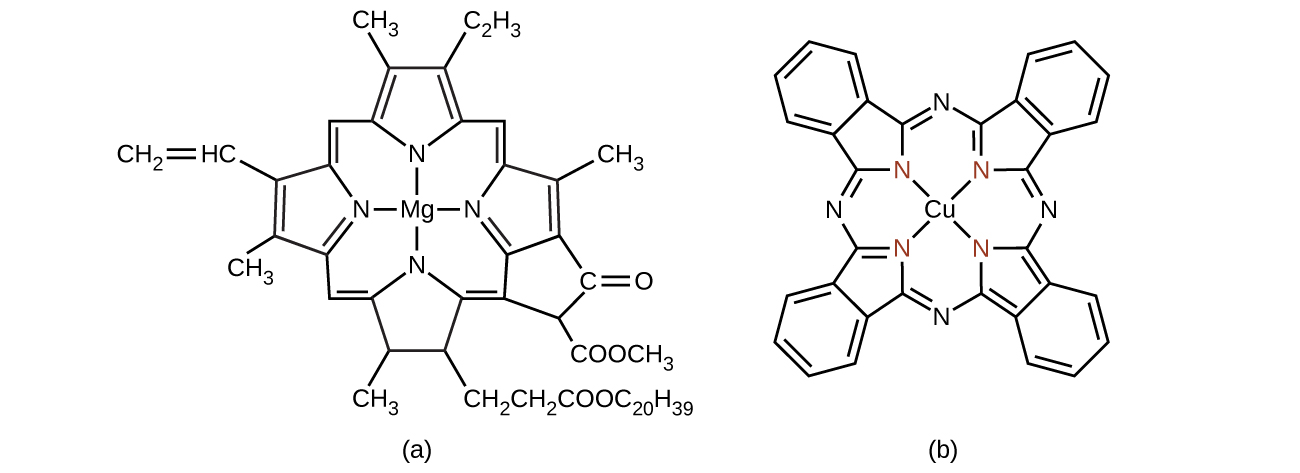
Figure 19.25図 19.25
(a) Chlorophyll comes in several different forms, which all have the same basic structure around the magnesium center. (b) Copper phthalocyanine blue, a square planar copper complex, is present in some blue dyes.
(a) クロロフィルにはいくつかの異なる形があるが、いずれもマグネシウム中心の周囲に同じ基本構造を持つ。(b) 平面正方形の銅錯体である銅フタロシアニンブルーは、一部の青色染料に含まれる。
Many other coordination complexes are also brightly colored. The square planar copper(II) complex phthalocyanine blue (from Figure 19.25) is one of many complexes used as pigments or dyes. This complex is used in blue ink, blue jeans, and certain blue paints.
他の多くの配位錯体も鮮やかな色を持つ。平面正方形の銅(II)錯体であるフタロシアニンブルー(図19.25)は、顔料や染料として使われる多くの錯体の一つである。この錯体は、青色インク、ブルージーンズ、一部の青色塗料に使われる。
The structure of heme (Figure 19.29), the iron-containing complex in hemoglobin, is very similar to that in chlorophyll. In hemoglobin, the red heme complex is bonded to a large protein molecule (globin) by the attachment of the protein to the heme ligand. Oxygen molecules are transported by hemoglobin in the blood by being bound to the iron center. When the hemoglobin loses its oxygen, the color changes to a bluish red. Hemoglobin will only transport oxygen if the iron is Fe2+; oxidation of the iron to Fe3+ prevents oxygen transport.
英語のヒント
ヘモグロビンに含まれる鉄錯体、ヘム(図19.29)の構造は、クロロフィルの構造と非常によく似ている。ヘモグロビンでは、タンパク質がヘム配位子に結合することによって、赤色のヘム錯体が大きなタンパク質分子(グロビン)に結合している。酸素分子は鉄中心に結合することで、血液中のヘモグロビンによって運ばれる。ヘモグロビンが酸素を失うと、色は青みがかった赤に変わる。ヘモグロビンが酸素を運ぶのは、鉄がFe2+である場合だけであり、鉄がFe3+へ酸化されると、酸素を運べなくなる。
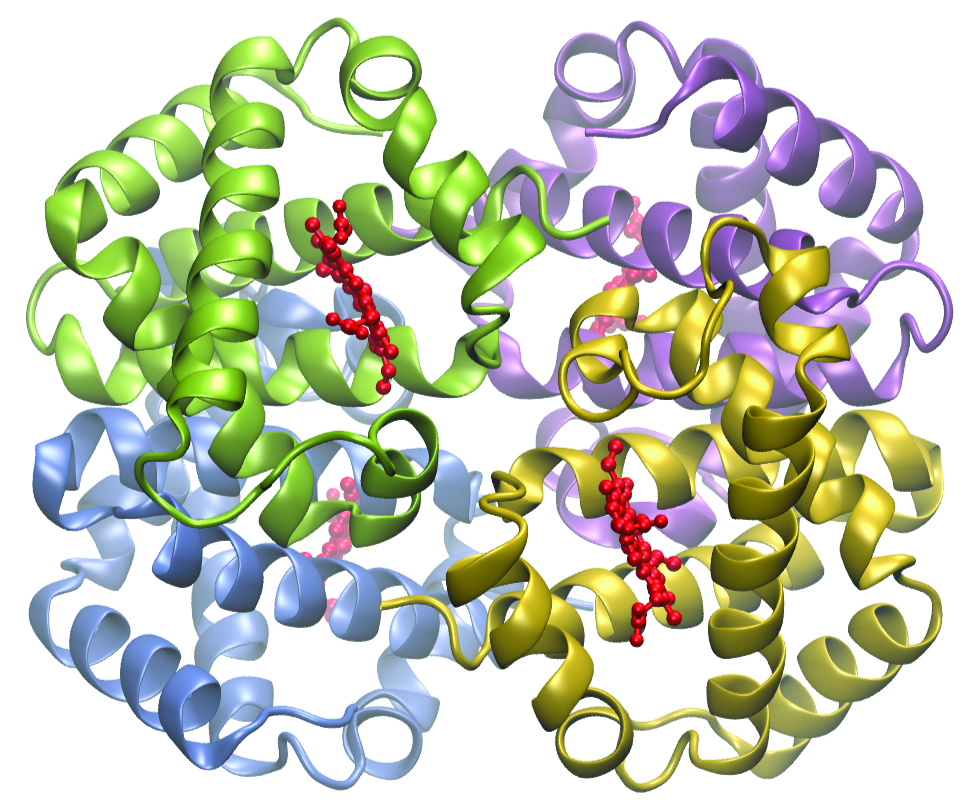
Figure 19.29図 19.29
Hemoglobin contains four protein subunits, each of which has an iron center attached to a heme ligand (shown in red), which is coordinated to a globin protein. Each subunit is shown in a different color.
ヘモグロビンは四つのタンパク質サブユニットを含む。各サブユニットはヘム配位子(赤で表示)に結合した鉄中心を持ち、このヘム配位子はグロビンタンパク質に配位している。各サブユニットを異なる色で示している。
Complexing agents often are used for water softening because they tie up such ions as Ca2+, Mg2+, and Fe2+, which make water hard. Many metal ions are also undesirable in food products because these ions can catalyze reactions that change the color of food. Coordination complexes are useful as preservatives. For example, the ligand EDTA, (HO2CCH2)2NCH2CH2N(CH2CO2H)2, coordinates to metal ions through six donor atoms and prevents the metals from reacting (Figure 19.30). This ligand also is used to sequester metal ions in paper production, textiles, and detergents, and has pharmaceutical uses.
英語のヒント
錯形成剤は、水を硬水にするCa2+、Mg2+、Fe2+などのイオンを捕らえるため、しばしば水の軟化に使われる。多くの金属イオンは、食品の色を変える反応を触媒できるため、食品中でも望ましくない。配位錯体は保存料として役立つ。たとえば、配位子EDTA、(HO2CCH2)2NCH2CH2N(CH2CO2H)2は、六個の供与原子を介して金属イオンに配位し、金属が反応するのを防ぐ(図19.30)。この配位子は、製紙、繊維、洗剤においても金属イオンを捕捉するために使われ、医薬品としての用途もある。
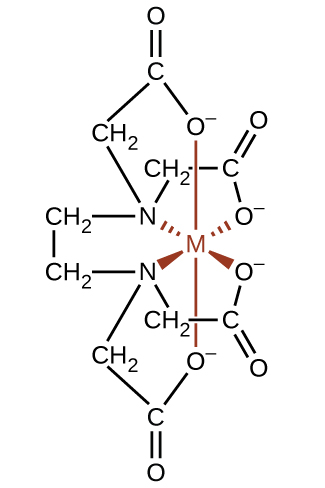
Figure 19.30図 19.30
The ligand EDTA binds tightly to a variety of metal ions by forming hexadentate complexes.
英語のヒント
配位子EDTAは、六座錯体を形成することにより、さまざまな金属イオンに強く結合する。
Complexing agents that tie up metal ions are also used as drugs. British Anti-Lewisite (BAL), HSCH2CH(SH)CH2OH, is a drug developed during World War I as an antidote for the arsenic-based war gas Lewisite. BAL is now used to treat poisoning by heavy metals, such as arsenic, mercury, thallium, and chromium. The drug is a ligand and functions by making a water-soluble chelate of the metal; the kidneys eliminate this metal chelate (Figure 19.31). Another polydentate ligand, enterobactin, which is isolated from certain bacteria, is used to form complexes of iron and thereby to control the severe iron buildup found in patients suffering from blood diseases such as Cooley’s anemia, who require frequent transfusions. As the transfused blood breaks down, the usual metabolic processes that remove iron are overloaded, and excess iron can build up to fatal levels. Enterobactin forms a water-soluble complex with excess iron, and the body can safely eliminate this complex.
英語のヒント
金属イオンを捕らえる錯形成剤は、医薬品としても使われる。英国抗ルイサイト剤(BAL)、HSCH2CH(SH)CH2OHは、ヒ素を主成分とする戦用ガス、ルイサイトの解毒剤として、第一次世界大戦中に開発された薬である。BALは現在、ヒ素、水銀、タリウム、クロムなどの重金属による中毒の治療に使われる。この薬は配位子であり、金属の水溶性キレートを作ることで作用する。腎臓がこの金属キレートを排泄する(図19.31)。特定の細菌から単離される別の多座配位子、エンテロバクチンは、鉄の錯体を作るために使われる。これにより、クーリー貧血などの血液疾患を患い、頻繁な輸血を必要とする患者に見られる、深刻な鉄の蓄積を抑える。輸血された血液が分解されると、鉄を除く通常の代謝過程に過剰な負担がかかり、過剰な鉄が致死的な量にまで蓄積することがある。エンテロバクチンは過剰な鉄と水溶性錯体を作り、体はこの錯体を安全に排泄できる。
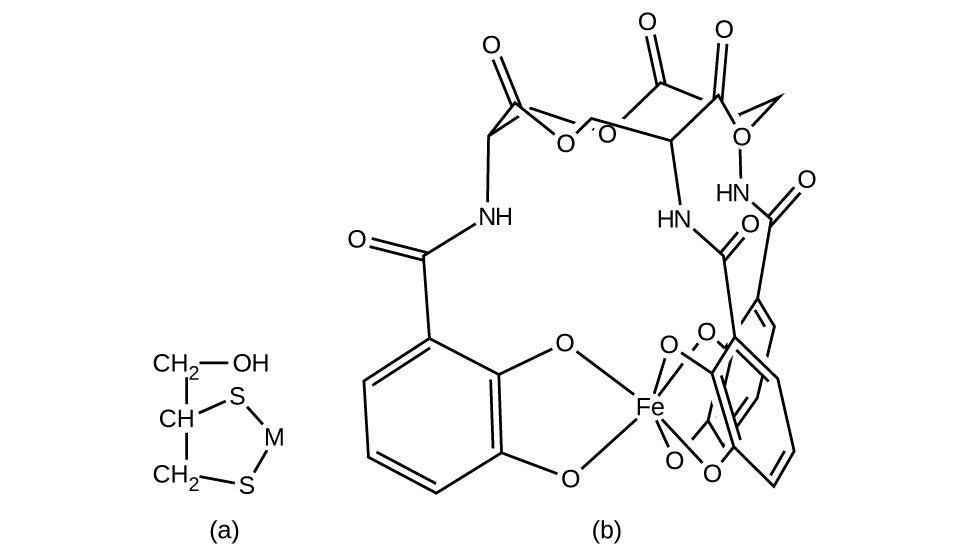
Figure 19.31図 19.31
Coordination complexes are used as drugs. (a) British Anti-Lewisite is used to treat heavy metal poisoning by coordinating metals (M), and enterobactin (b) allows excess iron in the blood to be removed.
配位錯体は医薬品として使われる。(a) 英国抗ルイサイト剤は、金属(M)に配位することによって重金属中毒を治療するために使われる。(b) エンテロバクチンは、血液中の過剰な鉄を除けるようにする。
Example 19.6例題 19.6
Chelation Therapyキレート療法
Ligands like BAL and enterobactin are important in medical treatments for heavy metal poisoning. However, chelation therapies can disrupt the normal concentration of ions in the body, leading to serious side effects, so researchers are searching for new chelation drugs. One drug that has been developed is dimercaptosuccinic acid (DMSA), shown in Figure 19.32. Identify which atoms in this molecule could act as donor atoms.
英語のヒント
BALやエンテロバクチンのような配位子は、重金属中毒の医学的治療で重要である。しかし、キレート療法は体内の正常なイオン濃度を乱し、深刻な副作用を引き起こすことがあるので、研究者は新しいキレート薬を探している。開発された薬の一つが、図19.32に示すジメルカプトコハク酸(DMSA)である。この分子内のどの原子が、供与原子として働く可能性があるかを特定しなさい。
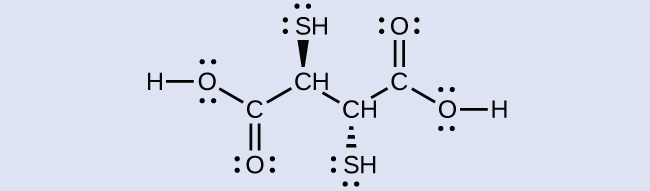


Figure 19.32図 19.32
Dimercaptosuccinic acid is used to treat heavy metal poisoning.
ジメルカプトコハク酸は、重金属中毒の治療に使われる。
Solution解き方
All of the oxygen and sulfur atoms have lone pairs of electrons that can be used to coordinate to a metal center, so there are six possible donor atoms. Geometrically, only two of these atoms can be coordinated to a metal at once. The most common binding mode involves the coordination of one sulfur atom and one oxygen atom, forming a five-member ring with the metal.
英語のヒント
すべての酸素原子と硫黄原子は、金属中心への配位に使える孤立電子対を持つので、供与原子となりうる原子は六個ある。幾何学的には、これらの原子のうち二個だけが、同時に一つの金属に配位できる。最も一般的な結合様式では、硫黄原子一個と酸素原子一個が配位し、金属を含む五員環を作る。
Check Your Learning理解度の確認
Some alternative medicine practitioners recommend chelation treatments for ailments that are not clearly related to heavy metals, such as cancer and autism, although the practice is discouraged by many scientific organizations. National Council against Health Fraud, NCAHF Policy Statement on Chelation Therapy, (Peabody, MA, 2002). Identify at least two biologically important metals that could be disrupted by chelation therapy.
英語のヒント
一部の代替医療の施術者は、がんや自閉症など、重金属との関連が明確でない疾患にキレート治療を勧めているが、多くの科学団体はその実施を推奨していない。全米医療詐欺対策評議会「キレート療法に関するNCAHF方針声明」(マサチューセッツ州ピーボディ、2002年)。キレート療法によって乱される可能性がある、生物学的に重要な金属を少なくとも二つ挙げなさい。
Ligands are also used in the electroplating industry. When metal ions are reduced to produce thin metal coatings, metals can clump together to form clusters and nanoparticles. When metal coordination complexes are used, the ligands keep the metal atoms isolated from each other. It has been found that many metals plate out as a smoother, more uniform, better-looking, and more adherent surface when plated from a bath containing the metal as a complex ion. Thus, complexes such as [Ag(CN)2]− and [Au(CN)2]− are used extensively in the electroplating industry.
英語のヒント
配位子は、電気めっき産業でも使われる。金属イオンを還元して薄い金属皮膜を作るとき、金属は凝集して、クラスターやナノ粒子を作ることがある。金属配位錯体を使うと、配位子が金属原子を互いに隔離した状態に保つ。金属を錯イオンとして含む浴からめっきすると、多くの金属が、より滑らかで、より均一で、外観がよく、より密着性の高い表面として析出することが分かっている。したがって、[Ag(CN)2]−や[Au(CN)2]−などの錯体は、電気めっき産業で広く使われている。
In 1965, scientists at Michigan State University discovered that there was a platinum complex that inhibited cell division in certain microorganisms. Later work showed that the complex was cis-diamminedichloroplatinum(II), [Pt(NH3)2(Cl)2], and that the trans isomer was not effective. The inhibition of cell division indicated that this square planar compound could be an anticancer agent. In 1978, the US Food and Drug Administration approved this compound, known as cisplatin, for use in the treatment of certain forms of cancer. Since that time, many similar platinum compounds have been developed for the treatment of cancer. In all cases, these are the cis isomers and never the trans isomers. The diammine (NH3)2 portion is retained with other groups, replacing the dichloro [(Cl)2] portion. The newer drugs include carboplatin, oxaliplatin, and satraplatin.
英語のヒント
1965年、ミシガン州立大学の科学者たちは、特定の微生物の細胞分裂を阻害する白金錯体があることを発見した。その後の研究で、その錯体はシス-ジアンミンジクロロ白金(II)、[Pt(NH3)2(Cl)2]であり、トランス異性体には効果がないことが示された。細胞分裂の阻害は、この平面正方形の化合物が抗がん剤になりうることを示していた。1978年、米国食品医薬品局は、シスプラチンとして知られるこの化合物を、特定の種類のがんの治療に用いることを承認した。それ以降、がんの治療のために、多くの類似した白金化合物が開発されてきた。いずれの場合も、これらはシス異性体であり、トランス異性体では決してない。ジアンミン(NH3)2部分は保持し、ジクロロ[(Cl)2]部分を他の基で置き換えている。より新しい薬には、カルボプラチン、オキサリプラチン、サトラプラチンがある。