第19章遷移金属と錯体化学
Key Concepts and Summary重要概念とまとめ
The transition elements and main group elements can form coordination compounds, or complexes, in which a central metal atom or ion is bonded to one or more ligands by coordinate covalent bonds. Ligands with more than one donor atom are called polydentate ligands and form chelates. The common geometries found in complexes are tetrahedral and square planar (both with a coordination number of four) and octahedral (with a coordination number of six). Cis and trans configurations are possible in some octahedral and square planar complexes. In addition to these geometrical isomers, optical isomers (molecules or ions that are mirror images but not superimposable) are possible in certain octahedral complexes. Coordination complexes have a wide variety of uses including oxygen transport in blood, water purification, and pharmaceutical use.
遷移元素と主族元素は、配位化合物、すなわち錯体を作ることができる。そこでは、中心金属原子またはイオンが、一つ以上の配位子と配位共有結合で結合している。供与原子を複数持つ配位子は多座配位子と呼ばれ、キレートを作る。錯体に一般的に見られる形状は、四面体と平面正方形(どちらも配位数4)、および八面体(配位数6)である。一部の八面体錯体と平面正方形錯体では、シス配置とトランス配置が可能である。これらの幾何異性体に加え、特定の八面体錯体では、光学異性体(互いに鏡像であるが重ね合わせられない分子やイオン)も可能である。配位錯体には、血液中の酸素輸送、水の浄化、医薬品としての利用など、非常に多様な用途がある。
Chemistry End of Chapter Exercises章末問題
Exercises 26–35練習問題 26–35
Exercise 26問題 26
Indicate the coordination number for the central metal atom in each of the following coordination compounds:
次の各配位化合物について、中心金属原子の配位数を示しなさい。
(a) [Pt(H2O)2Br2]
(a) [Pt(H2O)2Br2]
(b) [Pt(NH3)(py)(Cl)(Br)] (py = pyridine, C5H5N)
(b) [Pt(NH3)(py)(Cl)(Br)](py = ピリジン、C5H5N)
(c) [Zn(NH3)2Cl2]
(c) [Zn(NH3)2Cl2]
(d) [Zn(NH3)(py)(Cl)(Br)]
(d) [Zn(NH3)(py)(Cl)(Br)]
(e) [Ni(H2O)4Cl2]
(e) [Ni(H2O)4Cl2]
(f) [Fe(en)2(CN)2]+ (en = ethylenediamine, C2H8N2)
(f) [Fe(en)2(CN)2]+(en = エチレンジアミン、C2H8N2)
Exercise 27問題 27
Give the coordination numbers and write the formulas for each of the following, including all isomers where appropriate:
次のそれぞれについて、必要に応じてすべての異性体を含め、配位数を示し、化学式を書きなさい。
(a) tetrahydroxozincate(II) ion (tetrahedral)
(a) テトラヒドロキソ亜鉛(II)酸イオン(四面体)
(b) hexacyanopalladate(IV) ion
(b) ヘキサシアノパラジウム(IV)酸イオン
(c) dichloroaurate(I) ion (note that aurum is Latin for "gold")
(c) ジクロロ金(I)酸イオン(aurumはラテン語で「金」を意味することに注意)
(d) diamminedichloroplatinum(II)
(d) ジアンミンジクロロ白金(II)
(e) potassium diamminetetrachlorochromate(III)
(e) ジアンミンテトラクロロクロム(III)酸カリウム
(f) hexaamminecobalt(III) hexacyanochromate(III)
(f) ヘキサシアノクロム(III)酸ヘキサアンミンコバルト(III)
(g) dibromobis(ethylenediamine) cobalt(III) nitrate
(g) 硝酸ジブロモビス(エチレンジアミン)コバルト(III)
Solution解き方
(a) 4, [Zn(OH)4]2−; (b) 6, [Pd(CN)6]2−; (c) 2, [AuCl2]−; (d) 4, [Pt(NH3)2Cl2]; (e) 6, K[Cr(NH3)2Cl4]; (f) 6, [Co(NH3)6][Cr(CN)6]; (g) 6, [Co(en)2Br2]NO3
(a) 4, [Zn(OH)4]2−; (b) 6, [Pd(CN)6]2−; (c) 2, [AuCl2]−; (d) 4, [Pt(NH3)2Cl2]; (e) 6, K[Cr(NH3)2Cl4]; (f) 6, [Co(NH3)6][Cr(CN)6]; (g) 6, [Co(en)2Br2]NO3
Exercise 28問題 28
Give the coordination number for each metal ion in the following compounds:
次の化合物中の各金属イオンの配位数を示しなさい。
(a) [Co(CO3)3]3− (note that CO32− is bidentate in this complex)
(a) [Co(CO3)3]3−(この錯体ではCO32−が二座配位子であることに注意)
(b) [Cu(NH3)4]2+
(b) [Cu(NH3)4]2+
(c) [Co(NH3)4Br2]2(SO4)
(c) [Co(NH3)4Br2]2(SO4)
(d) [Pt(NH3)4][PtCl4]
(d) [Pt(NH3)4][PtCl4]
(e) [Cr(en)3](NO3)3
(e) [Cr(en)3](NO3)3
(f) [Pd(NH3)2Br2] (square planar)
(f) [Pd(NH3)2Br2](平面正方形)
(g) K3[Cu(Cl)5]
(g) K3[Cu(Cl)5]
(h) [Zn(NH3)2Cl2]
(h) [Zn(NH3)2Cl2]
Exercise 29問題 29
Sketch the structures of the following complexes. Indicate any cis, trans, and optical isomers.
次の錯体の構造を描きなさい。存在するシス異性体、トランス異性体、光学異性体を示しなさい。
(a) [Pt(H2O)2Br2] (square planar)
(a) [Pt(H2O)2Br2](平面正方形)
(b) [Pt(NH3)(py)(Cl)(Br)] (square planar, py = pyridine, C5H5N)
(b) [Pt(NH3)(py)(Cl)(Br)](平面正方形、py = ピリジン、C5H5N)
(c) [Zn(NH3)3Cl]+ (tetrahedral)
(c) [Zn(NH3)3Cl]+(四面体)
(d) [Pt(NH3)3Cl]+ (square planar)
(d) [Pt(NH3)3Cl]+(平面正方形)
(e) [Ni(H2O)4Cl2]
(e) [Ni(H2O)4Cl2]
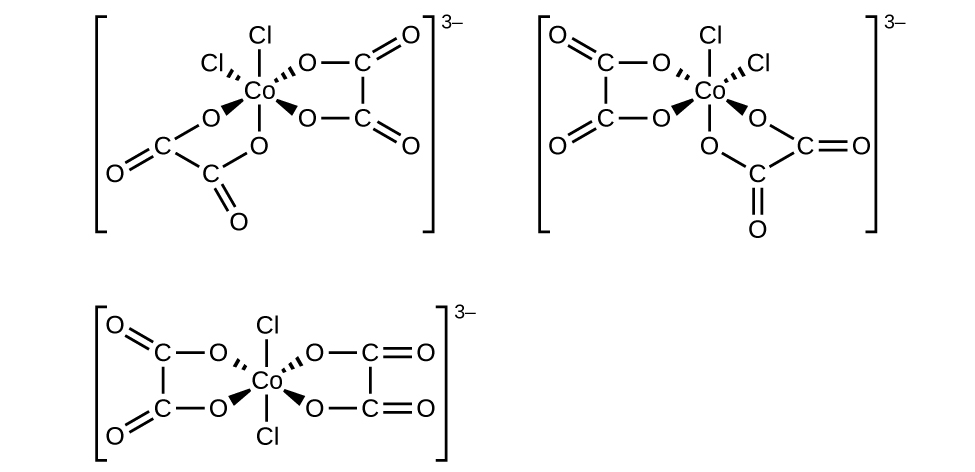
(f) [Co(C2O4)2Cl2]3− (note that is the bidentate oxalate ion,
(f) [Co(C2O4)2Cl2]3−(は二座のシュウ酸イオンであることに注意、
Solution解き方
(a) [Pt(H2O)2Br2]:
(a) [Pt(H2O)2Br2]:
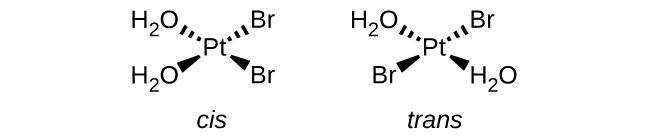
(b) [Pt(NH3)(py)(Cl)(Br)]:
(b) [Pt(NH3)(py)(Cl)(Br)]:

(c) [Zn(NH3)3Cl]+ :
(c) [Zn(NH3)3Cl]+ :
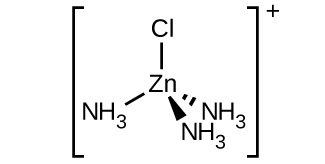
(d) [Pt(NH3)3Cl]+ :
(d) [Pt(NH3)3Cl]+ :
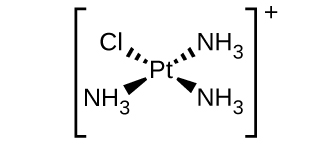
(e) [Ni(H2O)4Cl2]:
(e) [Ni(H2O)4Cl2]:
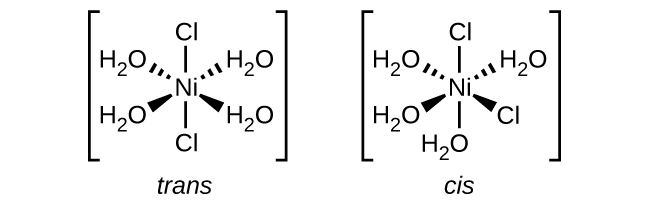
(f) [Co(C2O4)2Cl2]3−:
(f) [Co(C2O4)2Cl2]3−:
Exercise 30問題 30
Draw diagrams for any cis, trans, and optical isomers that could exist for the following (en is ethylenediamine):
次について、存在しうるシス異性体、トランス異性体、光学異性体をすべて図に描きなさい(enはエチレンジアミン)。
(a) [Co(en)2(NO2)Cl]+
(a) [Co(en)2(NO2)Cl]+
(b) [Co(en)2Cl2]+
(b) [Co(en)2Cl2]+
(c) [Pt(NH3)2Cl4]
(c) [Pt(NH3)2Cl4]
(d) [Cr(en)3]3+
(d) [Cr(en)3]3+
(e) [Pt(NH3)2Cl2]
(e) [Pt(NH3)2Cl2]
Exercise 31問題 31
Name each of the compounds or ions given in Exercise 28, including the oxidation state of the metal.
演習28に挙げた各化合物またはイオンを、金属の酸化状態を含めて命名しなさい。
Solution解き方
(a) tricarbonatocobaltate(III) ion; (b) tetraaminecopper(II) ion; (c) tetraaminedibromocobalt(III) sulfate; (d) tetraamineplatinum(II) tetrachloroplatinate(II); (e) tris-(ethylenediamine)chromium(III) nitrate; (f) diaminedibromopalladium(II); (g) potassium pentachlorocuprate(II); (h) diaminedichlorozinc(II)
(a) トリカルボナトコバルト(III)酸イオン;(b) テトラアンミン銅(II)イオン;(c) 硫酸テトラアンミンジブロモコバルト(III);(d) テトラクロロ白金(II)酸テトラアンミン白金(II);(e) 硝酸トリス(エチレンジアミン)クロム(III);(f) ジアンミンジブロモパラジウム(II);(g) ペンタクロロ銅(II)酸カリウム;(h) ジアンミンジクロロ亜鉛(II)
Exercise 32問題 32
Name each of the compounds or ions given in Exercise 30.
演習30に挙げた各化合物またはイオンを命名しなさい。
Exercise 33問題 33
Specify whether the following complexes have isomers.
次の錯体に異性体があるかどうかを示しなさい。
(a) tetrahedral [Ni(CO)2(Cl)2]
(a) 四面体の[Ni(CO)2(Cl)2]
(b) trigonal bipyramidal [Mn(CO)4NO]
(b) 三方両錐の[Mn(CO)4NO]
(c) [Pt(en)2Cl2]Cl2
(c) [Pt(en)2Cl2]Cl2
Solution解き方
(a) none; (b) none; (c) The two Cl ligands can be cis or trans. When they are cis, there will also be an optical isomer.
(a) ない;(b) ない;(c) 二つのCl配位子は、シス配置またはトランス配置をとることができる。シス配置では、光学異性体も存在する。
Exercise 34問題 34
Predict whether the carbonate ligand will coordinate to a metal center as a monodentate, bidentate, or tridentate ligand.
炭酸配位子は、金属中心に単座、二座、三座のいずれの配位子として配位するかを予測しなさい。


bidentate ligand
二座配位子
ligand that coordinates to one central metal through coordinate bonds from two different atoms
異なる二個の原子からの配位結合によって、一つの中心金属に配位する配位子。
central metal
中心金属
ion or atom to which one or more ligands is attached through coordinate covalent bonds
一つ以上の配位子が、配位共有結合によって結合しているイオンまたは原子。
chelate
キレート
complex formed from a polydentate ligand attached to a central metal
中心金属に結合した多座配位子から形成される錯体。
chelating ligand
キレート配位子
ligand that attaches to a central metal ion by bonds from two or more donor atoms
二個以上の供与原子からの結合によって、中心金属イオンに結合する配位子。
cis configuration
シス配置
configuration of a geometrical isomer in which two similar groups are on the same side of an imaginary reference line on the molecule
分子上に仮想的に引いた基準線の同じ側に、二つの同様な基がある幾何異性体の配置。
coordination compound
配位化合物
substance consisting of atoms, molecules, or ions attached to a central atom through Lewis acid-base interactions
ルイス酸塩基相互作用を介して中心原子に結合した、原子、分子、またはイオンからなる物質。
coordination number
配位数
number of coordinate covalent bonds to the central metal atom in a complex or the number of closest contacts to an atom in a crystalline form
錯体中の中心金属原子への配位共有結合の数、または結晶形中のある原子に最も近接しているものの数。
coordination sphere
配位圏
central metal atom or ion plus the attached ligands of a complex
錯体の中心金属原子またはイオンと、それに結合した配位子。
donor atom
供与原子
atom in a ligand with a lone pair of electrons that forms a coordinate covalent bond to a central metal
中心金属への配位共有結合を作る孤立電子対を持つ、配位子内の原子。
ionization isomer
イオン化異性体
(or coordination isomer) isomer in which an anionic ligand is replaced by the counter ion in the inner coordination sphere
(配位異性体ともいう)内側の配位圏において、陰イオン配位子が対イオンで置き換えられる異性体。
ligand
配位子
ion or neutral molecule attached to the central metal ion in a coordination compound
配位化合物中で中心金属イオンに結合している、イオンまたは中性分子。
linkage isomer
結合異性体
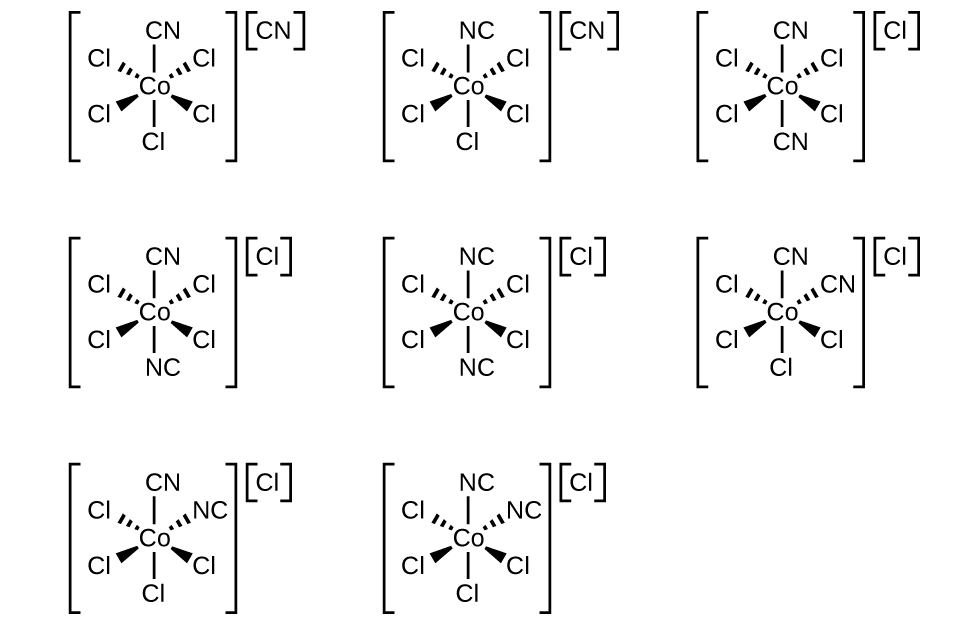
coordination compound that possesses a ligand that can bind to the transition metal in two different ways (CN− vs. NC−)
遷移金属に二つの異なる様式で結合できる配位子を持つ配位化合物(CN−とNC−)。
monodentate
単座
ligand that attaches to a central metal through just one coordinate covalent bond
ただ一本の配位共有結合を介して、中心金属に結合する配位子。
optical isomer
光学異性体
(also, enantiomer) molecule that is a nonsuperimposable mirror image with identical chemical and physical properties, except when it reacts with other optical isomers
(エナンチオマーともいう)重ね合わせられない鏡像である分子。他の光学異性体と反応する場合を除き、化学的・物理的性質が同一である。
polydentate ligand
多座配位子
ligand that is attached to a central metal ion by bonds from two or more donor atoms, named with prefixes specifying how many donors are present (e.g., hexadentate = six coordinate bonds formed)
二個以上の供与原子からの結合によって中心金属イオンに結合している配位子。供与原子の数を指定する接頭辞を付けて命名する(例:六座 = 六本の配位結合を作る)。
trans configuration
トランス配置
configuration of a geometrical isomer in which two similar groups are on opposite sides of an imaginary reference line on the molecule
分子上に仮想的に引いた基準線の反対側に、二つの同様な基がある幾何異性体の配置。