第19章遷移金属と錯体化学
19.1 Occurrence, Preparation, and Properties of Transition Metals and Their Compounds19.1 遷移金属とその化合物の存在・製法・性質
Transition metals are defined as those elements that have (or readily form) partially filled d orbitals. As shown in Figure 19.2, the d-block elements in groups 3–11 are transition elements. The f-block elements, also called inner transition metals (the lanthanides and actinides), also meet this criterion because the d orbital is partially occupied before the f orbitals. The d orbitals fill with the copper family (group 11); for this reason, the next family (group 12) are technically not transition elements. However, the group 12 elements do display some of the same chemical properties and are commonly included in discussions of transition metals. Some chemists do treat the group 12 elements as transition metals.
英語のヒント
遷移金属は、部分的に満たされたd軌道を持つ(または容易に形成する)元素と定義される。図19.2に示すように、3~11族のdブロック元素は遷移元素である。内部遷移金属(ランタノイドとアクチノイド)とも呼ばれるfブロック元素も、f軌道より先にd軌道が部分的に占有されるため、この基準を満たす。d軌道は銅の族(11族)で満たされるので、次の族(12族)は厳密には遷移元素ではない。しかし、12族元素はいくつか同じ化学的性質を示し、遷移金属の説明に含められることが多い。12族元素を遷移金属として扱う化学者もいる。
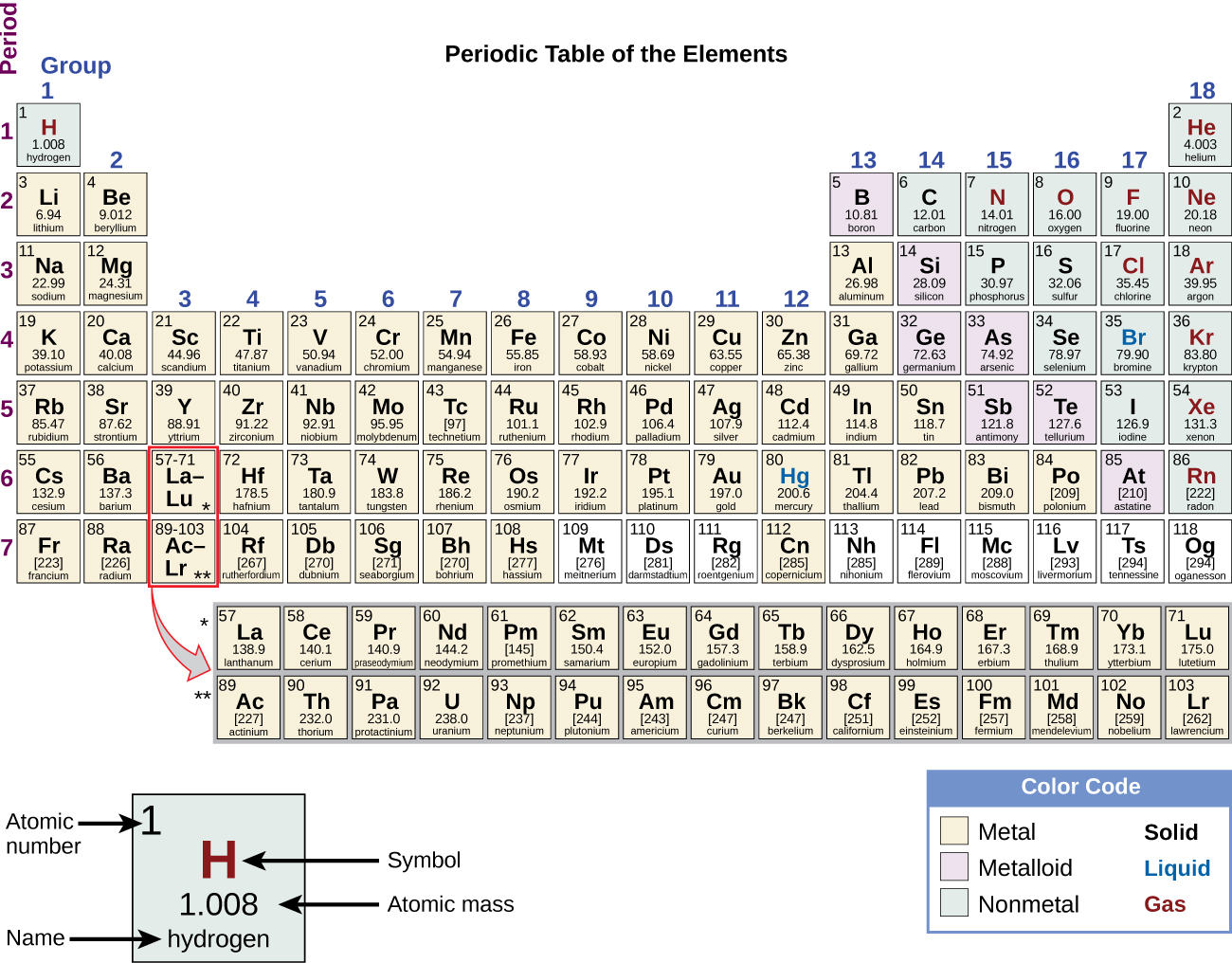

Figure 19.2図 19.2
The transition metals are located in groups 3–11 of the periodic table. The inner transition metals are in the two rows below the body of the table.
遷移金属は、周期表の3~11族に位置する。内部遷移金属は、表本体の下の二行にある。
The d-block elements are divided into the first transition series (the elements Sc through Cu), the second transition series (the elements Y through Ag), and the third transition series (the element La and the elements Hf through Au). Actinium, Ac, is the first member of the fourth transition series, which also includes Rf through Rg.
dブロック元素は、第一遷移系列(ScからCuまでの元素)、第二遷移系列(YからAgまでの元素)、第三遷移系列(La、およびHfからAuまでの元素)に分かれる。アクチニウムAcは第四遷移系列の最初の元素であり、この系列にはRfからRgまでも含まれる。
The f-block elements are the elements Ce through Lu, which constitute the lanthanide series (or lanthanoid series), and the elements Th through Lr, which constitute the actinide series (or actinoid series). Because lanthanum behaves very much like the lanthanide elements, it is considered a lanthanide element, even though its electron configuration makes it the first member of the third transition series. Similarly, the behavior of actinium means it is part of the actinide series, although its electron configuration makes it the first member of the fourth transition series.
fブロック元素は、ランタノイド系列(ランタナイド系列ともいう)を構成するCeからLuまでの元素と、アクチノイド系列(アクチナイド系列ともいう)を構成するThからLrまでの元素である。ランタンは、電子配置上は第三遷移系列の最初の元素であるが、ランタノイド元素に非常によく似た挙動を示すため、ランタノイド元素とみなされる。同様に、アクチニウムも、電子配置上は第四遷移系列の最初の元素であるが、その挙動からアクチノイド系列の一部とされる。
Example 19.1例題 19.1
Valence Electrons in Transition Metals遷移金属の価電子
Review how to write electron configurations, covered in the chapter on electronic structure and periodic properties of elements. Recall that for the transition and inner transition metals, it is necessary to remove the s electrons before the d or f electrons. Then, for each ion, give the electron configuration:
元素の電子構造と周期的性質の章で扱った、電子配置の書き方を復習しよう。遷移金属と内部遷移金属では、d電子やf電子より先にs電子を取り除く必要があることを思い出そう。そのうえで、各イオンの電子配置を示しなさい。
(a) cerium(III)
(a) セリウム(III)
(b) lead(II)
(b) 鉛(II)
(c) Ti2+
(c) Ti2+
(d) Am3+
(d) Am3+
(e) Pd2+
(e) Pd2+
For the examples that are transition metals, determine to which series they belong.
遷移金属に該当する例について、それぞれが属する系列を求めなさい。
Solution解き方
For ions, the s-valence electrons are lost prior to the d or f electrons.
イオンでは、s価電子が、d電子やf電子より先に失われる。
(a) Ce3+[Xe]4f1; Ce3+ is an inner transition element in the lanthanide series.
(a) Ce3+[Xe]4f1。Ce3+は、ランタノイド系列の内部遷移元素である。
(b) Pb2+[Xe]6s25d104f14; the electrons are lost from the p orbital. This is a main group element.
(c) titanium(II) [Ar]3d2; first transition series
(c) titanium(II) [Ar]3d2; first transition series
(b) Pb2+[Xe]6s25d104f14。電子はp軌道から失われる。これは主族元素である。(c) チタン(II) [Ar]3d2。第一遷移系列。
(d) americium(III) [Rn]5f6; actinide
(d) アメリシウム(III) [Rn]5f6。アクチノイド。
(e) palladium(II) [Kr]4d8; second transition series
(e) パラジウム(II) [Kr]4d8。第二遷移系列。
Check Your Learning理解度の確認
Give an example of an ion from the first transition series with no d electrons.
d電子を持たない、第一遷移系列のイオンの例を一つ示しなさい。
The transition elements have many properties in common with other metals. They are almost all hard, high-melting solids that conduct heat and electricity well. They readily form alloys and lose electrons to form stable cations. In addition, transition metals form a wide variety of stable coordination compounds, in which the central metal atom or ion acts as a Lewis acid and accepts one or more pairs of electrons. Many different molecules and ions can donate lone pairs to the metal center, serving as Lewis bases. In this chapter, we shall focus primarily on the chemical behavior of the elements of the first transition series.
英語のヒント
遷移元素は、他の金属と多くの共通した性質を持つ。ほぼすべてが、熱と電気をよく伝える、硬く高融点の固体である。容易に合金を作り、電子を失って安定な陽イオンを作る。さらに、遷移金属は多種多様な安定な配位化合物を作り、その中では中心の金属原子やイオンがルイス酸として働いて、一組以上の電子対を受け取る。多くの異なる分子やイオンが、ルイス塩基として働き、金属中心に孤立電子対を与えられる。この章では、主として第一遷移系列の元素の化学的挙動に焦点を当てる。