第19章遷移金属と錯体化学
19.2 Coordination Chemistry of Transition Metals19.2 遷移金属の配位化学
Learning Objectives学習目標
By the end of this section, you will be able to:
この節を学び終えると、次のことができるようになる。
- List the defining traits of coordination compounds配位化合物を特徴付ける性質を列挙する。
- Describe the structures of complexes containing monodentate and polydentate ligands単座配位子と多座配位子を含む錯体の構造を説明する。
- Use standard nomenclature rules to name coordination compounds標準的な命名規則を用いて、配位化合物を命名する。
- Explain and provide examples of geometric and optical isomerism幾何異性と光学異性を説明し、例を挙げる。
- Identify several natural and technological occurrences of coordination compounds自然界と技術分野で見られる配位化合物をいくつか挙げる。
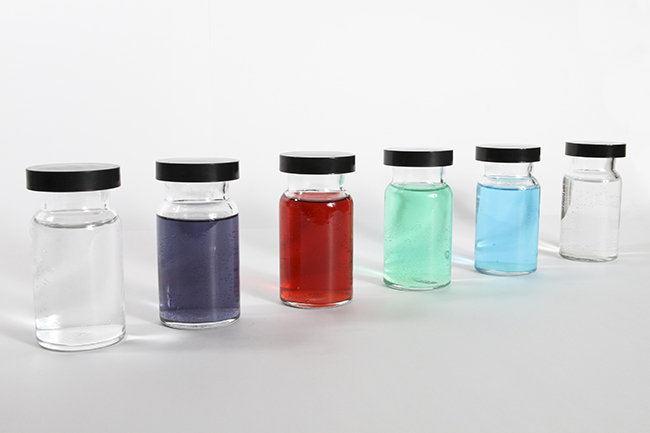
The hemoglobin in your blood, the chlorophyll in green plants, vitamin B-12, and the catalyst used in the manufacture of polyethylene all contain coordination compounds. Ions of the metals, especially the transition metals, are likely to form complexes. Many of these compounds are highly colored (Figure 19.12). In the remainder of this chapter, we will consider the structure and bonding of these remarkable compounds.
血液中のヘモグロビン、緑色植物のクロロフィル、ビタミンB-12、ポリエチレンの製造に使う触媒は、すべて配位化合物を含む。金属、特に遷移金属のイオンは、錯体を作りやすい。これらの化合物の多くは、強い色を持つ(図19.12)。この章の残りでは、これらの注目すべき化合物の構造と結合を考える。
OpenStax, Rice University, Chemistry 2e. Original caption credit: (credit: Sahar Atwa) · CC BY 4.0 · Source出典
Figure 19.12図 19.12
Metal ions that contain partially filled d subshell usually form colored complex ions; ions with empty d subshell (d0) or with filled d subshells (d10) usually form colorless complexes. This figure shows, from left to right, solutions containing [M(H2O)6]n+ ions with M = Sc3+(d0), Cr3+(d3), Co2+(d7), Ni2+(d8), Cu2+(d9), and Zn2+(d10). (credit: Sahar Atwa)
部分的に満たされたd副殻を持つ金属イオンは、通常、有色の錯イオンを作る。d副殻が空のイオン(d0)や、満たされたd副殻を持つイオン(d10)は、通常、無色の錯体を作る。この図は、左から順に、M = Sc3+(d0)、Cr3+(d3)、Co2+(d7)、Ni2+(d8)、Cu2+(d9)、Zn2+(d10)である、[M(H2O)6]n+イオンを含む溶液を示している。(クレジット:Sahar Atwa)
Remember that in most main group element compounds, the valence electrons of the isolated atoms combine to form chemical bonds that satisfy the octet rule. For instance, the four valence electrons of carbon overlap with electrons from four hydrogen atoms to form CH4. The one valence electron leaves sodium and adds to the seven valence electrons of chlorine to form the ionic formula unit NaCl (Figure 19.13). Transition metals do not normally bond in this fashion. They primarily form coordinate covalent bonds, a form of the Lewis acid-base interaction in which both of the electrons in the bond are contributed by a donor (Lewis base) to an electron acceptor (Lewis acid). The Lewis acid in coordination complexes, often called a central metal ion (or atom), is often a transition metal or inner transition metal, although main group elements can also form coordination compounds. The Lewis base donors, called ligands, can be a wide variety of chemicals—atoms, molecules, or ions. The only requirement is that they have one or more electron pairs, which can be donated to the central metal. Most often, this involves a donor atom with a lone pair of electrons that can form a coordinate bond to the metal.
英語のヒント
主族元素の化合物の大部分では、孤立した原子の価電子が組み合わさり、オクテット則を満たす化学結合を作ることを思い出そう。たとえば、炭素の四個の価電子は、四個の水素原子の電子と重なり、CH4を作る。ナトリウムの一個の価電子は、ナトリウムを離れて塩素の七個の価電子に加わり、イオン性の式単位NaClを作る(図19.13)。遷移金属は、通常このようには結合しない。主として配位共有結合を作る。これはルイス酸塩基相互作用の一形態であり、結合中の二個の電子が、どちらも供与体(ルイス塩基)から電子受容体(ルイス酸)へ与えられる。配位錯体中のルイス酸は、しばしば中心金属イオン(または原子)と呼ばれ、遷移金属や内部遷移金属であることが多いが、主族元素も配位化合物を作ることができる。配位子と呼ばれるルイス塩基の供与体には、原子、分子、イオンなど、多様な化学物質がなれる。必要な条件は、中心金属へ供与できる電子対を一組以上持つことだけである。多くの場合、これは、金属への配位結合を作れる孤立電子対を持つ、供与原子を伴う。
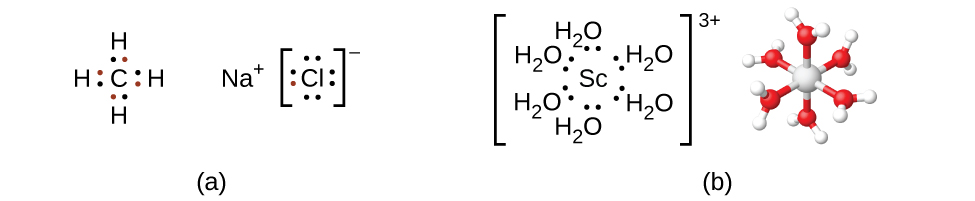
Figure 19.13図 19.13
(a) Covalent bonds involve the sharing of electrons, and ionic bonds involve the transferring of electrons associated with each bonding atom, as indicated by the colored electrons. (b) However, coordinate covalent bonds involve electrons from a Lewis base being donated to a metal center. The lone pairs from six water molecules form bonds to the scandium ion to form an octahedral complex. (Only the donated pairs are shown.)
(a) 色を付けた電子が示すように、共有結合では、結合する各原子に属する電子を共有し、イオン結合では、それらの電子を移動させる。(b) 一方、配位共有結合では、ルイス塩基の電子が金属中心へ供与される。六個の水分子の孤立電子対がスカンジウムイオンへの結合を作り、八面体錯体を形成する。(供与された電子対だけを示している。)
The coordination sphere consists of the central metal ion or atom plus its attached ligands. Brackets in a formula enclose the coordination sphere; species outside the brackets are not part of the coordination sphere. The coordination number of the central metal ion or atom is the number of donor atoms bonded to it. The coordination number for the silver ion in [Ag(NH3)2]+ is two (Figure 19.14). For the copper(II) ion in [CuCl4]2−, the coordination number is four, whereas for the cobalt(II) ion in [Co(H2O)6]2+ the coordination number is six. Each of these ligands is monodentate, from the Greek for “one toothed,” meaning that they connect with the central metal through only one atom. In this case, the number of ligands and the coordination number are equal.
英語のヒント
配位圏は、中心金属イオンまたは原子と、それに結合した配位子からなる。化学式の角括弧は配位圏を囲み、括弧の外の化学種は配位圏の一部ではない。中心金属イオンまたは原子の配位数は、それに結合した供与原子の数である。[Ag(NH3)2]+中の銀イオンの配位数は2である(図19.14)。[CuCl4]2−中の銅(II)イオンの配位数は4であり、[Co(H2O)6]2+中のコバルト(II)イオンの配位数は6である。これらの配位子はどれも単座配位子である。monodentateは「一つの歯」を表すギリシャ語に由来し、一個の原子だけを介して中心金属につながることを意味する。この場合、配位子の数と配位数は等しい。

Figure 19.14図 19.14
The complexes (a) [Ag(NH3)2]+, (b) [Cu(Cl)4]2−, and (c) [Co(H2O)6]2+ have coordination numbers of two, four, and six, respectively. The geometries of these complexes are the same as we have seen with VSEPR theory for main group elements: linear, tetrahedral, and octahedral.
錯体(a) [Ag(NH3)2]+、(b) [Cu(Cl)4]2−、(c) [Co(H2O)6]2+の配位数は、それぞれ2、4、6である。これらの錯体の形は、主族元素についてVSEPR理論で見たものと同じであり、直線形、四面体形、八面体形である。
Many other ligands coordinate to the metal in more complex fashions. Bidentate ligands are those in which two atoms coordinate to the metal center. For example, ethylenediamine (en, H2NCH2CH2NH2) contains two nitrogen atoms, each of which has a lone pair and can serve as a Lewis base (Figure 19.15). Both of the atoms can coordinate to a single metal center. In the complex [Co(en)3]3+, there are three bidentate en ligands, and the coordination number of the cobalt(III) ion is six. The most common coordination numbers are two, four, and six, but examples of all coordination numbers from 1 to 15 are known.
英語のヒント
他の多くの配位子は、より複雑な仕方で金属へ配位する。二座配位子とは、二個の原子が金属中心に配位するものである。たとえば、エチレンジアミン(en、H2NCH2CH2NH2)は二個の窒素原子を含み、それぞれが孤立電子対を持って、ルイス塩基として働ける(図19.15)。両原子とも、一つの金属中心に配位できる。錯体[Co(en)3]3+には三つの二座en配位子があり、コバルト(III)イオンの配位数は6である。最も一般的な配位数は2、4、6だが、1から15までのすべての配位数の例が知られている。
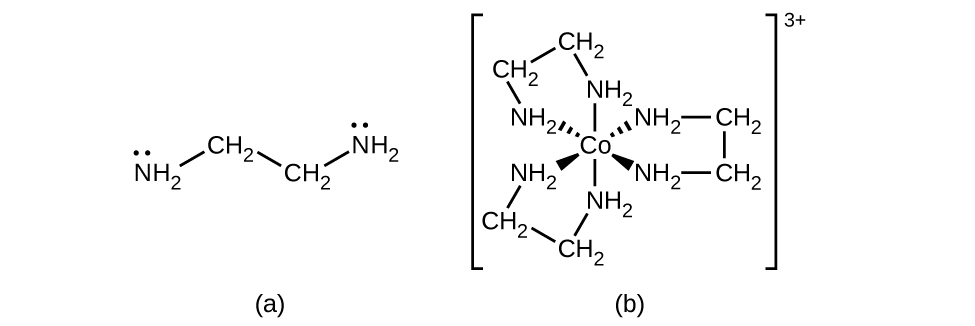
Figure 19.15図 19.15
(a) The ethylenediamine (en) ligand contains two atoms with lone pairs that can coordinate to the metal center. (b) The cobalt(III) complex contains three of these ligands, each forming two bonds to the cobalt ion.
(a) エチレンジアミンen配位子は、金属中心に配位できる孤立電子対を持つ原子を二個含む。(b) コバルト(III)錯体は、この配位子を三つ含み、それぞれがコバルトイオンに対して二つの結合を作る。
Any ligand that bonds to a central metal ion by more than one donor atom is a polydentate ligand (or “many teeth”) because it can bite into the metal center with more than one bond. The term chelate (pronounced “KEY-late”) from the Greek for “claw” is also used to describe this type of interaction. Many polydentate ligands are chelating ligands, and a complex consisting of one or more of these ligands and a central metal is a chelate. A chelating ligand is also known as a chelating agent. A chelating ligand holds the metal ion rather like a crab’s claw would hold a marble. Figure 19.15 showed one example of a chelate. The heme complex in hemoglobin is another important example (Figure 19.16). It contains a polydentate ligand with four donor atoms that coordinate to iron.
英語のヒント
複数の供与原子によって中心金属イオンに結合する配位子は、複数の結合で金属中心を挟み込めるため、多座配位子(「多くの歯」)という。「爪」を意味するギリシャ語に由来するchelate(「キー・レイト」と発音)という語も、この種の相互作用を説明するために使われる。多くの多座配位子はキレート配位子であり、一つ以上のこのような配位子と中心金属からなる錯体は、キレートである。キレート配位子は、キレート剤とも呼ばれる。カニのはさみがビー玉をつかむように、金属イオンを保持する。図19.15は、キレートの一例を示していた。ヘモグロビンのヘム錯体も、重要な例である(図19.16)。鉄に配位する四個の供与原子を持つ、多座配位子を含んでいる。
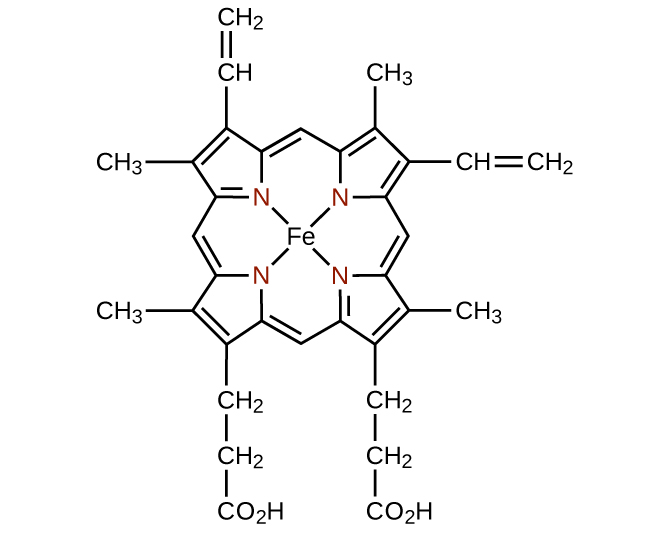
Figure 19.16図 19.16
The single ligand heme contains four nitrogen atoms that coordinate to iron in hemoglobin to form a chelate.
一つの配位子であるヘムは、ヘモグロビン中の鉄に配位してキレートを作る、四個の窒素原子を含む。
Polydentate ligands are sometimes identified with prefixes that indicate the number of donor atoms in the ligand. As we have seen, ligands with one donor atom, such as NH3, Cl−, and H2O, are monodentate ligands. Ligands with two donor groups are bidentate ligands. Ethylenediamine, H2NCH2CH2NH2, and the anion of the acid glycine, (Figure 19.17) are examples of bidentate ligands. Tridentate ligands, tetradentate ligands, pentadentate ligands, and hexadentate ligands contain three, four, five, and six donor atoms, respectively. The ligand in heme (Figure 19.16) is a tetradentate ligand.
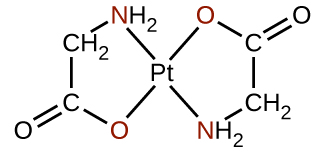


Figure 19.17図 19.17
Each of the anionic ligands shown attaches in a bidentate fashion to platinum(II), with both a nitrogen and oxygen atom coordinating to the metal.
示した各陰イオン配位子は、窒素原子と酸素原子の両方を金属に配位させ、白金(II)へ二座で結合している。