第19章遷移金属と錯体化学
Isolation of Copper銅の単離
The most important ores of copper contain copper sulfides (such as covellite, CuS), although copper oxides (such as tenorite, CuO) and copper hydroxycarbonates [such as malachite, Cu2(OH)2CO3] are sometimes found. In the production of copper metal, the concentrated sulfide ore is roasted to remove part of the sulfur as sulfur dioxide. The remaining mixture, which consists of Cu2S, FeS, FeO, and SiO2, is mixed with limestone, which serves as a flux (a material that aids in the removal of impurities), and heated. Molten slag forms as the iron and silica are removed by Lewis acid-base reactions:
英語のヒント
銅の最も重要な鉱石は、銅硫化物(銅藍CuSなど)を含むが、銅酸化物(黒銅鉱CuOなど)や塩基性炭酸銅[孔雀石Cu2(OH)2CO3など]が見られることもある。金属銅の生産では、濃縮した硫化鉱を焙焼し、硫黄の一部を二酸化硫黄として除く。残った混合物は、Cu2S、FeS、FeO、SiO2からなり、融剤(不純物の除去を助ける材料)として働く石灰岩と混ぜて加熱する。ルイス酸塩基反応によって鉄とシリカが除去され、溶融スラグが生じる。
In these reactions, the silicon dioxide behaves as a Lewis acid, which accepts a pair of electrons from the Lewis base (the oxide ion).
これらの反応では、二酸化ケイ素はルイス酸として働き、ルイス塩基(酸化物イオン)から電子対を受け取る。
Reduction of the Cu2S that remains after smelting is accomplished by blowing air through the molten material. The air converts part of the Cu2S into Cu2O. As soon as copper(I) oxide is formed, it is reduced by the remaining copper(I) sulfide to metallic copper:
溶融製錬後に残るCu2Sは、溶融物に空気を吹き込むことで還元する。空気はCu2Sの一部をCu2Oに変える。酸化銅(I)ができるとすぐに、残る硫化銅(I)によって金属銅へ還元される。
The copper obtained in this way is called blister copper because of its characteristic appearance, which is due to the air blisters it contains (Figure 19.8). This impure copper is cast into large plates, which are used as anodes in the electrolytic refining of the metal (which is described in the chapter on electrochemistry).
英語のヒント
このようにして得られる銅は、含まれる気泡による独特の外観のため、粗銅(ブリスター銅)と呼ばれる(図19.8)。この不純な銅は大きな板に鋳造され、金属の電解精製(電気化学の章で説明する)のアノードとして使われる。
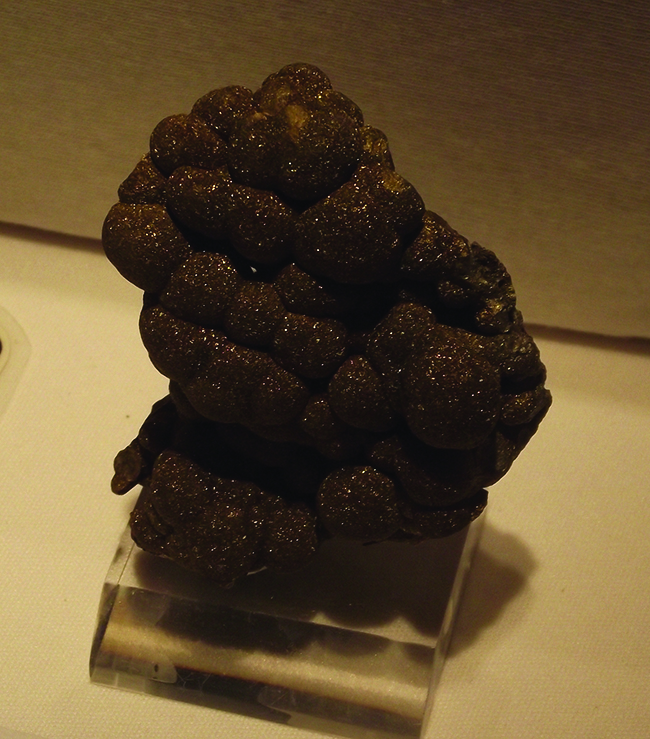
OpenStax, Rice University, Chemistry 2e. Original caption credit: (credit: “Tortie tude”/Wikimedia Commons) Source work: Chalcopyrite, botallack, cornwall.JPG · CC0 1.0 · Source出典

Figure 19.8図 19.8
Blister copper is obtained during the conversion of copper-containing ore into pure copper. (credit: “Tortie tude”/Wikimedia Commons)
銅を含む鉱石を純銅に変える過程で、粗銅が得られる。(クレジット:「Tortie tude」/Wikimedia Commons)
Isolation of Silver銀の単離
Silver sometimes occurs in large nuggets (Figure 19.9) but more frequently in veins and related deposits. At one time, panning was an effective method of isolating both silver and gold nuggets. Due to their low reactivity, these metals, and a few others, occur in deposits as nuggets. The discovery of platinum was due to Spanish explorers in Central America mistaking platinum nuggets for silver. When the metal is not in the form of nuggets, it often useful to employ a process called hydrometallurgy to separate silver from its ores. Hydrology involves the separation of a metal from a mixture by first converting it into soluble ions and then extracting and reducing them to precipitate the pure metal. In the presence of air, alkali metal cyanides readily form the soluble dicyanoargentate(I) ion, from silver metal or silver-containing compounds such as Ag2S and AgCl. Representative equations are:
英語のヒント
銀は大きな塊として存在することもある(図19.9)が、鉱脈や関連する鉱床に存在することのほうが多い。かつて、パンニングは、銀や金の塊を単離する効果的な方法であった。これらの金属と少数の他の金属は、反応性が低いため、鉱床中に塊として存在する。白金の発見は、中央アメリカのスペイン人探検家が、白金の塊を銀と取り違えたことによる。金属が塊の形でない場合には、湿式冶金と呼ばれる過程を使って、鉱石から銀を分離すると有用なことが多い。水文学は、まず金属を可溶性イオンに変え、次にそれを抽出・還元して純粋な金属を沈殿させることによる、混合物からの金属の分離を含む。空気の存在下で、アルカリ金属シアン化物は、金属銀や、Ag2S、AgClなどの銀を含む化合物から、可溶性のジシアノ銀(I)酸イオンを容易に作る。代表的な反応式は、次のとおりである。
Image omitted because its reuse rights could not be verified.権利の確認ができないため画像を割愛。
Figure 19.9図 19.9
Naturally occurring free silver may be found as nuggets (a) or in veins (b). (credit a: modification of work by “Teravolt”/Wikimedia Commons; credit b: modification of work by James St. John)
天然の単体銀は、塊(a)または鉱脈(b)として見つかることがある。(クレジットa:「Teravolt」/Wikimedia Commonsの作品を改変。クレジットb:James St. Johnの作品を改変。)
The silver is precipitated from the cyanide solution by the addition of either zinc or iron(II) ions, which serves as the reducing agent:
還元剤として働く亜鉛または鉄(II)イオンを加えると、シアン化物溶液から銀が沈殿する。
Example 19.3例題 19.3
Refining Redox精製における酸化還元
One of the steps for refining silver involves converting silver into dicyanoargenate(I) ions:
銀の精製の一段階には、銀をジシアノ銀(I)酸イオンに変える過程がある。
Explain why oxygen must be present to carry out the reaction. Why does the reaction not occur as:
反応を進めるために酸素が存在しなければならない理由を説明しなさい。次のように反応しないのはなぜか。
Solution解き方
The charges, as well as the atoms, must balance in reactions. The silver atom is being oxidized from the 0 oxidation state to the 1+ state. Whenever something loses electrons, something must also gain electrons (be reduced) to balance the equation. Oxygen is a good oxidizing agent for these reactions because it can gain electrons to go from the 0 oxidation state to the 2− state.
反応では、原子だけでなく電荷もつり合わなければならない。銀原子は、酸化状態0から1+へ酸化されている。何かが電子を失うときには、式をつり合わせるために、別の何かが電子を受け取る(還元される)必要がある。酸素は、電子を受け取って酸化状態0から2−へ移ることができるため、これらの反応によい酸化剤となる。
Check Your Learning理解度の確認
During the refining of iron, carbon must be present in the blast furnace. Why is carbon necessary to convert iron oxide into iron?
鉄の精製中には、高炉内に炭素が存在しなければならない。酸化鉄を鉄に変えるのに、炭素が必要なのはなぜか。
Transition Metal Compounds遷移金属化合物
The bonding in the simple compounds of the transition elements ranges from ionic to covalent. In their lower oxidation states, the transition elements form ionic compounds; in their higher oxidation states, they form covalent compounds or polyatomic ions. The variation in oxidation states exhibited by the transition elements gives these compounds a metal-based, oxidation-reduction chemistry. The chemistry of several classes of compounds containing elements of the transition series follows.
遷移元素の単純な化合物の結合は、イオン結合から共有結合までさまざまである。低い酸化状態ではイオン性化合物を作り、高い酸化状態では共有結合性化合物や多原子イオンを作る。遷移元素が示す酸化状態の変化によって、これらの化合物には金属を中心とした酸化還元の化学が生じる。以下では、遷移系列の元素を含む化合物のいくつかの分類について、その化学を説明する。