第19章遷移金属と錯体化学
The Structures of Complexes錯体の構造
For transition metal complexes, the coordination number determines the geometry around the central metal ion. The most common structures of the complexes in coordination compounds are square planar, tetrahedral, and octahedral, corresponding to coordination numbers of four, four, and six, respectively. Coordination numbers greater than six are less common and yield a variety of structures (see Figure 19.18 and Table 19.5):
英語のヒント
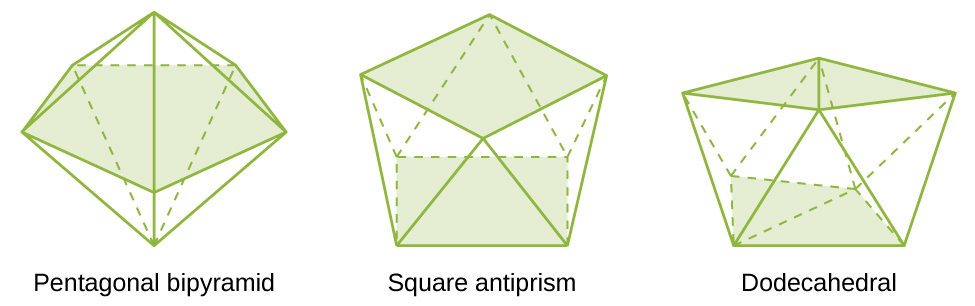
Figure 19.18図 19.18
These are geometries of some complexes with coordination numbers of seven and eight.
これらは、配位数が7および8である錯体のいくつかの形状である。
Coordination Numbers and Molecular Geometry 配位数と分子の形状 |
||
|---|---|---|
Coordination Number 配位数 |
Molecular Geometry 分子の形状 |
Example 例 |
2 |
linear 直線形 |
[Ag(NH3)2]+ |
3 |
trigonal planar 平面三角形 |
[Cu(CN)3]2− |
4 |
tetrahedral(d0 or d10), low oxidation states for M 四面体(d0またはd10)、Mの酸化状態は低い |
[Ni(CO)4] |
4 |
square planar (d8) 平面正方形(d8) |
[Ni(CN)4]2− |
5 |
trigonal bipyramidal 三方両錐 |
[CoCl5]2− |
5 |
square pyramidal 四角錐 |
[VO(CN)4]2− |
6 |
octahedral 八面体 |
[CoCl6]3− |
7 |
pentagonal bipyramid 五方両錐 |
[ZrF7]3− |
8 |
square antiprism 正方逆プリズム |
[ReF8]2− |
8 |
dodecahedron 十二面体 |
[Mo(CN)8]4− |
9 and above 9以上 |
more complicated structures より複雑な構造 |
[ReH9]2− |
Unlike main group atoms in which both the bonding and nonbonding electrons determine the molecular shape, the nonbonding d-electrons do not change the arrangement of the ligands. Octahedral complexes have a coordination number of six, and the six donor atoms are arranged at the corners of an octahedron around the central metal ion. Examples are shown in Figure 19.19. The chloride and nitrate anions in [Co(H2O)6]Cl2 and [Cr(en)3](NO3)3, and the potassium cations in K2[PtCl6], are outside the brackets and are not bonded to the metal ion.
英語のヒント
結合電子と非結合電子の両方が分子の形を決める主族原子とは異なり、非結合性のd電子は配位子の配置を変えない。八面体錯体の配位数は6であり、六個の供与原子は、中心金属イオンの周囲で八面体の頂点に配置されている。例を図19.19に示す。[Co(H2O)6]Cl2と[Cr(en)3](NO3)3の塩化物陰イオンおよび硝酸陰イオン、ならびにK2[PtCl6]のカリウム陽イオンは、角括弧の外にあり、金属イオンに結合していない。
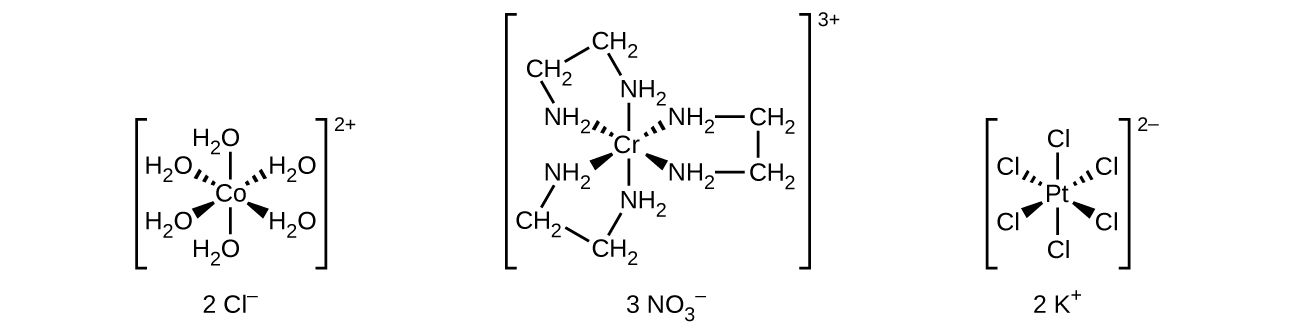
Figure 19.19図 19.19
Many transition metal complexes adopt octahedral geometries, with six donor atoms forming bond angles of 90° about the central atom with adjacent ligands. Note that only ligands within the coordination sphere affect the geometry around the metal center.
英語のヒント
多くの遷移金属錯体は、八面体形状をとる。六個の供与原子は、中心原子の周りで、隣接する配位子との間に90°の結合角を作る。配位圏内の配位子だけが、金属中心の周囲の形状に影響することに注意しよう。
For transition metals with a coordination number of four, two different geometries are possible: tetrahedral or square planar. Unlike main group elements, where these geometries can be predicted from VSEPR theory, a more detailed discussion of transition metal orbitals (discussed in the section on Crystal Field Theory) is required to predict which complexes will be tetrahedral and which will be square planar. In tetrahedral complexes such as [Zn(CN)4]2− (Figure 19.20), each of the ligand pairs forms an angle of 109.5°. In square planar complexes, such as [Pt(NH3)2Cl2], each ligand has two other ligands at 90° angles (called the cis positions) and one additional ligand at an 180° angle, in the trans position.
英語のヒント
配位数4の遷移金属では、四面体または平面正方形という二つの異なる形状が可能である。VSEPR理論からこれらの形状を予測できる主族元素とは異なり、どの錯体が四面体になり、どの錯体が平面正方形になるかを予測するには、遷移金属の軌道について、さらに詳しい議論(結晶場理論の節で扱う)が必要である。[Zn(CN)4]2−(図19.20)などの四面体錯体では、どの配位子の対も109.5°の角を作る。[Pt(NH3)2Cl2]などの平面正方形錯体では、各配位子に対して、他の二つの配位子が90°の角の位置(シス位という)にあり、さらに一つの配位子が180°の角のトランス位にある。
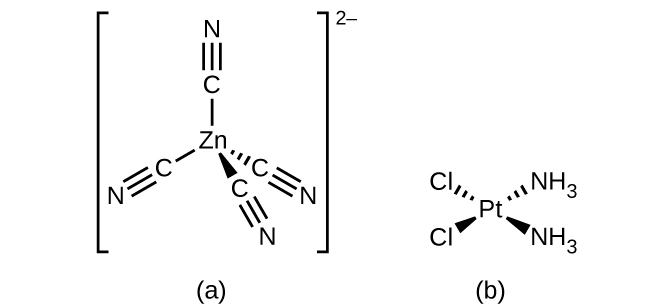
Figure 19.20図 19.20
Transition metals with a coordination number of four can adopt a tetrahedral geometry (a) as in K2[Zn(CN)4] or a square planar geometry (b) as shown in [Pt(NH3)2Cl2].
配位数4の遷移金属は、K2[Zn(CN)4]のような四面体形状(a)、または[Pt(NH3)2Cl2]に示すような平面正方形形状(b)をとることができる。
Isomerism in Complexes錯体の異性
Isomers are different chemical species that have the same chemical formula. Transition metal complexes often exist as geometric isomers, in which the same atoms are connected through the same types of bonds but with differences in their orientation in space. Coordination complexes with two different ligands in the cis and trans positions from a ligand of interest form isomers. For example, the octahedral [Co(NH3)4Cl2]+ ion has two isomers. In the cis configuration, the two chloride ligands are adjacent to each other (Figure 19.21). The other isomer, the trans configuration, has the two chloride ligands directly across from one another.
英語のヒント
異性体とは、同じ化学式を持つ異なる化学種である。遷移金属錯体は、しばしば幾何異性体として存在する。そこでは、同じ原子が同じ種類の結合でつながっているが、空間内での向きが異なる。注目する配位子から見たシス位とトランス位に二種類の配位子を持つ配位錯体は、異性体を作る。たとえば、八面体の[Co(NH3)4Cl2]+イオンには二つの異性体がある。シス配置では、二つの塩化物配位子が互いに隣り合っている(図19.21)。もう一つの異性体であるトランス配置では、二つの塩化物配位子が互いに真正面にある。
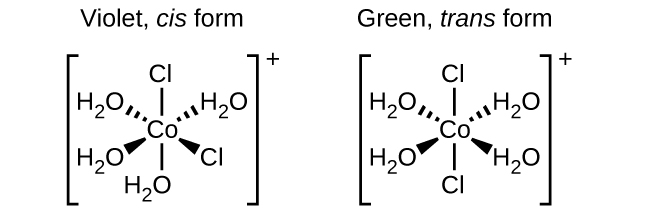
Figure 19.21図 19.21
The cis and trans isomers of [Co(H2O)4Cl2]+ contain the same ligands attached to the same metal ion, but the spatial arrangement causes these two compounds to have very different properties.
[Co(H2O)4Cl2]+のシス異性体とトランス異性体では、同じ配位子が同じ金属イオンに結合しているが、空間配置のために、この二つの化合物は大きく異なる性質を持つ。
Different geometric isomers of a substance are different chemical compounds. They exhibit different properties, even though they have the same formula. For example, the two isomers of [Co(NH3)4Cl2]NO3 differ in color; the cis form is violet, and the trans form is green. Furthermore, these isomers have different dipole moments, solubilities, and reactivities. As an example of how the arrangement in space can influence the molecular properties, consider the polarity of the two [Co(NH3)4Cl2]NO3 isomers. Remember that the polarity of a molecule or ion is determined by the bond dipoles (which are due to the difference in electronegativity of the bonding atoms) and their arrangement in space. In one isomer, cis chloride ligands cause more electron density on one side of the molecule than on the other, making it polar. For the trans isomer, each ligand is directly across from an identical ligand, so the bond dipoles cancel out, and the molecule is nonpolar.
英語のヒント
ある物質の異なる幾何異性体は、異なる化合物である。同じ化学式を持つにもかかわらず、異なる性質を示す。たとえば、[Co(NH3)4Cl2]NO3の二つの異性体は色が異なり、シス形は紫色、トランス形は緑色である。さらに、これらの異性体は、双極子モーメント、溶解度、反応性も異なる。空間内の配置が分子の性質にどのように影響するかの例として、二つの[Co(NH3)4Cl2]NO3異性体の極性を考えよう。分子やイオンの極性は、結合双極子(結合する原子の電気陰性度の差によって生じる)と、その空間配置で決まることを思い出そう。一方の異性体では、シス位の塩化物配位子によって、分子の片側の電子密度が反対側より高くなり、極性が生じる。トランス異性体では、各配位子が同じ配位子の真正面にあるため、結合双極子が打ち消し合い、分子は無極性である。
Example 19.5例題 19.5
Geometric Isomers幾何異性体
Identify which geometric isomer of [Pt(NH3)2Cl2] is shown in Figure 19.20. Draw the other geometric isomer and give its full name.
図19.20に示されているのは、[Pt(NH3)2Cl2]のどちらの幾何異性体かを特定しなさい。もう一方の幾何異性体を描き、完全な名称を示しなさい。
Solution解き方
In the Figure 19.20, the two chlorine ligands occupy cis positions. The other form is shown in Figure 19.22. When naming specific isomers, the descriptor is listed in front of the name. Therefore, this complex is trans-diamminedichloroplatinum(II).
英語のヒント
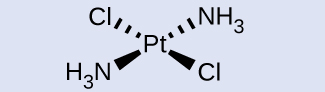
Figure 19.22図 19.22
The trans isomer of [Pt(NH3)2Cl2] has each ligand directly across from an adjacent ligand.
[Pt(NH3)2Cl2]のトランス異性体では、各配位子は隣接する配位子の真正面にある。
Check Your Learning理解度の確認
Draw the ion trans-diaqua-trans-dibromo-trans-dichlorocobalt(II).
トランス-ジアクア-トランス-ジブロモ-トランス-ジクロロコバルト(II)イオンを描きなさい。
Another important type of isomers are optical isomers, or enantiomers, in which two objects are exact mirror images of each other but cannot be lined up so that all parts match. This means that optical isomers are nonsuperimposable mirror images. A classic example of this is a pair of hands, in which the right and left hand are mirror images of one another but cannot be superimposed. Optical isomers are very important in organic and biochemistry because living systems often incorporate one specific optical isomer and not the other. Unlike geometric isomers, pairs of optical isomers have identical properties (boiling point, polarity, solubility, etc.). Optical isomers differ only in the way they affect polarized light and how they react with other optical isomers. For coordination complexes, many coordination compounds such as [M(en)3]n+ [in which Mn+ is a central metal ion such as iron(III) or cobalt(II)] form enantiomers, as shown in Figure 19.23. These two isomers will react differently with other optical isomers. For example, DNA helices are optical isomers, and the form that occurs in nature (right-handed DNA) will bind to only one isomer of [M(en)3]n+ and not the other.
英語のヒント
異性体のもう一つの重要な種類は、光学異性体、すなわちエナンチオマーである。二つの物体は互いに正確な鏡像であるが、すべての部分が一致するように合わせることはできない。つまり、光学異性体は重ね合わせられない鏡像である。典型的な例は左右の手であり、右手と左手は互いの鏡像だが、重ね合わせることはできない。生体系では、しばしば一方の特定の光学異性体だけを取り込み、もう一方は取り込まないため、光学異性体は有機化学および生化学で非常に重要である。幾何異性体とは異なり、光学異性体の対は、同一の性質(沸点、極性、溶解度など)を持つ。光学異性体の違いは、偏光への作用と、他の光学異性体との反応の仕方だけである。配位錯体では、[M(en)3]n+[Mn+は鉄(III)やコバルト(II)などの中心金属イオン]など、多くの配位化合物が、図19.23に示すようなエナンチオマーを作る。この二つの異性体は、他の光学異性体とは異なる反応をする。たとえば、DNAらせんは光学異性体であり、自然界に存在する形(右巻きDNA)は、[M(en)3]n+の一方の異性体だけに結合し、もう一方には結合しない。
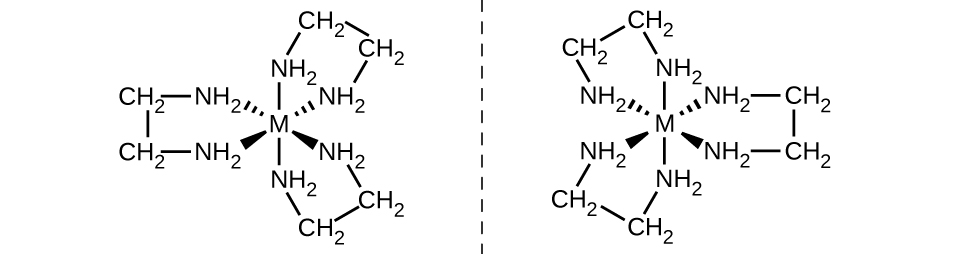
Figure 19.23図 19.23
The complex [M(en)3]n+ (Mn+ = a metal ion, en = ethylenediamine) has a nonsuperimposable mirror image.
錯体[M(en)3]n+(Mn+ = 金属イオン、en = エチレンジアミン)は、重ね合わせられない鏡像を持つ。
The [Co(en)2Cl2]+ ion exhibits geometric isomerism (cis/trans), and its cis isomer exists as a pair of optical isomers (Figure 19.24).
[Co(en)2Cl2]+イオンは幾何異性(シス/トランス)を示し、そのシス異性体は光学異性体の対として存在する(図19.24)。
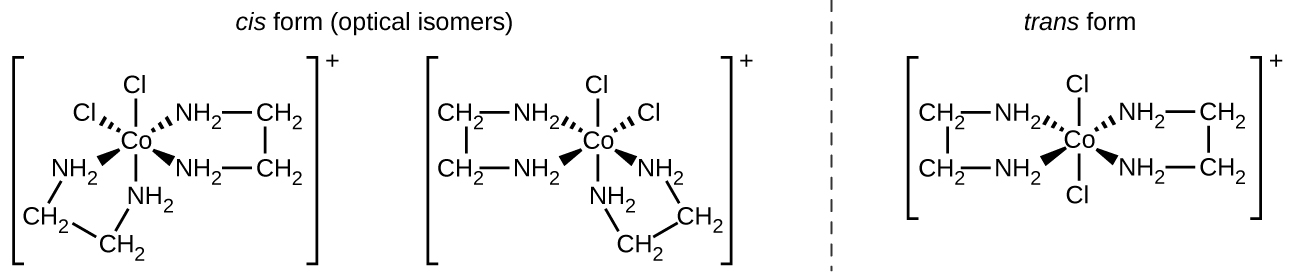


Figure 19.24図 19.24
Three isomeric forms of [Co(en)2Cl2]+ exist. The trans isomer, formed when the chlorines are positioned at a 180° angle, has very different properties from the cis isomers. The mirror images of the cis isomer form a pair of optical isomers, which have identical behavior except when reacting with other enantiomers.
[Co(en)2Cl2]+には三つの異性体が存在する。塩素が180°の角の位置にあるときにできるトランス異性体は、シス異性体とは大きく異なる性質を持つ。シス異性体の鏡像は一対の光学異性体を作り、他のエナンチオマーと反応する場合を除いて、同一の挙動を示す。
Linkage isomers occur when the coordination compound contains a ligand that can bind to the transition metal center through two different atoms. For example, the CN ligand can bind through the carbon atom (cyano) or through the nitrogen atom (isocyano). Similarly, SCN− can be bound through the sulfur or nitrogen atom, affording two distinct compounds ([Co(NH3)5SCN]2+ or [Co(NH3)5NCS]2+).
英語のヒント
配位化合物が、異なる二個の原子を介して遷移金属中心に結合できる配位子を含むとき、結合異性体が生じる。たとえば、CN配位子は、炭素原子を介して(シアノ)、または窒素原子を介して(イソシアノ)結合できる。同様に、SCN−は硫黄原子または窒素原子を介して結合でき、二つの異なる化合物([Co(NH3)5SCN]2+または[Co(NH3)5NCS]2+)を与える。
Ionization isomers (or coordination isomers) occur when one anionic ligand in the inner coordination sphere is replaced with the counter ion from the outer coordination sphere. A simple example of two ionization isomers are [CoCl6][Br] and [CoCl5Br][Cl].
英語のヒント
内側の配位圏の一つの陰イオン配位子が、外側の配位圏の対イオンと置き換わると、イオン化異性体(または配位異性体)が生じる。二つのイオン化異性体の簡単な例は、[CoCl6][Br]と[CoCl5Br][Cl]である。