第19章遷移金属と錯体化学
Properties of the Transition Elements遷移元素の性質
Transition metals demonstrate a wide range of chemical behaviors. As can be seen from their reduction potentials (see Appendix H), some transition metals are strong reducing agents, whereas others have very low reactivity. For example, the lanthanides all form stable 3+ aqueous cations. The driving force for such oxidations is similar to that of alkaline earth metals such as Be or Mg, forming Be2+ and Mg2+. On the other hand, materials like platinum and gold have much higher reduction potentials. Their ability to resist oxidation makes them useful materials for constructing circuits and jewelry.
遷移金属は、幅広い化学的挙動を示す。還元電位(付録H参照)からわかるように、強い還元剤となる遷移金属もあれば、反応性が非常に低いものもある。たとえば、ランタノイドはすべて、安定な3+の水和陽イオンを作る。このような酸化の駆動力は、BeやMgなどのアルカリ土類金属がBe2+やMg2+を作る場合に似ている。一方、白金や金のような材料は、はるかに高い還元電位を持つ。酸化に耐える能力によって、回路や宝飾品を作るための有用な材料となる。
Ions of the lighter d-block elements, such as Cr3+, Fe3+, and Co2+, form colorful hydrated ions that are stable in water. However, ions in the period just below these (Mo3+, Ru3+, and Ir2+) are unstable and react readily with oxygen from the air. The majority of simple, water-stable ions formed by the heavier d-block elements are oxyanions such as and
Cr3+、Fe3+、Co2+など、軽いdブロック元素のイオンは、水中で安定な、色のある水和イオンを作る。しかし、そのすぐ下の周期のイオン(Mo3+、Ru3+、Ir2+)は不安定で、空気中の酸素と容易に反応する。重いdブロック元素が作る、水中で安定な単純なイオンの大部分は、やなどのオキソ陰イオンである。
Ruthenium, osmium, rhodium, iridium, palladium, and platinum are the platinum metals. With difficulty, they form simple cations that are stable in water, and, unlike the earlier elements in the second and third transition series, they do not form stable oxyanions.
英語のヒント
ルテニウム、オスミウム、ロジウム、イリジウム、パラジウム、白金は、白金族金属である。水中で安定な単純陽イオンは作りにくく、第二・第三遷移系列の前方の元素と異なり、安定なオキソ陰イオンも作らない。
Both the d- and f-block elements react with nonmetals to form binary compounds; heating is often required. These elements react with halogens to form a variety of halides ranging in oxidation state from 1+ to 6+. On heating, oxygen reacts with all of the transition elements except palladium, platinum, silver, and gold. The oxides of these latter metals can be formed using other reactants, but they decompose upon heating. The f-block elements, the elements of group 3, and the elements of the first transition series except copper react with aqueous solutions of acids, forming hydrogen gas and solutions of the corresponding salts.
dブロック元素もfブロック元素も、非金属と反応して二元化合物を作り、多くの場合、加熱が必要である。これらの元素はハロゲンと反応して、酸化状態が1+から6+にわたる、さまざまなハロゲン化物を作る。加熱すると、酸素は、パラジウム、白金、銀、金を除くすべての遷移元素と反応する。これら四つの金属の酸化物は、他の反応物を用いれば作れるが、加熱すると分解する。fブロック元素、3族元素、および銅を除く第一遷移系列の元素は、酸の水溶液と反応し、水素ガスと対応する塩の溶液を作る。
Transition metals can form compounds with a wide range of oxidation states. Some of the observed oxidation states of the elements of the first transition series are shown in Figure 19.4. As we move from left to right across the first transition series, we see that the number of common oxidation states increases at first to a maximum towards the middle of the table, then decreases. The values in the table are typical values; there are other known values, and it is possible to synthesize new additions. For example, in 2014, researchers were successful in synthesizing a new oxidation state of iridium (9+).
遷移金属は、幅広い酸化状態の化合物を作ることができる。第一遷移系列の元素で観察される酸化状態の一部を、図19.4に示す。第一遷移系列を左から右へ進むと、一般的な酸化状態の数は、最初は増加して表の中央付近で最大となり、その後減少する。表の値は典型的な値であり、他にも知られている値があるほか、さらに新しいものを合成することもできる。たとえば、2014年には、研究者がイリジウムの新しい酸化状態(9+)の合成に成功した。
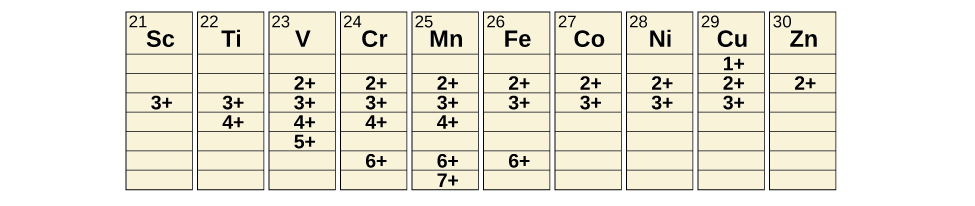

Figure 19.4図 19.4
Transition metals of the first transition series can form compounds with varying oxidation states.
第一遷移系列の遷移金属は、さまざまな酸化状態の化合物を作ることができる。
For the elements scandium through manganese (the first half of the first transition series), the highest oxidation state corresponds to the loss of all of the electrons in both the s and d orbitals of their valence shells. The titanium(IV) ion, for example, is formed when the titanium atom loses its two 3d and two 4s electrons. These highest oxidation states are the most stable forms of scandium, titanium, and vanadium. However, it is not possible to continue to remove all of the valence electrons from metals as we continue through the series. Iron is known to form oxidation states from 2+ to 6+, with iron(II) and iron(III) being the most common. Most of the elements of the first transition series form ions with a charge of 2+ or 3+ that are stable in water, although those of the early members of the series can be readily oxidized by air.
スカンジウムからマンガンまで(第一遷移系列の前半)の元素では、最高酸化状態は、価電子殻のs軌道とd軌道の両方から、すべての電子を失うことに対応する。たとえば、チタン(IV)イオンは、チタン原子が二個の3d電子と二個の4s電子を失うと生じる。これらの最高酸化状態は、スカンジウム、チタン、バナジウムの最も安定な形である。しかし、系列の先へ進んでも、引き続き金属からすべての価電子を取り去れるわけではない。鉄は2+から6+までの酸化状態を作ることが知られ、鉄(II)と鉄(III)が最も一般的である。第一遷移系列の元素の大部分は、水中で安定な2+または3+の電荷を持つイオンを作るが、系列の前方の元素のイオンは、空気によって容易に酸化されることがある。
The elements of the second and third transition series generally are more stable in higher oxidation states than are the elements of the first series. In general, the atomic radius increases down a group, which leads to the ions of the second and third series being larger than are those in the first series. Removing electrons from orbitals that are located farther from the nucleus is easier than removing electrons close to the nucleus. For example, molybdenum and tungsten, members of group 6, are limited mostly to an oxidation state of 6+ in aqueous solution. Chromium, the lightest member of the group, forms stable Cr3+ ions in water and, in the absence of air, less stable Cr2+ ions. The sulfide with the highest oxidation state for chromium is Cr2S3, which contains the Cr3+ ion. Molybdenum and tungsten form sulfides in which the metals exhibit oxidation states of 4+ and 6+.
第二・第三遷移系列の元素は、一般に第一遷移系列の元素より、高い酸化状態で安定である。一般に、族を下ると原子半径が増すため、第二・第三系列のイオンは第一系列のイオンより大きくなる。原子核から遠い軌道の電子を取り去るほうが、原子核に近い電子を取り去るより容易である。たとえば、6族のモリブデンとタングステンは、水溶液中ではほぼ6+の酸化状態に限られる。同族で最も軽いクロムは、水中で安定なCr3+イオンを作り、空気がない場合には、安定性の低いCr2+イオンを作る。クロムの酸化状態が最も高い硫化物はCr2S3であり、Cr3+イオンを含む。モリブデンとタングステンは、金属の酸化状態が4+と6+の硫化物を作る。
Example 19.2例題 19.2
Activity of the Transition Metals遷移金属の活性
Which is the strongest oxidizing agent in acidic solution: dichromate ion, which contains chromium(VI), permanganate ion, which contains manganese(VII), or titanium dioxide, which contains titanium(IV)?
クロム(VI)を含む二クロム酸イオン、マンガン(VII)を含む過マンガン酸イオン、チタン(IV)を含む二酸化チタンのうち、酸性溶液中で最も強い酸化剤はどれか。
Solution解き方
First, we need to look up the reduction half reactions (in Appendix L) for each oxide in the specified oxidation state:
まず、各酸化物の指定された酸化状態について、還元半反応を付録Lで調べる必要がある。
A larger reduction potential means that it is easier to reduce the reactant. Permanganate, with the largest reduction potential, is the strongest oxidizer under these conditions. Dichromate is next, followed by titanium dioxide as the weakest oxidizing agent (the hardest to reduce) of this set.
英語のヒント
還元電位が大きいほど、その反応物は還元されやすい。還元電位が最大の過マンガン酸イオンが、この条件では最も強い酸化剤である。次が二クロム酸イオンで、最後が、この組の中で最も弱い酸化剤(最も還元されにくいもの)である二酸化チタンとなる。
Check Your Learning理解度の確認
Predict what reaction (if any) will occur between HCl and Co(s), and between HBr and Pt(s). You will need to use the standard reduction potentials from Appendix L.
HClとCo(s)の間、およびHBrとPt(s)の間で、どのような反応が起こるか(起こる場合は)を予測しなさい。付録Lの標準還元電位を用いる必要がある。