第19章遷移金属と錯体化学
Magnetic Moments of Molecules and Ions分子とイオンの磁気モーメント
Experimental evidence of magnetic measurements supports the theory of high- and low-spin complexes. Remember that molecules such as O2 that contain unpaired electrons are paramagnetic. Paramagnetic substances are attracted to magnetic fields. Many transition metal complexes have unpaired electrons and hence are paramagnetic. Molecules such as N2 and ions such as Na+ and [Fe(CN)6]4− that contain no unpaired electrons are diamagnetic. Diamagnetic substances have a slight tendency to be repelled by magnetic fields.
英語のヒント
磁気測定による実験的証拠は、高スピン錯体と低スピン錯体の理論を支持する。O2のように不対電子を含む分子は常磁性であることを思い出そう。常磁性物質は磁場に引き付けられる。多くの遷移金属錯体は不対電子を持つので、常磁性である。N2などの分子や、Na+および[Fe(CN)6]4−などのイオンのように、不対電子を持たないものは反磁性である。反磁性物質は、磁場によってわずかに反発される傾向がある。
When an electron in an atom or ion is unpaired, the magnetic moment due to its spin makes the entire atom or ion paramagnetic. The size of the magnetic moment of a system containing unpaired electrons is related directly to the number of such electrons: the greater the number of unpaired electrons, the larger the magnetic moment. Therefore, the observed magnetic moment is used to determine the number of unpaired electrons present. The measured magnetic moment of low-spin d6 [Fe(CN)6]4− confirms that iron is diamagnetic, whereas high-spin d6 [Fe(H2O)6]2+ has four unpaired electrons with a magnetic moment that confirms this arrangement.
英語のヒント
原子やイオン内の電子が不対電子であると、そのスピンによる磁気モーメントが、原子やイオン全体を常磁性にする。不対電子を含む系の磁気モーメントの大きさは、不対電子の数に直接関係しており、不対電子が多いほど磁気モーメントは大きい。したがって、観測された磁気モーメントから、存在する不対電子の数を求める。低スピンd6の[Fe(CN)6]4−で測定される磁気モーメントは、鉄が反磁性であることを確認する。一方、高スピンd6の[Fe(H2O)6]2+には不対電子が四個あり、その磁気モーメントによって、この配置が確認される。
Colors of Transition Metal Complexes遷移金属錯体の色
When atoms or molecules absorb light at the proper frequency, their electrons are excited to higher-energy orbitals. For many main group atoms and molecules, the absorbed photons are in the ultraviolet range of the electromagnetic spectrum, which cannot be detected by the human eye. For coordination compounds, the energy difference between the d orbitals often allows photons in the visible range to be absorbed.
英語のヒント
原子や分子が適切な振動数の光を吸収すると、その電子は、よりエネルギーの高い軌道へ励起される。多くの主族原子や分子では、吸収する光子は電磁スペクトルの紫外領域にあり、人の目では検出できない。配位化合物では、d軌道間のエネルギー差によって、可視領域の光子を吸収できることが多い。
The human eye perceives a mixture of all the colors, in the proportions present in sunlight, as white light. Complementary colors, those located across from each other on a color wheel, are also used in color vision. The eye perceives a mixture of two complementary colors, in the proper proportions, as white light. Likewise, when a color is missing from white light, the eye sees its complement. For example, when red photons are absorbed from white light, the eyes see the color green. When violet photons are removed from white light, the eyes see lemon yellow. The blue color of the [Cu(NH3)4]2+ ion results because this ion absorbs orange and red light, leaving the complementary colors of blue and green (Figure 19.37).
英語のヒント
人の目は、太陽光に含まれる割合ですべての色が混ざったものを、白色光として知覚する。色相環で互いに反対側に位置する補色も、色覚に関与する。目は、二つの補色が適切な割合で混ざったものを、白色光として知覚する。同様に、白色光からある色が欠けると、その補色が見える。たとえば、白色光から赤色の光子が吸収されると、目には緑色が見える。白色光から紫色の光子が取り除かれると、レモンイエローが見える。[Cu(NH3)4]2+イオンが青色なのは、このイオンが橙色と赤色の光を吸収し、補色である青色と緑色を残すためである(図19.37)。
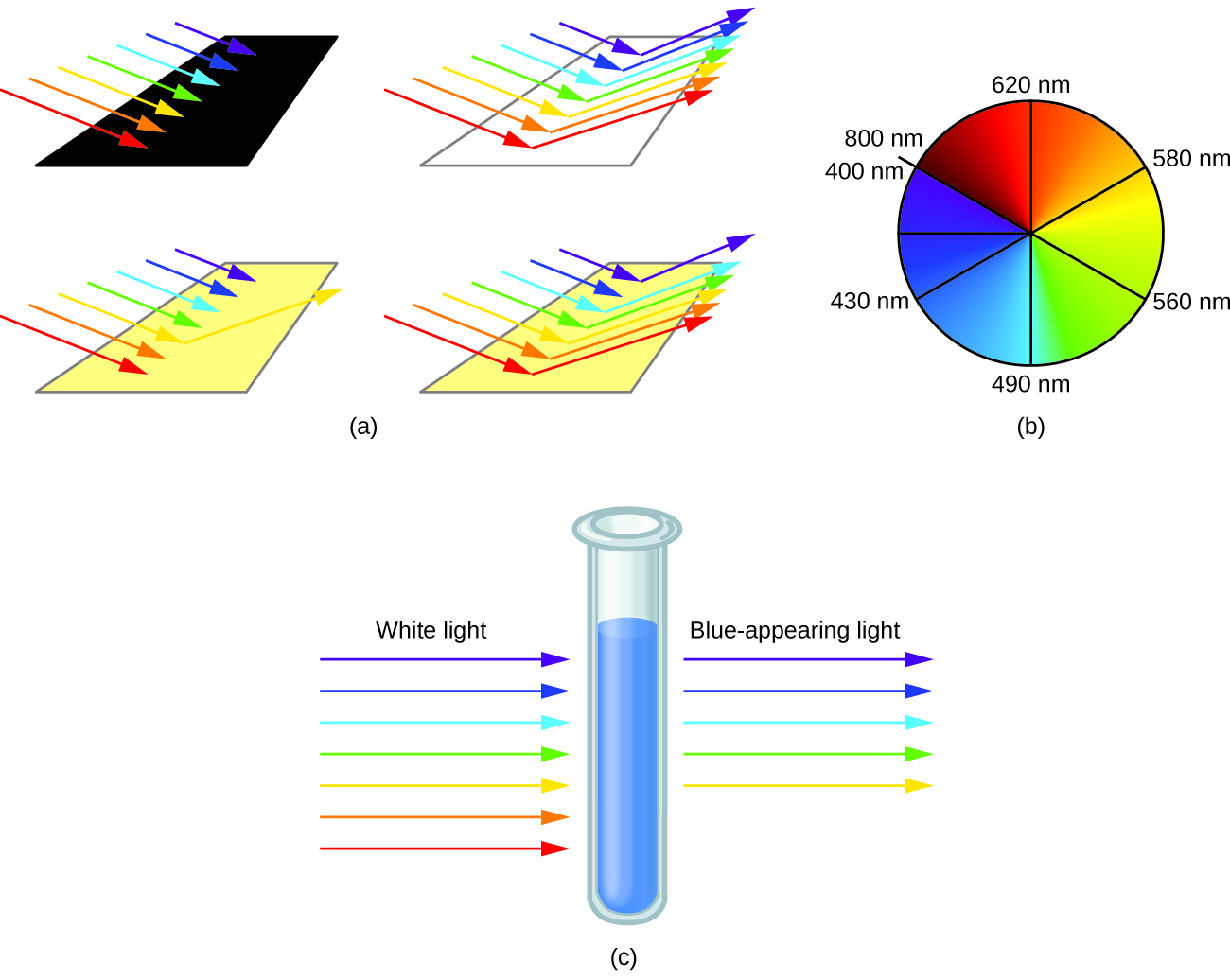
Figure 19.37図 19.37
(a) An object is black if it absorbs all colors of light. If it reflects all colors of light, it is white. An object has a color if it absorbs all colors except one, such as this yellow strip. The strip also appears yellow if it absorbs the complementary color from white light (in this case, indigo). (b) Complementary colors are located directly across from one another on the color wheel. (c) A solution of [Cu(NH3)4]2+ ions absorbs red and orange light, so the transmitted light appears as the complementary color, blue.
(a) すべての色の光を吸収する物体は黒い。すべての色の光を反射する物体は白い。この黄色い帯のように、一色を除くすべての色を吸収する物体は、その色を持つ。また、この帯は、白色光から補色(この場合は藍色)を吸収しても黄色に見える。(b) 補色は、色相環で互いに真正面に位置する。(c) [Cu(NH3)4]2+イオンの溶液は、赤色と橙色の光を吸収するので、透過光は補色である青色に見える。
Example 19.9例題 19.9
Colors of Complexes錯体の色
The octahedral complex [Ti(H2O)6]3+ has a single d electron. To excite this electron from the ground state t2g orbital to the eg orbital, this complex absorbs light from 450 to 600 nm. The maximum absorbance corresponds to Δoct and occurs at 499 nm. Calculate the value of Δoct in Joules and predict what color the solution will appear.
英語のヒント
八面体錯体[Ti(H2O)6]3+は、d電子を一個持つ。この電子を基底状態のt2g軌道からeg軌道へ励起するために、この錯体は450~600 nmの光を吸収する。最大吸光度はΔoctに対応し、499 nmで生じる。Δoctの値をジュール単位で計算し、溶液が何色に見えるかを予測しなさい。
Solution解き方
Using Planck's equation (refer to the section on electromagnetic energy), we calculate:
プランクの式(電磁エネルギーの節を参照)を用いて、次のように計算する。
Because the complex absorbs 600 nm (orange) through 450 (blue), the indigo, violet, and red wavelengths will be transmitted, and the complex will appear purple.
この錯体は600 nm(橙色)から450 nm(青色)までを吸収するので、藍色、紫色、赤色の波長が透過し、錯体は紫色に見える。
Check Your Learning理解度の確認
A complex that appears green, absorbs photons of what wavelengths?
緑色に見える錯体は、どの波長の光子を吸収するか。
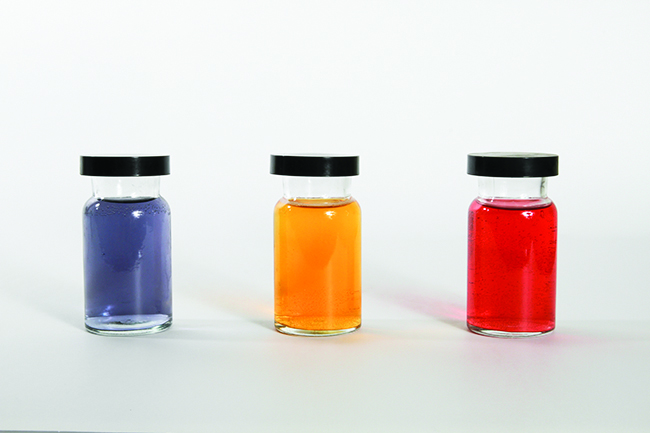
Small changes in the relative energies of the orbitals that electrons are transitioning between can lead to drastic shifts in the color of light absorbed. Therefore, the colors of coordination compounds depend on many factors. As shown in Figure 19.38, different aqueous metal ions can have different colors. In addition, different oxidation states of one metal can produce different colors, as shown for the vanadium complexes in the link below.
英語のヒント
電子が遷移する二つの軌道の相対的エネルギーがわずかに変わるだけで、吸収する光の色が大きく変わることがある。したがって、配位化合物の色は多くの因子に依存する。図19.38に示すように、水溶液中の金属イオンは、種類が異なれば色も異なりうる。さらに、下のリンクに示すバナジウム錯体のように、同じ金属でも酸化状態が異なると異なる色を生じることがある。
OpenStax, Rice University, Chemistry 2e. Original caption credit: (credit: Sahar Atwa) · CC BY 4.0 · Source出典
Figure 19.38図 19.38
The partially filled d orbitals of the stable ions Cr3+(aq), Fe3+(aq), and Co2+(aq) (left, center and right, respectively) give rise to various colors. (credit: Sahar Atwa)
安定なイオンCr3+(aq)、Fe3+(aq)、Co2+(aq)(それぞれ左、中央、右)の部分的に満たされたd軌道が、さまざまな色を生じさせる。(クレジット:Sahar Atwa)
The specific ligands coordinated to the metal center also influence the color of coordination complexes. For example, the iron(II) complex [Fe(H2O)6]SO4 appears blue-green because the high-spin complex absorbs photons in the red wavelengths (Figure 19.39). In contrast, the low-spin iron(II) complex K4[Fe(CN)6] appears pale yellow because it absorbs higher-energy violet photons.
英語のヒント
金属中心に配位する配位子の種類も、配位錯体の色に影響する。たとえば、鉄(II)錯体[Fe(H2O)6]SO4は、高スピン錯体が赤色の波長の光子を吸収するため、青緑色に見える(図19.39)。これに対し、低スピンの鉄(II)錯体K4[Fe(CN)6]は、よりエネルギーの高い紫色の光子を吸収するため、淡黄色に見える。
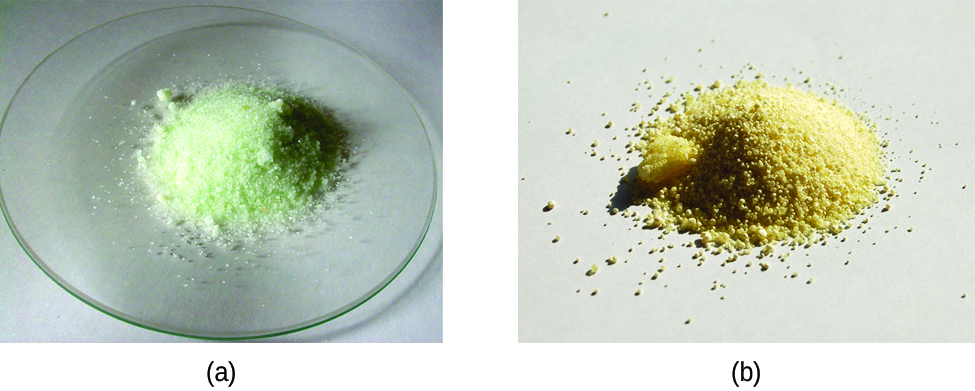
Figure 19.39図 19.39
Both (a) hexaaquairon(II) sulfate and (b) potassium hexacyanoferrate(II) contain d6 iron(II) octahedral metal centers, but they absorb photons in different ranges of the visible spectrum.
(a) 硫酸ヘキサアクア鉄(II)と(b) ヘキサシアノ鉄(II)酸カリウムは、どちらもd6の鉄(II)八面体金属中心を含むが、可視スペクトルの異なる領域の光子を吸収する。
In general, strong-field ligands cause a large split in the energies of d orbitals of the central metal atom (large Δoct). Transition metal coordination compounds with these ligands are yellow, orange, or red because they absorb higher-energy violet or blue light. On the other hand, coordination compounds of transition metals with weak-field ligands are often blue-green, blue, or indigo because they absorb lower-energy yellow, orange, or red light.
一般に、強い場の配位子は、中心金属原子のd軌道のエネルギーを大きく分裂させる(大きなΔoct)。このような配位子を持つ遷移金属配位化合物は、エネルギーの高い紫色や青色の光を吸収するため、黄色、橙色、赤色である。一方、弱い場の配位子を持つ遷移金属配位化合物は、エネルギーの低い黄色、橙色、赤色の光を吸収するため、青緑色、青色、藍色であることが多い。
A coordination compound of the Cu+ ion has a d10 configuration, and all the eg orbitals are filled. To excite an electron to a higher level, such as the 4p orbital, photons of very high energy are necessary. This energy corresponds to very short wavelengths in the ultraviolet region of the spectrum. No visible light is absorbed, so the eye sees no change, and the compound appears white or colorless. A solution containing [Cu(CN)2]−, for example, is colorless. On the other hand, octahedral Cu2+ complexes have a vacancy in the eg orbitals, and electrons can be excited to this level. The wavelength (energy) of the light absorbed corresponds to the visible part of the spectrum, and Cu2+ complexes are almost always colored—blue, blue-green violet, or yellow (Figure 19.40). Although CFT successfully describes many properties of coordination complexes, molecular orbital explanations (beyond the introductory scope provided here) are required to understand fully the behavior of coordination complexes.
英語のヒント
Cu+イオンの配位化合物はd10配置を持ち、すべてのeg軌道が満たされている。電子を4p軌道などのより高い準位へ励起するには、非常に高いエネルギーの光子が必要である。このエネルギーは、スペクトルの紫外領域の非常に短い波長に対応する。可視光は吸収されないので、目には変化が見えず、化合物は白色または無色に見える。たとえば、[Cu(CN)2]−を含む溶液は無色である。一方、八面体のCu2+錯体ではeg軌道に空きがあり、電子はこの準位へ励起されることができる。吸収する光の波長(エネルギー)は、スペクトルの可視領域に対応し、Cu2+錯体はほぼ常に、青色、青緑色、紫色、黄色などの色を持つ(図19.40)。CFTは配位錯体の多くの性質をうまく説明するが、その挙動を完全に理解するには、分子軌道による説明(ここで扱う入門的な範囲を超える)が必要である。
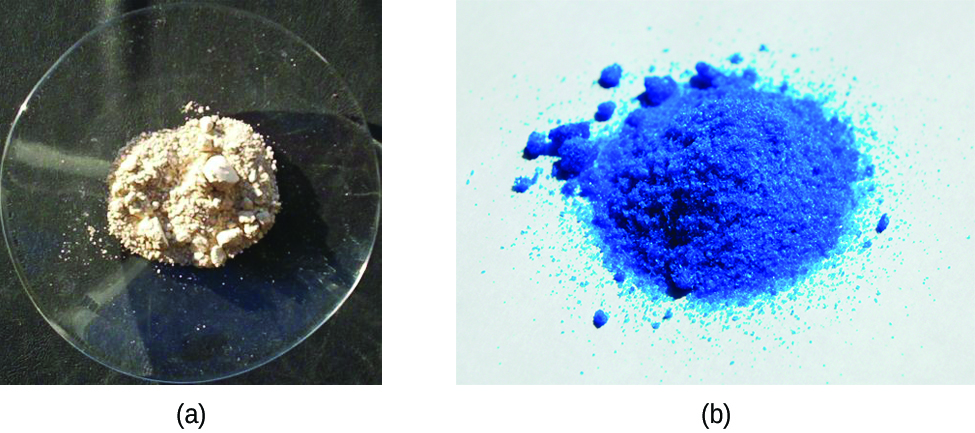


Figure 19.40図 19.40
(a) Copper(I) complexes with d10 configurations such as CuI tend to be colorless, whereas (b) d9 copper(II) complexes such as Cu(NO3)2·5H2O are brightly colored.
(a) CuIなど、d10配置を持つ銅(I)錯体は無色の傾向がある一方、(b) Cu(NO3)2·5H2Oなどのd9銅(II)錯体は鮮やかな色を持つ。