第13章化学平衡の基本概念
Calculation of a Missing Equilibrium Concentration未知の平衡濃度の計算
When the equilibrium constant and all but one equilibrium concentration are provided, the other equilibrium concentration(s) may be calculated. A computation of this sort is illustrated in the next example exercise.
英語のヒント
平衡定数と、一つを除くすべての平衡濃度が与えられれば、残りの平衡濃度を計算できる。次の例題で、この種類の計算を示す。
Example 13.8例題 13.8
Calculation of a Missing Equilibrium Concentration未知の平衡濃度の計算
Nitrogen oxides are air pollutants produced by the reaction of nitrogen and oxygen at high temperatures. At 2000 °C, the value of the Kc for the reaction, is 4.1 10−4. Calculate the equilibrium concentration of NO(g) in air at 1 atm pressure and 2000 °C. The equilibrium concentrations of N2 and O2 at this pressure and temperature are 0.036 M and 0.0089 M, respectively.
窒素酸化物は、窒素と酸素が高温で反応して生じる大気汚染物質である。2000 °Cでの反応のKcは、4.1 10−4である。圧力1 atm、2000 °Cの空気中でのNO(g)の平衡濃度を計算しなさい。この圧力と温度でのN2とO2の平衡濃度は、それぞれ0.036 Mと0.0089 Mである。
Solution解法
Substitute the provided quantities into the equilibrium constant expression and solve for [NO]:
与えられた値を平衡定数の式に代入し、[NO]について解く。
Thus [NO] is 3.6 10−4 mol/L at equilibrium under these conditions.
したがって、この条件の平衡では[NO]は3.6 10−4 mol/Lとなる。
To confirm this result, it may be used along with the provided equilibrium concentrations to calculate a value for K:
結果を確かめるため、この値と与えられた平衡濃度を使ってKを計算してみる。
This result is consistent with the provided value for K within nominal uncertainty, differing by just 1 in the least significant digit’s place.
英語のヒント
この結果は、通常の不確かさの範囲内で、与えられたKと一致している。違うのは、最下位の有効数字が1だけである。
Check Your Learning理解を確かめよう
The equilibrium constant Kc for the reaction of nitrogen and hydrogen to produce ammonia at a certain temperature is 6.00 10−2. Calculate the equilibrium concentration of ammonia if the equilibrium concentrations of nitrogen and hydrogen are 4.26 M and 2.09 M, respectively.
ある温度で、窒素と水素が反応してアンモニアを生じる反応の平衡定数Kcは6.00 10−2である。窒素と水素の平衡濃度がそれぞれ4.26 Mと2.09 Mのとき、アンモニアの平衡濃度を計算しなさい。
Calculation of Equilibrium Concentrations from Initial Concentrations初濃度から平衡濃度を計算する
Perhaps the most challenging type of equilibrium calculation can be one in which equilibrium concentrations are derived from initial concentrations and an equilibrium constant. For these calculations, a four-step approach is typically useful:
平衡計算の中でもおそらく最も難しいのは、初濃度と平衡定数から平衡濃度を求める種類の計算である。この計算には、通常、次の四段階の方法が役立つ。
- Identify the direction in which the reaction will proceed to reach equilibrium.平衡に達するまで反応がどちらの方向へ進むかを判断する。
- Develop an ICE table.ICE表を作る。
- Calculate the concentration changes and, subsequently, the equilibrium concentrations.濃度変化を計算し、続いて平衡濃度を求める。
- Confirm the calculated equilibrium concentrations.計算した平衡濃度を確かめる。
The last two example exercises of this chapter demonstrate the application of this strategy.
本章の最後の二つの例題で、この方法の適用を示す。
Example 13.9例題 13.9
Calculation of Equilibrium Concentrations平衡濃度の計算
Under certain conditions, the equilibrium constant Kc for the decomposition of PCl5(g) into PCl3(g) and Cl2(g) is 0.0211. What are the equilibrium concentrations of PCl5, PCl3, and Cl2 in a mixture that initially contained only PCl5 at a concentration of 1.00 M?
ある条件で、PCl5(g)がPCl3(g)とCl2(g)に分解する反応の平衡定数Kcは0.0211である。初めにPCl5だけを濃度1.00 Mで含んでいた混合物において、PCl5、PCl3、Cl2の平衡濃度はいくらか。
Solution解法
Use the stepwise process described earlier.
先に述べた段階的な手順を使う。
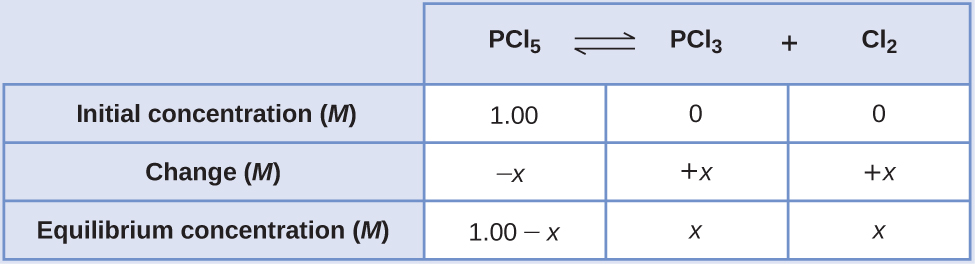
- Determine the direction the reaction proceeds.反応が進む方向を判断する。The balanced equation for the decomposition of PCl5 isPCl5の分解を表す、係数を整えた反応式は次のとおりである。Because only the reactant is present initially Qc = 0 and the reaction will proceed to the right.初めに存在するのは反応物だけなので、Qc=0であり、反応は右へ進む。
- Develop an ICE table.ICE表を作る。
- Solve for the change and the equilibrium concentrations.変化量と平衡濃度を求める。Substituting the equilibrium concentrations into the equilibrium constant equation gives平衡濃度を平衡定数の式に代入すると、次の式が得られる。Appendix B shows an equation of the form ax2 + bx + c = 0 can be rearranged to solve for x:
英語のヒント
付録Bに示すように、ax2+bx+c=0の形の式は、変形してxについて解くことができる。In this case, a = 1, b = 0.0211, and c = −0.0211. Substituting the appropriate values for a, b, and c yields:この場合、a=1、b=0.0211、c=−0.0211である。a、b、cにこれらの値を代入すると、次のようになる。The two roots of the quadratic are, therefore,したがって、この二次方程式の二つの解は、andおよびFor this scenario, only the positive root is physically meaningful (concentrations are either zero or positive), and so x = 0.135 M.英語のヒント
この場合、物理的に意味があるのは正の解だけである。濃度は0または正でなければならないため、x=0.135 Mとなる。The equilibrium concentrations are平衡濃度は次のとおりである。 - Confirm the calculated equilibrium concentrations.計算した平衡濃度を確かめる。Substitution into the expression for Kc (to check the calculation) gives計算を確認するため、Kcの式に代入すると、次のようになる。The equilibrium constant calculated from the equilibrium concentrations is equal to the value of Kc given in the problem (when rounded to the proper number of significant figures).
英語のヒント
平衡濃度から計算した平衡定数は、適切な有効数字に丸めると、問題で与えられたKcと等しくなる。
Check Your Learning理解を確かめよう
Acetic acid, CH3CO2H, reacts with ethanol, C2H5OH, to form water and ethyl acetate, CH3CO2C2H5.
酢酸CH3CO2HはエタノールC2H5OHと反応し、水と酢酸エチルCH3CO2C2H5を生成する。
The equilibrium constant for this reaction with dioxane as a solvent is 4.0. What are the equilibrium concentrations for a mixture that is initially 0.15 M in CH3CO2H, 0.15 M in C2H5OH, 0.40 M in CH3CO2C2H5, and 0.40 M in H2O?
ジオキサンを溶媒にしたとき、この反応の平衡定数は4.0である。初濃度がCH3CO2Hは0.15 M、C2H5OHは0.15 M、CH3CO2C2H5は0.40 M、H2Oは0.40 Mの混合物では、平衡濃度はいくらか。
Check Your Learning理解を確かめよう
A 1.00-L flask is filled with 1.00 mole of H2 and 2.00 moles of I2. The value of the equilibrium constant for the reaction of hydrogen and iodine reacting to form hydrogen iodide is 50.5 under the given conditions. What are the equilibrium concentrations of H2, I2, and HI in moles/L?
1.00 Lのフラスコに、H2を1.00 mol、I2を2.00 mol入れる。水素とヨウ素が反応してヨウ化水素を生じる反応の平衡定数は、この条件では50.5である。H2、I2、HIの平衡濃度をmol/Lで求めなさい。
Example 13.10例題 13.10
Calculation of Equilibrium Concentrations Using an Algebra-Simplifying Assumption代数計算を簡単にする仮定を用いた平衡濃度の計算
What are the concentrations at equilibrium of a 0.15 M solution of HCN?
HCNの0.15 M溶液では、平衡での各濃度はいくらか。
Solution解法
Using “x” to represent the concentration of each product at equilibrium gives this ICE table.
平衡における各生成物の濃度をxで表すと、次のICE表が得られる。
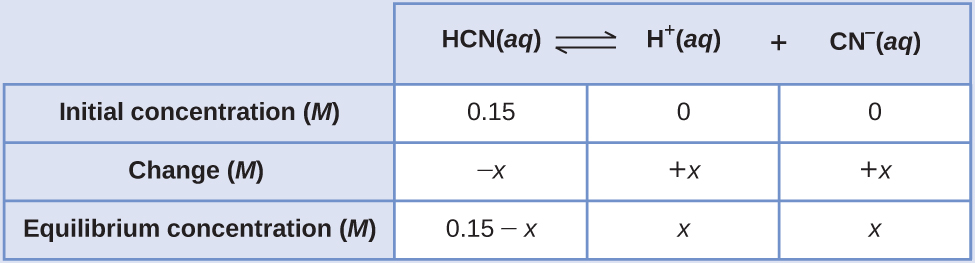


Substitute the equilibrium concentration terms into the Kc expression
平衡濃度を表す項をKcの式に代入する。
rearrange to the quadratic form and solve for x
二次方程式の形に整理し、xについて解く。
Thus [H+] = [CN–] = x = 8.6 10–6 M and [HCN] = 0.15 – x = 0.15 M.
したがって、[H+]=[CN–]=x=8.6 10–6 M、[HCN]=0.15−x=0.15 Mである。
Note in this case that the change in concentration is significantly less than the initial concentration (a consequence of the small K), and so the initial concentration experiences a negligible change:
英語のヒント
この場合、Kが小さいため、濃度の変化量は初濃度よりはるかに小さいことに注意しよう。したがって、初濃度からの変化は無視できる。
This approximation allows for a more expedient mathematical approach to the calculation that avoids the need to solve for the roots of a quadratic equation:
英語のヒント
この近似を使うと、二次方程式の解を求めずに、より手早く計算できる。
The value of x calculated is, indeed, much less than the initial concentration
実際、計算したxは初濃度よりはるかに小さい。
and so the approximation was justified. If this simplified approach were to yield a value for x that did not justify the approximation, the calculation would need to be repeated without making the approximation.
英語のヒント
したがって、この近似は妥当だった。もし簡略化した方法で得たxが近似を正当化できない値なら、近似を使わずに計算をやり直す必要がある。
Check Your Learning理解を確かめよう
What are the equilibrium concentrations in a 0.25 M NH3 solution?
NH3の0.25 M溶液では、平衡濃度はいくらか。