第13章化学平衡の基本概念
Effect of a Change in Temperature温度変化の影響
Consistent with the law of mass action, an equilibrium stressed by a change in concentration will shift to re-establish equilibrium without any change in the value of the equilibrium constant, K. When an equilibrium shifts in response to a temperature change, however, it is re-established with a different relative composition that exhibits a different value for the equilibrium constant.
英語のヒント
質量作用の法則に従い、濃度変化という外乱を受けた平衡は、平衡定数Kの値を変えずに移動し、再び成立する。しかし、温度変化に応じて平衡が移動する場合には、異なる相対組成で平衡が再成立し、平衡定数も異なる値をとる。
To understand this phenomenon, consider the elementary reaction
この現象を理解するため、次の素反応を考えよう。
Since this is an elementary reaction, the rates laws for the forward and reverse may be derived directly from the balanced equation’s stoichiometry:
これは素反応なので、正反応と逆反応の速度式は、係数を整えた反応式の化学量論から直接導ける。
When the system is at equilibrium,
系が平衡にあるとき、
Substituting the rate laws into this equality and rearranging gives
この等式に速度式を代入して整理すると、次の式が得られる。
The equilibrium constant is seen to be a mathematical function of the rate constants for the forward and reverse reactions. Since the rate constants vary with temperature as described by the Arrhenius equation, it stands to reason that the equilibrium constant will likewise vary with temperature (assuming the rate constants are affected to different extents by the temperature change). For more complex reactions involving multistep reaction mechanisms, a similar but more complex mathematical relation exists between the equilibrium constant and the rate constants of the steps in the mechanism. Regardless of how complex the reaction may be, the temperature-dependence of its equilibrium constant persists.
英語のヒント
平衡定数は、正反応と逆反応の速度定数の数学的な関数であることがわかる。速度定数はアレニウスの式に従って温度とともに変わるので、平衡定数も温度で変わると考えるのは自然である。ただし、温度変化による影響の程度が、正逆の速度定数で異なると仮定する。複数段階の反応機構を持つ、より複雑な反応でも、平衡定数と各段階の速度定数の間には、同様だがもっと複雑な数学的関係がある。反応がどれほど複雑でも、平衡定数の温度依存性は変わらず存在する。
Predicting the shift an equilibrium will experience in response to a change in temperature is most conveniently accomplished by considering the enthalpy change of the reaction. For example, the decomposition of dinitrogen tetroxide is an endothermic (heat-consuming) process:
温度を変えたときに平衡がどちらへ移動するかを予測するには、反応のエンタルピー変化を考えるのが最も便利である。例えば、四酸化二窒素の分解は吸熱過程、すなわち熱を消費する過程である。
For purposes of applying Le Chatelier’s principle, heat (q) may be viewed as a reactant:
ルシャトリエの原理を適用する際には、熱qを反応物とみなせる。
Raising the temperature of the system is akin to increasing the amount of a reactant, and so the equilibrium will shift to the right. Lowering the system temperature will likewise cause the equilibrium to shift left. For exothermic processes, heat is viewed as a product of the reaction and so the opposite temperature dependence is observed.
英語のヒント
系の温度を上げることは、反応物の量を増やすことに似ているので、平衡は右へ移動する。同様に、系の温度を下げると平衡は左へ移動する。発熱過程では熱を生成物とみなすので、温度への依存の仕方は逆になる。
Effect of a Catalyst触媒の影響
The kinetics chapter of this text identifies a catalyst as a substance that enables a reaction to proceed via a different mechanism with an accelerated rate. The catalyzed reaction mechanism involves a lower energy transition state than the uncatalyzed reaction, resulting in a lower activation energy, Ea, and a correspondingly greater rate constant.
英語のヒント
本書の反応速度の章では、触媒を、別の反応機構を通して反応を速く進ませる物質として説明した。触媒のある反応機構では、触媒のない反応より遷移状態のエネルギーが低い。その結果、活性化エネルギーEaが小さくなり、それに対応して速度定数が大きくなる。
To discern the effect of catalysis on an equilibrium system, consider the reaction diagram for a simple one-step (elementary) reaction shown in Figure 13.8. The lowered transition state energy of the catalyzed reaction results in lowered activation energies for both the forward and the reverse reactions. Consequently, both forward and reverse reactions are accelerated, and equilibrium is achieved more quickly but without a change in the equilibrium constant.
平衡系への触媒作用の影響を見分けるため、図13.8の単純な一段階反応、すなわち素反応のエネルギー図を考えよう。触媒によって遷移状態のエネルギーが下がると、正反応と逆反応の両方の活性化エネルギーが低下する。そのため、両方向の反応が速くなって平衡に早く達するが、平衡定数は変化しない。
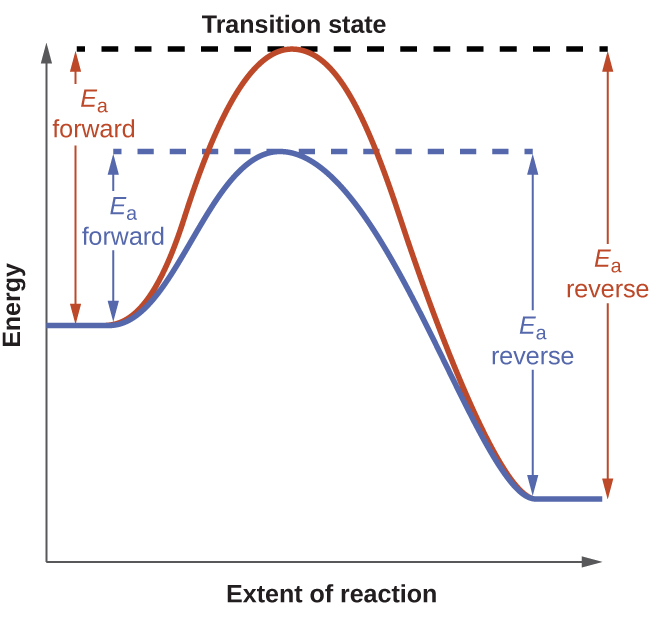
Figure 13.8図 13.8
Reaction diagrams for an elementary process in the absence (red) and presence (blue) of a catalyst. The presence of catalyst lowers the activation energies of both the forward and reverse reactions but does not affect the value of the equilibrium constant.
触媒がない場合(赤)とある場合(青)の、素過程の反応エネルギー図。触媒は正反応と逆反応の両方の活性化エネルギーを下げるが、平衡定数の値には影響しない。
An interesting case study highlighting these equilibrium concepts is the industrial production of ammonia, NH3. This substance is among the “top 10” industrial chemicals with regard to production, with roughly two billion pounds produced annually in the US. Ammonia is used as a chemical feedstock to synthesize a wide range of commercially useful compounds, including fertilizers, plastics, dyes, and explosives.
英語のヒント
これらの平衡の概念をよく示す興味深い事例が、アンモニアNH3の工業生産である。アンモニアは生産量で工業化学品の上位10品目に入り、米国では年間およそ20億ポンドが生産される。肥料、プラスチック、染料、爆薬など、商業的に有用な幅広い化合物を合成する原料として使われる。
Most industrial production of ammonia uses the Haber-Bosch process based on the following equilibrium reaction:
工業的なアンモニア生産の大部分は、次の平衡反応を利用したハーバー・ボッシュ法による。
The traits of this reaction present challenges to its use in an efficient industrial process. The equilibrium constant is relatively small (Kp on the order of 10−5 at 25 °C), meaning very little ammonia is present in an equilibrium mixture. Also, the rate of this reaction is relatively slow at low temperatures. To raise the yield of ammonia, the industrial process is designed to operate under conditions favoring product formation:
英語のヒント
この反応の性質は、効率的な工業工程に利用するうえで課題となる。平衡定数は比較的小さく、25 °CでKpは10−5程度であるため、平衡混合物にはアンモニアがごくわずかしか存在しない。また、低温では反応速度が比較的遅い。アンモニアの収率を高めるため、工業工程は生成物の形成に有利な条件で運転するよう設計される。
- High pressures (concentrations) of reactants are used, ~150−250 atm, to shift the equilibrium right, favoring product formation.反応物を約150〜250 atmという高圧(高濃度)にし、平衡を右へ移動させて生成物の形成を促す。
- Ammonia is continually removed (collected) from the equilibrium mixture during the process, lowering its concentration and also shifting the equilibrium right.工程中、平衡混合物からアンモニアを絶えず取り除いて回収し、その濃度を下げることによっても、平衡を右へ移動させる。
- Although low temperatures favor product formation for this exothermic process, the reaction rate at low temperatures is inefficiently slow. A catalyst is used to accelerate the reaction to reasonable rates at relatively moderate temperatures (400−500 °C).
英語のヒント
この発熱過程では、低温が生成物の形成に有利だが、低温での反応速度は遅すぎて効率が悪い。触媒を使い、比較的中程度の温度(400〜500 °C)で、実用的な速さまで反応を加速する。
A diagram illustrating a typical industrial setup for production of ammonia via the Haber-Bosch process is shown in Figure 13.9.
ハーバー・ボッシュ法による代表的なアンモニア工業生産設備の模式図を、図13.9に示す。
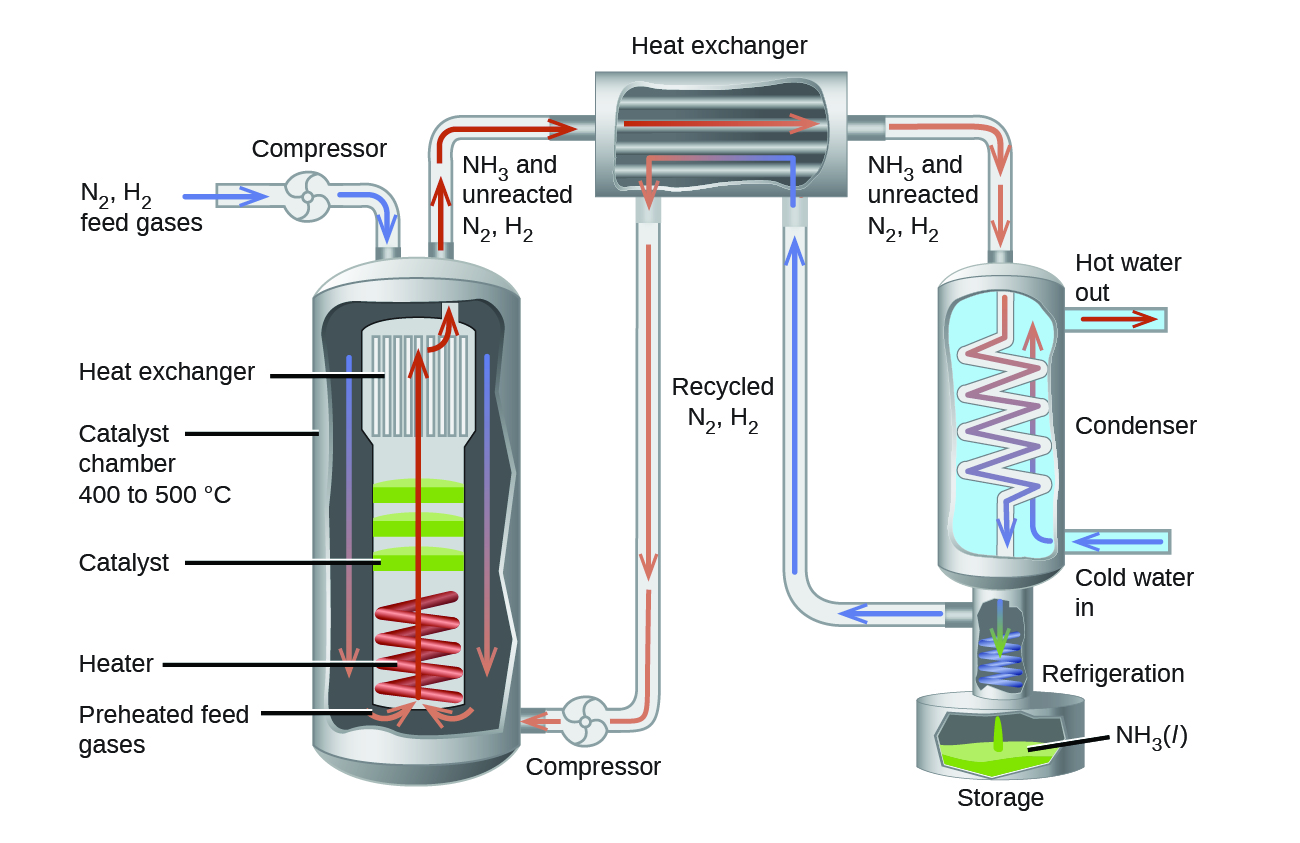


Figure 13.9図 13.9
The figure shows a typical industrial setup for the commercial production of ammonia by the Haber-Bosch process. The process operates under conditions that stress the chemical equilibrium to favor product formation.
ハーバー・ボッシュ法によるアンモニアの商業生産に用いる、代表的な工業設備。生成物ができやすい方向に化学平衡を動かす条件で運転される。