第13章化学平衡の基本概念
13.2 Equilibrium Constants13.2 平衡定数
Learning Objectives学習目標
By the end of this section, you will be able to:
この節を学ぶと、次のことができるようになる。
- Derive reaction quotients from chemical equations representing homogeneous and heterogeneous reactions均一反応と不均一反応を表す化学反応式から、反応商を導く。
- Calculate values of reaction quotients and equilibrium constants, using concentrations and pressures濃度と圧力を使って、反応商と平衡定数の値を計算する。
- Relate the magnitude of an equilibrium constant to properties of the chemical system平衡定数の大きさを、化学系の性質と関連づける。
The status of a reversible reaction is conveniently assessed by evaluating its reaction quotient (Q). For a reversible reaction described by
英語のヒント
可逆反応の状態を調べるには、反応商Qを求めると便利である。次の式で表される可逆反応について、
the reaction quotient is derived directly from the stoichiometry of the balanced equation as
反応商は、係数を整えた反応式の化学量論から、次のように直接導かれる。
where the subscript c denotes the use of molar concentrations in the expression. If the reactants and products are gaseous, a reaction quotient may be similarly derived using partial pressures:
英語のヒント
ここで、添字cは、式中でモル濃度を用いていることを表す。反応物と生成物が気体なら、分圧を使って同様に反応商を導くことができる。
Note that the reaction quotient equations above are a simplification of more rigorous expressions that use relative values for concentrations and pressures rather than absolute values. These relative concentration and pressure values are dimensionless (they have no units); consequently, so are the reaction quotients. For purposes of this introductory text, it will suffice to use the simplified equations and to disregard units when computing Q. In most cases, this will introduce only modest errors in calculations involving reaction quotients.
英語のヒント
上に示した反応商の式は、より厳密な式を簡略化したものである。厳密な式では、濃度や圧力の絶対的な値ではなく、相対的な値を使う。その相対的な濃度と圧力は無次元、すなわち単位を持たないので、反応商も無次元である。この入門書の目的には、簡略化した式を使い、Qを計算するときは単位を考えないことにすれば十分である。大部分の場合、この扱いが反応商の計算にもたらす誤差は小さい。
Example 13.1例題 13.1
Writing Reaction Quotient Expressions反応商の式を書く
Write the concentration-based reaction quotient expression for each of the following reactions:
次の各反応について、濃度を用いた反応商の式を書きなさい。
(a)
(a)
(b)
(b)
(c)
(c)
Solution解法
(a)
(a)
(b)
(b)
(c)
(c)
Check Your Learning理解を確かめよう
Write the concentration-based reaction quotient expression for each of the following reactions:
次の各反応について、濃度を用いた反応商の式を書きなさい。
(a)
(a)
(b)
(b)
(c)
(c)
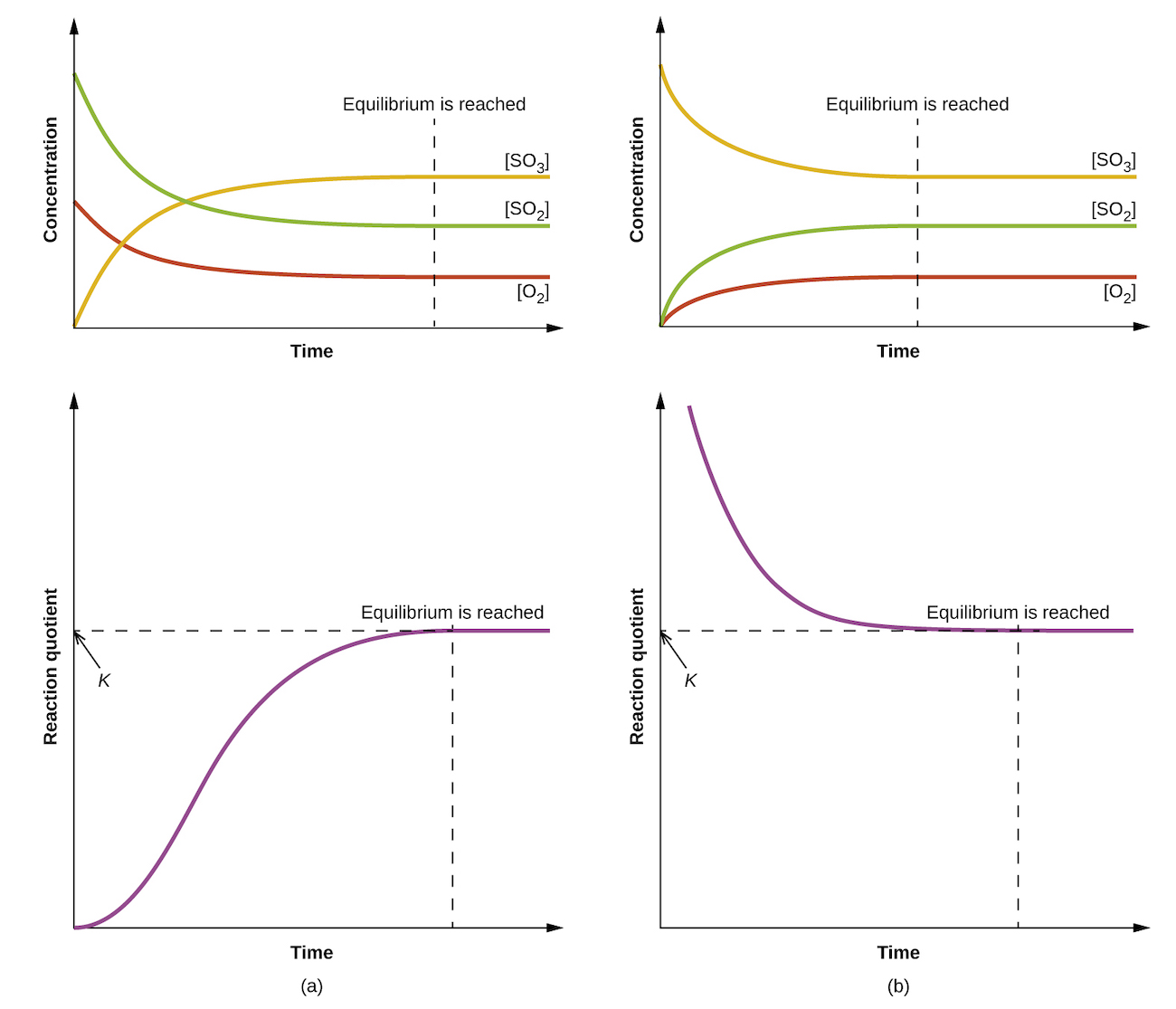
Figure 13.5図 13.5
Changes in concentrations and Qc for a chemical equilibrium achieved beginning with (a) a mixture of reactants only and (b) products only.
(a) 反応物だけの混合物、(b) 生成物だけから出発し、化学平衡に達するまでの濃度とQcの変化。
The numerical value of Q varies as a reaction proceeds towards equilibrium; therefore, it can serve as a useful indicator of the reaction’s status. To illustrate this point, consider the oxidation of sulfur dioxide:
英語のヒント
Qの数値は、反応が平衡へ向かって進むにつれて変わるため、反応の状態を示す有用な指標となる。このことを、二酸化硫黄の酸化反応で考えよう。
Two different experimental scenarios are depicted in Figure 13.5, one in which this reaction is initiated with a mixture of reactants only, SO2 and O2, and another that begins with only product, SO3. For the reaction that begins with a mixture of reactants only, Q is initially equal to zero:
英語のヒント
図13.5には、二つの異なる実験条件を示す。一つは反応物SO2とO2だけの混合物から反応を始める場合、もう一つは生成物SO3だけから始める場合である。反応物だけの混合物から始める反応では、最初のQは0になる。
As the reaction proceeds toward equilibrium in the forward direction, reactant concentrations decrease (as does the denominator of Qc), product concentration increases (as does the numerator of Qc), and the reaction quotient consequently increases. When equilibrium is achieved, the concentrations of reactants and product remain constant, as does the value of Qc.
英語のヒント
反応が正方向に進んで平衡へ近づくと、反応物濃度が下がり、Qcの分母も小さくなる。生成物濃度は上がり、Qcの分子も大きくなる。その結果、反応商は増加する。平衡に達すると、反応物と生成物の濃度は一定になり、Qcの値も一定になる。
If the reaction begins with only product present, the value of Qc is initially undefined (immeasurably large, or infinite):
英語のヒント
生成物だけが存在する状態で反応が始まる場合、最初のQcの値は定義できない。測れないほど大きい、すなわち無限大となる。
In this case, the reaction proceeds toward equilibrium in the reverse direction. The product concentration and the numerator of Qc decrease with time, the reactant concentrations and the denominator of Qc increase, and the reaction quotient consequently decreases until it becomes constant at equilibrium.
この場合、反応は逆方向に進んで平衡へ近づく。時間とともに生成物濃度とQcの分子が小さくなり、反応物濃度とQcの分母が大きくなる。そのため反応商は減少し、平衡で一定になる。
The constant value of Q exhibited by a system at equilibrium is called the equilibrium constant, K:
平衡にある系が示すQの一定値を、平衡定数Kという。
Comparison of the data plots in Figure 13.5 shows that both experimental scenarios resulted in the same value for the equilibrium constant. This is a general observation for all equilibrium systems, known as the law of mass action: At a given temperature, the reaction quotient for a system at equilibrium is constant.
英語のヒント
図13.5のグラフを比較すると、どちらの実験条件でも平衡定数が同じ値になることがわかる。これは、すべての平衡系に共通する観察結果で、質量作用の法則として知られる。すなわち、一定の温度では、平衡にある系の反応商は一定である。
Example 13.2例題 13.2
Evaluating a Reaction Quotient反応商を求める
Gaseous nitrogen dioxide forms dinitrogen tetroxide according to this equation:
気体の二酸化窒素は、次の式に従って四酸化二窒素を生成する。
When 0.10 mol NO2 is added to a 1.0-L flask at 25 °C, the concentration changes so that at equilibrium, [NO2] = 0.016 M and [N2O4] = 0.042 M.
25 °Cで1.0 LのフラスコにNO2を0.10 mol入れると濃度が変化し、平衡では[NO2]=0.016 M、[N2O4]=0.042 Mとなる。
(a) What is the value of the reaction quotient before any reaction occurs?
(a) 反応が起こる前の反応商はいくらか。
(b) What is the value of the equilibrium constant for the reaction?
(b) この反応の平衡定数はいくらか。
Solution解法
As for all equilibrium calculations in this text, use the simplified equations for Q and K and disregard any concentration or pressure units, as noted previously in this section.
本書のほかの平衡計算と同様、この節で先に述べたとおり、QとKには簡略化した式を使い、濃度や圧力の単位は考えない。
(a) Before any product is formed, and [N2O4] = 0 M. Thus,
(a) 生成物ができる前は、、[N2O4]=0 Mである。したがって、
(b) At equilibrium, The equilibrium constant is 1.6 102.
(b) 平衡ではである。平衡定数は1.6 102となる。
Check Your Learning理解を確かめよう
For the reaction the concentrations at equilibrium are [SO2] = 0.90 M, [O2] = 0.35 M, and [SO3] = 1.1 M. What is the value of the equilibrium constant, Kc?
反応について、平衡時の濃度は[SO2]=0.90 M、[O2]=0.35 M、[SO3]=1.1 Mである。平衡定数Kcはいくらか。
By its definition, the magnitude of an equilibrium constant explicitly reflects the composition of a reaction mixture at equilibrium, and it may be interpreted with regard to the extent of the forward reaction. A reaction exhibiting a large K will reach equilibrium when most of the reactant has been converted to product, whereas a small K indicates the reaction achieves equilibrium after very little reactant has been converted. It’s important to keep in mind that the magnitude of K does not indicate how rapidly or slowly equilibrium will be reached. Some equilibria are established so quickly as to be nearly instantaneous, and others so slowly that no perceptible change is observed over the course of days, years, or longer.
英語のヒント
平衡定数の大きさは、その定義から、平衡にある反応混合物の組成を明確に反映しており、正反応がどの程度進むかという観点から解釈できる。Kが大きい反応では、反応物の大部分が生成物に変わってから平衡に達する。一方、Kが小さければ、反応物がごくわずかしか変化しないうちに平衡に達する。Kの大きさは、平衡に達する速さを示すものではないことを忘れてはならない。ほとんど瞬時と言えるほど速く平衡が成立する場合もあれば、数日、数年、あるいはそれ以上にわたって、目に見える変化がないほど遅い場合もある。
The equilibrium constant for a reaction can be used to predict the behavior of mixtures containing its reactants and/or products. As demonstrated by the sulfur dioxide oxidation process described above, a chemical reaction will proceed in whatever direction is necessary to achieve equilibrium. Comparing Q to K for an equilibrium system of interest allows prediction of what reaction (forward or reverse), if any, will occur.
英語のヒント
反応の平衡定数を使うと、その反応物や生成物を含む混合物の振る舞いを予測できる。先ほどの二酸化硫黄の酸化過程が示すように、化学反応は、平衡に達するために必要な方向へ進む。調べたい平衡系のQをKと比較すれば、反応が起こるか、起こるなら正方向か逆方向かを予測できる。
To further illustrate this important point, consider the reversible reaction shown below:
この重要な点をさらに確かめるため、次の可逆反応を考えよう。
The bar charts in Figure 13.6 represent changes in reactant and product concentrations for three different reaction mixtures. The reaction quotients for mixtures 1 and 3 are initially lesser than the reaction’s equilibrium constant, so each of these mixtures will experience a net forward reaction to achieve equilibrium. The reaction quotient for mixture 2 is initially greater than the equilibrium constant, so this mixture will proceed in the reverse direction until equilibrium is established.
英語のヒント
図13.6の棒グラフは、三つの異なる反応混合物で、反応物と生成物の濃度がどう変わるかを示す。混合物1と3では、最初の反応商が平衡定数より小さいため、全体として正方向に反応が進んで平衡に達する。混合物2では、最初の反応商が平衡定数より大きいため、平衡になるまで逆方向に進む。
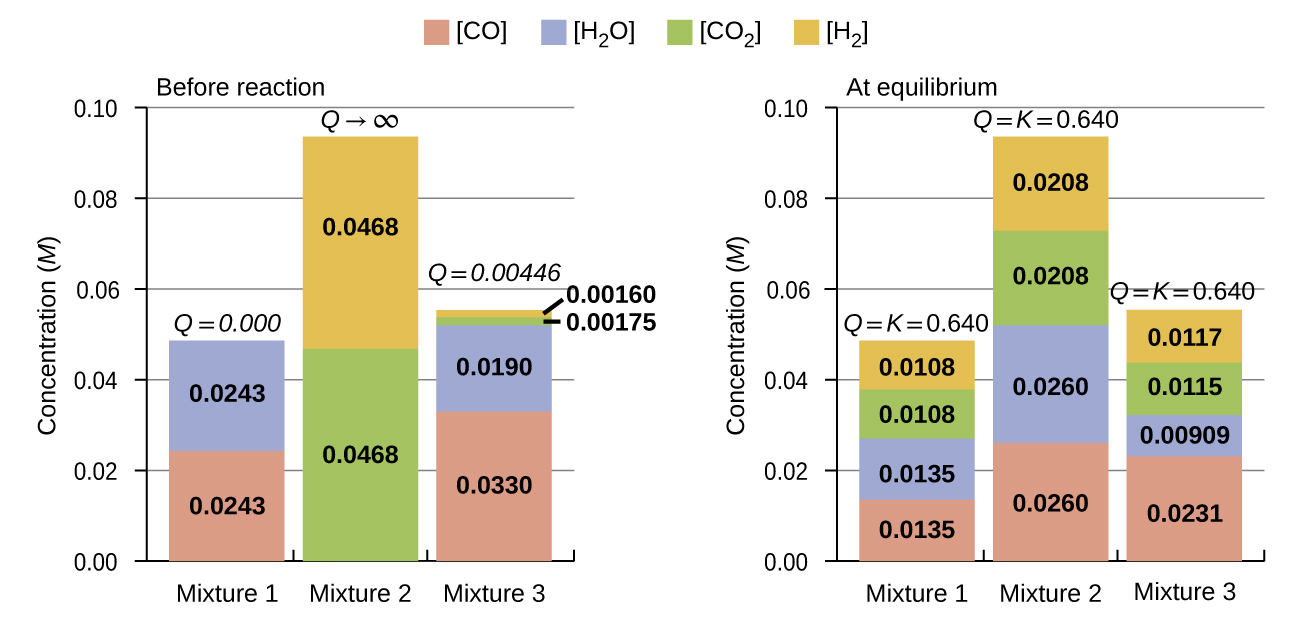


Figure 13.6図 13.6
Compositions of three mixtures before (Qc ≠ Kc) and after (Qc = Kc) equilibrium is established for the reaction
反応について、平衡が成立する前(Qc≠Kc)と後(Qc=Kc)の三つの混合物の組成。
Example 13.3例題 13.3
Predicting the Direction of Reaction反応が進む方向を予測する
Given here are the starting concentrations of reactants and products for three experiments involving this reaction:
英語のヒント
次の反応を扱う三つの実験について、反応物と生成物の初濃度を以下に示す。
Determine in which direction the reaction proceeds as it goes to equilibrium in each of the three experiments shown.
示された三つの実験それぞれについて、平衡に達するまで反応がどちらの方向へ進むかを求めなさい。
Reactants/Products 反応物/生成物 |
Experiment 1 実験1 |
Experiment 2 実験2 |
Experiment 3 実験3 |
|---|---|---|---|
[CO]i |
0.020 M |
0.011 M |
0.0094 M |
[H2O]i |
0.020 M |
0.0011 M |
0.0025 M |
[CO2]i |
0.0040 M |
0.037 M |
0.0015 M |
[H2]i |
0.0040 M |
0.046 M |
0.0076 M |
Solution解法
Experiment 1:
実験1:
Qc < Kc (0.040 < 0.64)
Qc<Kc(0.040<0.64)
The reaction will proceed in the forward direction.
反応は正方向に進む。
Experiment 2:
実験2:
Qc > Kc (140 > 0.64)
Qc>Kc(140>0.64)
The reaction will proceed in the reverse direction.
反応は逆方向に進む。
Experiment 3:
実験3:
Qc < Kc (0.48 < 0.64)
Qc<Kc(0.48<0.64)
The reaction will proceed in the forward direction.
反応は正方向に進む。
Check Your Learning理解を確かめよう
Calculate the reaction quotient and determine the direction in which each of the following reactions will proceed to reach equilibrium.
反応商を計算し、次の各反応が平衡に達するためにどちらの方向へ進むかを求めなさい。
(a) A 1.00-L flask containing 0.0500 mol of NO(g), 0.0155 mol of Cl2(g), and 0.500 mol of NOCl:
(a) NO(g)を0.0500 mol、Cl2(g)を0.0155 mol、NOClを0.500 mol含む1.00 Lのフラスコ:
(b) A 5.0-L flask containing 17 g of NH3, 14 g of N2, and 12 g of H2:
(b) NH3を17 g、N2を14 g、H2を12 g含む5.0 Lのフラスコ:
(c) A 2.00-L flask containing 230 g of SO3(g):
(c) SO3(g)を230 g含む2.00 Lのフラスコ: