第13章化学平衡の基本概念
13.4 Equilibrium Calculations13.4 平衡の計算
Learning Objectives学習目標
By the end of this section, you will be able to:
この節を学ぶと、次のことができるようになる。
- Identify the changes in concentration or pressure that occur for chemical species in equilibrium systems平衡系の化学種に生じる濃度または圧力の変化を求める。
- Calculate equilibrium concentrations or pressures and equilibrium constants, using various algebraic approachesさまざまな代数的手法を用いて、平衡濃度または平衡圧力、および平衡定数を計算する。
Having covered the essential concepts of chemical equilibria in the preceding sections of this chapter, this final section will demonstrate the more practical aspect of using these concepts and appropriate mathematical strategies to perform various equilibrium calculations. These types of computations are essential to many areas of science and technology—for example, in the formulation and dosing of pharmaceutical products. After a drug is ingested or injected, it is typically involved in several chemical equilibria that affect its ultimate concentration in the body system of interest. Knowledge of the quantitative aspects of these equilibria is required to compute a dosage amount that will solicit the desired therapeutic effect.
英語のヒント
本章の前の節では、化学平衡の基本概念を学んだ。最後のこの節では、それらの概念と適切な数学的手法を用いて、さまざまな平衡計算を行うという実用的な側面を扱う。この種の計算は、医薬品の処方や投与量の決定など、科学技術の多くの分野で欠かせない。薬物を飲んだり注射したりすると、通常はいくつかの化学平衡に関わり、それらが対象となる体内の系での最終的な濃度に影響する。望ましい治療効果をもたらす投与量を計算するには、この平衡を量的に理解する必要がある。
Many of the useful equilibrium calculations that will be demonstrated here require terms representing changes in reactant and product concentrations. These terms are derived from the stoichiometry of the reaction, as illustrated by decomposition of ammonia:
ここで扱う有用な平衡計算の多くでは、反応物と生成物の濃度変化を表す項が必要になる。これらの項は、次のアンモニアの分解で示すように、反応の化学量論から導かれる。
As shown earlier in this chapter, this equilibrium may be established within a sealed container that initially contains either NH3 only, or a mixture of any two of the three chemical species involved in the equilibrium. Regardless of its initial composition, a reaction mixture will show the same relationships between changes in the concentrations of the three species involved, as dictated by the reaction stoichiometry (see also the related content on expressing reaction rates in the chapter on kinetics). For example, if the nitrogen concentration increases by an amount x:
英語のヒント
本章で先に示したように、この平衡は、初めにNH3だけを含む密閉容器でも、平衡に関わる三つの化学種のうち任意の二つを含む密閉容器でも成立する。初期組成によらず、反応混合物中の三つの化学種の濃度変化には、反応の化学量論によって定まる同じ関係がある。反応速度の章にある、反応速度の表し方に関する説明も参照してほしい。例えば、窒素濃度の増加量をxとすると、
the corresponding changes in the other species concentrations are
対応するほかの化学種の濃度変化は、次のようになる。
where the negative sign indicates a decrease in concentration.
負号は濃度の減少を表す。
Example 13.6例題 13.6
Determining Relative Changes in Concentration濃度変化の比を求める
Derive the missing terms representing concentration changes for each of the following reactions.
次の各反応について、濃度変化を表す項の空欄を求めなさい。
(a)
(a)
(b)
(b)
(c)
(c)
Solution解法
(a)
(a)
(b)
(b)
(c)
(c)
Check Your Learning理解を確かめよう
Complete the changes in concentrations for each of the following reactions:
次の各反応について、濃度変化の記述を完成させなさい。
(a)
(a)
(b)
(b)
(c)
(c)
Calculation of an Equilibrium Constant平衡定数の計算
The equilibrium constant for a reaction is calculated from the equilibrium concentrations (or pressures) of its reactants and products. If these concentrations are known, the calculation simply involves their substitution into the K expression, as was illustrated by Example 13.2. A slightly more challenging example is provided next, in which the reaction stoichiometry is used to derive equilibrium concentrations from the information provided. The basic strategy of this computation is helpful for many types of equilibrium computations and relies on the use of terms for the reactant and product concentrations initially present, for how they change as the reaction proceeds, and for what they are when the system reaches equilibrium. The acronym ICE is commonly used to refer to this mathematical approach, and the concentrations terms are usually gathered in a tabular format called an ICE table.
英語のヒント
反応の平衡定数は、反応物と生成物の平衡濃度、または平衡圧力から計算する。これらの濃度がわかっていれば、例題13.2のようにKの式へ代入するだけでよい。次の例題は少し難しく、与えられた情報から、反応の化学量論を使って平衡濃度を導く。この計算の基本的な方法は、多くの平衡計算に役立つ。反応物と生成物の初めの濃度、反応が進むにつれてどれだけ変わるか、平衡に達したときいくらになるか、という三つを表す項を用いる。この数学的な方法は、一般に頭文字を取ってICEと呼ばれ、濃度の各項は通常、ICE表という表形式にまとめられる。
Example 13.7例題 13.7
Calculation of an Equilibrium Constant平衡定数の計算
Iodine molecules react reversibly with iodide ions to produce triiodide ions.
ヨウ素分子はヨウ化物イオンと可逆的に反応し、三ヨウ化物イオンを生成する。
If a solution with the concentrations of I2 and I− both equal to 1.000 10−3 M before reaction gives an equilibrium concentration of I2 of 6.61 10−4 M, what is the equilibrium constant for the reaction?
反応前のI2とI−の濃度がともに1.000 10−3 Mの溶液で、I2の平衡濃度が6.61 10−4 Mになった。この反応の平衡定数はいくらか。
Solution解法
To calculate the equilibrium constants, equilibrium concentrations are needed for all the reactants and products:
平衡定数を計算するには、すべての反応物と生成物の平衡濃度が必要である。
Provided are the initial concentrations of the reactants and the equilibrium concentration of the product. Use this information to derive terms for the equilibrium concentrations of the reactants, presenting all the information in an ICE table.
反応物の初濃度と、生成物の平衡濃度が与えられている。この情報から反応物の平衡濃度を表す項を導き、すべての情報をICE表にまとめる。
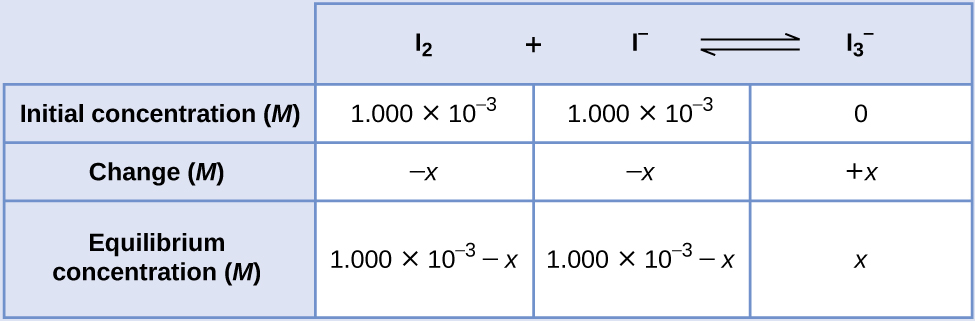
At equilibrium the concentration of I2 is 6.61 10−4 M so that
平衡ではI2の濃度が6.61 10−4 Mであるから、
The ICE table may now be updated with numerical values for all its concentrations:
ここでICE表のすべての濃度を数値に置き換えられる。
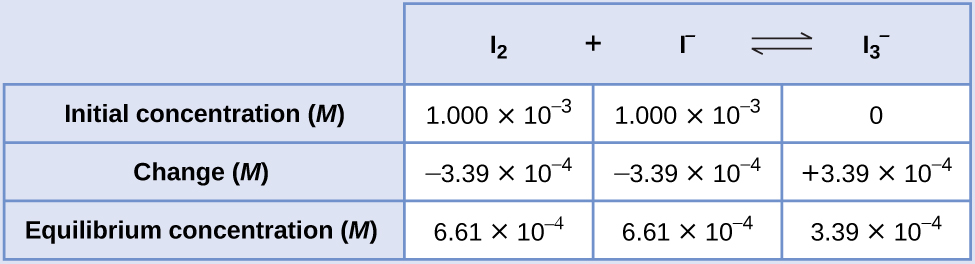


Finally, substitute the equilibrium concentrations into the K expression and solve:
最後に、平衡濃度をKの式に代入して計算する。
Check Your Learning理解を確かめよう
Ethanol and acetic acid react and form water and ethyl acetate, the solvent responsible for the odor of some nail polish removers.
英語のヒント
エタノールと酢酸が反応すると、水と酢酸エチルが生じる。酢酸エチルは、一部の除光液のにおいのもととなる溶媒である。
When 1 mol each of C2H5OH and CH3CO2H are allowed to react in 1 L of the solvent dioxane, equilibrium is established when mol of each of the reactants remains. Calculate the equilibrium constant for the reaction. (Note: Water is a solute in this reaction.)
溶媒ジオキサン1 L中でC2H5OHとCH3CO2Hをそれぞれ1 mol反応させると、両反応物がそれぞれ mol残ったときに平衡に達する。この反応の平衡定数を計算しなさい。(注:この反応では水は溶質である。)