第11章溶液とコロイド
Soaps and Detergents石けんと合成洗剤
Pioneers made soap by boiling fats with a strongly basic solution made by leaching potassium carbonate, K2CO3, from wood ashes with hot water. Animal fats contain polyesters of fatty acids (long-chain carboxylic acids). When animal fats are treated with a base like potassium carbonate or sodium hydroxide, glycerol and salts of fatty acids such as palmitic, oleic, and stearic acid are formed. The salts of fatty acids are called soaps. The sodium salt of stearic acid, sodium stearate, has the formula C17H35CO2Na and contains an uncharged nonpolar hydrocarbon chain, the C17H35— unit, and an ionic carboxylate group, the — unit (Figure 11.31).
英語のヒント
開拓者たちは、木灰から熱水で炭酸カリウムK2CO3を浸出させて強塩基性溶液をつくり、それで脂肪を煮て石けんをつくった。動物性脂肪は、脂肪酸、すなわち長鎖カルボン酸のポリエステルを含む。炭酸カリウムや水酸化ナトリウムのような塩基で動物性脂肪を処理すると、グリセロールと、パルミチン酸、オレイン酸、ステアリン酸などの脂肪酸の塩ができる。脂肪酸の塩を石けんと呼ぶ。ステアリン酸のナトリウム塩であるステアリン酸ナトリウムの化学式はC17H35CO2Naで、電荷をもたない無極性の炭化水素鎖C17H35—と、イオン性のカルボキシラート基—を含む(図11.31)。

Figure 11.31図 11.31
Soaps contain a nonpolar hydrocarbon end (blue) and an ionic end (red). The ionic end is a carboxylate group. The length of the hydrocarbon end can vary from soap to soap.
石けんには、無極性の炭化水素末端(青)とイオン性末端(赤)がある。イオン性末端はカルボキシラート基である。炭化水素末端の長さは、石けんによって異なる。
Detergents (soap substitutes) also contain nonpolar hydrocarbon chains, such as C12H25—, and an ionic group, such as a sulfate— or a sulfonate— (Figure 11.32). Soaps form insoluble calcium and magnesium compounds in hard water; detergents form water-soluble products—a definite advantage for detergents.
英語のヒント
合成洗剤、すなわち石けんの代用品も、C12H25—のような無極性炭化水素鎖と、硫酸エステル基—やスルホン酸基—のようなイオン性基を含む(図11.32)。石けんは硬水中で不溶性のカルシウム・マグネシウム化合物をつくるが、合成洗剤は水溶性の生成物をつくる。これは合成洗剤の明確な利点である。

Figure 11.32図 11.32
Detergents contain a nonpolar hydrocarbon end (blue) and an ionic end (red). The ionic end can be either a sulfate or a sulfonate. The length of the hydrocarbon end can vary from detergent to detergent.
合成洗剤は無極性の炭化水素末端(青)とイオン性末端(赤)を含む。イオン性末端は硫酸エステル基またはスルホン酸基である。炭化水素末端の長さは洗剤によって異なる。
The cleaning action of soaps and detergents can be explained in terms of the structures of the molecules involved. The hydrocarbon (nonpolar) end of a soap or detergent molecule dissolves in, or is attracted to, nonpolar substances such as oil, grease, or dirt particles. The ionic end is attracted by water (polar), illustrated in Figure 11.33. As a result, the soap or detergent molecules become oriented at the interface between the dirt particles and the water so they act as a kind of bridge between two different kinds of matter, nonpolar and polar. Molecules such as this are termed amphiphilic since they have both a hydrophobic (“water-fearing”) part and a hydrophilic (“water-loving”) part. As a consequence, dirt particles become suspended as colloidal particles and are readily washed away.
英語のヒント
石けんと合成洗剤の洗浄作用は、関わる分子の構造から説明できる。石けんや洗剤の分子の炭化水素、すなわち無極性の末端は、油、脂、汚れの粒子のような無極性物質に溶け込むか、引き寄せられる。イオン性の末端は、図11.33のように極性のある水に引き寄せられる。その結果、石けんや洗剤の分子は汚れの粒子と水との界面で向きをそろえ、無極性と極性という異なる二種類の物質の橋渡しをする。この種の分子は、疎水性の「水を嫌う」部分と親水性の「水を好む」部分の両方をもつため、両親媒性と呼ばれる。その結果、汚れの粒子はコロイド粒子として浮遊し、容易に洗い流される。
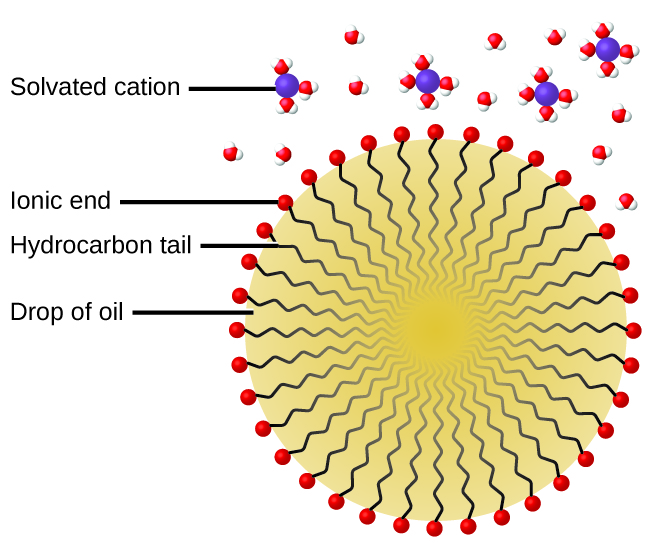


Figure 11.33図 11.33
This diagrammatic cross section of an emulsified drop of oil in water shows how soap or detergent acts as an emulsifier.
水中で乳化した油滴の断面模式図。石けんや洗剤が乳化剤として働く仕組みを示している。