第11章溶液とコロイド
11.2 Electrolytes11.2 電解質
Learning Objectives学習目標
By the end of this section, you will be able to:
この節を終えると、次のことができるようになる。
- Define and give examples of electrolytes電解質を定義し、例を挙げる。
- Distinguish between the physical and chemical changes that accompany dissolution of ionic and covalent electrolytesイオン性電解質と共有結合性電解質の溶解に伴う、物理変化と化学変化を区別する。
- Relate electrolyte strength to solute-solvent attractive forces電解質の強弱を、溶質と溶媒の間の引力と関係づける。
When some substances are dissolved in water, they undergo either a physical or a chemical change that yields ions in solution. These substances constitute an important class of compounds called electrolytes. Substances that do not yield ions when dissolved are called nonelectrolytes. If the physical or chemical process that generates the ions is essentially 100% efficient (all of the dissolved compound yields ions), then the substance is known as a strong electrolyte. If only a relatively small fraction of the dissolved substance undergoes the ion-producing process, it is called a weak electrolyte.
英語のヒント
ある種の物質は水に溶けると、物理変化または化学変化によって、溶液中にイオンを生じる。これらは電解質と呼ばれる重要な化合物群を構成する。溶けてもイオンを生じない物質は、非電解質と呼ばれる。イオンを生じる物理的または化学的過程が実質的に100%進む場合(溶けた化合物がすべてイオンを生じる場合)、その物質を強電解質と呼ぶ。溶けた物質のうち比較的わずかな部分だけがイオンを生じる過程を経る場合は、弱電解質と呼ぶ。
Substances may be identified as strong, weak, or nonelectrolytes by measuring the electrical conductance of an aqueous solution containing the substance. To conduct electricity, a substance must contain freely mobile, charged species. Most familiar is the conduction of electricity through metallic wires, in which case the mobile, charged entities are electrons. Solutions may also conduct electricity if they contain dissolved ions, with conductivity increasing as ion concentration increases. Applying a voltage to electrodes immersed in a solution permits assessment of the relative concentration of dissolved ions, either quantitatively, by measuring the electrical current flow, or qualitatively, by observing the brightness of a light bulb included in the circuit (Figure 11.6).
英語のヒント
物質を含む水溶液の電気の通しやすさを測ると、その物質が強電解質、弱電解質、非電解質のどれかを判定できる。電気を通すには、物質に、自由に動ける電荷を帯びた化学種が含まれていなければならない。最も身近なのは金属線を通る電気伝導で、この場合、動ける荷電粒子は電子である。溶液も、溶けたイオンを含めば電気を通せる。イオン濃度が高いほど電気伝導度も高くなる。溶液に浸した電極に電圧を加えると、溶けたイオンの相対的な濃度を評価できる。電流を測って定量的に調べることも、回路内の電球の明るさを見て定性的に調べることもできる(図11.6)。
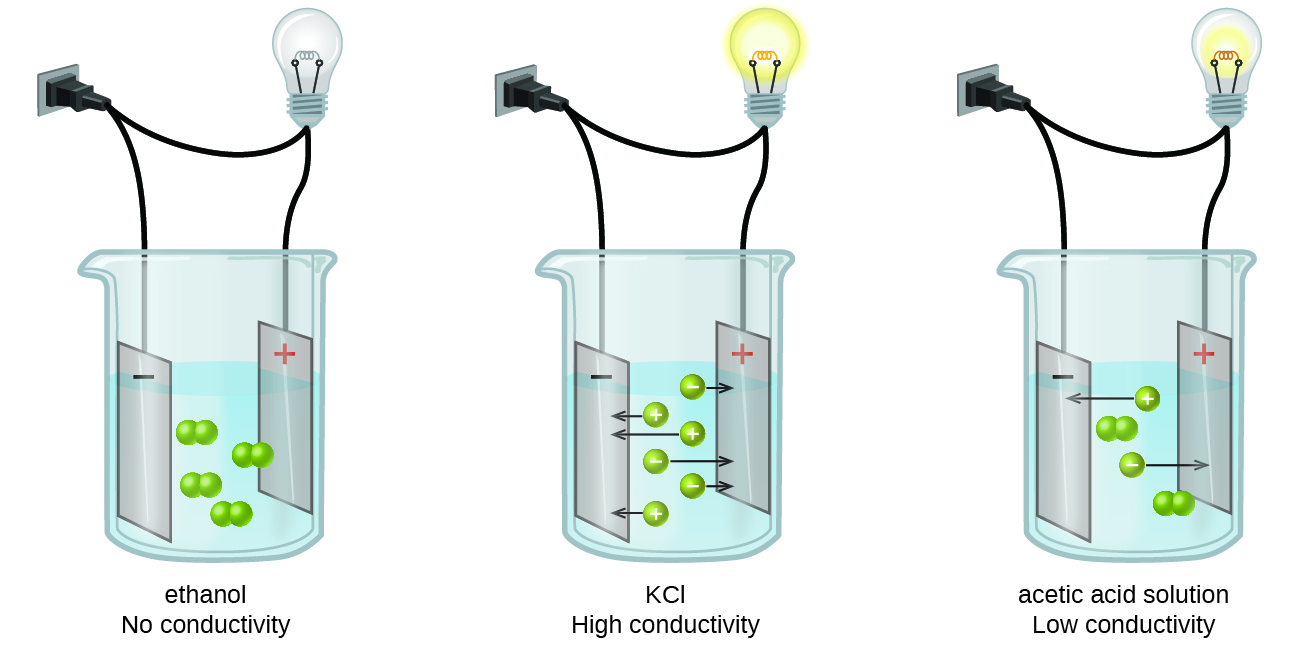
Figure 11.6図 11.6
Solutions of nonelectrolytes such as ethanol do not contain dissolved ions and cannot conduct electricity. Solutions of electrolytes contain ions that permit the passage of electricity. The conductivity of an electrolyte solution is related to the strength of the electrolyte.
エタノールのような非電解質の溶液は、溶けたイオンを含まないため、電気を通さない。電解質の溶液はイオンを含み、電気を通せる。電解質溶液の電気伝導度は、電解質の強弱に関係している。
Ionic Electrolytesイオン性電解質
Water and other polar molecules are attracted to ions, as shown in Figure 11.7. The electrostatic attraction between an ion and a molecule with a dipole is called an ion-dipole attraction. These attractions play an important role in the dissolution of ionic compounds in water.
英語のヒント
水やその他の極性分子は、図11.7のようにイオンに引き寄せられる。イオンと双極子をもつ分子の間の静電引力を、イオン–双極子引力と呼ぶ。この引力は、イオン化合物が水に溶ける際に重要な役割を果たす。
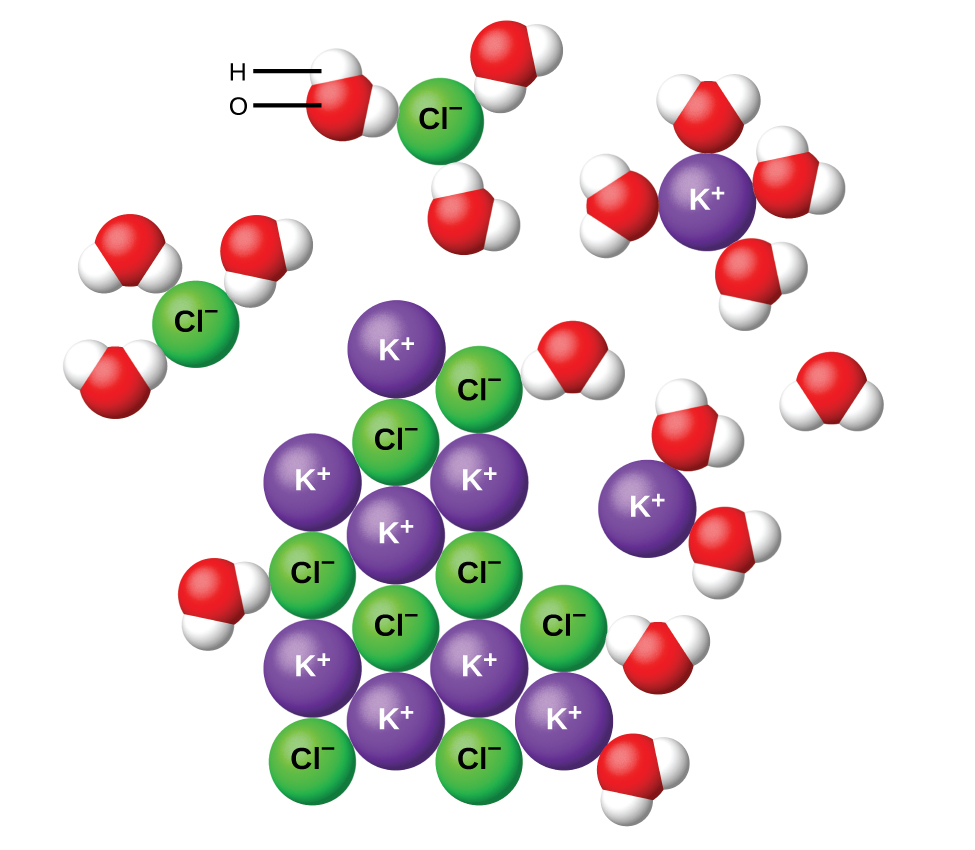
Figure 11.7図 11.7
As potassium chloride (KCl) dissolves in water, the ions are hydrated. The polar water molecules are attracted by the charges on the K+ and Cl− ions. Water molecules in front of and behind the ions are not shown.
塩化カリウムKClが水に溶けると、イオンは水和される。極性をもつ水分子は、K+とCl−のイオンの電荷に引き寄せられる。イオンの手前と奥にある水分子は描いていない。
When ionic compounds dissolve in water, the ions in the solid separate and disperse uniformly throughout the solution because water molecules surround and solvate the ions, reducing the strong electrostatic forces between them. This process represents a physical change known as dissociation. Under most conditions, ionic compounds will dissociate nearly completely when dissolved, and so they are classified as strong electrolytes. Even sparingly, soluble ionic compounds are strong electrolytes, since the small amount that does dissolve will dissociate completely.
英語のヒント
イオン化合物が水に溶けると、固体内のイオンは離れ、溶液全体に均一に分散する。これは、水分子がイオンを囲んで溶媒和し、イオン間の強い静電気力を弱めるためである。この過程は、解離という物理変化に当たる。ほとんどの条件で、イオン化合物は溶けるとほぼ完全に解離するため、強電解質に分類される。溶けにくいイオン化合物でさえ、溶けた少量は完全に解離するので、強電解質である。
Consider what happens at the microscopic level when solid KCl is added to water. Ion-dipole forces attract the positive (hydrogen) end of the polar water molecules to the negative chloride ions at the surface of the solid, and they attract the negative (oxygen) ends to the positive potassium ions. The water molecules surround individual K+ and Cl− ions, reducing the strong interionic forces that bind the ions together and letting them move off into solution as solvated ions, as Figure 11.7 shows. Overcoming the electrostatic attraction permits the independent motion of each hydrated ion in a dilute solution as the ions transition from fixed positions in the undissolved compound to widely dispersed, solvated ions in solution.
英語のヒント
固体KClを水に加えたとき、微視的には何が起こるか考えよう。イオン–双極子力は、極性水分子の正の端(水素側)を固体表面の負の塩化物イオンへ引き寄せ、負の端(酸素側)を正のカリウムイオンへ引き寄せる。水分子は個々のK+、Cl−イオンを囲み、イオンを結びつけている強いイオン間力を弱める。その結果、図11.7のように、イオンは溶媒和された状態で溶液中へ移れる。静電引力に打ち勝つことで、イオンは未溶解の化合物中の固定位置から、溶液内に広く分散した溶媒和イオンへと移り、希薄溶液では各水和イオンが独立に動けるようになる。
Covalent Electrolytes共有結合性電解質
Pure water is an extremely poor conductor of electricity because it is only very slightly ionized—only about two out of every 1 billion molecules ionize at 25 °C. Water ionizes when one molecule of water gives up a proton (H+ ion) to another molecule of water, yielding hydronium and hydroxide ions.
英語のヒント
純水は極めて電気を通しにくい物質である。ごくわずかしか電離せず、25 °Cでは10億分子につき約2分子だけが電離するからである。一つの水分子が別の水分子に陽子(H+イオン)を渡すと水が電離し、ヒドロニウムイオンと水酸化物イオンを生じる。
In some cases, solutions prepared from covalent compounds conduct electricity because the solute molecules react chemically with the solvent to produce ions. For example, pure hydrogen chloride is a gas consisting of covalent HCl molecules. This gas contains no ions. However, an aqueous solution of HCl is a very good conductor, indicating that an appreciable concentration of ions exists within the solution.
共有結合性化合物からつくった溶液でも、溶質分子が溶媒と化学反応してイオンを生じるために電気を通す場合がある。たとえば、純粋な塩化水素は共有結合したHCl分子からなる気体である。この気体はイオンを含まない。しかし、HCl水溶液は非常によく電気を通す。これは、溶液内に無視できない濃度のイオンが存在することを示す。
Because HCl is an acid, its molecules react with water, transferring H+ ions to form hydronium ions (H3O+) and chloride ions (Cl−):
HClは酸なので、その分子は水と反応してH+イオンを渡し、ヒドロニウムイオンH3O+と塩化物イオンCl−を生じる。



This reaction is essentially 100% complete for HCl (i.e., it is a strong acid and, consequently, a strong electrolyte). Likewise, weak acids and bases that only react partially generate relatively low concentrations of ions when dissolved in water and are classified as weak electrolytes. The reader may wish to review the discussion of strong and weak acids provided in the earlier chapter of this text on reaction classes and stoichiometry.
HClでは、この反応が実質的に100%進む(つまり、強酸であり、したがって強電解質である)。同様に、一部しか反応しない弱酸や弱塩基は、水に溶けると比較的低い濃度のイオンを生じるため、弱電解質に分類される。必要なら、本書の前の反応分類と化学量論の章にある、強酸と弱酸の説明を復習せよ。