第11章溶液とコロイド
11.1 The Dissolution Process11.1 溶解の過程
Learning Objectives学習目標
By the end of this section, you will be able to:
この節を終えると、次のことができるようになる。
- Describe the basic properties of solutions and how they form溶液の基本的な性質と、溶液ができる仕組みを説明する。
- Predict whether a given mixture will yield a solution based on molecular properties of its components各成分の分子的性質に基づき、与えられた混合物が溶液になるかどうか予測する。
- Explain why some solutions either produce or absorb heat when they form溶液ができるとき、熱を生じるものと吸収するものがある理由を説明する。
An earlier chapter of this text introduced solutions, defined as homogeneous mixtures of two or more substances. Often, one component of a solution is present at a significantly greater concentration, in which case it is called the solvent. The other components of the solution present in relatively lesser concentrations are called solutes. Sugar is a covalent solid composed of sucrose molecules, C12H22O11. When this compound dissolves in water, its molecules become uniformly distributed among the molecules of water:
英語のヒント
本書の前の章では、二種類以上の物質からなる均一な混合物として定義される溶液を紹介した。溶液のある一成分の濃度がほかより著しく高いことがよくあり、その場合、その成分を溶媒と呼ぶ。比較的低い濃度で存在するほかの成分は、溶質と呼ぶ。砂糖は、スクロース分子C12H22O11からなる共有結合性の固体である。この化合物が水に溶けると、その分子が水分子の間に均一に分布する。
The subscript “aq” in the equation signifies that the sucrose molecules are solutes and are therefore individually dispersed throughout the aqueous solution (water is the solvent). Although sucrose molecules are heavier than water molecules, they remain dispersed throughout the solution; gravity does not cause them to “settle out” over time.
英語のヒント
式中の添字「aq」は、スクロース分子が溶質であり、水溶液全体に一つずつ分散していることを示す(水が溶媒である)。スクロース分子は水分子より重いものの、溶液全体に分散したままである。重力によって時間とともに「沈降」することはない。
Potassium dichromate, K2Cr2O7, is an ionic compound composed of colorless potassium ions, K+, and orange dichromate ions, When a small amount of solid potassium dichromate is added to water, the compound dissolves and dissociates to yield potassium ions and dichromate ions uniformly distributed throughout the mixture (Figure 11.2), as indicated in this equation:
二クロム酸カリウムK2Cr2O7は、無色のカリウムイオンK+と橙色の二クロム酸イオンからなるイオン化合物である。固体の二クロム酸カリウムを少量、水に加えると、化合物は溶解して解離し、カリウムイオンと二クロム酸イオンが混合物全体に均一に分布する(図11.2)。この過程を次の式に示す。
As with the mixture of sugar and water, this mixture is also an aqueous solution. Its solutes, potassium and dichromate ions, remain individually dispersed among the solvent (water) molecules.
砂糖と水の混合物と同じく、これも水溶液である。溶質であるカリウムイオンと二クロム酸イオンは、溶媒である水の分子の間に、一つずつ分散したまま存在する。

OpenStax, Rice University, Chemistry 2e. Original caption credit: (credit: modification of work by Mark Ott) · CC BY 4.0 · Source出典
Figure 11.2図 11.2
When potassium dichromate (K2Cr2O7) is mixed with water, it forms a homogeneous orange solution. (credit: modification of work by Mark Ott)
二クロム酸カリウム(K2Cr2O7)を水と混ぜると、均一な橙色の溶液になる。(出典:Mark Ottの作品を改変)
Water is used so often as a solvent that the word solution has come to imply an aqueous solution to many people. However, almost any gas, liquid, or solid can act as a solvent. Many alloys are solid solutions of one metal dissolved in another; for example, US five-cent coins contain nickel dissolved in copper. Air is a gaseous solution, a homogeneous mixture of nitrogen, oxygen, and several other gases. Oxygen (a gas), alcohol (a liquid), and sugar (a solid) all dissolve in water (a liquid) to form liquid solutions. Table 11.1 gives examples of several different solutions and the phases of the solutes and solvents.
英語のヒント
水は溶媒として非常によく使われるため、多くの人にとって「溶液」という語は水溶液を意味するようになっている。しかし、ほぼどんな気体、液体、固体も溶媒になり得る。多くの合金は、ある金属が別の金属に溶けた固溶体である。たとえば、米国の5セント硬貨には、銅に溶けたニッケルが含まれる。空気は気体の溶液で、窒素、酸素、その他いくつかの気体の均一な混合物である。酸素(気体)、アルコール(液体)、砂糖(固体)は、いずれも水(液体)に溶けて液体の溶液になる。表11.1に、いくつかの溶液の例と、その溶質・溶媒の相を示す。
Different Types of Solutions さまざまな種類の溶液 |
||
|---|---|---|
Solution 溶液 |
Solute 溶質 |
Solvent 溶媒 |
air 空気 |
O2(g) |
N2(g) |
soft drinks If bubbles of gas are observed within the liquid, the mixture is not homogeneous and, thus, not a solution. 清涼飲料水。液体中に気泡が見える場合、混合物は均一ではないため、溶液ではない。 |
CO2(g) |
H2O(l) |
hydrogen in palladium パラジウム中の水素 |
H2(g) |
Pd(s) |
rubbing alcohol 消毒用アルコール |
H2O(l) |
C3H8O(l) (2-propanol) C3H8O(l)(2-プロパノール) |
saltwater 塩水 |
NaCl(s) |
H2O(l) |
brass 黄銅 |
Zn(s) |
Cu(s) |
Solutions exhibit these defining traits:
溶液は、次のような特徴をもつ。
- They are homogeneous; after a solution is mixed, it has the same composition at all points throughout (its composition is uniform).均一である。溶液を混ぜた後は、全体のどの場所でも組成が同じである(組成が一様である)。
- The physical state of a solution—solid, liquid, or gas—is typically the same as that of the solvent, as demonstrated by the examples in Table 11.1.溶液の物理的状態(固体、液体、気体)は、表11.1の例に示すように、通常、溶媒の状態と同じである。
- The components of a solution are dispersed on a molecular scale; they consist of a mixture of separated solute particles (molecules, atoms, and/or ions) each closely surrounded by solvent species.溶液の成分は分子規模で分散している。分離した溶質粒子(分子、原子、イオン、またはそれらの組合せ)の混合物からなり、各粒子は溶媒の化学種に密に取り囲まれている。
- The dissolved solute in a solution will not settle out or separate from the solvent.溶液中に溶けた溶質は、沈降したり溶媒から分離したりしない。
- The composition of a solution, or the concentrations of its components, can be varied continuously (within limits determined by the solubility of the components, discussed in detail later in this chapter).溶液の組成、すなわち各成分の濃度は、連続的に変えられる(各成分の溶解度が定める範囲内で。この点は本章の後半で詳しく扱う)。
The Formation of Solutions溶液の形成
The formation of a solution is an example of a spontaneous process, a process that occurs under specified conditions without the requirement of energy from some external source. Sometimes a mixture is stirred to speed up the dissolution process, but this is not necessary; a homogeneous solution will form eventually. The topic of spontaneity is critically important to the study of chemical thermodynamics and is treated more thoroughly in a later chapter of this text. For purposes of this chapter’s discussion, it will suffice to consider two criteria that favor, but do not guarantee, the spontaneous formation of a solution:
英語のヒント
溶液の形成は自発的過程の一例である。自発的過程とは、指定した条件のもとで、外部のエネルギー源からエネルギーを受け取る必要なく起こる過程である。溶解を速めるために混合物をかき混ぜることもあるが、それは必須ではなく、やがて均一な溶液ができる。自発性は化学熱力学を学ぶうえで極めて重要な主題であり、本書の後の章でより詳しく扱う。本章の議論では、溶液の自発的な形成を促進するものの保証はしない、次の二つの基準を考えれば十分である。
- a decrease in the internal energy of the system (an exothermic change, as discussed in the previous chapter on thermochemistry)系の内部エネルギーが減少すること(前の熱化学の章で述べた、発熱変化)。
- an increased dispersal of matter in the system (which indicates an increase in the entropy of the system, as you will learn about in the later chapter on thermodynamics)系内で物質がより広く分散すること(後の熱力学の章で学ぶように、系のエントロピーの増加を示す)。
In the process of dissolution, an internal energy change often, but not always, occurs as heat is absorbed or evolved. An increase in matter dispersal always results when a solution forms from the uniform distribution of solute molecules throughout a solvent.
英語のヒント
溶解の過程では、熱が吸収・放出されるのに伴って内部エネルギーが変化することがよくあるが、必ずではない。溶質分子が溶媒全体に均一に分布して溶液になるとき、物質の分散は常に増大する。
When the strengths of the intermolecular forces of attraction between solute and solvent species in a solution are no different than those present in the separated components, the solution is formed with no accompanying energy change. Such a solution is called an ideal solution. A mixture of ideal gases (or gases such as helium and argon, which closely approach ideal behavior) is an example of an ideal solution, since the entities comprising these gases experience no significant intermolecular attractions.
英語のヒント
溶液中の溶質と溶媒の化学種の間に働く分子間引力の強さが、分離していた各成分に存在したものと変わらない場合、溶液はエネルギー変化を伴わずにできる。このような溶液を理想溶液と呼ぶ。理想気体の混合物、またはヘリウムやアルゴンのように理想的な振る舞いに近い気体の混合物は、理想溶液の一例である。これらの気体を構成する粒子の間には、無視できないほどの分子間引力が働かないためである。
When containers of helium and argon are connected, the gases spontaneously mix due to diffusion and form a solution (Figure 11.3). The formation of this solution clearly involves an increase in matter dispersal, since the helium and argon atoms occupy a volume twice as large as that which each occupied before mixing.
英語のヒント
ヘリウムとアルゴンの容器をつなぐと、気体は拡散によって自発的に混ざり、溶液になる(図11.3)。混合後のヘリウム原子とアルゴン原子は、それぞれが混合前に占めていた体積の2倍の体積を占めるので、この溶液の形成には明らかに物質の分散の増大が伴っている。
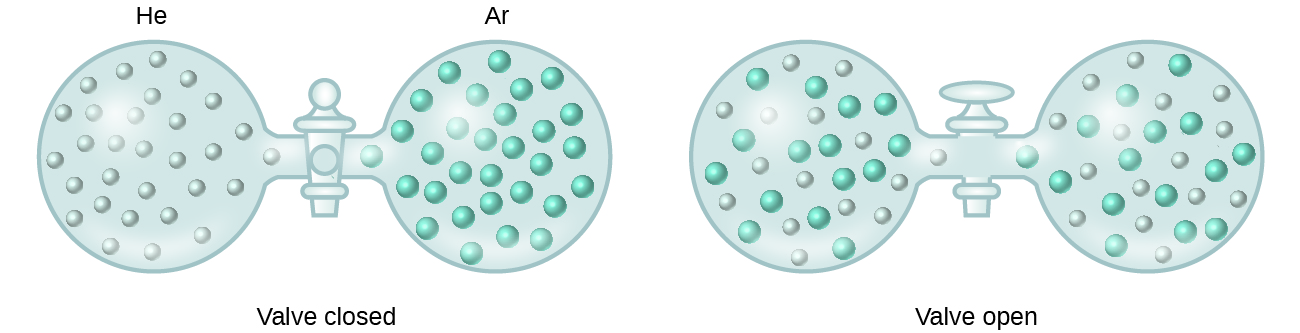
Figure 11.3図 11.3
Samples of helium and argon spontaneously mix to give a solution.
ヘリウムとアルゴンの試料は、自発的に混ざって溶液になる。
Ideal solutions may also form when structurally similar liquids are mixed. For example, mixtures of the alcohols methanol (CH3OH) and ethanol (C2H5OH) form ideal solutions, as do mixtures of the hydrocarbons pentane, C5H12, and hexane, C6H14. Placing methanol and ethanol, or pentane and hexane, in the bulbs shown in Figure 11.3 will result in the same diffusion and subsequent mixing of these liquids as is observed for the He and Ar gases (although at a much slower rate), yielding solutions with no significant change in energy. Unlike a mixture of gases, however, the components of these liquid-liquid solutions do, indeed, experience intermolecular attractive forces. But since the molecules of the two substances being mixed are structurally very similar, the intermolecular attractive forces between like and unlike molecules are essentially the same, and the dissolution process, therefore, does not entail any appreciable increase or decrease in energy. These examples illustrate how increased matter dispersal alone can provide the driving force required to cause the spontaneous formation of a solution. In some cases, however, the relative magnitudes of intermolecular forces of attraction between solute and solvent species may prevent dissolution.
英語のヒント
構造が似た液体を混ぜたときにも、理想溶液ができる場合がある。たとえば、アルコールであるメタノールCH3OHとエタノールC2H5OHの混合物や、炭化水素であるペンタンC5H12とヘキサンC6H14の混合物は、理想溶液になる。図11.3の球形容器にメタノールとエタノール、またはペンタンとヘキサンを入れると、HeとArの気体で見られたのと同じ拡散と、その後の混合が起こる。ただし速度ははるかに遅く、著しいエネルギー変化なしに溶液ができる。しかし気体の混合物とは異なり、これら液体どうしの溶液の成分には、実際に分子間引力が働く。それでも、混ぜる二物質の分子構造が非常によく似ているため、同種分子間と異種分子間の引力は実質的に同じであり、溶解過程は大きなエネルギーの増減を伴わない。これらの例は、物質の分散の増大だけで、溶液を自発的に形成させる駆動力となり得ることを示す。ただし、溶質と溶媒の化学種の間に働く分子間引力の相対的な大きさが、溶解を妨げる場合もある。
Three types of intermolecular attractive forces are relevant to the dissolution process: solute-solute, solvent-solvent, and solute-solvent. As illustrated in Figure 11.4, the formation of a solution may be viewed as a stepwise process in which energy is consumed to overcome solute-solute and solvent-solvent attractions (endothermic processes) and released when solute-solvent attractions are established (an exothermic process referred to as solvation). The relative magnitudes of the energy changes associated with these stepwise processes determine whether the dissolution process overall will release or absorb energy. In some cases, solutions do not form because the energy required to separate solute and solvent species is so much greater than the energy released by solvation.
英語のヒント
溶解過程には、溶質間、溶媒間、溶質と溶媒の間という三種類の分子間引力が関係する。図11.4に示すように、溶液の形成は段階的な過程として見ることができる。溶質間および溶媒間の引力に打ち勝つためにエネルギーを消費し(吸熱過程)、溶質と溶媒の間の引力ができるとエネルギーを放出する(溶媒和と呼ばれる発熱過程)。これら段階ごとのエネルギー変化の相対的な大きさによって、溶解過程全体がエネルギーを放出するか、吸収するかが決まる。溶質と溶媒の化学種を引き離すために必要なエネルギーが、溶媒和で放出されるエネルギーよりはるかに大きく、溶液ができない場合もある。
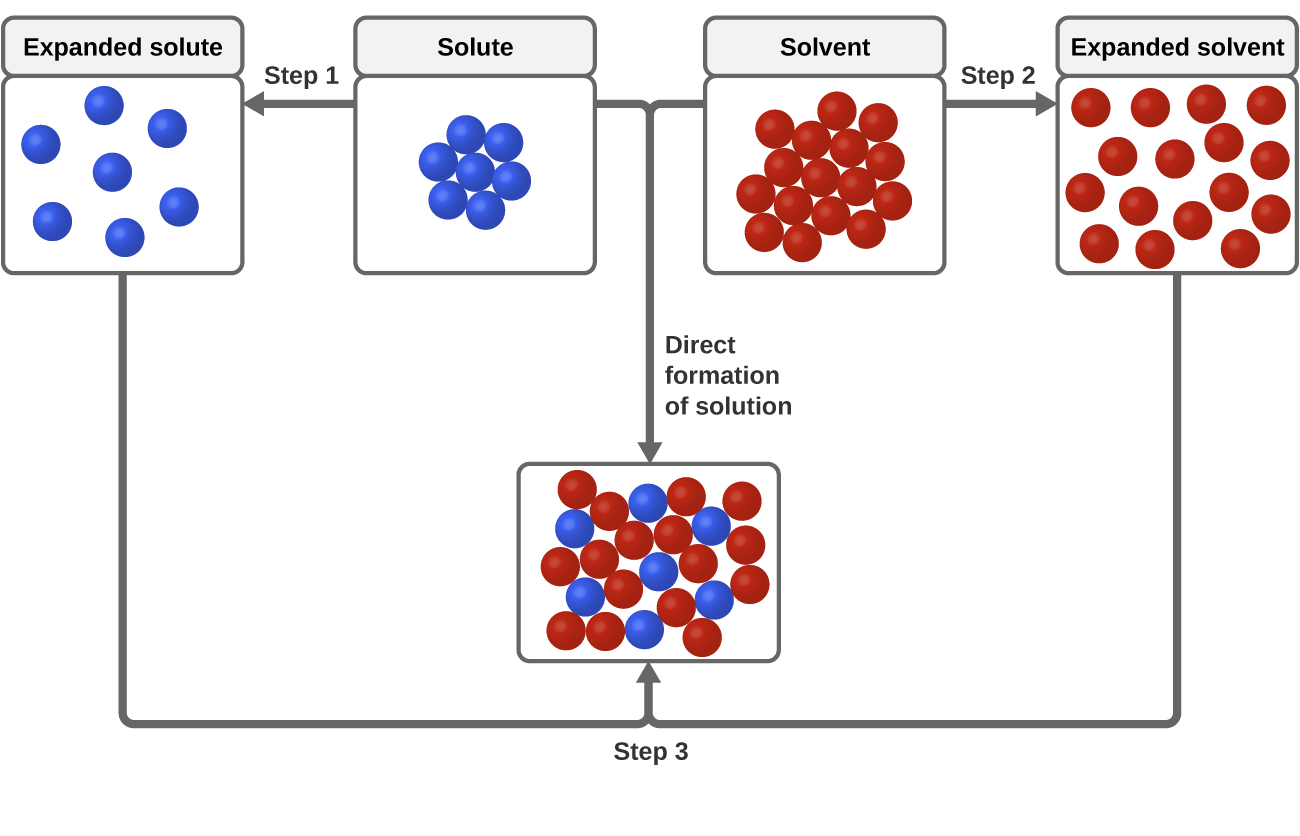
Figure 11.4図 11.4
This schematic represents the direct formation of a solution as a hypothetical stepwise process. Steps 1 and 2 involve separation/expansion of the solute and solvent molecules, both of which require an input of energy to overcome intermolecular attractions and are thus endothermic. Step 3 involves establishing intermolecular attractive forces between solute and solvent molecules (solvation), and is thus exothermic.
この模式図は、溶液が直接形成される過程を、仮想的な段階に分けて表している。段階1と2は、溶質分子と溶媒分子を分離・膨張させる過程である。どちらも分子間引力に打ち勝つエネルギーの投入が必要なので、吸熱的である。段階3は、溶質分子と溶媒分子の間に分子間引力をつくる過程(溶媒和)なので、発熱的である。
Consider the example of an ionic compound dissolving in water. Formation of the solution requires the electrostatic forces between the cations and anions of the compound (solute–solute) be overcome completely as attractive forces are established between these ions and water molecules (solute–solvent). Hydrogen bonding between a relatively small fraction of the water molecules must also be overcome to accommodate any dissolved solute. If the solute’s electrostatic forces are significantly greater than the solvation forces, the dissolution process is significantly endothermic and the compound may not dissolve to an appreciable extent. Calcium carbonate, the major component of coral reefs, is one example of such an “insoluble” ionic compound (see Figure 11.1). On the other hand, if the solvation forces are much stronger than the compound’s electrostatic forces, the dissolution is significantly exothermic and the compound may be highly soluble. A common example of this type of ionic compound is sodium hydroxide, commonly known as lye.
英語のヒント
イオン化合物が水に溶ける例を考えよう。溶液ができるには、化合物の陽イオンと陰イオンの間の静電気力(溶質間)に完全に打ち勝ち、それらのイオンと水分子の間に引力(溶質と溶媒の間)ができなければならない。溶けた溶質を受け入れるため、水分子の比較的小さな割合に関わる水素結合にも打ち勝つ必要がある。溶質の静電気力が溶媒和の力より著しく強ければ、溶解は著しい吸熱過程となり、化合物はそれほど多く溶けないかもしれない。サンゴ礁の主成分である炭酸カルシウムは、そのような「不溶性」イオン化合物の一例である(図11.1参照)。逆に、溶媒和の力が化合物の静電気力よりはるかに強ければ、溶解は著しい発熱過程となり、化合物は非常によく溶ける場合がある。よく灰汁として知られる水酸化ナトリウムは、この種のイオン化合物の一般的な例である。
As noted at the beginning of this module, spontaneous solution formation is favored, but not guaranteed, by exothermic dissolution processes. While many soluble compounds do, indeed, dissolve with the release of heat, some dissolve endothermically. Ammonium nitrate (NH4NO3) is one such example and is used to make instant cold packs, like the one pictured in Figure 11.5, which are used for treating injuries. A thin-walled plastic bag of water is sealed inside a larger bag with solid NH4NO3. When the smaller bag is broken, a solution of NH4NO3 forms, absorbing heat from the surroundings (the injured area to which the pack is applied) and providing a cold compress that decreases swelling. Endothermic dissolutions such as this one require a greater energy input to separate the solute species than is recovered when the solutes are solvated, but they are spontaneous nonetheless due to the increase in disorder that accompanies formation of the solution.
英語のヒント
この節の初めで述べたように、発熱的な溶解過程は溶液の自発的な形成を促すが、保証はしない。多くの可溶性化合物は確かに熱を放出して溶けるが、吸熱的に溶けるものもある。その一例が硝酸アンモニウムNH4NO3で、図11.5のような、けがの手当に使う瞬間冷却パックの製造に用いられる。水を入れた薄いプラスチック袋が、固体NH4NO3を入れた大きな袋の中に密封されている。小さい袋が破れるとNH4NO3の溶液ができ、周囲(パックを当てた患部)から熱を吸収する。その結果、腫れを抑える冷湿布になる。このような吸熱的溶解では、溶質の化学種を引き離すのに必要なエネルギーが、溶媒和で回収されるエネルギーより大きくなる。それでも、溶液の形成に伴って乱雑さが増すため、自発的に起こる。
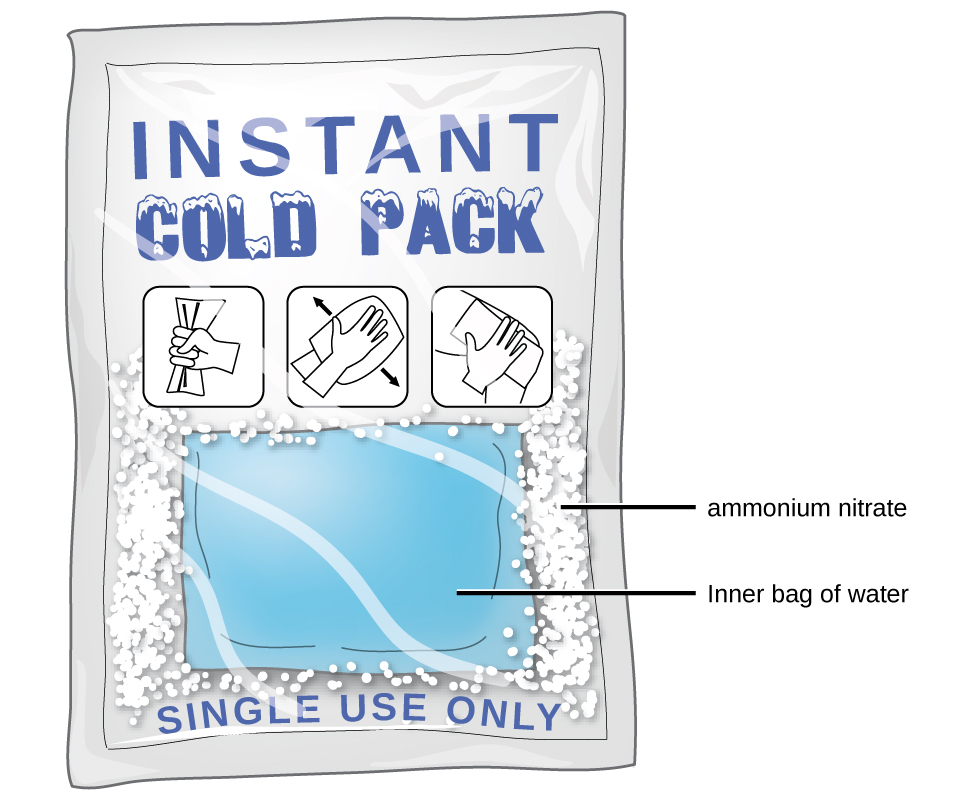


Figure 11.5図 11.5
An instant cold pack gets cold when certain salts, such as ammonium nitrate, dissolve in water—an endothermic process.
瞬間冷却パックは、硝酸アンモニウムなど特定の塩が水に溶ける吸熱過程によって冷たくなる。