第11章溶液とコロイド
11.3 Solubility11.3 溶解度
Learning Objectives学習目標
By the end of this section, you will be able to:
この節を終えると、次のことができるようになる。
- Describe the effects of temperature and pressure on solubility温度と圧力が溶解度に及ぼす影響を説明する。
- State Henry’s law and use it in calculations involving the solubility of a gas in a liquidヘンリーの法則を述べ、気体の液体への溶解度に関わる計算に使う。
- Explain the degrees of solubility possible for liquid-liquid solutions液体どうしの溶液で可能な、溶け合う程度の違いを説明する。
Imagine adding a small amount of sugar to a glass of water, stirring until all the sugar has dissolved, and then adding a bit more. You can repeat this process until the sugar concentration of the solution reaches its natural limit, a limit determined primarily by the relative strengths of the solute-solute, solute-solvent, and solvent-solvent attractive forces discussed in the previous two modules of this chapter. You can be certain that you have reached this limit because, no matter how long you stir the solution, undissolved sugar remains. The concentration of sugar in the solution at this point is known as its solubility.
英語のヒント
コップの水に少量の砂糖を加え、すべて溶けるまでかき混ぜてから、さらに少し加えるところを想像せよ。この操作は、溶液の砂糖濃度が自然な限界に達するまで繰り返せる。その限界は主として、本章の前の二節で述べた、溶質間、溶質と溶媒の間、溶媒間の引力の相対的な強さによって決まる。いくら長くかき混ぜても溶け残った砂糖があるので、この限界に達したことが確実に分かる。このときの溶液中の砂糖濃度を、砂糖の溶解度と呼ぶ。
The solubility of a solute in a particular solvent is the maximum concentration that may be achieved under given conditions when the dissolution process is at equilibrium.
ある溶媒に対する溶質の溶解度とは、指定した条件のもとで、溶解過程が平衡にあるときに達し得る最大濃度である。
When a solute’s concentration is equal to its solubility, the solution is said to be saturated with that solute. If the solute’s concentration is less than its solubility, the solution is said to be unsaturated. A solution that contains a relatively low concentration of solute is called dilute, and one with a relatively high concentration is called concentrated.
英語のヒント
溶質の濃度が溶解度と等しいとき、溶液はその溶質で飽和していると言う。溶質の濃度が溶解度より低いときは、不飽和であると言う。溶質濃度が比較的低い溶液は希薄、高い溶液は濃厚と呼ばれる。
Solutions may be prepared in which a solute concentration exceeds its solubility. Such solutions are said to be supersaturated, and they are interesting examples of nonequilibrium states (a detailed treatment of this important concept is provided in the text chapters on equilibrium). For example, the carbonated beverage in an open container that has not yet “gone flat” is supersaturated with carbon dioxide gas; given time, the CO2 concentration will decrease until it reaches its solubility.
英語のヒント
溶質の濃度が溶解度を超える溶液をつくることもできる。このような溶液は過飽和と呼ばれ、非平衡状態の興味深い例である(この重要な概念は、平衡の各章で詳しく扱う)。たとえば、開いた容器の中でまだ「気が抜けて」いない炭酸飲料は、二酸化炭素気体に関して過飽和である。時間がたてば、CO2濃度は溶解度に達するまで下がる。
Solutions of Gases in Liquids気体が液体に溶けた溶液
As for any solution, the solubility of a gas in a liquid is affected by the intermolecular attractive forces between solute and solvent species. Unlike solid and liquid solutes, however, there is no solute-solute intermolecular attraction to overcome when a gaseous solute dissolves in a liquid solvent (see Figure 11.4) since the atoms or molecules comprising a gas are far separated and experience negligible interactions. Consequently, solute-solvent interactions are the sole energetic factor affecting solubility. For example, the water solubility of oxygen is approximately three times greater than that of helium (there are greater dispersion forces between water and the larger oxygen molecules) but 100 times less than the solubility of chloroform, CHCl3 (polar chloroform molecules experience dipole–dipole attraction to polar water molecules). Likewise note the solubility of oxygen in hexane, C6H14, is approximately 20 times greater than it is in water because greater dispersion forces exist between oxygen and the larger hexane molecules.
英語のヒント
どの溶液でも同様であるが、気体の液体への溶解度は、溶質と溶媒の化学種の間の分子間引力に影響される。ただし、固体や液体の溶質とは異なり、気体の溶質が液体の溶媒に溶けるときには、打ち勝つべき溶質間の分子間引力がない(図11.4参照)。気体を構成する原子や分子は遠く離れ、相互作用が無視できるからである。そのため、溶質と溶媒の相互作用だけが、溶解度に影響するエネルギー面の要因になる。たとえば、酸素の水への溶解度は、ヘリウムの約3倍である(水と、より大きい酸素分子の間には、より強い分散力が働く)。しかし、クロロホルムCHCl3の溶解度の100分の1である(極性をもつクロロホルム分子には、極性水分子との双極子–双極子引力が働く)。同様に、酸素のヘキサンC6H14への溶解度が水への溶解度の約20倍であることにも注目せよ。酸素と、より大きいヘキサン分子の間には、より強い分散力があるためである。
Temperature is another factor affecting solubility, with gas solubility typically decreasing as temperature increases (Figure 11.8). This inverse relation between temperature and dissolved gas concentration is responsible for one of the major impacts of thermal pollution in natural waters.
英語のヒント
温度も溶解度に影響する要因で、気体の溶解度は、通常、温度が上がると下がる(図11.8)。温度と溶存気体濃度のこの逆の関係は、自然水域での熱汚染による主要な影響の一つを引き起こす。
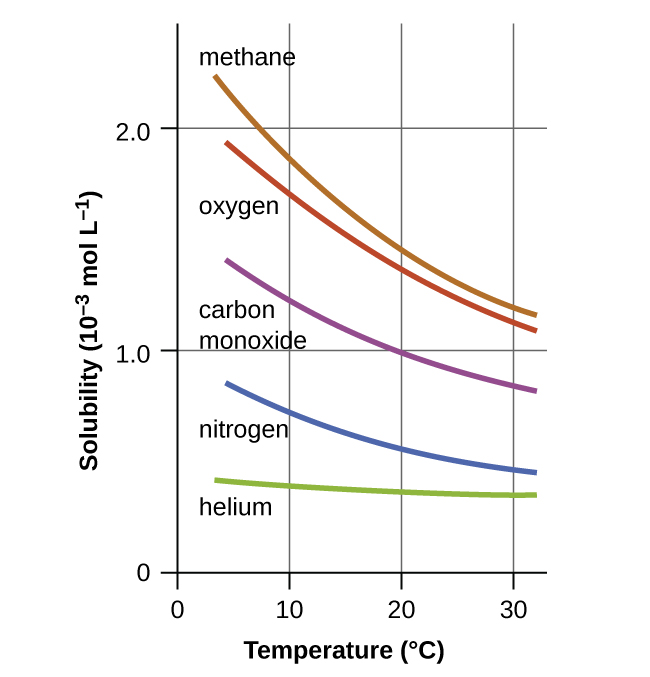
Figure 11.8図 11.8
The solubilities of these gases in water decrease as the temperature increases. All solubilities were measured with a constant pressure of 101.3 kPa (1 atm) of gas above the solutions.
これらの気体の水への溶解度は、温度が上がると低下する。いずれも、溶液の上の気体圧力を101.3 kPa(1 atm)に一定に保って測定した。
When the temperature of a river, lake, or stream is raised, the solubility of oxygen in the water is decreased. Decreased levels of dissolved oxygen may have serious consequences for the health of the water’s ecosystems and, in severe cases, can result in large-scale fish kills (Figure 11.9).
川、湖、小川の温度が上がると、水中の酸素の溶解度は下がる。溶存酸素量の減少は、その水域の生態系の健全さに深刻な影響を及ぼし、ひどい場合は魚の大量死を引き起こすことがある(図11.9)。
Image omitted because its reuse rights could not be verified.権利の確認ができないため画像を割愛。
Figure 11.9図 11.9
(a) The small bubbles of air in this glass of chilled water formed when the water warmed to room temperature and the solubility of its dissolved air decreased. (b) The decreased solubility of oxygen in natural waters subjected to thermal pollution can result in large-scale fish kills. (credit a: modification of work by Liz West; credit b: modification of work by U.S. Fish and Wildlife Service)
(a) 冷水を入れたこのコップの小さな空気の泡は、水が室温まで温まり、溶けた空気の溶解度が下がったときにできた。(b) 熱汚染を受けた自然水域で酸素の溶解度が下がると、魚の大量死につながる場合がある。(出典a:Liz Westの作品を改変、出典b:U.S. Fish and Wildlife Serviceの作品を改変)
The solubility of a gaseous solute is also affected by the partial pressure of solute in the gas to which the solution is exposed. Gas solubility increases as the pressure of the gas increases. Carbonated beverages provide a nice illustration of this relationship. The carbonation process involves exposing the beverage to a relatively high pressure of carbon dioxide gas and then sealing the beverage container, thus saturating the beverage with CO2 at this pressure. When the beverage container is opened, a familiar hiss is heard as the carbon dioxide gas pressure is released, and some of the dissolved carbon dioxide is typically seen leaving solution in the form of small bubbles (Figure 11.10). At this point, the beverage is supersaturated with carbon dioxide and, with time, the dissolved carbon dioxide concentration will decrease to its equilibrium value and the beverage will become “flat.”
英語のヒント
気体溶質の溶解度は、溶液が接する気体中での、その溶質の分圧にも影響される。気体の圧力が高いほど、溶解度も高くなる。炭酸飲料はこの関係をよく示している。炭酸を加える工程では、飲料を比較的高い圧力の二酸化炭素気体にさらしてから容器を密閉し、その圧力で飲料をCO2によって飽和させる。容器を開けると、二酸化炭素の圧力が解放され、おなじみの「シュー」という音がする。通常、溶けていた二酸化炭素の一部が小さな泡となって溶液から出ていくのが見える(図11.10)。この時点で、飲料は二酸化炭素に関して過飽和である。時間がたつと、溶存二酸化炭素の濃度が平衡値まで下がり、飲料は「気が抜けた」状態になる。
Image omitted because its reuse rights could not be verified.権利の確認ができないため画像を割愛。
Figure 11.10図 11.10
Opening the bottle of carbonated beverage reduces the pressure of the gaseous carbon dioxide above the beverage. The solubility of CO2 is thus lowered, and some dissolved carbon dioxide may be seen leaving the solution as small gas bubbles. (credit: modification of work by Derrick Coetzee)
炭酸飲料の瓶を開けると、飲料の上の二酸化炭素気体の圧力が下がる。そのためCO2の溶解度が下がり、溶けていた二酸化炭素の一部が小さな気泡として溶液から出ていくのが見られる。(出典:Derrick Coetzeeの作品を改変)
For many gaseous solutes, the relation between solubility, Cg, and partial pressure, Pg, is a proportional one:
多くの気体溶質では、溶解度Cgと分圧Pgは比例関係にある。
where k is a proportionality constant that depends on the identity of the gaseous solute, the identity of the solvent, and the solution temperature. This is a mathematical statement of Henry’s law: The quantity of an ideal gas that dissolves in a definite volume of liquid is directly proportional to the pressure of the gas.
ここでkは、気体溶質の種類、溶媒の種類、溶液の温度によって決まる比例定数である。これはヘンリーの法則を数式で表したものである。すなわち、一定体積の液体に溶ける理想気体の量は、その気体の圧力に正比例する。
Example 11.1例題 11.1
Application of Henry’s Lawヘンリーの法則の応用
At 20 °C, the concentration of dissolved oxygen in water exposed to gaseous oxygen at a partial pressure of 101.3 kPa is 1.38 10−3 mol L−1. Use Henry’s law to determine the solubility of oxygen when its partial pressure is 20.7 kPa, the approximate pressure of oxygen in earth’s atmosphere.
20 °Cで、分圧101.3 kPaの酸素気体に接した水の溶存酸素濃度は、1.38 10−3 mol L−1である。ヘンリーの法則を使って、酸素分圧が、地球大気中の酸素圧力のおよその値である20.7 kPaのときの溶解度を求めなさい。
Solution解答
According to Henry’s law, for an ideal solution the solubility, Cg, of a gas (1.38 10−3 mol L−1, in this case) is directly proportional to the pressure, Pg, of the undissolved gas above the solution (101.3 kPa in this case). Because both Cg and Pg are known, this relation can be rearranged and used to solve for k.
ヘンリーの法則によれば、理想溶液における気体の溶解度Cg(この場合は1.38 10−3 mol L−1)は、溶液の上にある未溶解の気体の圧力Pg(この場合は101.3 kPa)に正比例する。CgとPgがどちらも分かっているので、この関係式を変形してkを求められる。
Now, use k to find the solubility at the lower pressure.
次にkを使って、低い圧力での溶解度を求める。
Note that various units may be used to express the quantities involved in these sorts of computations. Any combination of units that yield to the constraints of dimensional analysis are acceptable.
この種の計算に関わる量は、さまざまな単位で表せることに注意せよ。次元解析の制約に従っていれば、どのような単位の組合せでも使える。
Check Your Learning理解度を確認
Exposing a 100.0 mL sample of water at 0 °C to an atmosphere containing a gaseous solute at 152 torr resulted in the dissolution of 1.45 10−3 g of the solute. Use Henry’s law to determine the solubility of this gaseous solute when its pressure is 760 torr.
0 °Cの水100.0 mLを、気体溶質を152 torrで含む雰囲気にさらしたところ、溶質が1.45 10−3 g溶けた。ヘンリーの法則を使って、この気体溶質の圧力が760 torrのときの溶解度を求めなさい。
Example 11.2例題 11.2
Thermal Pollution and Oxygen Solubility熱汚染と酸素の溶解度
A certain species of freshwater trout requires a dissolved oxygen concentration of 7.5 mg/L. Could these fish thrive in a thermally polluted mountain stream (water temperature is 30.0 °C, partial pressure of atmospheric oxygen is 0.17 atm)? Use the data in Figure 11.8 to estimate a value for the Henry's law constant at this temperature.
英語のヒント
ある種の淡水性のマスには、7.5 mg/Lの溶存酸素濃度が必要である。この魚は、熱汚染を受けた山の小川(水温30.0 °C、大気中の酸素分圧0.17 atm)で健全に生きられるか。図11.8のデータから、この温度でのヘンリーの法則の定数を見積もりなさい。
Solution解答
First, estimate the Henry’s law constant for oxygen in water at the specified temperature of 30.0 °C (Figure 11.8 indicates the solubility at this temperature is approximately ~1.2 mol/L).
まず、指定された30.0 °Cでの、水中の酸素に対するヘンリーの法則の定数を見積もる(図11.8によれば、この温度での溶解度は約1.2 mol/Lである)。
Then, use this k value to compute the oxygen solubility at the specified oxygen partial pressure, 0.17 atm.
次にこのkの値を使い、指定された酸素分圧0.17 atmでの溶解度を計算する。
Finally, convert this dissolved oxygen concentration from mol/L to mg/L.
最後に、この溶存酸素濃度をmol/Lからmg/Lに換算する。
This concentration is lesser than the required minimum value of 7.5 mg/L, and so these trout would likely not thrive in the polluted stream.
この濃度は必要な最低値7.5 mg/Lより低いので、このマスは汚染された小川では健全に生育できないと考えられる。
Check Your Learning理解度を確認
What dissolved oxygen concentration is expected for the stream above when it returns to a normal summer time temperature of 15 °C?
上の小川が、通常の夏の水温15 °Cに戻ったとき、予想される溶存酸素濃度はいくらか。
Deviations from Henry’s law are observed when a chemical reaction takes place between the gaseous solute and the solvent. Thus, for example, the solubility of ammonia in water increases more rapidly with increasing pressure than predicted by the law because ammonia, being a base, reacts to some extent with water to form ammonium ions and hydroxide ions.
英語のヒント
気体溶質と溶媒の間で化学反応が起こる場合、ヘンリーの法則からのずれが見られる。たとえば、水に対するアンモニアの溶解度は、圧力が上がると、法則の予測より速く増加する。アンモニアは塩基であり、水とある程度反応してアンモニウムイオンと水酸化物イオンを生じるためである。



Gases can form supersaturated solutions. If a solution of a gas in a liquid is prepared either at low temperature or under pressure (or both), then as the solution warms or as the gas pressure is reduced, the solution may become supersaturated. In 1986, more than 1700 people in Cameroon were killed when a cloud of gas, almost certainly carbon dioxide, bubbled from Lake Nyos (Figure 11.12), a deep lake in a volcanic crater. The water at the bottom of Lake Nyos is saturated with carbon dioxide by volcanic activity beneath the lake. It is believed that the lake underwent a turnover due to gradual heating from below the lake, and the warmer, less-dense water saturated with carbon dioxide reached the surface. Consequently, tremendous quantities of dissolved CO2 were released, and the colorless gas, which is denser than air, flowed down the valley below the lake and suffocated humans and animals living in the valley.
英語のヒント
気体も過飽和溶液をつくれる。気体を液体に溶かす際、低温または加圧下、あるいはその両方の条件で溶液をつくると、温度が上がったり気体の圧力が下がったりしたとき、過飽和になる場合がある。1986年、カメルーンの火口にある深いニオス湖(図11.12)から、ほぼ確実に二酸化炭素と考えられる気体の雲が噴き出し、1700人以上が亡くなった。ニオス湖の底の水は、湖底下の火山活動によって二酸化炭素で飽和している。湖の下から徐々に加熱されたため水が上下に入れ替わり、二酸化炭素で飽和した、より温かく密度の低い水が水面に達したと考えられている。その結果、溶けていた大量のCO2が放出された。この無色で空気より密度の高い気体が湖の下の谷へ流れ下り、谷に住む人や動物を窒息させた。
Image omitted because its reuse rights could not be verified.権利の確認ができないため画像を割愛。
Figure 11.12図 11.12
(a) It is believed that the 1986 disaster that killed more than 1700 people near Lake Nyos in Cameroon resulted when a large volume of carbon dioxide gas was released from the lake. (b) A CO2 vent has since been installed to help outgas the lake in a slow, controlled fashion and prevent a similar catastrophe from happening in the future. (credit a: modification of work by Jack Lockwood; credit b: modification of work by Bill Evans)
(a) 1986年にカメルーンのニオス湖付近で1700人以上を死亡させた災害は、湖から大量の二酸化炭素が放出されたためと考えられている。(b) その後CO2の排出管が設置され、ゆっくり制御しながら湖から気体を抜き、将来の同様の大惨事を防ぐのに役立てられている。(出典a:Jack Lockwoodの作品を改変、出典b:Bill Evansの作品を改変)