第11章溶液とコロイド
Determination of Molar Massesモル質量の決定
Osmotic pressure and changes in freezing point, boiling point, and vapor pressure are directly proportional to the number of solute species present in a given amount of solution. Consequently, measuring one of these properties for a solution prepared using a known mass of solute permits determination of the solute’s molar mass.
浸透圧、および凝固点、沸点、蒸気圧の変化は、一定量の溶液中に存在する溶質化学種の数に正比例する。したがって、既知の質量の溶質を使ってつくった溶液で、これらの性質の一つを測れば、溶質のモル質量を求められる。
Example 11.11例題 11.11
Determination of a Molar Mass from a Freezing Point Depression凝固点降下からモル質量を求める
A solution of 4.00 g of a nonelectrolyte dissolved in 55.0 g of benzene is found to freeze at 2.32 °C. Assuming ideal solution behavior, what is the molar mass of this compound?
非電解質4.00 gをベンゼン55.0 gに溶かした溶液が、2.32 °Cで凍ることが分かった。理想溶液として振る舞うと仮定して、この化合物のモル質量はいくらか。
Solution解答
Solve this problem using the following steps.
次の手順で、この問題を解く。
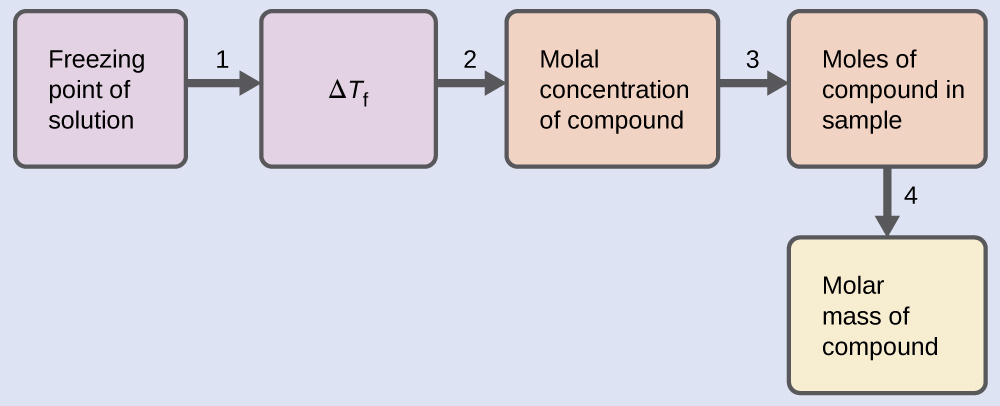
- Determine the change in freezing point from the observed freezing point and the freezing point of pure benzene (Table 11.2).観察した凝固点と、純粋なベンゼンの凝固点(表11.2)から、凝固点の変化を求める。
- Determine the molal concentration from Kf, the freezing point depression constant for benzene (Table 11.2), and ΔTf.ベンゼンの凝固点降下定数Kf(表11.2)とΔTfから、質量モル濃度を求める。
- Determine the number of moles of compound in the solution from the molal concentration and the mass of solvent used to make the solution.質量モル濃度と、溶液をつくるのに使った溶媒の質量から、溶液中の化合物の物質量を求める。
- Determine the molar mass from the mass of the solute and the number of moles in that mass.溶質の質量と、その質量に含まれる物質量から、モル質量を求める。
Check Your Learning理解度を確認
A solution of 35.7 g of a nonelectrolyte in 220.0 g of chloroform has a boiling point of 64.5 °C. Assuming ideal solution behavior, what is the molar mass of this compound?
非電解質35.7 gをクロロホルム220.0 gに溶かした溶液の沸点は64.5 °Cである。理想溶液として振る舞うと仮定して、この化合物のモル質量はいくらか。
Example 11.12例題 11.12
Determination of a Molar Mass from Osmotic Pressure浸透圧からモル質量を求める
A 0.500 L sample of an aqueous solution containing 10.0 g of hemoglobin has an osmotic pressure of 5.9 torr at 22 °C. Assuming ideal solution behavior, what is the molar mass of hemoglobin?
ヘモグロビン10.0 gを含む水溶液0.500 Lの試料は、22 °Cで5.9 torrの浸透圧を示す。理想溶液として振る舞うと仮定して、ヘモグロビンのモル質量はいくらか。
Solution解答
Here is one set of steps that can be used to solve the problem:
問題を解くための手順の一例を示す。

- Convert the osmotic pressure to atmospheres, then determine the molar concentration from the osmotic pressure.浸透圧をatmに換算し、浸透圧からモル濃度を求める。
- Determine the number of moles of hemoglobin in the solution from the concentration and the volume of the solution.溶液の濃度と体積から、溶液中のヘモグロビンの物質量を求める。
- Determine the molar mass from the mass of hemoglobin and the number of moles in that mass.ヘモグロビンの質量と、その質量に含まれる物質量から、モル質量を求める。
Check Your Learning理解度を確認
Assuming ideal solution behavior, what is the molar mass of a protein if a solution of 0.02 g of the protein in 25.0 mL of solution has an osmotic pressure of 0.56 torr at 25 °C?
タンパク質0.02 gを含む体積25.0 mLの溶液の浸透圧が、25 °Cで0.56 torrであった。理想溶液として振る舞うと仮定して、このタンパク質のモル質量はいくらか。
Colligative Properties of Electrolytes電解質の束一的性質
As noted previously in this module, the colligative properties of a solution depend only on the number, not on the identity, of solute species dissolved. The concentration terms in the equations for various colligative properties (freezing point depression, boiling point elevation, osmotic pressure) pertain to all solute species present in the solution. For the solutions considered thus far in this chapter, the solutes have been nonelectrolytes that dissolve physically without dissociation or any other accompanying process. Each molecule that dissolves yields one dissolved solute molecule. The dissolution of an electroyte, however, is not this simple, as illustrated by the two common examples below:
英語のヒント
この節で先に述べたように、溶液の束一的性質は、溶けた溶質化学種の種類ではなく、その数だけに依存する。凝固点降下、沸点上昇、浸透圧などの式に現れる濃度の項は、溶液に存在するすべての溶質化学種を対象とする。本章でここまで考えた溶液では、溶質は非電解質であり、解離などほかの過程を伴わず、物理的に溶けていた。溶ける分子一つにつき、溶存する溶質分子一つが生じる。しかし電解質の溶解は、次の二つの一般的な例に示すように、それほど単純ではない。
Considering the first of these examples, and assuming complete dissociation, a 1.0 m aqueous solution of NaCl contains 2.0 mole of ions (1.0 mol Na+ and 1.0 mol Cl−) per each kilogram of water, and its freezing point depression is expected to be
最初の例で完全な解離を仮定すると、1.0 mのNaCl水溶液は、水1 kgにつき2.0 molのイオン(Na+ 1.0 molとCl− 1.0 mol)を含み、その凝固点降下は次のように予想される。
When this solution is actually prepared and its freezing point depression measured, however, a value of 3.4 °C is obtained. Similar discrepancies are observed for other ionic compounds, and the differences between the measured and expected colligative property values typically become more significant as solute concentrations increase. These observations suggest that the ions of sodium chloride (and other strong electrolytes) are not completely dissociated in solution.
英語のヒント
しかし、この溶液を実際につくって凝固点降下を測ると、3.4 °Cという値が得られる。他のイオン化合物でも同様の食い違いが見られ、束一的性質の実測値と予想値の差は、通常、溶質濃度が高いほど大きくなる。これらの観察結果は、塩化ナトリウムなどの強電解質のイオンが、溶液中で完全には解離していないことを示唆する。
To account for this and avoid the errors accompanying the assumption of total dissociation, an experimentally measured parameter named in honor of Nobel Prize-winning German chemist Jacobus Henricus van’t Hoff is used. The van’t Hoff factor (i) is defined as the ratio of solute particles in solution to the number of formula units dissolved:
英語のヒント
これを考慮し、完全解離を仮定することで生じる誤差を避けるため、実験で測定されるパラメーターを使う。これは、ノーベル賞を受賞したドイツの化学者ヤコブス・ヘンリクス・ファントホッフにちなんで名付けられた。ファントホッフ係数iは、溶けた式単位の数に対する、溶液中の溶質粒子の数の比と定義される。
Values for measured van’t Hoff factors for several solutes, along with predicted values assuming complete dissociation, are shown in Table 11.3.
いくつかの溶質について、ファントホッフ係数の実測値と、完全解離を仮定した予測値を表11.3に示す。
Predicated and Measured van’t Hoff Factors for Several 0.050 m Aqueous Solutions いくつかの0.050 m水溶液のファントホッフ係数の予測値と実測値 |
||||
|---|---|---|---|---|
Formula unit 式単位 |
Classification 分類 |
Dissolution products 溶解で生じるもの |
i (predicted) i(予測値) |
i (measured) i(実測値) |
C12H22O11 (sucrose) C12H22O11(スクロース) |
Nonelectrolyte 非電解質 |
C12H22O11 |
1 |
1.0 |
NaCl |
Strong electrolyte 強電解質 |
Na+, Cl− |
2 |
1.9 |
HCl |
Strong electrolyte (acid) 強電解質(酸) |
H3O+, Cl− |
2 |
1.9 |
MgSO4 |
Strong electrolyte 強電解質 |
Mg2+, SO42−, |
2 |
1.3 |
MgCl2 |
Strong electrolyte 強電解質 |
Mg2+, 2Cl− |
3 |
2.7 |
FeCl3 |
Strong electrolyte 強電解質 |
Fe3+, 3Cl− |
4 |
3.4 |
In 1923, the chemists Peter Debye and Erich Hückel proposed a theory to explain the apparent incomplete ionization of strong electrolytes. They suggested that although interionic attraction in an aqueous solution is very greatly reduced by solvation of the ions and the insulating action of the polar solvent, it is not completely nullified. The residual attractions prevent the ions from behaving as totally independent particles (Figure 11.28). In some cases, a positive and negative ion may actually touch, giving a solvated unit called an ion pair. Thus, the activity, or the effective concentration, of any particular kind of ion is less than that indicated by the actual concentration. Ions become more and more widely separated the more dilute the solution, and the residual interionic attractions become less and less. Thus, in extremely dilute solutions, the effective concentrations of the ions (their activities) are essentially equal to the actual concentrations. Note that the van’t Hoff factors for the electrolytes in Table 11.3 are for 0.05 m solutions, at which concentration the value of i for NaCl is 1.9, as opposed to an ideal value of 2.
英語のヒント
1923年、化学者のペーター・デバイとエーリッヒ・ヒュッケルは、強電解質の見かけ上の不完全な電離を説明する理論を提案した。イオンの溶媒和と極性溶媒の絶縁作用によって、水溶液中のイオン間引力は大幅に弱まるが、完全に消えるわけではないと考えたのである。残る引力のため、イオンは完全に独立した粒子として振る舞えない(図11.28)。場合によっては正と負のイオンが実際に接触し、イオン対と呼ばれる溶媒和した単位になる。したがって、ある種類のイオンの活量、すなわち有効濃度は、実際の濃度が示す値より小さくなる。溶液を薄くするほどイオン間の距離は広がり、残るイオン間引力は小さくなる。そのため、極めて希薄な溶液では、イオンの有効濃度、すなわち活量は、実際の濃度と実質的に等しくなる。表11.3の電解質のファントホッフ係数は0.05 m溶液の値であることに注意せよ。この濃度では、NaClのiは理想値2に対して1.9である。
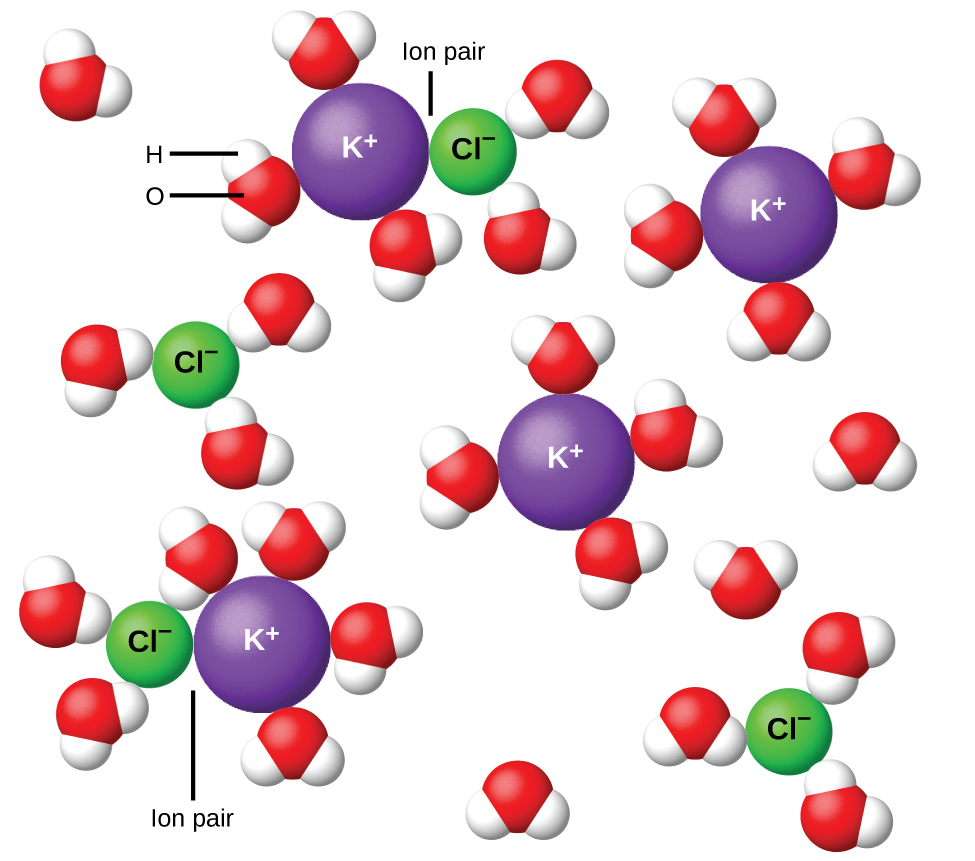
Figure 11.28図 11.28
Dissociation of ionic compounds in water is not always complete due to the formation of ion pairs.
イオン対ができるため、水中でのイオン化合物の解離は、常に完全とは限らない。
Example 11.13例題 11.13
The Freezing Point of a Solution of an Electrolyte電解質溶液の凝固点
The concentration of ions in seawater is approximately the same as that in a solution containing 4.2 g of NaCl dissolved in 125 g of water. Use this information and a predicted value for the van’t Hoff factor (Table 11.3) to determine the freezing temperature the solution (assume ideal solution behavior).
海水中のイオン濃度は、NaCl 4.2 gを水125 gに溶かした溶液とほぼ同じである。この情報とファントホッフ係数の予測値(表11.3)を使って、溶液の凝固温度を求めなさい。理想溶液として振る舞うと仮定する。
Solution解答
Solve this problem using the following series of steps.
次の一連の手順で、この問題を解く。
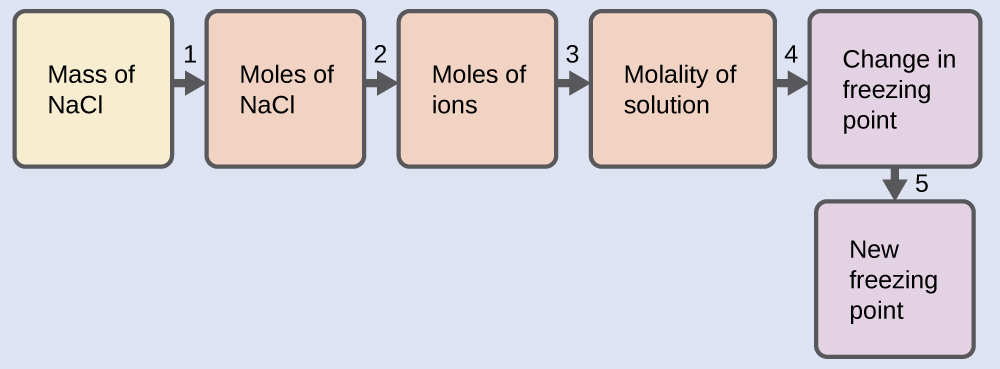


- Convert from grams to moles of NaCl using the molar mass of NaCl in the unit conversion factor.
Result: 0.072 mol NaClNaClのモル質量を単位換算因子に使って、NaClの質量gを物質量に換算する。結果:NaCl 0.072 mol。 - Determine the number of moles of ions present in the solution using the number of moles of ions in 1 mole of NaCl as the conversion factor (2 mol ions/1 mol NaCl).
Result: 0.14 mol ionsNaCl 1 mol中のイオンのモル数を換算因子(2 mol イオン/1 mol NaCl)として、溶液中のイオンの物質量を求める。結果:イオン0.14 mol。 - Determine the molality of the ions in the solution from the number of moles of ions and the mass of solvent, in kilograms.
Result: 1.2 mイオンの物質量と、kgで表した溶媒の質量から、溶液中のイオンの質量モル濃度を求める。結果:1.2 m。 - Use the direct proportionality between the change in freezing point and molal concentration to determine how much the freezing point changes.
Result: 2.1 °C凝固点変化と質量モル濃度の正比例関係を使って、凝固点がどれだけ変わるか求める。結果:2.1 °C。 - Determine the new freezing point from the freezing point of the pure solvent and the change.
Result: −2.1 °C
Check each result as a self-assessment, taking care to avoid rounding errors by retaining guard digits in each step’s result for computing the next step’s result.純粋な溶媒の凝固点と変化量から、新しい凝固点を求める。結果:−2.1 °C。自己確認として各結果を確かめよ。次の段階の計算には、各段階の結果で余分な桁を保持し、丸め誤差を避けるように注意する。
Check Your Learning理解度を確認
Assuming complete dissociation and ideal solution behavior, calculate the freezing point of a solution of 0.724 g of CaCl2 in 175 g of water.
完全解離と理想溶液としての振る舞いを仮定して、CaCl2 0.724 gを水175 gに溶かした溶液の凝固点を計算しなさい。