第11章溶液とコロイド
Solutions of Liquids in Liquids液体が液体に溶けた溶液
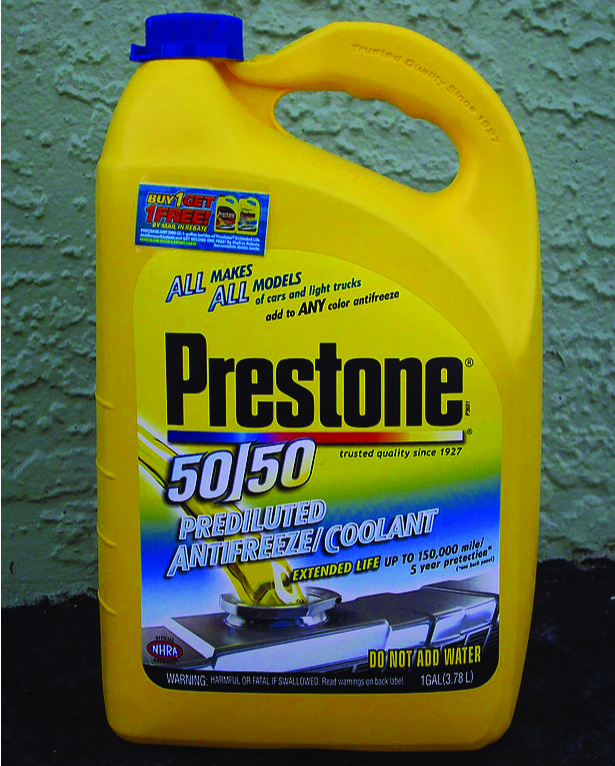
Some liquids may be mixed in any proportions to yield solutions; in other words, they have infinite mutual solubility and are said to be miscible. Ethanol, sulfuric acid, and ethylene glycol (popular for use as antifreeze, pictured in Figure 11.13) are examples of liquids that are completely miscible with water. Two-cycle motor oil is miscible with gasoline, mixtures of which are used as lubricating fuels for various types of outdoor power equipment (chainsaws, leaf blowers, and so on).
英語のヒント
どんな比率で混ぜても溶液になる液体がある。言い換えれば、互いに無限に溶け合い、混和性があると言う。エタノール、硫酸、エチレングリコール(不凍液としてよく使われ、図11.13に示されている)は、水と完全に混和する液体の例である。2サイクルエンジン用オイルはガソリンと混和し、その混合物は、チェーンソーや落ち葉ブロワーなど、さまざまな屋外用動力機器の潤滑性のある燃料として使われる。
OpenStax, Rice University, Chemistry 2e. Original caption credit: (credit: “dno1967”/Wikimedia commons) Source work: Antifreeze.jpg · CC BY 2.0 · Source出典
Figure 11.13図 11.13
Water and antifreeze are miscible; mixtures of the two are homogeneous in all proportions. (credit: “dno1967”/Wikimedia commons)
水と不凍液は混和し、どんな比率で混ぜても均一な混合物になる。(出典:「dno1967」/Wikimedia commons)
Miscible liquids are typically those with very similar polarities. Consider, for example, liquids that are polar or capable of hydrogen bonding. For such liquids, the dipole-dipole attractions (or hydrogen bonding) of the solute molecules with the solvent molecules are at least as strong as those between molecules in the pure solute or in the pure solvent. Hence, the two kinds of molecules mix easily. Likewise, nonpolar liquids are miscible with each other because there is no appreciable difference in the strengths of solute-solute, solvent-solvent, and solute-solvent intermolecular attractions. The solubility of polar molecules in polar solvents and of nonpolar molecules in nonpolar solvents is, again, an illustration of the chemical axiom “like dissolves like.”
英語のヒント
混和する液体は、通常、極性が非常によく似ている。たとえば、極性がある液体や水素結合のできる液体を考えよう。このような液体では、溶質分子と溶媒分子の間の双極子–双極子引力、または水素結合が、純粋な溶質内や純粋な溶媒内の分子間のものと少なくとも同じくらい強いため、二種類の分子は容易に混ざる。同様に、無極性液体どうしは、溶質間、溶媒間、溶質と溶媒の間の分子間引力の強さに大きな差がないため、互いに混和する。極性分子が極性溶媒に、無極性分子が無極性溶媒に溶けることも、「似たものは似たものを溶かす」という化学の原則を示す例である。
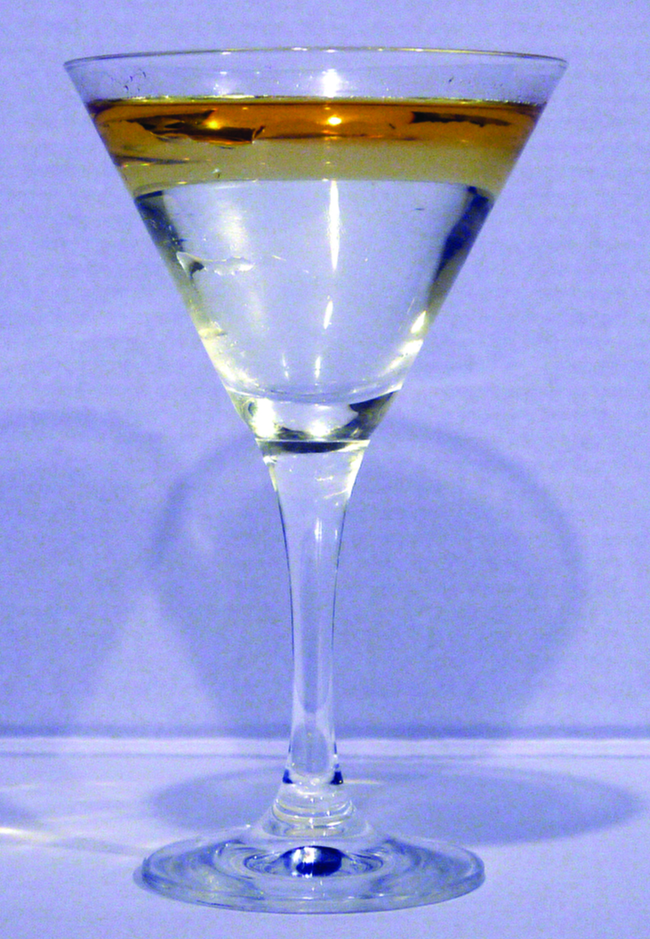
Two liquids that do not mix to an appreciable extent are called immiscible. Separate layers are formed when immiscible liquids are poured into the same container. Gasoline, oil (Figure 11.14), benzene, carbon tetrachloride, some paints, and many other nonpolar liquids are immiscible with water. Relatively weak attractive forces between the polar water molecules and the nonpolar liquid molecules are not adequate to overcome much stronger hydrogen bonding between water molecules. The distinction between immiscibility and miscibility is really one of extent, so that miscible liquids are of infinite mutual solubility, while liquids said to be immiscible are of very low (though not zero) mutual solubility.
英語のヒント
ほとんど混ざらない二つの液体は、不混和であると言う。不混和の液体を同じ容器に注ぐと、別々の層になる。ガソリン、油(図11.14)、ベンゼン、四塩化炭素、一部の塗料、その他多くの無極性液体は、水と混和しない。極性水分子と無極性液体分子の間の比較的弱い引力は、水分子間のはるかに強い水素結合に打ち勝つには不十分である。不混和と混和の区別は実際には程度の問題である。混和する液体は互いに無限に溶けるが、不混和と呼ぶ液体は、互いに溶ける量が非常に少ない、ただし0ではないということである。
OpenStax, Rice University, Chemistry 2e. Original caption credit: (credit: “Yortw”/Flickr) Source title: Oil and Water 2. · CC BY 2.0 · Source出典
Figure 11.14図 11.14
Water and oil are immiscible. Mixtures of these two substances will form two separate layers with the less dense oil floating on top of the water. (credit: “Yortw”/Flickr)
水と油は不混和である。この二物質の混合物は二層に分かれ、密度の低い油が水の上に浮く。(出典:「Yortw」/Flickr)
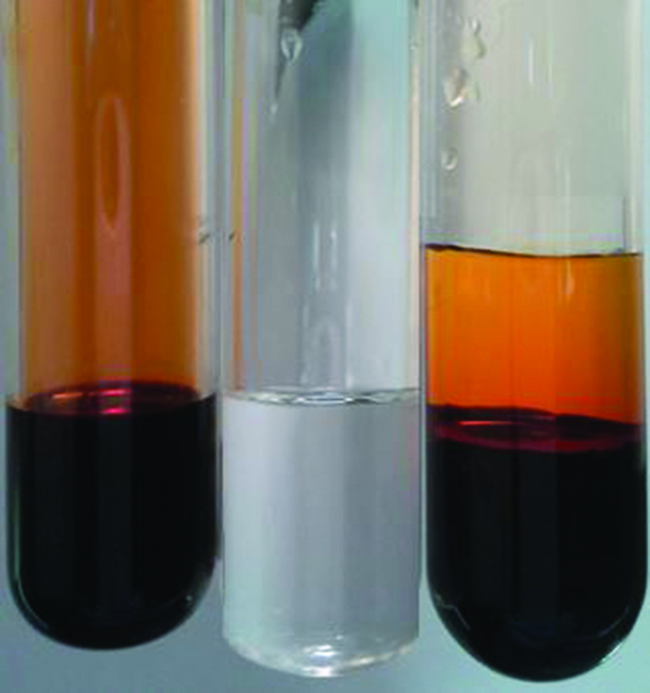
Two liquids, such as bromine and water, that are of moderate mutual solubility are said to be partially miscible. Two partially miscible liquids usually form two layers when mixed. In the case of the bromine and water mixture, the upper layer is water, saturated with bromine, and the lower layer is bromine saturated with water. Since bromine is nonpolar, and, thus, not very soluble in water, the water layer is only slightly discolored by the bright orange bromine dissolved in it. Since the solubility of water in bromine is very low, there is no noticeable effect on the dark color of the bromine layer (Figure 11.15).
英語のヒント
臭素と水のように、互いに中程度に溶ける二液体は、部分的に混和すると言う。部分的に混和する二液体は、通常、混ぜると二層になる。臭素と水の混合物では、上層は臭素で飽和した水、下層は水で飽和した臭素である。臭素は無極性で水にあまり溶けないため、水の層は、溶けた鮮やかな橙色の臭素によってわずかに色づくだけである。臭素に対する水の溶解度は非常に低いので、臭素層の濃い色には目立った変化がない(図11.15)。
OpenStax, Rice University, Chemistry 2e. Original caption credit: (credit: Paul Flowers) · CC BY 4.0 · Source出典
Figure 11.15図 11.15
Bromine (the deep orange liquid on the left) and water (the clear liquid in the middle) are partially miscible. The top layer in the mixture on the right is a saturated solution of bromine in water; the bottom layer is a saturated solution of water in bromine. (credit: Paul Flowers)
臭素(左の濃い橙色の液体)と水(中央の透明な液体)は、部分的に混和する。右の混合物の上層は、臭素が水に溶けた飽和溶液で、下層は、水が臭素に溶けた飽和溶液である。(出典:Paul Flowers)
Solutions of Solids in Liquids固体が液体に溶けた溶液
The dependence of solubility on temperature for a number of solids in water is shown by the solubility curves in Figure 11.16. Reviewing these data indicates a general trend of increasing solubility with temperature, although there are exceptions, as illustrated by the ionic compound cerium sulfate.
いくつかの固体について、水への溶解度の温度依存性を図11.16の溶解度曲線に示す。これらのデータを見ると、一般に温度が上がるほど溶解度が高くなる傾向が分かるが、イオン化合物の硫酸セリウムに見られるような例外もある。
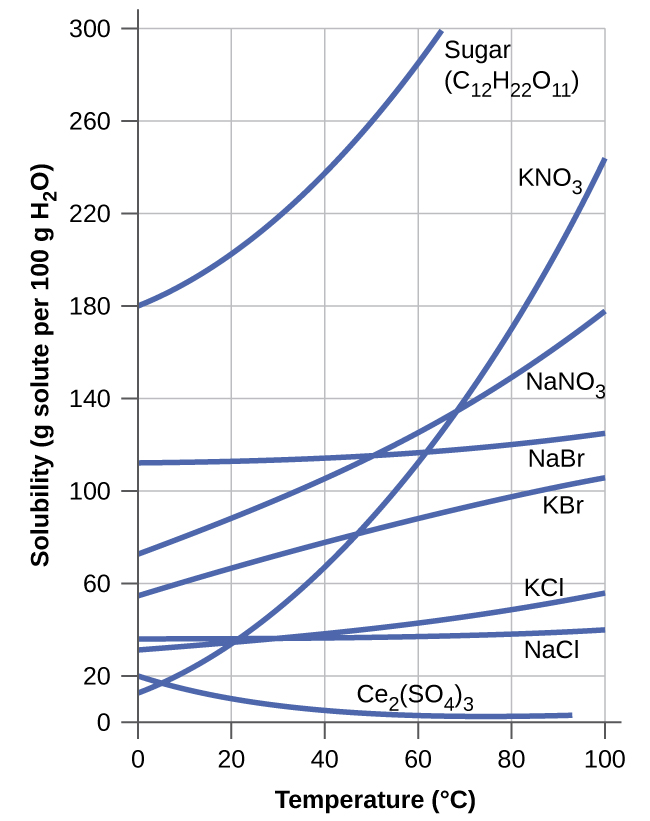


Figure 11.16図 11.16
This graph shows how the solubility of several solids changes with temperature.
このグラフは、いくつかの固体の溶解度が温度によってどう変わるかを示している。
The temperature dependence of solubility can be exploited to prepare supersaturated solutions of certain compounds. A solution may be saturated with the compound at an elevated temperature (where the solute is more soluble) and subsequently cooled to a lower temperature without precipitating the solute. The resultant solution contains solute at a concentration greater than its equilibrium solubility at the lower temperature (i.e., it is supersaturated) and is relatively stable. Precipitation of the excess solute can be initiated by adding a seed crystal (see the video in the Link to Learning earlier in this module) or by mechanically agitating the solution. Some hand warmers, such as the one pictured in Figure 11.17, take advantage of this behavior.
英語のヒント
溶解度の温度依存性を利用すると、特定の化合物の過飽和溶液をつくれる。高温、つまり溶質がより溶けやすい温度でその化合物の飽和溶液をつくり、その後、溶質を沈殿させずに低温まで冷やす。できた溶液は、その低温での平衡溶解度より高い濃度の溶質を含む、すなわち過飽和の状態であるが、比較的安定である。種結晶を加えるか(この節の前の「学習へのリンク」にある動画参照)、溶液を機械的に揺り動かすと、過剰な溶質の沈殿を開始させられる。図11.17のような携帯カイロには、この性質を利用するものがある。
Image omitted because its reuse rights could not be verified.権利の確認ができないため画像を割愛。
Figure 11.17図 11.17
This hand warmer produces heat when the sodium acetate in a supersaturated solution precipitates. Precipitation of the solute is initiated by a mechanical shockwave generated when the flexible metal disk within the solution is “clicked.” (credit: modification of work by “Velela”/Wikimedia Commons)
この携帯カイロは、過飽和溶液中の酢酸ナトリウムが沈殿するときに熱を出す。溶液内の曲がる金属円板を「カチッ」とさせたときに生じる機械的な衝撃波が、溶質の沈殿を開始させる。(出典:「Velela」/Wikimedia Commonsの作品を改変)