第11章溶液とコロイド
Phase Diagram for a Solution溶液の相図
The colligative effects on vapor pressure, boiling point, and freezing point described in the previous section are conveniently summarized by comparing the phase diagrams for a pure liquid and a solution derived from that liquid (Figure 11.23).
前の項で述べた、蒸気圧、沸点、凝固点に対する束一的効果は、純粋な液体の相図と、その液体からつくった溶液の相図を比較すると、分かりやすくまとめられる(図11.23)。
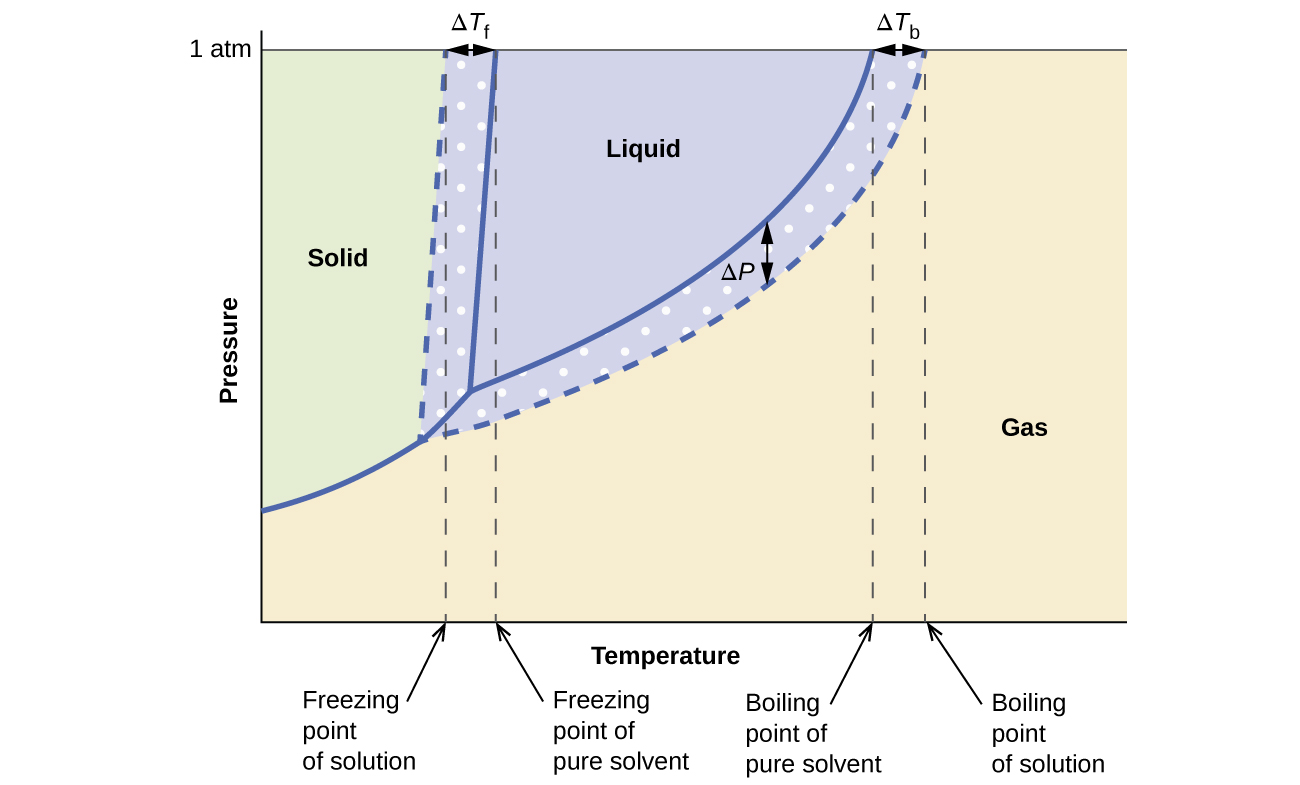
Figure 11.23図 11.23
Phase diagrams for a pure solvent (solid curves) and a solution formed by dissolving nonvolatile solute in the solvent (dashed curves).
純粋な溶媒(実線)と、その溶媒に不揮発性溶質を溶かした溶液(破線)の相図。
The liquid-vapor curve for the solution is located beneath the corresponding curve for the solvent, depicting the vapor pressure lowering, ΔP, that results from the dissolution of nonvolatile solute. Consequently, at any given pressure, the solution’s boiling point is observed at a higher temperature than that for the pure solvent, reflecting the boiling point elevation, ΔTb, associated with the presence of nonvolatile solute. The solid-liquid curve for the solution is displaced left of that for the pure solvent, representing the freezing point depression, ΔTf, that accompanies solution formation. Finally, notice that the solid-gas curves for the solvent and its solution are identical. This is the case for many solutions comprising liquid solvents and nonvolatile solutes. Just as for vaporization, when a solution of this sort is frozen, it is actually just the solvent molecules that undergo the liquid-to-solid transition, forming pure solid solvent that excludes solute species. The solid and gaseous phases, therefore, are composed of solvent only, and so transitions between these phases are not subject to colligative effects.
英語のヒント
溶液の液体–蒸気曲線は、溶媒の対応する曲線より下にある。これは、不揮発性溶質を溶かした結果の蒸気圧降下ΔPを表す。そのため、どの圧力でも、溶液の沸点は純粋な溶媒より高い温度にあり、不揮発性溶質の存在に伴う沸点上昇ΔTbを反映している。溶液の固体–液体曲線は、純粋な溶媒のものより左にずれ、溶液形成に伴う凝固点降下ΔTfを表す。最後に、溶媒と溶液の固体–気体曲線は同一であることに注目せよ。液体溶媒と不揮発性溶質からなる多くの溶液で、これが成り立つ。蒸発の場合と同様、この種の溶液が凍るとき、実際に液体から固体へ移るのは溶媒分子だけであり、溶質を排除した純粋な固体溶媒ができる。したがって、固相と気相は溶媒だけからなり、その間の相転移は束一的効果を受けない。
Osmosis and Osmotic Pressure of Solutions溶液の浸透と浸透圧
A number of natural and synthetic materials exhibit selective permeation, meaning that only molecules or ions of a certain size, shape, polarity, charge, and so forth, are capable of passing through (permeating) the material. Biological cell membranes provide elegant examples of selective permeation in nature, while dialysis tubing used to remove metabolic wastes from blood is a more simplistic technological example. Regardless of how they may be fabricated, these materials are generally referred to as semipermeable membranes.
英語のヒント
多くの天然材料や合成材料は、選択的透過性を示す。つまり、特定の大きさ、形、極性、電荷などをもつ分子やイオンだけが、その材料を通り抜けられる。生体の細胞膜は、自然界における巧みな選択的透過の例である。一方、血液から代謝老廃物を取り除く透析チューブは、より単純な技術的な例である。どのように作られたかにかかわらず、これらの材料は一般に半透膜と呼ばれる。
Consider the apparatus illustrated in Figure 11.24, in which samples of pure solvent and a solution are separated by a membrane that only solvent molecules may permeate. Solvent molecules will diffuse across the membrane in both directions. Since the concentration of solvent is greater in the pure solvent than the solution, these molecules will diffuse from the solvent side of the membrane to the solution side at a faster rate than they will in the reverse direction. The result is a net transfer of solvent molecules from the pure solvent to the solution. Diffusion-driven transfer of solvent molecules through a semipermeable membrane is a process known as osmosis.
英語のヒント
図11.24の装置を考えよう。純粋な溶媒と溶液が、溶媒分子だけを通す膜で隔てられている。溶媒分子は、膜を通って両方向へ拡散する。純粋な溶媒中のほうが溶液中より溶媒の濃度が高いため、膜の溶媒側から溶液側への拡散は、逆方向より速くなる。その結果、正味では、溶媒分子が純粋な溶媒から溶液へ移動する。この、拡散によって溶媒分子が半透膜を通過する過程を、浸透と呼ぶ。
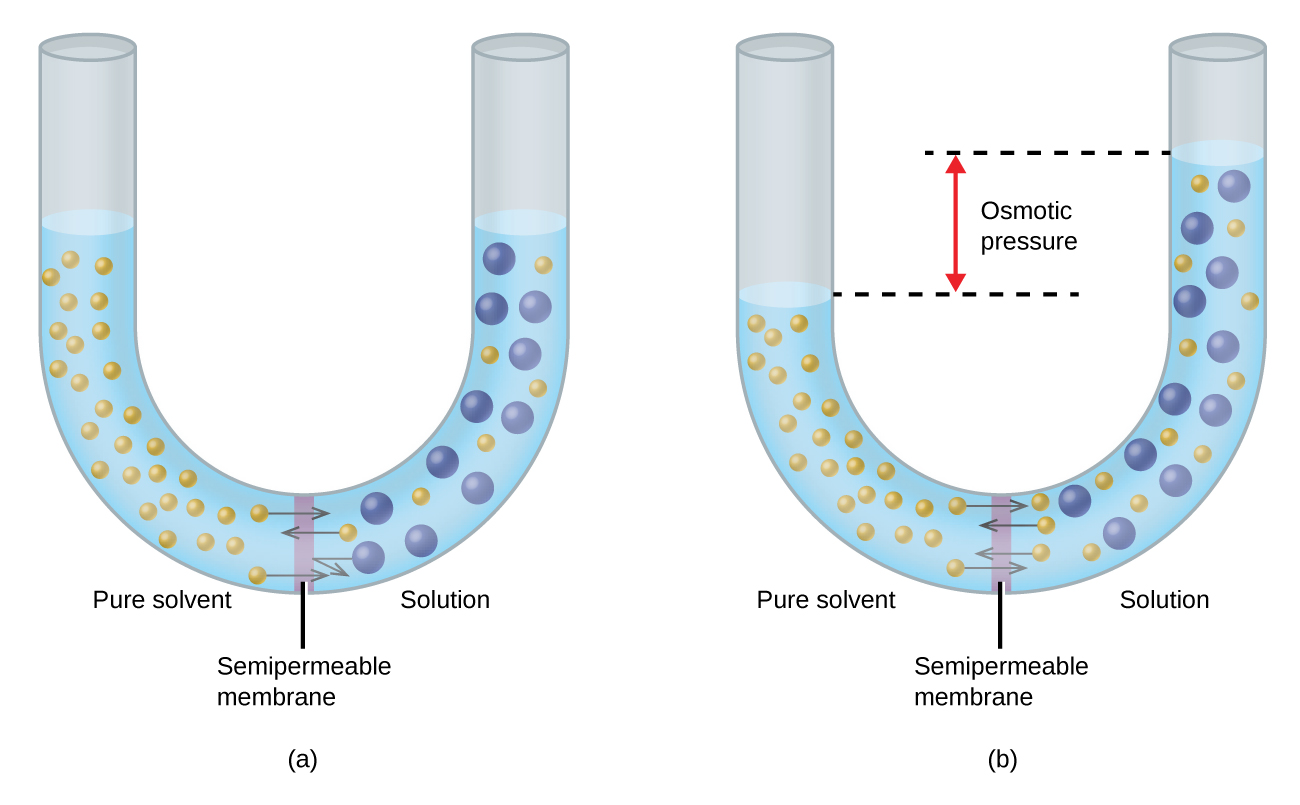
Figure 11.24図 11.24
(a) A solution and pure solvent are initially separated by an osmotic membrane. (b) Net transfer of solvent molecules to the solution occurs until its osmotic pressure yields equal rates of transfer in both directions.
(a) 初め、溶液と純粋な溶媒は浸透膜で隔てられている。(b) 溶媒分子は正味で溶液側へ移動し、浸透圧によって両方向の移動速度が等しくなるまで続く。
When osmosis is carried out in an apparatus like that shown in Figure 11.24, the volume of the solution increases as it becomes diluted by accumulation of solvent. This causes the level of the solution to rise, increasing its hydrostatic pressure (due to the weight of the column of solution in the tube) and resulting in a faster transfer of solvent molecules back to the pure solvent side. When the pressure reaches a value that yields a reverse solvent transfer rate equal to the osmosis rate, bulk transfer of solvent ceases. This pressure is called the osmotic pressure (Π) of the solution. The osmotic pressure of a dilute solution is related to its solute molarity, M, and absolute temperature, T, according to the equation
英語のヒント
図11.24のような装置で浸透が起こると、溶媒が蓄積して溶液が薄まり、その体積が増える。そのため溶液の液面が上がり、管内の溶液柱の重さによる静水圧が高くなって、純溶媒側へ戻る溶媒分子の移動が速まる。逆方向の溶媒移動速度が浸透の速度に等しくなる圧力に達すると、溶媒の全体としての移動は止まる。この圧力を溶液の浸透圧Πと呼ぶ。希薄溶液の浸透圧は、溶質のモル濃度Mと絶対温度Tに、次の式で関係づけられる。
where R is the universal gas constant.
ここでRは普遍気体定数である。
Example 11.10例題 11.10
Calculation of Osmotic Pressure浸透圧の計算
Assuming ideal solution behavior, what is the osmotic pressure (atm) of a 0.30 M solution of glucose in water that is used for intravenous infusion at body temperature, 37 °C?
理想溶液として振る舞うと仮定して、静脈内点滴に使う0.30 Mのグルコース水溶液の、体温37 °Cでの浸透圧は何atmか。
Solution解答
Find the osmotic pressure, Π, using the formula Π = MRT, where T is on the Kelvin scale (310 K) and the value of R is expressed in appropriate units (0.08206 L atm/mol K).
式Π = MRTを使って浸透圧Πを求める。Tはケルビン温度310 Kを使い、Rは適切な単位の値0.08206 L atm/mol Kで表す。
Check Your Learning理解度を確認
Assuming ideal solution behavior, what is the osmotic pressure (atm) a solution with a volume of 0.750 L that contains 5.0 g of methanol, CH3OH, in water at 37 °C?
理想溶液として振る舞うと仮定して、メタノールCH3OH 5.0 gを含む、体積0.750 Lの水溶液の37 °Cでの浸透圧は何atmか。
If a solution is placed in an apparatus like the one shown in Figure 11.25, applying pressure greater than the osmotic pressure of the solution reverses the osmosis and pushes solvent molecules from the solution into the pure solvent. This technique of reverse osmosis is used for large-scale desalination of seawater and on smaller scales to produce high-purity tap water for drinking.
英語のヒント
図11.25のような装置に溶液を入れ、その浸透圧を超える圧力をかけると、浸透が逆向きになり、溶媒分子が溶液から純粋な溶媒側へ押し出される。この逆浸透という技術は、大規模な海水淡水化や、より小規模には飲用の高純度の水道水の製造に使われる。
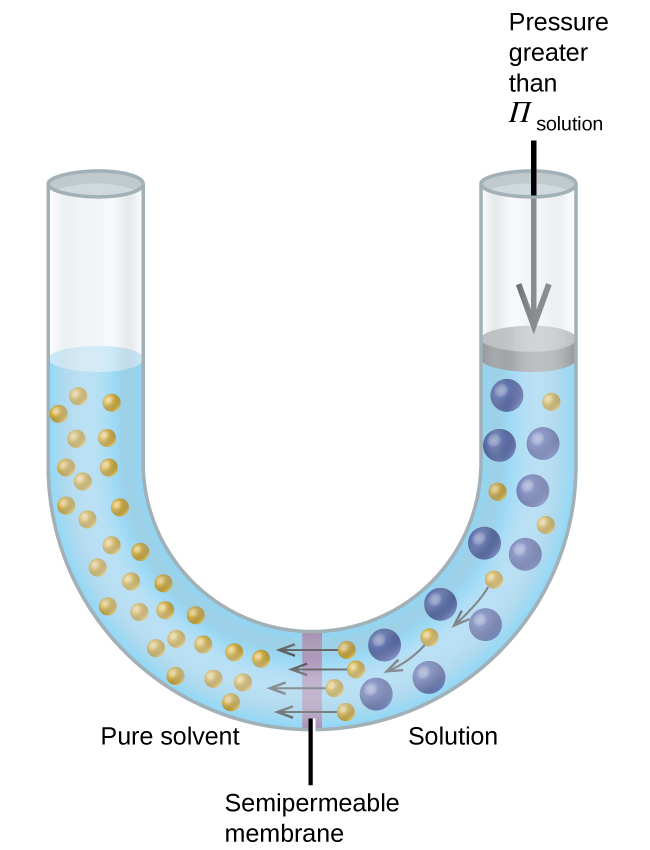


Figure 11.25図 11.25
Applying a pressure greater than the osmotic pressure of a solution will reverse osmosis. Solvent molecules from the solution are pushed into the pure solvent.
溶液の浸透圧を超える圧力をかけると、浸透は逆向きになる。溶液中の溶媒分子が、純粋な溶媒側へ押し出される。
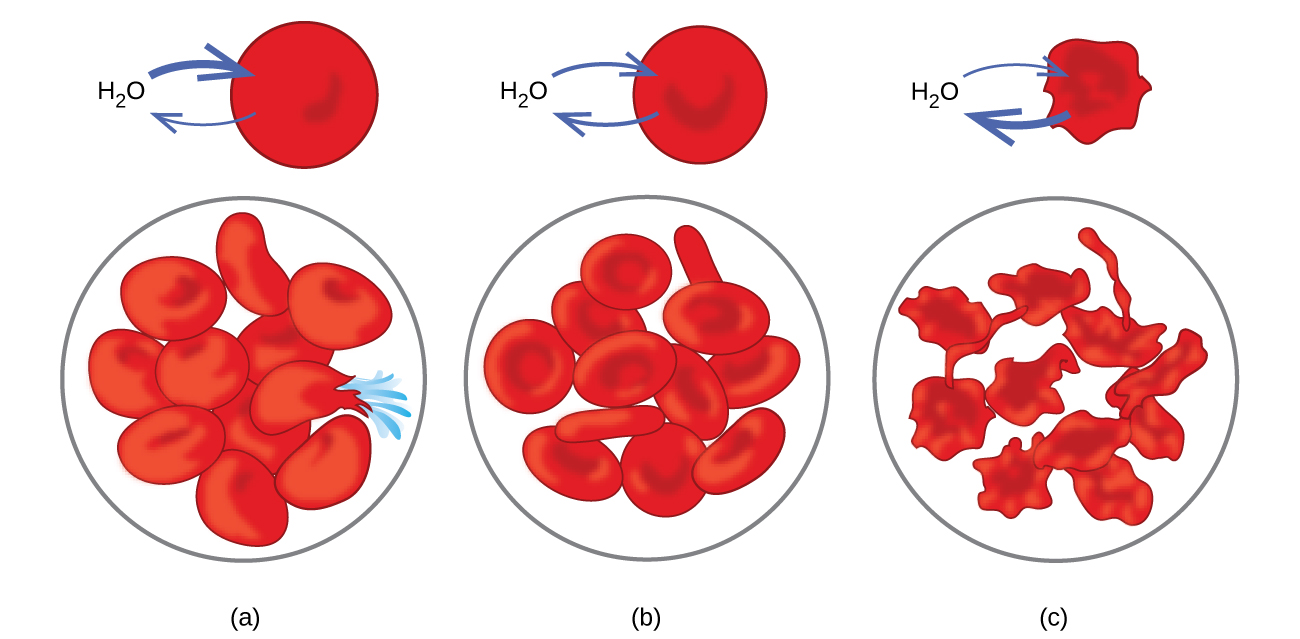
Examples of osmosis are evident in many biological systems because cells are surrounded by semipermeable membranes. Carrots and celery that have become limp because they have lost water can be made crisp again by placing them in water. Water moves into the carrot or celery cells by osmosis. A cucumber placed in a concentrated salt solution loses water by osmosis and absorbs some salt to become a pickle. Osmosis can also affect animal cells. Solute concentrations are particularly important when solutions are injected into the body. Solutes in body cell fluids and blood serum give these solutions an osmotic pressure of approximately 7.7 atm. Solutions injected into the body must have the same osmotic pressure as blood serum; that is, they should be isotonic with blood serum. If a less concentrated solution, a hypotonic solution, is injected in sufficient quantity to dilute the blood serum, water from the diluted serum passes into the blood cells by osmosis, causing the cells to expand and rupture. This process is called hemolysis. When a more concentrated solution, a hypertonic solution, is injected, the cells lose water to the more concentrated solution, shrivel, and possibly die in a process called crenation. These effects are illustrated in Figure 11.27.
英語のヒント
細胞は半透膜に囲まれているので、多くの生物系で浸透の例が見られる。水を失ってしなびたニンジンやセロリは、水に浸すと再びしゃきっとさせられる。浸透によって細胞内へ水が入るためである。濃い食塩水に入れたキュウリは、浸透で水を失い、塩をある程度吸収して漬物になる。浸透は動物細胞にも影響する。体内に溶液を注入するとき、溶質濃度は特に重要である。体細胞の液体や血清は、その中の溶質によって約7.7 atmの浸透圧をもつ。体内に注入する溶液は、血清と同じ浸透圧、すなわち血清と等張でなければならない。より濃度の低い低張液を、血清を薄めるほど十分な量注入すると、薄まった血清から血球へ浸透によって水が入り、細胞が膨らんで破裂する。この過程を溶血と呼ぶ。より濃い高張液を注入すると、細胞はその溶液に水を失って縮み、死ぬ場合もある。この過程を収縮と呼ぶ。これらの効果を図11.27に示す。
OpenStax, Rice University, Chemistry 2e. Original caption credit: (credit a/b/c: modifications of work by “LadyofHats”/Wikimedia commons) Source work: Osmotic pressure on blood cells diagram.svg · Public domain; OpenStax adaptation CC BY 4.0 · Source出典

Figure 11.27図 11.27
Red blood cell membranes are water permeable and will (a) swell and possibly rupture in a hypotonic solution; (b) maintain normal volume and shape in an isotonic solution; and (c) shrivel and possibly die in a hypertonic solution. (credit a/b/c: modifications of work by “LadyofHats”/Wikimedia commons)
赤血球の膜は水を通すため、(a) 低張液中では膨張して破裂する場合があり、(b) 等張液中では正常な体積と形を保ち、(c) 高張液中では収縮して死ぬ場合がある。(出典a/b/c:「LadyofHats」/Wikimedia commonsの作品を改変)