第11章溶液とコロイド
Key Concepts and Summary重要な概念とまとめ
Substances that dissolve in water to yield ions are called electrolytes. Electrolytes may be covalent compounds that chemically react with water to produce ions (for example, acids and bases), or they may be ionic compounds that dissociate to yield their constituent cations and anions, when dissolved. Dissolution of an ionic compound is facilitated by ion-dipole attractions between the ions of the compound and the polar water molecules. Soluble ionic substances and strong acids ionize completely and are strong electrolytes, while weak acids and bases ionize to only a small extent and are weak electrolytes. Nonelectrolytes are substances that do not produce ions when dissolved in water.
水に溶けてイオンを生じる物質を電解質と呼ぶ。電解質には、水と化学反応してイオンを生じる共有結合性化合物(酸や塩基など)もあれば、溶けると解離し、構成する陽イオンと陰イオンになるイオン化合物もある。イオン化合物の溶解は、化合物のイオンと極性水分子の間のイオン–双極子引力によって促される。可溶性イオン物質や強酸は完全に電離する強電解質であるが、弱酸や弱塩基はわずかしか電離しない弱電解質である。非電解質は、水に溶けてもイオンを生じない物質である。
Chemistry End of Chapter Exercises化学の章末問題
Exercises 9–15練習問題 9–15
Exercise 9問題 9
Explain why the ions Na+ and Cl− are strongly solvated in water but not in hexane, a solvent composed of nonpolar molecules.
Na+とCl−のイオンは水中では強く溶媒和されるが、無極性分子からなる溶媒ヘキサン中ではそうならない理由を説明しなさい。
Solution解き方
Crystals of NaCl dissolve in water, a polar liquid with a very large dipole moment, and the individual ions become strongly solvated. Hexane is a nonpolar liquid with a dipole moment of zero and, therefore, does not significantly interact with the ions of the NaCl crystals.
NaCl結晶が、双極子モーメントの非常に大きい極性液体である水に溶けると、個々のイオンは強く溶媒和される。ヘキサンは双極子モーメントが0の無極性液体なので、NaCl結晶のイオンとはあまり相互作用しない。
Exercise 10問題 10
Explain why solutions of HBr in benzene (a nonpolar solvent) are nonconductive, while solutions in water (a polar solvent) are conductive.
英語のヒント
HBrをベンゼン(無極性溶媒)に溶かした溶液は電気を通さず、水(極性溶媒)に溶かした溶液は電気を通す理由を説明しなさい。
Exercise 11問題 11
Consider the solutions presented:
図に示した溶液について考えなさい。
(a) Which of the following sketches best represents the ions in a solution of Fe(NO3)3(aq)?
(a) 次の模式図のうち、Fe(NO3)3(aq)の溶液中のイオンを最もよく表すものはどれか。
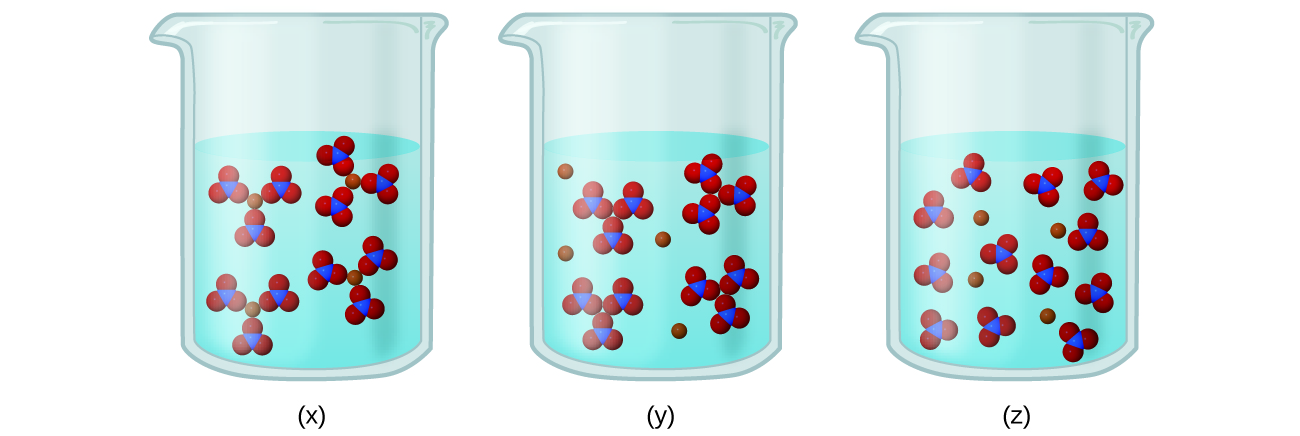

(b) Write a balanced chemical equation showing the products of the dissolution of Fe(NO3)3.
(b) Fe(NO3)3の溶解で生じるものを示す、係数のつり合った化学反応式を書きなさい。
Solution解き方
(a) Fe(NO3)3 is a strong electrolyte, thus it should completely dissociate into Fe3+ and ions. Therefore, (z) best represents the solution. (b)
(a) Fe(NO3)3は強電解質なので、Fe3+とのイオンに完全に解離するはずである。したがって、溶液を最もよく表すのは(z)である。(b)
Exercise 12問題 12
Compare the processes that occur when methanol (CH3OH), hydrogen chloride (HCl), and sodium hydroxide (NaOH) dissolve in water. Write equations and prepare sketches showing the form in which each of these compounds is present in its respective solution.
メタノールCH3OH、塩化水素HCl、水酸化ナトリウムNaOHが水に溶けるときの過程を比較しなさい。各化合物がそれぞれの溶液中で存在する形を示す反応式と模式図を書きなさい。
Exercise 13問題 13
What is the expected electrical conductivity of the following solutions?
次の溶液の電気伝導性は、どの程度になると予想されるか。
(a) NaOH(aq)
(a) NaOH(aq)
(b) HCl(aq)
(b) HCl(aq)
(c) C6H12O6(aq) (glucose)
(c) C6H12O6(aq)(グルコース)
(d) NH3(aq)
(d) NH3(aq)
Solution解き方
(a) high conductivity (solute is an ionic compound that will dissociate when dissolved); (b) high conductivity (solute is a strong acid and will ionize completely when dissolved); (c) nonconductive (solute is a covalent compound, neither acid nor base, unreactive towards water); (d) low conductivity (solute is a weak base and will partially ionize when dissolved)
(a) 高い電気伝導性(溶質は、溶けると解離するイオン化合物)、(b) 高い電気伝導性(溶質は強酸で、溶けると完全に電離する)、(c) 電気を通さない(溶質は酸でも塩基でもない共有結合性化合物で、水と反応しない)、(d) 低い電気伝導性(溶質は弱塩基で、溶けると一部が電離する)。
Exercise 14問題 14
Why are most solid ionic compounds electrically nonconductive, whereas aqueous solutions of ionic compounds are good conductors? Would you expect a liquid (molten) ionic compound to be electrically conductive or nonconductive? Explain.
大部分の固体イオン化合物は電気を通さないのに、イオン化合物の水溶液は電気をよく通すのはなぜか。液体、すなわち融解したイオン化合物は、電気を通すと予想するか、それとも通さないと予想するか。説明しなさい。
Exercise 15問題 15
Indicate the most important type of intermolecular attraction responsible for solvation in each of the following solutions:
次の各溶液で、溶媒和をもたらす最も重要な分子間引力の種類を示しなさい。
(a) the solutions in Figure 11.7
(a) 図11.7の溶液
(b) methanol, CH3OH, dissolved in ethanol, C2H5OH
(b) エタノールC2H5OHに溶けたメタノールCH3OH
(c) methane, CH4, dissolved in benzene, C6H6
(c) ベンゼンC6H6に溶けたメタンCH4
(d) the polar halocarbon CF2Cl2 dissolved in the polar halocarbon CF2ClCFCl2
(d) 極性ハロカーボンCF2ClCFCl2に溶けた、極性ハロカーボンCF2Cl2
(e) O2(l) in N2(l)
(e) N2(l)中のO2(l)
Solution解き方
(a) ion-dipole; (b) hydrogen bonds; (c) dispersion forces; (d) dipole-dipole attractions; (e) dispersion forces
(a) イオン–双極子引力、(b) 水素結合、(c) 分散力、(d) 双極子–双極子引力、(e) 分散力
dissociation
解離
physical process accompanying the dissolution of an ionic compound in which the compound’s constituent ions are solvated and dispersed throughout the solution
イオン化合物の溶解に伴う物理的過程。化合物を構成するイオンが溶媒和され、溶液全体に分散する。
electrolyte
電解質
substance that produces ions when dissolved in water
水に溶けるとイオンを生じる物質。
ion-dipole attraction
イオン–双極子引力
electrostatic attraction between an ion and a polar molecule
イオンと極性分子の間の静電引力。
nonelectrolyte
非電解質
substance that does not produce ions when dissolved in water
水に溶けてもイオンを生じない物質。
strong electrolyte
強電解質
substance that dissociates or ionizes completely when dissolved in water
水に溶けると完全に解離または電離する物質。
weak electrolyte
弱電解質
substance that ionizes only partially when dissolved in water
水に溶けると一部だけが電離する物質。