第11章溶液とコロイド
Vapor Pressure Lowering蒸気圧降下
As described in the chapter on liquids and solids, the equilibrium vapor pressure of a liquid is the pressure exerted by its gaseous phase when vaporization and condensation are occurring at equal rates:
液体と固体の章で述べたように、液体の平衡蒸気圧は、蒸発と凝縮が同じ速度で起こっているとき、その気相が及ぼす圧力である。
Dissolving a nonvolatile substance in a volatile liquid results in a lowering of the liquid’s vapor pressure. This phenomenon can be rationalized by considering the effect of added solute molecules on the liquid's vaporization and condensation processes. To vaporize, solvent molecules must be present at the surface of the solution. The presence of solute decreases the surface area available to solvent molecules and thereby reduces the rate of solvent vaporization. Since the rate of condensation is unaffected by the presence of solute, the net result is that the vaporization-condensation equilibrium is achieved with fewer solvent molecules in the vapor phase (i.e., at a lower vapor pressure) (Figure 11.18). While this interpretation is useful, it does not account for several important aspects of the colligative nature of vapor pressure lowering. A more rigorous explanation involves the property of entropy, a topic of discussion in a later text chapter on thermodynamics. For purposes of understanding the lowering of a liquid's vapor pressure, it is adequate to note that the more dispersed nature of matter in a solution, compared to separate solvent and solute phases, serves to effectively stabilize the solvent molecules and hinder their vaporization. A lower vapor pressure results, and a correspondingly higher boiling point as described in the next section of this module.
英語のヒント
揮発性液体に不揮発性物質を溶かすと、液体の蒸気圧が下がる。この現象は、加えた溶質分子が液体の蒸発・凝縮過程に及ぼす影響から説明できる。蒸発するには、溶媒分子は溶液の表面に存在しなければならない。溶質があると溶媒分子が使える表面積が減り、その結果、溶媒の蒸発速度が下がる。凝縮速度は溶質の存在に影響されないため、結果として、気相中の溶媒分子がより少ない状態、すなわち蒸気圧がより低い状態で、蒸発と凝縮の平衡に達する(図11.18)。この解釈は有用であるが、蒸気圧降下が束一的性質であることの、いくつかの重要な側面は説明できない。より厳密な説明にはエントロピーが関わり、後の熱力学の章で扱う。液体の蒸気圧が下がることを理解するうえでは、溶液では溶媒と溶質が別々の相で存在する場合より物質が分散しており、それが溶媒分子を実質的に安定化し、蒸発を妨げると考えれば十分である。その結果、蒸気圧が下がり、それに対応して、次の項で述べるように沸点が上がる。
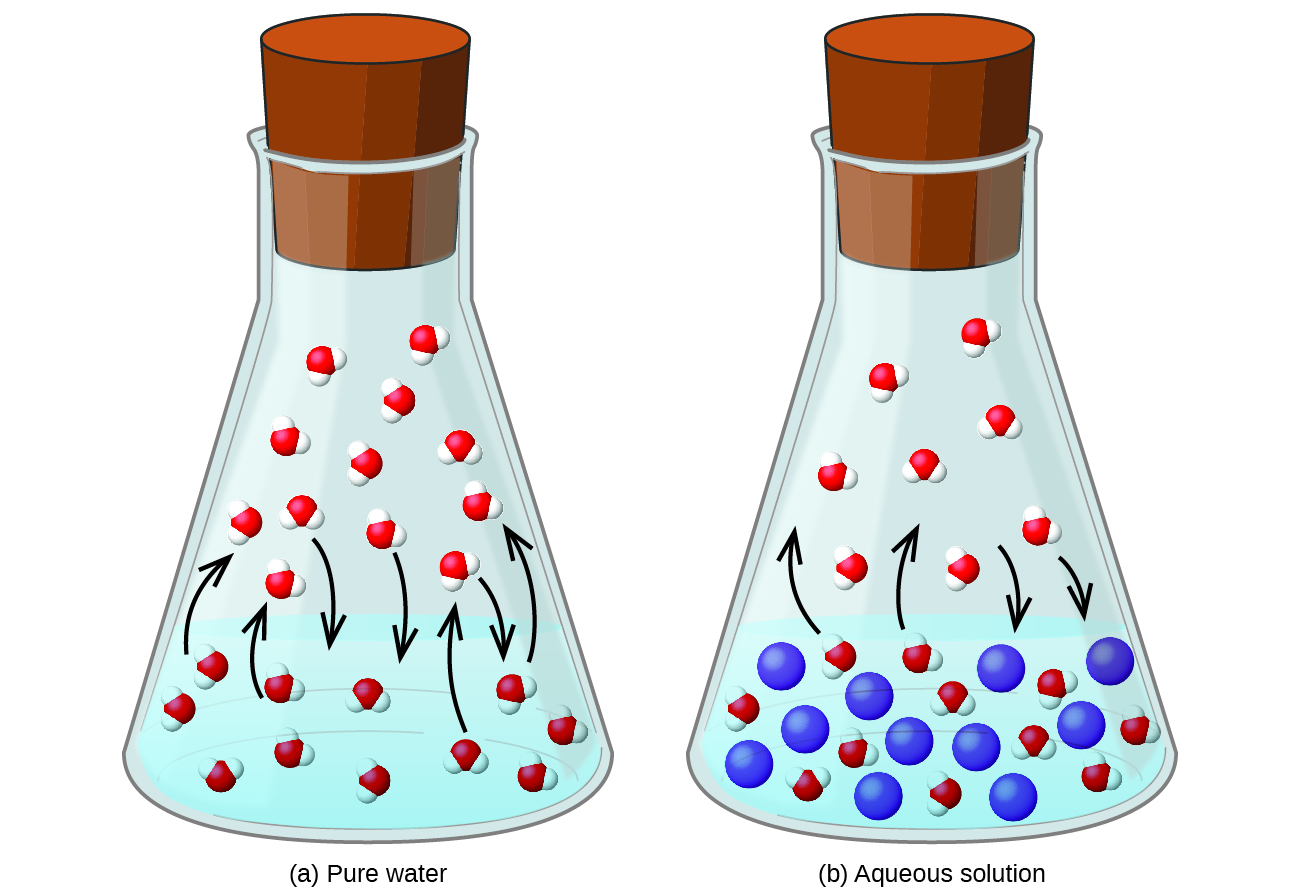
Figure 11.18図 11.18
The presence of nonvolatile solutes lowers the vapor pressure of a solution by impeding the evaporation of solvent molecules.
不揮発性溶質が存在すると、溶媒分子の蒸発を妨げるため、溶液の蒸気圧が下がる。
The relationship between the vapor pressures of solution components and the concentrations of those components is described by Raoult’s law: The partial pressure exerted by any component of an ideal solution is equal to the vapor pressure of the pure component multiplied by its mole fraction in the solution.
溶液成分の蒸気圧と濃度の関係は、ラウールの法則で表される。理想溶液の任意の成分が及ぼす分圧は、その純成分の蒸気圧に、溶液中のその成分のモル分率を掛けた値に等しくなる。
where PA is the partial pressure exerted by component A in the solution, is the vapor pressure of pure A, and XA is the mole fraction of A in the solution.
ここでPAは溶液中の成分Aが及ぼす分圧、は純粋なAの蒸気圧、XAは溶液中のAのモル分率である。
Recalling that the total pressure of a gaseous mixture is equal to the sum of partial pressures for all its components (Dalton’s law of partial pressures), the total vapor pressure exerted by a solution containing i components is
混合気体の全圧は、すべての成分の分圧の和に等しいこと(ドルトンの分圧の法則)を思い出すと、i個の成分を含む溶液が及ぼす全蒸気圧は、次のようになる。
A nonvolatile substance is one whose vapor pressure is negligible (P* ≈ 0), and so the vapor pressure above a solution containing only nonvolatile solutes is due only to the solvent:
不揮発性物質は、蒸気圧が無視できるほど小さい物質(P* ≈ 0)である。そのため、不揮発性の溶質だけを含む溶液の上の蒸気圧は、溶媒だけによるものである。
Example 11.6例題 11.6
Calculation of a Vapor Pressure蒸気圧の計算
Compute the vapor pressure of an ideal solution containing 92.1 g of glycerin, C3H5(OH)3, and 184.4 g of ethanol, C2H5OH, at 40 °C. The vapor pressure of pure ethanol is 0.178 atm at 40 °C. Glycerin is essentially nonvolatile at this temperature.
英語のヒント
グリセリンC3H5(OH)3 92.1 gとエタノールC2H5OH 184.4 gを含む理想溶液について、40 °Cでの蒸気圧を計算しなさい。純粋なエタノールの蒸気圧は40 °Cで0.178 atmである。この温度でグリセリンは実質的に不揮発性である。
Solution解答
Since the solvent is the only volatile component of this solution, its vapor pressure may be computed per Raoult’s law as:
この溶液で揮発性の成分は溶媒だけなので、ラウールの法則により、蒸気圧を次のように計算できる。
First, calculate the molar amounts of each solution component using the provided mass data.
まず、与えられた質量データを使って、溶液の各成分の物質量を計算する。
Next, calculate the mole fraction of the solvent (ethanol) and use Raoult’s law to compute the solution’s vapor pressure.
次に溶媒であるエタノールのモル分率を計算し、ラウールの法則を使って溶液の蒸気圧を求める。
Check Your Learning理解度を確認
A solution contains 5.00 g of urea, CO(NH2)2 (a nonvolatile solute) and 0.100 kg of water. If the vapor pressure of pure water at 25 °C is 23.7 torr, what is the vapor pressure of the solution assuming ideal behavior?
尿素CO(NH2)2(不揮発性溶質)5.00 gと水0.100 kgを含む溶液がある。25 °Cでの純水の蒸気圧が23.7 torrのとき、理想的な振る舞いを仮定した溶液の蒸気圧はいくらか。
Distillation of Solutions溶液の蒸留
Solutions whose components have significantly different vapor pressures may be separated by a selective vaporization process known as distillation. Consider the simple case of a mixture of two volatile liquids, A and B, with A being the more volatile liquid. Raoult’s law can be used to show that the vapor above the solution is enriched in component A, that is, the mole fraction of A in the vapor is greater than the mole fraction of A in the liquid (see end-of-chapter Exercise 65). By appropriately heating the mixture, component A may be vaporized, condensed, and collected—effectively separating it from component B.
英語のヒント
成分の蒸気圧が大きく異なる溶液は、蒸留という選択的な蒸発過程で分離できる。揮発性液体AとBの混合物という簡単な場合を考え、Aのほうが揮発しやすいとする。ラウールの法則を使うと、溶液の上の蒸気では成分Aの割合が高くなる、つまり気相中のAのモル分率が液体中のAのモル分率より大きいと示せる(章末の問題65参照)。混合物を適切に加熱すれば、成分Aを蒸発させ、凝縮して回収し、成分Bから効果的に分離できる。
Distillation is widely applied in both laboratory and industrial settings, being used to refine petroleum, to isolate fermentation products, and to purify water. A typical apparatus for laboratory-scale distillations is shown in Figure 11.19.
蒸留は実験室でも工業でも広く用いられ、石油の精製、発酵生成物の単離、水の精製に使われる。実験室規模の典型的な蒸留装置を図11.19に示す。
Image omitted because its reuse rights could not be verified.権利の確認ができないため画像を割愛。
Figure 11.19図 11.19
A typical laboratory distillation unit is shown in (a) a photograph and (b) a schematic diagram of the components. (credit a: modification of work by “Rifleman82”/Wikimedia commons; credit b: modification of work by “Slashme”/Wikimedia Commons)
典型的な実験室用蒸留装置を、(a) 写真と(b) 構成要素の模式図で示す。(出典a:「Rifleman82」/Wikimedia commonsの作品を改変、出典b:「Slashme」/Wikimedia Commonsの作品を改変)
Oil refineries use large-scale fractional distillation to separate the components of crude oil. The crude oil is heated to high temperatures at the base of a tall fractionating column, vaporizing many of the components that rise within the column. As vaporized components reach adequately cool zones during their ascent, they condense and are collected. The collected liquids are simpler mixtures of hydrocarbons and other petroleum compounds that are of appropriate composition for various applications (e.g., diesel fuel, kerosene, gasoline), as depicted in Figure 11.20.
英語のヒント
製油所では、大規模な分留によって原油の成分を分離する。原油は高い分留塔の底部で高温に加熱され、多くの成分が蒸発して塔内を上昇する。蒸発した成分が、上昇途中で十分に低温の領域に達すると、凝縮して回収される。回収した液体は、炭化水素などの石油成分からなる、より単純な混合物であり、図11.20に示すように、軽油、灯油、ガソリンなど、それぞれの用途に適した組成をもつ。
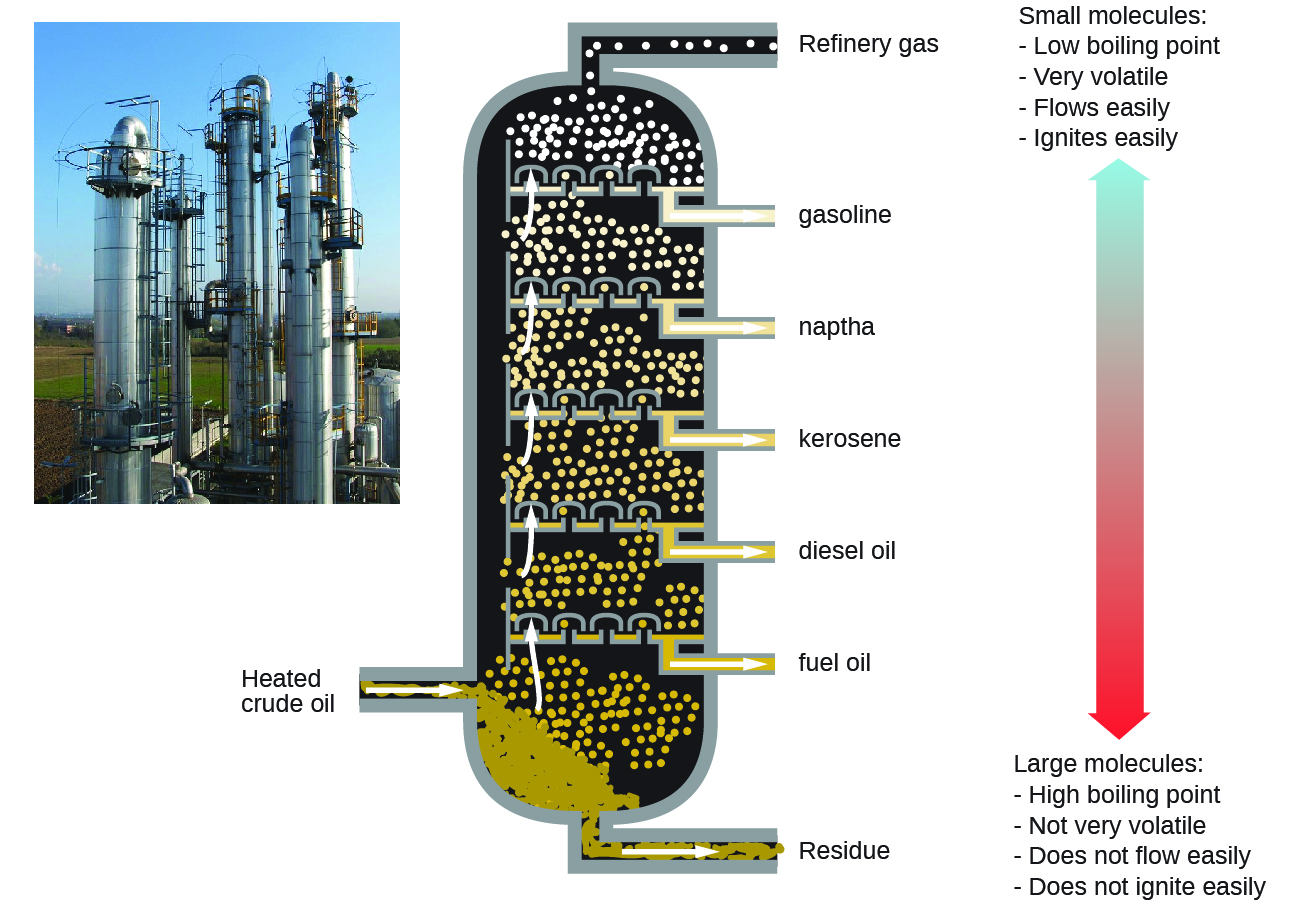


Figure 11.20図 11.20
Crude oil is a complex mixture that is separated by large-scale fractional distillation to isolate various simpler mixtures.
原油は複雑な混合物であり、大規模な分留によって、さまざまな、より単純な混合物に分離される。