第8章共有結合の理論
8.4 Molecular Orbital Theory8.4 分子軌道理論
Learning Objectives学習目標
By the end of this section, you will be able to:
この節を学ぶと、次のことができるようになる。
- Outline the basic quantum-mechanical approach to deriving molecular orbitals from atomic orbitals原子軌道から分子軌道を導く基本的な量子力学的手法の概略を述べる
- Describe traits of bonding and antibonding molecular orbitals結合性分子軌道と反結合性分子軌道の特徴を説明する
- Calculate bond orders based on molecular electron configurations分子の電子配置に基づいて結合次数を計算する
- Write molecular electron configurations for first- and second-row diatomic molecules第1周期と第2周期の二原子分子の電子配置を書く
- Relate these electron configurations to the molecules’ stabilities and magnetic propertiesこれらの電子配置を、分子の安定性や磁気的性質と関連付ける
For almost every covalent molecule that exists, we can now draw the Lewis structure, predict the electron-pair geometry, predict the molecular geometry, and come close to predicting bond angles. However, one of the most important molecules we know, the oxygen molecule O2, presents a problem with respect to its Lewis structure. We would write the following Lewis structure for O2:
英語のヒント
ここまでで、存在するほぼすべての共有結合性分子について、ルイス構造を描き、電子対の配置と分子の形を予測し、結合角もかなり近い値まで予測できるようになった。しかし、最も重要な分子の一つである酸素分子O2には、ルイス構造に関する問題がある。O2のルイス構造は次のように書かれる。

This electronic structure adheres to all the rules governing Lewis theory. There is an O=O double bond, and each oxygen atom has eight electrons around it. However, this picture is at odds with the magnetic behavior of oxygen. By itself, O2 is not magnetic, but it is attracted to magnetic fields. Thus, when we pour liquid oxygen past a strong magnet, it collects between the poles of the magnet and defies gravity, as in Figure 8.1. Such attraction to a magnetic field is called paramagnetism, and it arises in molecules that have unpaired electrons. And yet, the Lewis structure of O2 indicates that all electrons are paired. How do we account for this discrepancy?
英語のヒント
この電子構造は、ルイス理論のすべての規則に従っている。O=O二重結合があり、各酸素原子の周囲には8個の電子がある。しかし、この描像は酸素の磁気的な振る舞いと食い違う。O2はそれ自体では磁石にはならないが、磁場に引き寄せられる。そのため、液体酸素を強い磁石のそばに注ぐと、図8.1のように磁極の間に集まり、重力に逆らって留まる。このように磁場に引き寄せられる性質を常磁性といい、不対電子をもつ分子に生じる。ところがO2のルイス構造では、すべての電子が対を作っている。この食い違いをどのように説明すればよいだろうか。
Magnetic susceptibility measures the force experienced by a substance in a magnetic field. When we compare the weight of a sample to the weight measured in a magnetic field (Figure 8.27), paramagnetic samples that are attracted to the magnet will appear heavier because of the force exerted by the magnetic field. We can calculate the number of unpaired electrons based on the increase in weight.
英語のヒント
磁化率は、磁場内で物質が受ける力を測るものである。試料の重さを磁場内で測った重さと比較すると(図8.27)、磁石に引き寄せられる常磁性試料は、磁場が及ぼす力によって重くなったように見える。この重さの増加に基づいて、不対電子の数を計算できる。
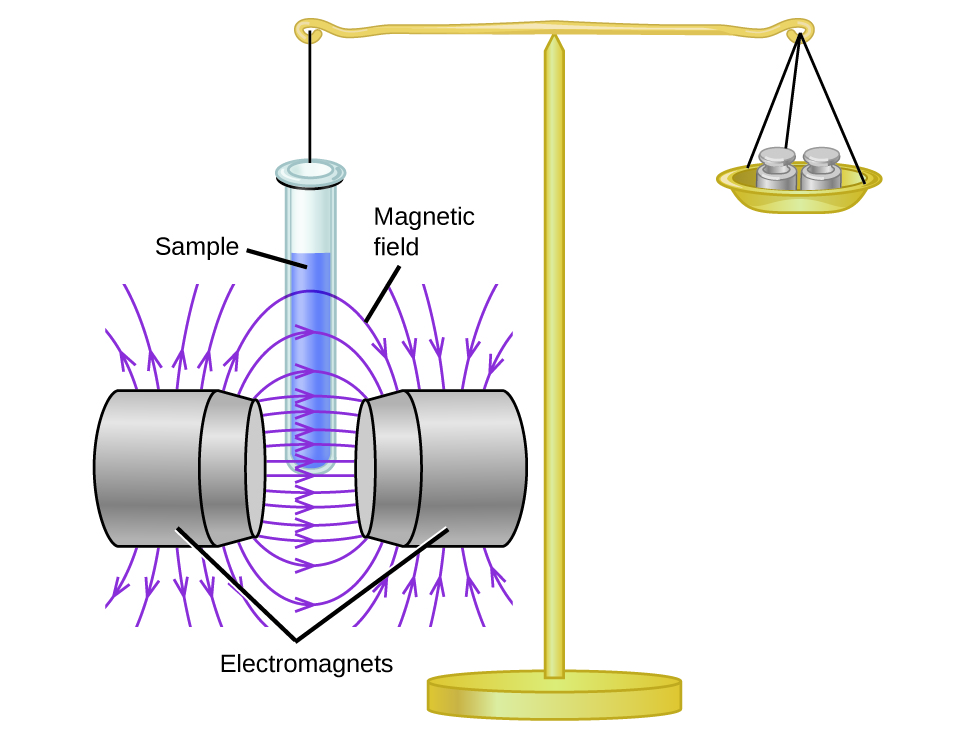
Figure 8.27図 8.27
A Gouy balance compares the mass of a sample in the presence of a magnetic field with the mass with the electromagnet turned off to determine the number of unpaired electrons in a sample.
グーイ磁気天秤は、磁場があるときの試料の質量と、電磁石の電源を切ったときの質量を比較して、試料中の不対電子数を求める。
Experiments show that each O2 molecule has two unpaired electrons. The Lewis-structure model does not predict the presence of these two unpaired electrons. Unlike oxygen, the apparent weight of most molecules decreases slightly in the presence of an inhomogeneous magnetic field. Materials in which all of the electrons are paired are diamagnetic and weakly repel a magnetic field. Paramagnetic and diamagnetic materials do not act as permanent magnets. Only in the presence of an applied magnetic field do they demonstrate attraction or repulsion.
英語のヒント
実験によると、各O2分子には不対電子が二つある。ルイス構造モデルは、この二つの不対電子の存在を予測しない。酸素とは異なり、ほとんどの分子は不均一な磁場内で見かけの重さがわずかに減少する。すべての電子が対になっている物質は反磁性であり、磁場を弱く反発する。常磁性物質も反磁性物質も、永久磁石として働くわけではない。外部から磁場を加えたときにだけ、引力や反発を示す。
Molecular orbital theory (MO theory) provides an explanation of chemical bonding that accounts for the paramagnetism of the oxygen molecule. It also explains the bonding in a number of other molecules, such as violations of the octet rule and more molecules with more complicated bonding (beyond the scope of this text) that are difficult to describe with Lewis structures. Additionally, it provides a model for describing the energies of electrons in a molecule and the probable location of these electrons. Unlike valence bond theory, which uses hybrid orbitals that are assigned to one specific atom, MO theory uses the combination of atomic orbitals to yield molecular orbitals that are delocalized over the entire molecule rather than being localized on its constituent atoms. MO theory also helps us understand why some substances are electrical conductors, others are semiconductors, and still others are insulators. Table 8.2 summarizes the main points of the two complementary bonding theories. Both theories provide different, useful ways of describing molecular structure.
英語のヒント
分子軌道理論(MO理論)は、酸素分子の常磁性を説明できる化学結合の説明を与える。さらに、オクテット則に従わない分子や、ルイス構造では記述しにくい、もっと複雑な結合をもつ分子(本書の範囲外)など、他の多くの分子の結合も説明する。また、分子内の電子のエネルギーと、それらの電子が存在しそうな位置を記述するモデルも与える。特定の一原子に割り当てられた混成軌道を使う原子価結合理論とは異なり、MO理論は原子軌道の組み合わせを使って分子軌道を作る。この分子軌道は、構成原子に局在するのではなく、分子全体にわたって非局在化している。MO理論はまた、電気を通す導体となる物質、半導体となる物質、絶縁体となる物質がある理由を理解するのにも役立つ。表8.2に、互いを補う二つの結合理論の要点をまとめる。どちらの理論も、分子構造を記述するための、異なる有用な方法を与える。
Comparison of Bonding Theories 結合理論の比較 |
|
|---|---|
Valence Bond Theory 原子価結合理論 |
Molecular Orbital Theory 分子軌道理論 |
considers bonds as localized between one pair of atoms 結合は一対の原子間に局在すると考える |
considers electrons delocalized throughout the entire molecule 電子は分子全体に非局在すると考える |
creates bonds from overlap of atomic orbitals (s, p, d…) and hybrid orbitals (sp, sp2, sp3…) 原子軌道(s、p、dなど)や混成軌道(sp、sp2、sp3など)の重なりによって結合を作る |
combines atomic orbitals to form molecular orbitals (σ, σ*, π, π*) 原子軌道を組み合わせて分子軌道(σ、σ*、π、π*)を形成する |
forms σ or π bonds σ結合またはπ結合を形成する |
creates bonding and antibonding interactions based on which orbitals are filled どの軌道が占有されるかに応じて、結合性または反結合性の相互作用を生じる |
predicts molecular shape based on the number of regions of electron density 電子密度の領域の数に基づいて分子の形を予測する |
predicts the arrangement of electrons in molecules 分子内の電子の配置を予測する |
needs multiple structures to describe resonance 共鳴を記述するために複数の構造を必要とする |
|
Molecular orbital theory describes the distribution of electrons in molecules in much the same way that the distribution of electrons in atoms is described using atomic orbitals. Using quantum mechanics, the behavior of an electron in a molecule is still described by a wave function, Ψ, analogous to the behavior in an atom. Just like electrons around isolated atoms, electrons around atoms in molecules are limited to discrete (quantized) energies. The region of space in which a valence electron in a molecule is likely to be found is called a molecular orbital (Ψ2). Like an atomic orbital, a molecular orbital is full when it contains two electrons with opposite spin.
英語のヒント
分子軌道理論は、原子内の電子分布を原子軌道で記述するのとほぼ同じ方法で、分子内の電子分布を記述する。量子力学を用いると、分子内の電子の振る舞いも、原子内と同様に波動関数Ψで記述される。孤立した原子の周囲の電子と同様、分子内の原子の周囲の電子がとれるエネルギーは離散的(量子化された)な値に限られる。分子の原子価電子が見つかりやすい空間領域を、分子軌道(Ψ2)という。原子軌道と同様に、分子軌道も、逆向きのスピンをもつ二つの電子が入ると満たされる。
We will consider the molecular orbitals in molecules composed of two identical atoms (H2 or Cl2, for example). Such molecules are called homonuclear diatomic molecules. In these diatomic molecules, several types of molecular orbitals occur.
英語のヒント
ここでは、同じ原子二つからなる分子(たとえばH2やCl2)の分子軌道を考える。このような分子を等核二原子分子という。これらの二原子分子では、いくつかの種類の分子軌道が現れる。
The mathematical process of combining atomic orbitals to generate molecular orbitals is called the linear combination of atomic orbitals (LCAO). The wave function describes the wavelike properties of an electron. Molecular orbitals are combinations of atomic orbital wave functions. Combining waves can lead to constructive interference, in which peaks line up with peaks, or destructive interference, in which peaks line up with troughs (Figure 8.28). In orbitals, the waves are three dimensional, and they combine with in-phase waves producing regions with a higher probability of electron density and out-of-phase waves producing nodes, or regions of no electron density.
英語のヒント
原子軌道を組み合わせて分子軌道を作る数学的操作を、原子軌道の線形結合(LCAO)という。波動関数は、電子の波としての性質を記述する。分子軌道は、原子軌道の波動関数の組み合わせである。波を重ね合わせると、山と山がそろう強め合いの干渉、または山と谷がそろう弱め合いの干渉が生じうる(図8.28)。軌道では波は三次元であり、同位相の波の重ね合わせは電子密度の確率が高い領域を生じ、逆位相の波の重ね合わせは節、すなわち電子密度のない領域を生じる。
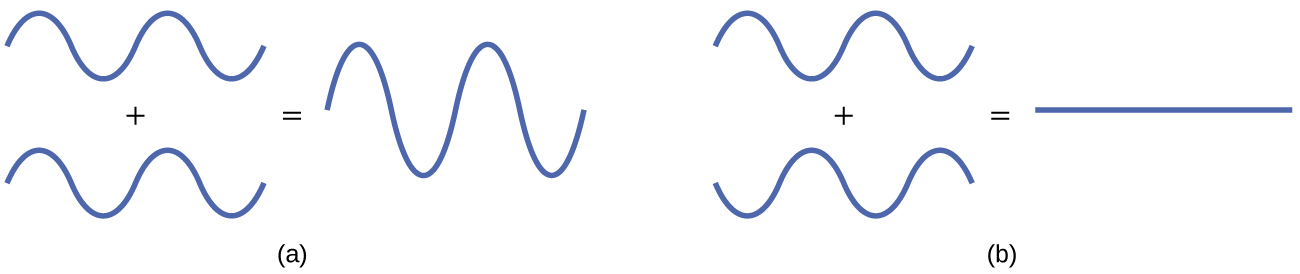
Figure 8.28図 8.28
(a) When in-phase waves combine, constructive interference produces a wave with greater amplitude. (b) When out-of-phase waves combine, destructive interference produces a wave with less (or no) amplitude.
英語のヒント
(a)同位相の波を重ねると、強め合いの干渉によって振幅の大きい波が生じる。(b)逆位相の波を重ねると、弱め合いの干渉によって振幅の小さい(または振幅がゼロの)波が生じる。
There are two types of molecular orbitals that can form from the overlap of two atomic s orbitals on adjacent atoms. The two types are illustrated in Figure 8.29. The in-phase combination produces a lower energy σs molecular orbital (read as "sigma-s") in which most of the electron density is directly between the nuclei. The out-of-phase addition (which can also be thought of as subtracting the wave functions) produces a higher energy molecular orbital (read as "sigma-s-star") molecular orbital in which there is a node between the nuclei. The asterisk signifies that the orbital is an antibonding orbital. Electrons in a σs orbital are attracted by both nuclei at the same time and are more stable (of lower energy) than they would be in the isolated atoms. Adding electrons to these orbitals creates a force that holds the two nuclei together, so we call these orbitals bonding orbitals. Electrons in the orbitals are located well away from the region between the two nuclei. The attractive force between the nuclei and these electrons pulls the two nuclei apart. Hence, these orbitals are called antibonding orbitals. Electrons fill the lower-energy bonding orbital before the higher-energy antibonding orbital, just as they fill lower-energy atomic orbitals before they fill higher-energy atomic orbitals.
英語のヒント
隣接する原子の二つのs原子軌道が重なることで形成できる分子軌道には、二つの種類がある。それらを図8.29に示す。同位相での組み合わせは、電子密度の大部分が原子核のすぐ間にある、エネルギーの低いσs分子軌道(「シグマ・エス」と読む)を生じる。逆位相での加え合わせ(波動関数の引き算とも考えられる)は、核間に節をもつ、エネルギーの高い分子軌道(「シグマ・エス・スター」と読む)を生じる。アスタリスクは、その軌道が反結合性軌道であることを示す。σs軌道の電子は、両方の原子核に同時に引き寄せられ、孤立した原子にあるときよりも安定である(エネルギーが低い)。この軌道に電子を加えると二つの原子核をつなぎ留める力が生じるため、これを結合性軌道と呼ぶ。軌道の電子は、二つの原子核の間の領域から大きく離れた位置にある。原子核とそれらの電子との間の引力は、二つの原子核を引き離す。したがって、これらの軌道を反結合性軌道と呼ぶ。電子は、エネルギーの高い原子軌道よりも低い原子軌道を先に満たすのと同様に、エネルギーの高い反結合性軌道よりも低い結合性軌道を先に満たす。
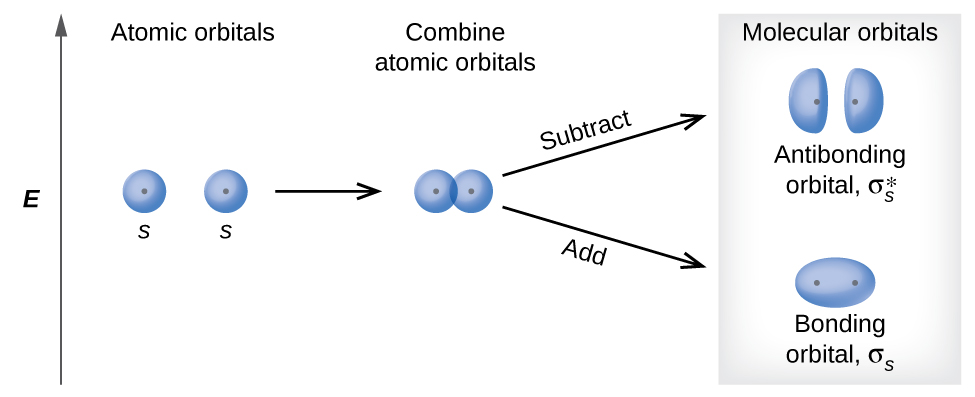
Figure 8.29図 8.29
Sigma (σ) and sigma-star (σ*) molecular orbitals are formed by the combination of two s atomic orbitals. The dots (·) indicate the locations of nuclei.
シグマ(σ)およびシグマ・スター(σ*)分子軌道は、二つのs原子軌道の組み合わせによって形成される。点(・)は原子核の位置を示す。
In p orbitals, the wave function gives rise to two lobes with opposite phases, analogous to how a two-dimensional wave has both parts above and below the average. We indicate the phases by shading the orbital lobes different colors. When orbital lobes of the same phase overlap, constructive wave interference increases the electron density. When regions of opposite phase overlap, the destructive wave interference decreases electron density and creates nodes. When p orbitals overlap end to end, they create σ and σ* orbitals (Figure 8.30). If two atoms are located along the x-axis in a Cartesian coordinate system, the two px orbitals overlap end to end and form σpx (bonding) and (antibonding) (read as "sigma-p-x" and "sigma-p-x star," respectively). Just as with s-orbital overlap, the asterisk indicates the orbital with a node between the nuclei, which is a higher-energy, antibonding orbital.
英語のヒント
p軌道では、二次元の波に平均位置より上の部分と下の部分があるのと同様に、波動関数から位相が逆の二つのローブが生じる。軌道のローブを異なる色で塗り分けて位相を表す。同じ位相のローブが重なると、波の強め合いの干渉によって電子密度が増加する。逆位相の領域が重なると、弱め合いの干渉によって電子密度が減少し、節が生じる。p軌道が端どうしで重なると、σ軌道とσ*軌道ができる(図8.30)。直交座標系のx軸上に二つの原子を置くと、二つのpx軌道が端どうしで重なり、σpx(結合性)と(反結合性)が形成される(それぞれ「シグマ・ピー・エックス」「シグマ・ピー・エックス・スター」と読む)。s軌道の重なりの場合と同様、アスタリスクは核間に節のある軌道を示し、これはエネルギーが高い反結合性軌道である。
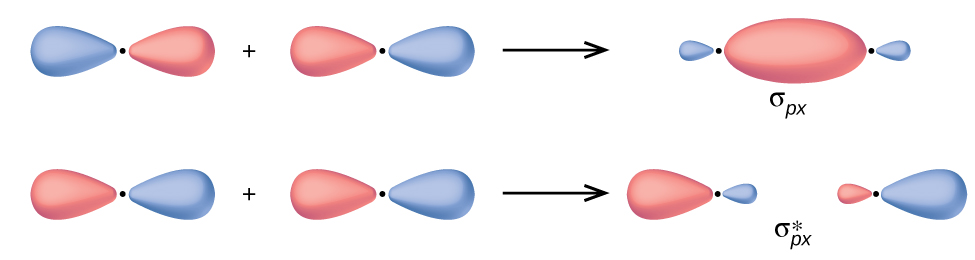
Figure 8.30図 8.30
Combining wave functions of two p atomic orbitals along the internuclear axis creates two molecular orbitals, σp and
二つのp原子軌道の波動関数を原子核間の軸に沿って組み合わせると、σpとという二つの分子軌道ができる。
The side-by-side overlap of two p orbitals gives rise to a pi (π) bonding molecular orbital and a π* antibonding molecular orbital, as shown in Figure 8.31. In valence bond theory, we describe π bonds as containing a nodal plane containing the internuclear axis and perpendicular to the lobes of the p orbitals, with electron density on either side of the node. In molecular orbital theory, we describe the π orbital by this same shape, and a π bond exists when this orbital contains electrons. Electrons in this orbital interact with both nuclei and help hold the two atoms together, making it a bonding orbital. For the out-of-phase combination, there are two nodal planes created, one along the internuclear axis and a perpendicular one between the nuclei.
英語のヒント
図8.31に示すように、二つのp軌道が横に並んで重なると、パイ(π)結合性分子軌道とπ*反結合性分子軌道が生じる。原子価結合理論では、π結合は原子核間の軸を含み、p軌道のローブに垂直な節面をもち、その節の両側に電子密度があると記述する。分子軌道理論でもπ軌道を同じ形で記述し、その軌道に電子が入るとπ結合が存在する。この軌道の電子は両方の原子核と相互作用し、二原子をつなぎ留めるのを助けるため、結合性軌道となる。逆位相の組み合わせでは、原子核間の軸に沿う節面と、二つの原子核の間でその軸に垂直な節面の二つができる。
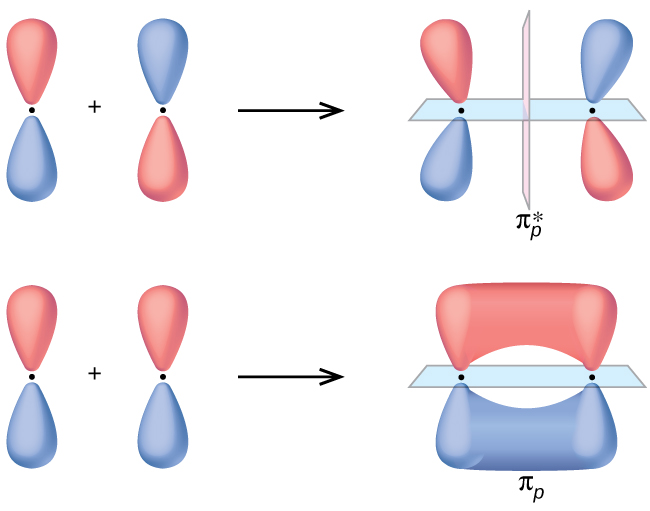
Figure 8.31図 8.31
Side-by-side overlap of each two p orbitals results in the formation of two π molecular orbitals. Combining the out-of-phase orbitals results in an antibonding molecular orbital with two nodes. One contains the internuclear axis, and one is perpendicular to the axis. Combining the in-phase orbitals results in a bonding orbital. There is a node (blue) containing the internuclear axis with the two lobes of the orbital located above and below this node.
二つのp軌道の各組が横に並んで重なると、二つのπ分子軌道が形成される。逆位相の軌道を組み合わせると、節が二つある反結合性分子軌道になる。一つは原子核間の軸を含み、もう一つはその軸に垂直である。同位相の軌道を組み合わせると結合性軌道になる。原子核間の軸を含む節(青)があり、軌道の二つのローブはこの節の上と下に位置する。
In the molecular orbitals of diatomic molecules, each atom also has two sets of p orbitals oriented side by side (py and pz), so these four atomic orbitals combine pairwise to create two π orbitals and two π* orbitals. The πpy and orbitals are oriented at right angles to the πpz and orbitals. Except for their orientation, the πpy and πpz orbitals are identical and have the same energy; they are degenerate orbitals. The and antibonding orbitals are also degenerate and identical except for their orientation. A total of six molecular orbitals results from the combination of the six atomic p orbitals in two atoms: σpx and πpy and πpz and
英語のヒント
二原子分子の分子軌道では、各原子はさらに横並びに向く二組のp軌道(pyとpz)をもつ。この四つの原子軌道が二つずつ組み合わさり、二つのπ軌道と二つのπ*軌道ができる。πpy軌道および軌道は、πpz軌道および軌道に対して直角をなす。πpy軌道とπpz軌道は、向き以外は同一で、エネルギーも等しい。このような軌道を縮退した軌道という。との反結合性軌道も縮退しており、向き以外は同一である。二原子にある六つのp原子軌道を組み合わせると、σpxと、πpyと、πpzとという、計六つの分子軌道が生じる。
Example 8.5例題 8.5
Molecular Orbitals分子軌道
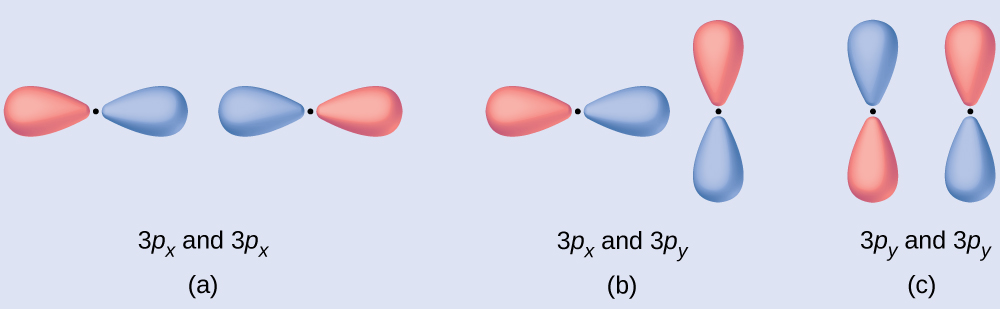
Predict what type (if any) of molecular orbital would result from adding the wave functions so each pair of orbitals shown overlap. The orbitals are all similar in energy.
図の各軌道対が重なるように波動関数を加えると、どの種類の分子軌道ができるか予測しなさい。分子軌道ができない場合もある。軌道のエネルギーはすべて互いに近い。
Solution解法
(a) is an in-phase combination, resulting in a σ3p orbital
(a)は同位相の組み合わせで、σ3p軌道が生じる。
(b) will not result in a new orbital because the in-phase component (bottom) and out-of-phase component (top) cancel out. Only orbitals with the correct alignment can combine.
英語のヒント
(b)では同位相の成分(下側)と逆位相の成分(上側)が打ち消し合うため、新しい軌道は生じない。正しい向きに配置された軌道だけが組み合わさることができる。
(c) is an out-of-phase combination, resulting in a orbital.
(c)は逆位相の組み合わせで、軌道が生じる。
Check Your Learning理解を確かめよう
Label the molecular orbital shown as σ or π, bonding or antibonding and indicate where the node occurs.
示した分子軌道を、σかπか、結合性か反結合性かに分類し、節がどこにあるか示しなさい。



