第8章共有結合の理論
8.2 Hybrid Atomic Orbitals8.2 混成原子軌道
Learning Objectives学習目標
By the end of this section, you will be able to:
この節を学ぶと、次のことができるようになる。
- Explain the concept of atomic orbital hybridization原子軌道の混成という概念を説明する
- Determine the hybrid orbitals associated with various molecular geometriesさまざまな分子の形に対応する混成軌道を求める
Thinking in terms of overlapping atomic orbitals is one way for us to explain how chemical bonds form in diatomic molecules. However, to understand how molecules with more than two atoms form stable bonds, we require a more detailed model. As an example, let us consider the water molecule, in which we have one oxygen atom bonding to two hydrogen atoms. Oxygen has the electron configuration 1s22s22p4, with two unpaired electrons (one in each of the two 2p orbitals). Valence bond theory would predict that the two O–H bonds form from the overlap of these two 2p orbitals with the 1s orbitals of the hydrogen atoms. If this were the case, the bond angle would be 90°, as shown in Figure 8.6, because p orbitals are perpendicular to each other. Experimental evidence shows that the bond angle is 104.5°, not 90°. The prediction of the valence bond theory model does not match the real-world observations of a water molecule; a different model is needed.
英語のヒント
原子軌道の重なりで考えることは、二原子分子で化学結合がどのように形成されるかを説明する一つの方法である。しかし、三つ以上の原子からなる分子が安定な結合を形成する仕組みを理解するには、もっと詳しいモデルが必要となる。例として、一つの酸素原子が二つの水素原子に結合する水分子を考えよう。酸素の電子配置は1s22s22p4で、不対電子が二つある(二つの2p軌道に一つずつ入っている)。原子価結合理論では、この二つの2p軌道と水素原子の1s軌道が重なって、二つのO–H結合が形成されると予測される。もしそうなら、p軌道は互いに直交するため、図8.6に示すように結合角は90°になるはずである。実験によれば結合角は90°ではなく104.5°である。原子価結合理論のモデルによる予測は、水分子についての実際の観測と一致しないため、別のモデルが必要になる。
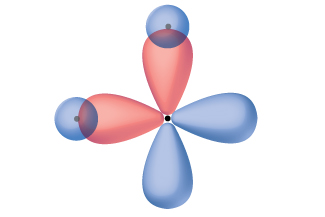
Figure 8.6図 8.6
The hypothetical overlap of two of the 2p orbitals on an oxygen atom (red) with the 1s orbitals of two hydrogen atoms (blue) would produce a bond angle of 90°. This is not consistent with experimental evidence. Note that orbitals may sometimes be drawn in an elongated “balloon” shape rather than in a more realistic “plump” shape in order to make the geometry easier to visualize.
英語のヒント
酸素原子(赤)の二つの2p軌道が、二つの水素原子(青)の1s軌道と重なると仮定すると、結合角は90°になる。この結果は実験的な証拠と一致しない。幾何学的な配置をイメージしやすくするため、軌道を、より実際に近い「ふっくらした」形ではなく、細長い「風船」の形で描く場合があることに注意しよう。
Quantum-mechanical calculations suggest why the observed bond angles in H2O differ from those predicted by the overlap of the 1s orbital of the hydrogen atoms with the 2p orbitals of the oxygen atom. The mathematical expression known as the wave function, ψ, contains information about each orbital and the wavelike properties of electrons in an isolated atom. When atoms are bound together in a molecule, the wave functions combine to produce new mathematical descriptions that have different shapes. This process of combining the wave functions for atomic orbitals is called hybridization and is mathematically accomplished by the linear combination of atomic orbitals, LCAO, (a technique that we will encounter again later). The new orbitals that result are called hybrid orbitals. The valence orbitals in an isolated oxygen atom are a 2s orbital and three 2p orbitals. The valence orbitals in an oxygen atom in a water molecule differ; they consist of four equivalent hybrid orbitals that point approximately toward the corners of a tetrahedron (Figure 8.7). Consequently, the overlap of the O and H orbitals should result in a tetrahedral bond angle (109.5°). The observed angle of 104.5° is experimental evidence for which quantum-mechanical calculations give a useful explanation: Valence bond theory must include a hybridization component to give accurate predictions.
英語のヒント
量子力学的な計算は、H2Oで観測される結合角が、水素原子の1s軌道と酸素原子の2p軌道の重なりから予測される角度と異なる理由を示している。波動関数ψと呼ばれる数式には、孤立した原子内の各軌道と、電子の波としての性質についての情報が含まれる。原子が分子の中で結び付くと、波動関数が組み合わさり、形の異なる新たな数学的記述が生まれる。原子軌道の波動関数を組み合わせるこの過程を混成といい、数学的には原子軌道の線形結合、LCAOによって行う(この手法は後でも再び扱う)。その結果生じる新しい軌道を混成軌道という。孤立した酸素原子の原子価軌道は、一つの2s軌道と三つの2p軌道である。一方、水分子内の酸素原子の原子価軌道は異なり、四面体の各頂点にほぼ向かう四つの等価な混成軌道からなる(図8.7)。したがって、OとHの軌道の重なりは、四面体の結合角(109.5°)を生じるはずである。観測される104.5°という角度は実験的な証拠であり、量子力学的な計算はそれに有用な説明を与える。すなわち、原子価結合理論が正確に予測するためには、混成という要素を含めなければならない。
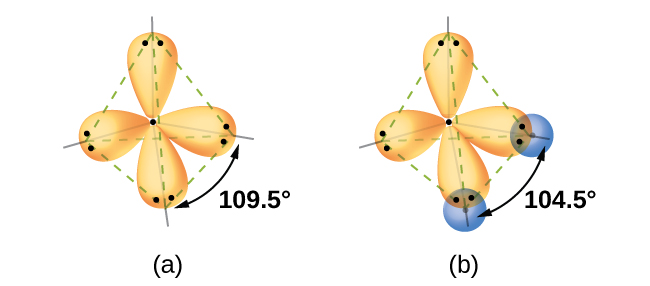


Figure 8.7図 8.7
(a) A water molecule has four regions of electron density, so VSEPR theory predicts a tetrahedral arrangement of hybrid orbitals. (b) Two of the hybrid orbitals on oxygen contain lone pairs, and the other two overlap with the 1s orbitals of hydrogen atoms to form the O–H bonds in H2O. This description is more consistent with the experimental structure.
(a)水分子には電子密度の高い領域が四つあるため、VSEPR理論は混成軌道が四面体状に配置されると予測する。(b)酸素の混成軌道のうち二つには非共有電子対が入り、残る二つは水素原子の1s軌道と重なって、H2OのO–H結合を形成する。この説明のほうが、実験で得られる構造とよく一致する。
The following ideas are important in understanding hybridization:
混成を理解するうえで、次の考え方が重要である。
- Hybrid orbitals do not exist in isolated atoms. They are formed only in covalently bonded atoms.混成軌道は孤立した原子には存在しない。共有結合している原子にだけ形成される。
- Hybrid orbitals have shapes and orientations that are very different from those of the atomic orbitals in isolated atoms.混成軌道の形と向きは、孤立した原子の原子軌道の形と向きとは大きく異なる。
- A set of hybrid orbitals is generated by combining atomic orbitals. The number of hybrid orbitals in a set is equal to the number of atomic orbitals that were combined to produce the set.混成軌道の一組は、原子軌道を組み合わせて生成される。その組に含まれる混成軌道の数は、それを作るために組み合わせた原子軌道の数と等しい。
- All orbitals in a set of hybrid orbitals are equivalent in shape and energy.一組の混成軌道に含まれる軌道は、すべて形とエネルギーが等価である。
- The type of hybrid orbitals formed in a bonded atom depends on its electron-pair geometry as predicted by the VSEPR theory.結合した原子に形成される混成軌道の種類は、VSEPR理論から予測される電子対の幾何学的配置に依存する。
- Hybrid orbitals overlap to form σ bonds. Unhybridized orbitals overlap to form π bonds.混成軌道は重なってσ結合を形成する。混成していない軌道は重なってπ結合を形成する。
In the following sections, we shall discuss the common types of hybrid orbitals.
以下の節では、一般的な種類の混成軌道を論じる。