第8章共有結合の理論
Molecular Orbital Energy Diagrams分子軌道エネルギー図
The relative energy levels of atomic and molecular orbitals are typically shown in a molecular orbital diagram (Figure 8.34). For a diatomic molecule, the atomic orbitals of one atom are shown on the left, and those of the other atom are shown on the right. Each horizontal line represents one orbital that can hold two electrons. The molecular orbitals formed by the combination of the atomic orbitals are shown in the center. Dashed lines show which of the atomic orbitals combine to form the molecular orbitals. For each pair of atomic orbitals that combine, one lower-energy (bonding) molecular orbital and one higher-energy (antibonding) orbital result. Thus we can see that combining the six 2p atomic orbitals results in three bonding orbitals (one σ and two π) and three antibonding orbitals (one σ* and two π*).
原子軌道と分子軌道の相対的なエネルギー準位は、通常、分子軌道図で示す(図8.34)。二原子分子の場合、一方の原子の原子軌道を左に、他方の原子の原子軌道を右に描く。各水平線は、電子を二つ収められる一つの軌道を表す。原子軌道の組み合わせで形成される分子軌道は中央に示す。どの原子軌道どうしが組み合わさって分子軌道を形成するかを、破線で示す。組み合わさる原子軌道の各対から、エネルギーの低い分子軌道(結合性)一つと、エネルギーの高い軌道(反結合性)一つが生じる。したがって、六つの2p原子軌道を組み合わせると、三つの結合性軌道(σ一つ、π二つ)と三つの反結合性軌道(σ*一つ、π*二つ)ができるとわかる。
We predict the distribution of electrons in these molecular orbitals by filling the orbitals in the same way that we fill atomic orbitals, by the Aufbau principle. Lower-energy orbitals fill first, electrons spread out among degenerate orbitals before pairing, and each orbital can hold a maximum of two electrons with opposite spins (Figure 8.34). Just as we write electron configurations for atoms, we can write the molecular electronic configuration by listing the orbitals with superscripts indicating the number of electrons present. For clarity, we place parentheses around molecular orbitals with the same energy. In this case, each orbital is at a different energy, so parentheses separate each orbital. Thus we would expect a diatomic molecule or ion containing seven electrons (such as would have the molecular electron configuration It is common to omit the core electrons from molecular orbital diagrams and configurations and include only the valence electrons.
英語のヒント
これらの分子軌道への電子の分布は、原子軌道と同じく構築原理に従って軌道を満たすことで予測する。エネルギーが低い軌道から先に電子が入り、縮退した軌道では電子対を作る前に別々の軌道に分かれて入り、各軌道には逆向きのスピンの電子を最大二つまで収められる(図8.34)。原子の電子配置を書くのと同様に、各軌道を並べ、そこにある電子数を上付きで示すことで分子の電子配置を書ける。わかりやすくするため、同じエネルギーの分子軌道を括弧でまとめる。この場合は各軌道のエネルギーが異なるので、軌道ごとに括弧で区切る。したがって、電子を七つ含む二原子分子またはイオン(など)の分子電子配置はと予想される。分子軌道図や電子配置から内殻電子を省き、原子価電子だけを示すのが一般的である。
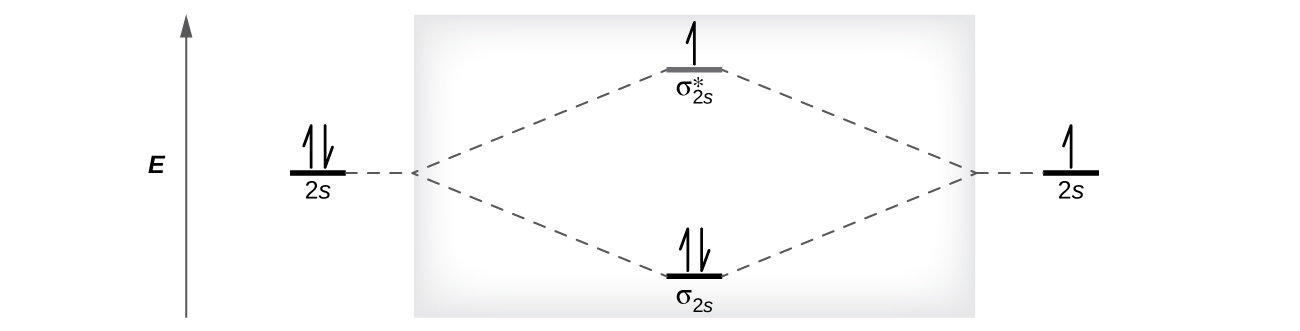
Figure 8.34図 8.34
This is the molecular orbital diagram for the homonuclear diatomic showing the molecular orbitals of the valence shell only. The molecular orbitals are filled in the same manner as atomic orbitals, using the Aufbau principle and Hund’s rule.
等核二原子種の分子軌道図。原子価殻の分子軌道だけを示している。分子軌道は原子軌道と同様、構築原理とフントの規則に従って満たされる。
Bond Order結合次数
The filled molecular orbital diagram shows the number of electrons in both bonding and antibonding molecular orbitals. The net contribution of the electrons to the bond strength of a molecule is identified by determining the bond order that results from the filling of the molecular orbitals by electrons.
英語のヒント
電子を入れた分子軌道図は、結合性分子軌道と反結合性分子軌道の両方にある電子数を示す。電子が分子の結合の強さに与える正味の寄与は、分子軌道への電子の入り方から結合次数を求めることによってわかる。
When using Lewis structures to describe the distribution of electrons in molecules, we define bond order as the number of bonding pairs of electrons between two atoms. Thus a single bond has a bond order of 1, a double bond has a bond order of 2, and a triple bond has a bond order of 3. We define bond order differently when we use the molecular orbital description of the distribution of electrons, but the resulting bond order is usually the same. The MO technique is more accurate and can handle cases when the Lewis structure method fails, but both methods describe the same phenomenon.
英語のヒント
ルイス構造を使って分子内の電子分布を記述するとき、結合次数は二原子間の結合電子対の数と定義する。したがって単結合の結合次数は1、二重結合は2、三重結合は3である。分子軌道で電子分布を記述する場合には結合次数の定義を変えるが、得られる結合次数は通常同じである。MO法はより正確で、ルイス構造の方法では扱えない場合にも対応できるが、両方の方法は同じ現象を記述している。
In the molecular orbital model, an electron contributes to a bonding interaction if it occupies a bonding orbital and it contributes to an antibonding interaction if it occupies an antibonding orbital. The bond order is calculated by subtracting the destabilizing (antibonding) electrons from the stabilizing (bonding) electrons. Since a bond consists of two electrons, we divide by two to get the bond order. We can determine bond order with the following equation:
分子軌道モデルでは、結合性軌道を占有する電子は結合性の相互作用に寄与し、反結合性軌道を占有する電子は反結合性の相互作用に寄与する。結合次数の計算では、安定化する(結合性の)電子数から、不安定化する(反結合性の)電子数を引く。結合は二つの電子からなるため、さらに2で割ると結合次数が得られる。次の式で結合次数を求められる。
The order of a covalent bond is a guide to its strength; a bond between two given atoms becomes stronger as the bond order increases (Table 8.1). If the distribution of electrons in the molecular orbitals between two atoms is such that the resulting bond would have a bond order of zero, a stable bond does not form. We next look at some specific examples of MO diagrams and bond orders.
共有結合の次数は強さの目安となり、特定の二原子間の結合は、結合次数が大きいほど強くなる(表8.1)。二原子間の分子軌道の電子分布が、できる結合の次数をゼロにするものであれば、安定な結合は形成されない。次に、MO図と結合次数の具体例を見る。
Bonding in Diatomic Molecules二原子分子の結合
A dihydrogen molecule (H2) forms from two hydrogen atoms. When the atomic orbitals of the two atoms combine, the electrons occupy the molecular orbital of lowest energy, the σ1s bonding orbital. A dihydrogen molecule, H2, readily forms because the energy of a H2 molecule is lower than that of two H atoms. The σ1s orbital that contains both electrons is lower in energy than either of the two 1s atomic orbitals.
二つの水素原子から二水素分子(H2)が形成される。二原子の原子軌道が組み合わさると、電子はエネルギーが最も低い分子軌道、すなわちσ1s結合性軌道を占有する。H2分子のエネルギーは二つのH原子のエネルギーより低いため、二水素分子H2は容易に形成される。二つの電子を収めるσ1s軌道は、二つの1s原子軌道のどちらよりもエネルギーが低い。
A molecular orbital can hold two electrons, so both electrons in the H2 molecule are in the σ1s bonding orbital; the electron configuration is We represent this configuration by a molecular orbital energy diagram (Figure 8.35) in which a single upward arrow indicates one electron in an orbital, and two (upward and downward) arrows indicate two electrons of opposite spin.
一つの分子軌道には電子を二つ収められるため、H2分子の二つの電子はどちらもσ1s結合性軌道に入り、電子配置はとなる。この配置は、分子軌道エネルギー図(図8.35)で表す。図では一つの上向き矢印を軌道内の電子1個、上下二つの矢印を逆スピンの電子2個として示す。
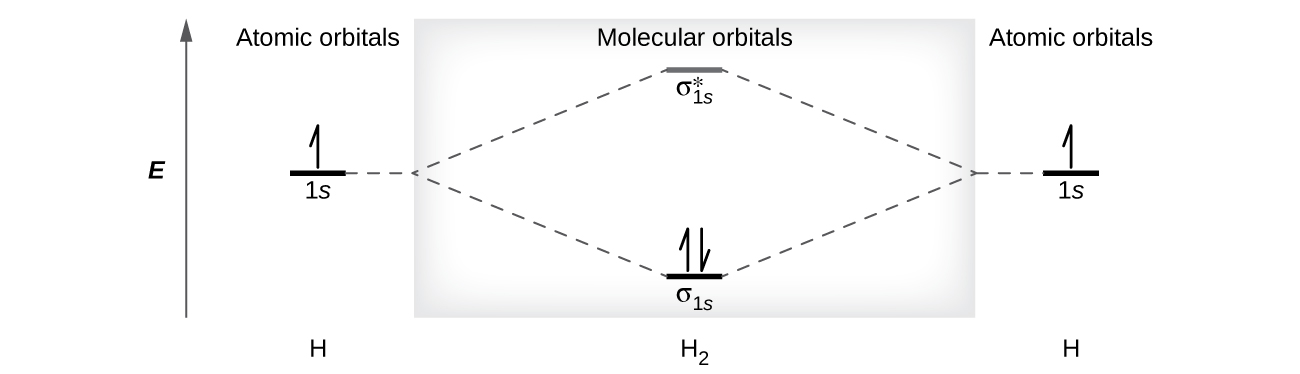
Figure 8.35図 8.35
The molecular orbital energy diagram predicts that H2 will be a stable molecule with lower energy than the separated atoms.
分子軌道エネルギー図は、H2が、離れた原子よりもエネルギーの低い安定な分子となると予測する。
A dihydrogen molecule contains two bonding electrons and no antibonding electrons so we have
二水素分子には結合性電子が二つあり、反結合性電子はないので、次のようになる。
Because the bond order for the H–H bond is equal to 1, the bond is a single bond.
H–H結合の結合次数は1なので、これは単結合である。
A helium atom has two electrons, both of which are in its 1s orbital. Two helium atoms do not combine to form a dihelium molecule, He2, with four electrons, because the stabilizing effect of the two electrons in the lower-energy bonding orbital would be offset by the destabilizing effect of the two electrons in the higher-energy antibonding molecular orbital. We would write the hypothetical electron configuration of He2 as as in Figure 8.36. The net energy change would be zero, so there is no driving force for helium atoms to form the diatomic molecule. In fact, helium exists as discrete atoms rather than as diatomic molecules. The bond order in a hypothetical dihelium molecule would be zero.
英語のヒント
ヘリウム原子には電子が二つあり、どちらも1s軌道に入っている。二つのヘリウム原子が組み合わさって、電子を四つもつ二ヘリウム分子He2を形成することはない。低エネルギーの結合性軌道にある二電子による安定化が、高エネルギーの反結合性分子軌道にある二電子による不安定化によって相殺されるからである。He2の仮想的な電子配置は、図8.36のようにと書かれる。正味のエネルギー変化はゼロとなるため、ヘリウム原子が二原子分子を形成する駆動力はない。実際、ヘリウムは二原子分子ではなく個々の原子として存在する。仮想的な二ヘリウム分子の結合次数はゼロとなる。
A bond order of zero indicates that no bond is formed between two atoms.
結合次数がゼロであることは、二原子間に結合が形成されないことを示す。
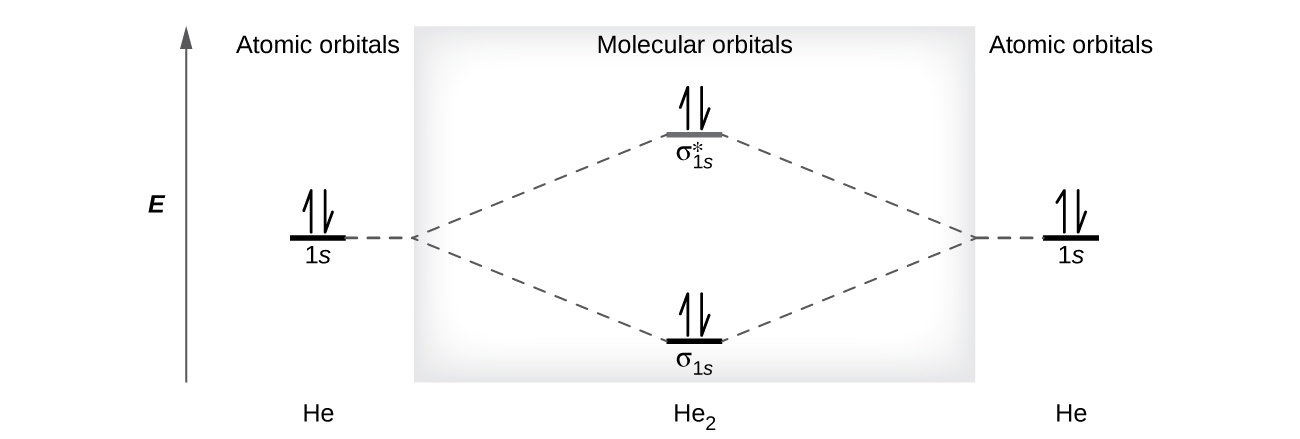


Figure 8.36図 8.36
The molecular orbital energy diagram predicts that He2 will not be a stable molecule, since it has equal numbers of bonding and antibonding electrons.
分子軌道エネルギー図は、He2の結合性電子と反結合性電子の数が等しいため、安定な分子にはならないと予測する。