第8章共有結合の理論
Key Concepts and Summary重要概念とまとめ
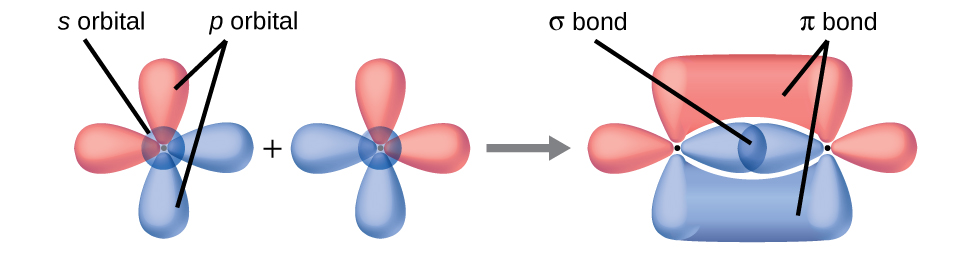
Valence bond theory describes bonding as a consequence of the overlap of two separate atomic orbitals on different atoms that creates a region with one pair of electrons shared between the two atoms. When the orbitals overlap along an axis containing the nuclei, they form a σ bond. When they overlap in a fashion that creates a node along this axis, they form a π bond.
英語のヒント
原子価結合理論では、異なる原子にある二つの原子軌道が重なり、二原子間で1組の電子対が共有される領域が生じる結果として結合を説明する。軌道が原子核を通る軸に沿って重なるとσ結合ができる。その軸に沿って節が生じるように重なるとπ結合ができる。
Chemistry End of Chapter Exercises章末演習
Exercises 1–8練習問題 1–8
Exercise 1問題 1
Explain how σ and π bonds are similar and how they are different.
σ結合とπ結合の共通点と相違点を説明しなさい。
Solution解き方
Similarities: Both types of bonds result from overlap of atomic orbitals on adjacent atoms and contain a maximum of two electrons. Differences: σ bonds are stronger and result from end-to-end overlap and all single bonds are σ bonds; π bonds between the same two atoms are weaker because they result from side-by-side overlap, and multiple bonds contain one or more π bonds (in addition to a σ bond).
英語のヒント
共通点:どちらも隣接する原子の原子軌道が重なって生じ、最大2個の電子を含む。相違点:σ結合はより強く、軌道の端どうしの重なりから生じる。また、単結合はすべてσ結合である。同じ二原子間のπ結合は横並びの重なりから生じるため、より弱い。多重結合にはσ結合に加えて1本以上のπ結合が含まれる。
Exercise 2問題 2
Draw a curve that describes the energy of a system with H and Cl atoms at varying distances. Then, find the minimum energy of this curve two ways.
H原子とCl原子の間の距離を変えたときの、系のエネルギーを表す曲線を描きなさい。次に、この曲線のエネルギーの最小値を二通りの方法で求めなさい。
(a) Use the bond energy found in Table 8.1 to calculate the energy for one single HCl bond (Hint: How many bonds are in a mole?)
(a)表8.1の結合エネルギーを用いて、HClの単結合1本あたりのエネルギーを計算しなさい。(ヒント:1モルには結合が何本あるか。)
(b) Use the enthalpy of reaction and the bond energies for H2 and Cl2 to solve for the energy of one mole of HCl bonds.
(b)反応エンタルピーと、H2およびCl2の結合エネルギーを用いて、HClの結合1モルあたりのエネルギーを求めなさい。
Exercise 3問題 3
Explain why bonds occur at specific average bond distances instead of the atoms approaching each other infinitely close.
英語のヒント
原子が互いに限りなく近づくのではなく、特定の平均結合距離で結合する理由を説明しなさい。
Solution解き方
The specific average bond distance is the distance with the lowest energy. At distances less than the bond distance, the positive charges on the two nuclei repel each other, and the overall energy increases.
その特定の平均結合距離は、エネルギーが最小になる距離である。結合距離より近くなると、二つの原子核の正電荷が互いに反発し、全体のエネルギーは増加する。
Exercise 4問題 4
Use valence bond theory to explain the bonding in F2, HF, and ClBr. Sketch the overlap of the atomic orbitals involved in the bonds.
原子価結合理論を用いて、F2、HF、ClBrの結合を説明しなさい。結合に関与する原子軌道の重なりを略図で示しなさい。
Exercise 5問題 5
Use valence bond theory to explain the bonding in O2. Sketch the overlap of the atomic orbitals involved in the bonds in O2.
原子価結合理論を用いて、O2の結合を説明しなさい。O2の結合に関与する原子軌道の重なりを略図で示しなさい。
Solution解き方
Bonding: One σ bond and one π bond. The s orbitals are filled and do not overlap. The p orbitals overlap along the axis to form a σ bond and side-by-side to form the π bond.
結合:σ結合1本とπ結合1本。s軌道は満たされており、重ならない。p軌道は軸に沿って重なってσ結合を形成し、横に並んで重なってπ結合を形成する。
Exercise 6問題 6
How many σ and π bonds are present in the molecule HCN?
HCN分子にはσ結合とπ結合がそれぞれ何本あるか。
Exercise 7問題 7
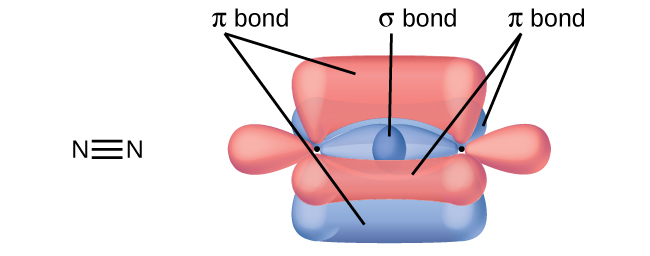
A friend tells you N2 has three π bonds due to overlap of the three p-orbitals on each N atom. Do you agree?
友人が「N2では、各N原子の三つのp軌道が重なるため、π結合が3本ある」と言った。この説明に賛成するか。


Exercise 8問題 8
Draw the Lewis structures for CO2 and CO, and predict the number of σ and π bonds for each molecule.
CO2とCOのルイス構造を描き、それぞれの分子のσ結合とπ結合の本数を予測しなさい。
(a) CO2
(a)CO2
(b) CO
(b)CO
overlap
重なり
coexistence of orbitals from two different atoms sharing the same region of space, leading to the formation of a covalent bond
異なる二原子の軌道が同じ空間領域を共有して存在すること。共有結合の形成につながる。
node
節
plane separating different lobes of orbitals, where the probability of finding an electron is zero
軌道の異なるローブを隔てる平面で、その面では電子が見つかる確率がゼロである。
pi bond (π bond)
パイ結合(π結合)
covalent bond formed by side-by-side overlap of atomic orbitals; the electron density is found on opposite sides of the internuclear axis
原子軌道が横に並んで重なることにより形成される共有結合。電子密度は、原子核を結ぶ軸の両側に分布する。
sigma bond (σ bond)
シグマ結合(σ結合)
covalent bond formed by overlap of atomic orbitals along the internuclear axis
原子核を結ぶ軸に沿った原子軌道の重なりによって形成される共有結合。
valence bond theory
原子価結合理論
description of bonding that involves atomic orbitals overlapping to form σ or π bonds, within which pairs of electrons are shared
英語のヒント
原子軌道が重なってσ結合またはπ結合を形成し、その中で電子対が共有されるという、結合の説明。