第8章共有結合の理論
sp3 Hybridizationsp3混成
The valence orbitals of an atom surrounded by a tetrahedral arrangement of bonding pairs and lone pairs consist of a set of four sp3 hybrid orbitals. The hybrids result from the mixing of one s orbital and all three p orbitals that produces four identical sp3 hybrid orbitals (Figure 8.15). Each of these hybrid orbitals points toward a different corner of a tetrahedron.
結合電子対と非共有電子対が四面体状に周囲に配置された原子の原子価軌道は、一組の四つのsp3混成軌道からなる。この混成は、一つのs軌道と三つすべてのp軌道が混ざり、四つの同一のsp3混成軌道を生じることによる(図8.15)。各混成軌道は、四面体の異なる頂点に向いている。
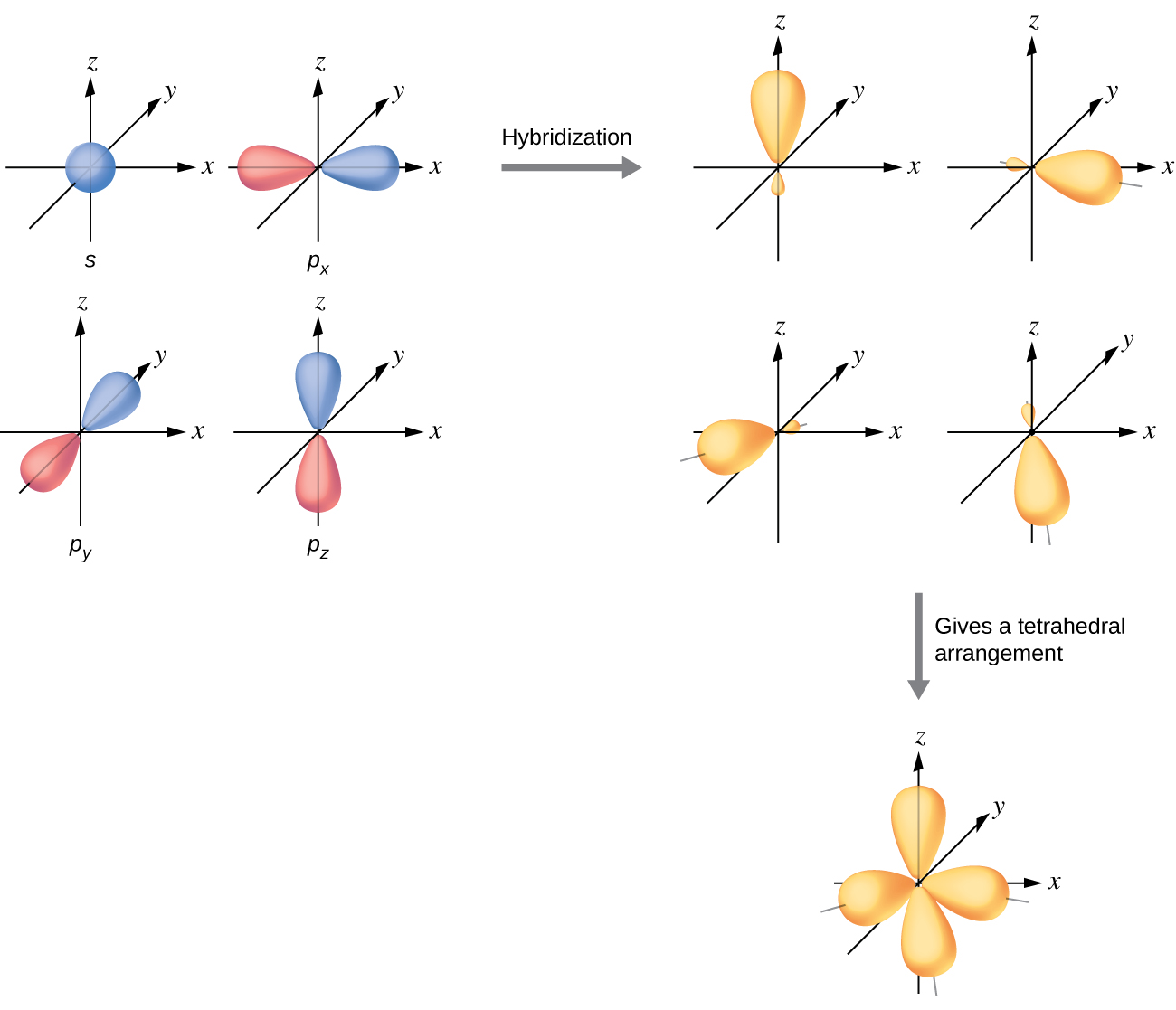
Figure 8.15図 8.15
The hybridization of an s orbital (blue) and three p orbitals (red) produces four equivalent sp3 hybridized orbitals (yellow) oriented at 109.5° with respect to each other.
一つのs軌道(青)と三つのp軌道(赤)の混成により、互いに109.5°の向きをとる四つの等価なsp3混成軌道(黄)が生じる。
A molecule of methane, CH4, consists of a carbon atom surrounded by four hydrogen atoms at the corners of a tetrahedron. The carbon atom in methane exhibits sp3 hybridization. We illustrate the orbitals and electron distribution in an isolated carbon atom and in the bonded atom in CH4 in Figure 8.16. The four valence electrons of the carbon atom are distributed equally in the hybrid orbitals, and each carbon electron pairs with a hydrogen electron when the C–H bonds form.
英語のヒント
メタンCH4の分子は、炭素原子を四つの水素原子が四面体の頂点で囲む構造をもつ。メタン中の炭素原子はsp3混成を示す。孤立した炭素原子と、CH4内で結合した原子の軌道および電子分布を図8.16に示す。炭素原子の四つの原子価電子は混成軌道に均等に分配され、C–H結合の形成時に各炭素電子が水素の電子と対を作る。
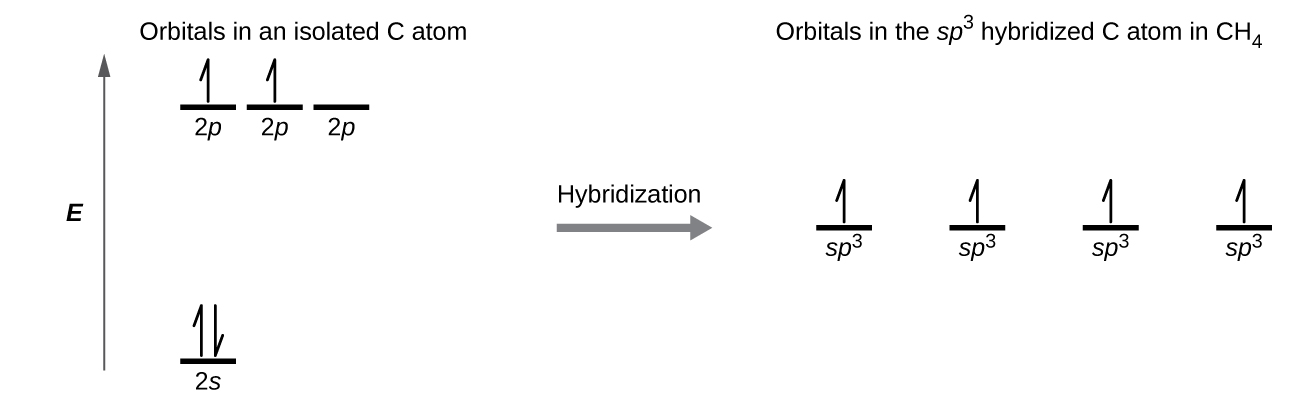
Figure 8.16図 8.16
The four valence atomic orbitals from an isolated carbon atom all hybridize when the carbon bonds in a molecule like CH4 with four regions of electron density. This creates four equivalent sp3 hybridized orbitals. Overlap of each of the hybrid orbitals with a hydrogen orbital creates a C–H σ bond.
炭素がCH4のように電子密度の領域を四つもつ分子内で結合すると、孤立した炭素原子の四つの原子価軌道はすべて混成する。その結果、四つの等価なsp3混成軌道が生じる。各混成軌道と水素の軌道との重なりが、C–Hのσ結合を形成する。
In a methane molecule, the 1s orbital of each of the four hydrogen atoms overlaps with one of the four sp3 orbitals of the carbon atom to form a sigma (σ) bond. This results in the formation of four strong, equivalent covalent bonds between the carbon atom and each of the hydrogen atoms to produce the methane molecule, CH4.
メタン分子では、四つの水素原子の1s軌道がそれぞれ炭素原子の四つのsp3軌道の一つと重なり、シグマ(σ)結合を形成する。その結果、炭素原子と各水素原子の間に四つの強く等価な共有結合が形成され、メタン分子CH4が生じる。
The structure of ethane, C2H6, is similar to that of methane in that each carbon in ethane has four neighboring atoms arranged at the corners of a tetrahedron—three hydrogen atoms and one carbon atom (Figure 8.17). However, in ethane an sp3 orbital of one carbon atom overlaps end to end with an sp3 orbital of a second carbon atom to form a σ bond between the two carbon atoms. Each of the remaining sp3 hybrid orbitals overlaps with an s orbital of a hydrogen atom to form carbon–hydrogen σ bonds. The structure and overall outline of the bonding orbitals of ethane are shown in Figure 8.17. The orientation of the two CH3 groups is not fixed relative to each other. Experimental evidence shows that rotation around σ bonds occurs easily.
英語のヒント
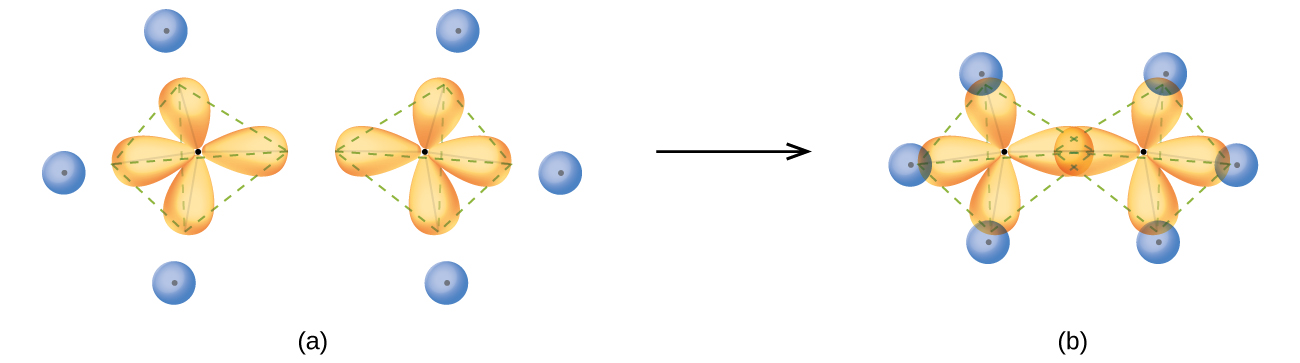
Figure 8.17図 8.17
(a) In the ethane molecule, C2H6, each carbon has four sp3 orbitals. (b) These four orbitals overlap to form seven σ bonds.
(a)エタン分子C2H6では、各炭素が四つのsp3軌道をもつ。(b)これら四つの軌道が重なり、7本のσ結合を形成する。
An sp3 hybrid orbital can also hold a lone pair of electrons. For example, the nitrogen atom in ammonia is surrounded by three bonding pairs and a lone pair of electrons directed to the four corners of a tetrahedron. The nitrogen atom is sp3 hybridized with one hybrid orbital occupied by the lone pair.
sp3混成軌道には非共有電子対が入ることもある。たとえばアンモニアの窒素原子は、四面体の四つの頂点に向く三つの結合電子対と一つの非共有電子対に囲まれている。窒素原子はsp3混成しており、一つの混成軌道を非共有電子対が占有している。
The molecular structure of water is consistent with a tetrahedral arrangement of two lone pairs and two bonding pairs of electrons. Thus we say that the oxygen atom is sp3 hybridized, with two of the hybrid orbitals occupied by lone pairs and two by bonding pairs. Since lone pairs occupy more space than bonding pairs, structures that contain lone pairs have bond angles slightly distorted from the ideal. Perfect tetrahedra have angles of 109.5°, but the observed angles in ammonia (107.3°) and water (104.5°) are slightly smaller. Other examples of sp3 hybridization include CCl4, PCl3, and NCl3.
英語のヒント
水の分子構造は、二つの非共有電子対と二つの結合電子対が四面体状に配置されることと一致する。そこで、酸素原子はsp3混成し、そのうち二つの混成軌道を非共有電子対が、残る二つを結合電子対が占有しているという。非共有電子対は結合電子対より広い空間を占めるため、非共有電子対を含む構造の結合角は、理想的な値からわずかにずれる。完全な四面体の角度は109.5°だが、アンモニアで観測される107.3°、水で観測される104.5°は、それよりやや小さい。sp3混成の他の例には、CCl4、PCl3、NCl3がある。
sp3d and sp3d2 Hybridizationsp3d混成とsp3d2混成
To describe the five bonding orbitals in a trigonal bipyramidal arrangement, we must use five of the valence shell atomic orbitals (the s orbital, the three p orbitals, and one of the d orbitals), which gives five sp3d hybrid orbitals. With an octahedral arrangement of six hybrid orbitals, we must use six valence shell atomic orbitals (the s orbital, the three p orbitals, and two of the d orbitals in its valence shell), which gives six sp3d2 hybrid orbitals. These hybridizations are only possible for atoms that have d orbitals in their valence subshells (that is, not those in the first or second period).
英語のヒント
三方両錐の配置をとる五つの結合軌道を記述するには、原子価殻の五つの原子軌道(s軌道、三つのp軌道、一つのd軌道)を用いる必要があり、それによって五つのsp3d混成軌道が得られる。六つの混成軌道が八面体状に配置される場合には、原子価殻の六つの原子軌道(s軌道、三つのp軌道、原子価殻の二つのd軌道)を用いる必要があり、六つのsp3d2混成軌道が得られる。これらの混成は、原子価殻の副殻にd軌道をもつ原子でのみ可能である(すなわち、第1周期と第2周期の原子では不可能である)。
In a molecule of phosphorus pentachloride, PCl5, there are five P–Cl bonds (thus five pairs of valence electrons around the phosphorus atom) directed toward the corners of a trigonal bipyramid. We use the 3s orbital, the three 3p orbitals, and one of the 3d orbitals to form the set of five sp3d hybrid orbitals (Figure 8.19) that are involved in the P–Cl bonds. Other atoms that exhibit sp3d hybridization include the sulfur atom in SF4 and the chlorine atoms in ClF3 and in (The electrons on fluorine atoms are omitted for clarity.)
五塩化リンPCl5の分子には、三方両錐の頂点へ向く五つのP–Cl結合がある(したがって、リン原子の周囲に原子価電子対が五つある)。3s軌道、三つの3p軌道、一つの3d軌道を用いて、P–Cl結合に関与する五つのsp3d混成軌道(図8.19)を形成する。sp3d混成を示す他の原子には、SF4の硫黄原子、ClF3およびの塩素原子がある。(見やすくするため、フッ素原子上の電子は省略している。)
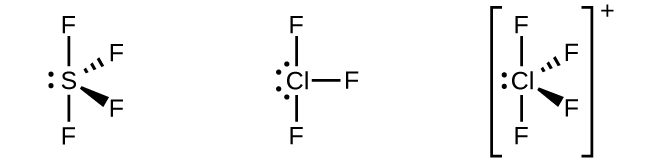
Figure 8.18図 8.18
The three compounds pictured exhibit sp3d hybridization in the central atom and a trigonal bipyramid form. SF4 and have one lone pair of electrons on the central atom, and ClF3 has two lone pairs giving it the T-shape shown.
図示した三つの化合物では中心原子がsp3d混成し、三方両錐の形をとる。SF4とでは中心原子に非共有電子対が一つある。ClF3には非共有電子対が二つあり、図のようなT字形になる。
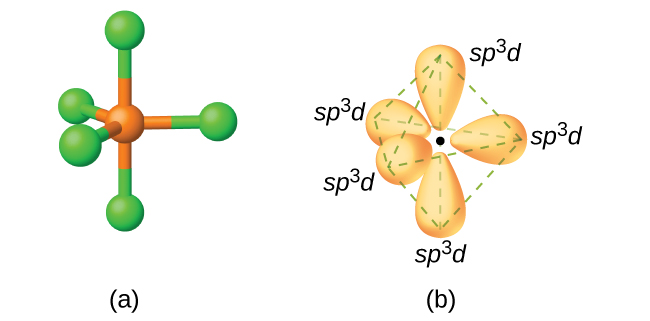
Figure 8.19図 8.19
(a) The five regions of electron density around phosphorus in PCl5 require five hybrid sp3d orbitals. (b) These orbitals combine to form a trigonal bipyramidal structure with each large lobe of the hybrid orbital pointing at a vertex. As before, there are also small lobes pointing in the opposite direction for each orbital (not shown for clarity).
英語のヒント
(a)PCl5のリンの周囲にある五つの電子密度の領域には、五つのsp3d混成軌道が必要である。(b)これらの軌道は、各混成軌道の大きなローブが頂点へ向く三方両錐構造を形成する。これまでと同様に、各軌道には逆向きに伸びる小さなローブもある(見やすくするため省略)。
The sulfur atom in sulfur hexafluoride, SF6, exhibits sp3d2 hybridization. A molecule of sulfur hexafluoride has six bonding pairs of electrons connecting six fluorine atoms to a single sulfur atom. There are no lone pairs of electrons on the central atom. To bond six fluorine atoms, the 3s orbital, the three 3p orbitals, and two of the 3d orbitals form six equivalent sp3d2 hybrid orbitals, each directed toward a different corner of an octahedron. Other atoms that exhibit sp3d2 hybridization include the phosphorus atom in the iodine atom in the interhalogens IF5, and the xenon atom in XeF4.
英語のヒント
六フッ化硫黄SF6の硫黄原子は、sp3d2混成を示す。六フッ化硫黄の分子には、六つのフッ素原子を一つの硫黄原子につなぐ六つの結合電子対がある。中心原子には非共有電子対はない。六つのフッ素原子と結合するため、3s軌道、三つの3p軌道、二つの3d軌道が、八面体の各頂点に向く六つの等価なsp3d2混成軌道を形成する。sp3d2混成を示す他の原子には、のリン原子、ハロゲン間化合物、IF5、、のヨウ素原子、およびXeF4のキセノン原子がある。
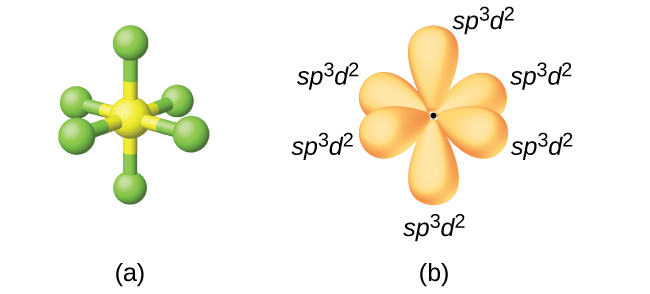


Figure 8.20図 8.20
(a) Sulfur hexafluoride, SF6, has an octahedral structure that requires sp3d2 hybridization. (b) The six sp3d2 orbitals form an octahedral structure around sulfur. Again, the minor lobe of each orbital is not shown for clarity.
(a)六フッ化硫黄SF6は、sp3d2混成を必要とする八面体構造をもつ。(b)六つのsp3d2軌道は、硫黄の周囲で八面体構造を形成する。ここでも、見やすくするため各軌道の小さなローブは省略している。