第8章共有結合の理論
8.1 Valence Bond Theory8.1 原子価結合理論
Learning Objectives学習目標
By the end of this section, you will be able to:
この節を学ぶと、次のことができるようになる。
- Describe the formation of covalent bonds in terms of atomic orbital overlap共有結合の形成を、原子軌道の重なりによって説明する
- Define and give examples of σ and π bondsσ結合とπ結合を定義し、例を挙げる
As we know, a scientific theory is a strongly supported explanation for observed natural laws or large bodies of experimental data. For a theory to be accepted, it must explain experimental data and be able to predict behavior. For example, VSEPR theory has gained widespread acceptance because it predicts three-dimensional molecular shapes that are consistent with experimental data collected for thousands of different molecules. However, VSEPR theory does not provide an explanation of chemical bonding.
英語のヒント
すでに知っているように、科学の理論とは、観察された自然法則や大量の実験データに対する、十分な裏付けのある説明である。理論が受け入れられるには、実験データを説明し、振る舞いを予測できなければならない。たとえばVSEPR理論が広く受け入れられているのは、何千種類もの分子について集められた実験データと一致する、三次元的な分子の形を予測するからである。しかし、VSEPR理論は化学結合そのものを説明してはいない。
There are successful theories that describe the electronic structure of atoms. We can use quantum mechanics to predict the specific regions around an atom where electrons are likely to be located: A spherical shape for an s orbital, a dumbbell shape for a p orbital, and so forth. However, these predictions only describe the orbitals around free atoms. When atoms bond to form molecules, atomic orbitals are not sufficient to describe the regions where electrons will be located in the molecule. A more complete understanding of electron distributions requires a model that can account for the electronic structure of molecules. One popular theory holds that a covalent bond forms when a pair of electrons is shared by two atoms and is simultaneously attracted by the nuclei of both atoms. In the following sections, we will discuss how such bonds are described by valence bond theory and hybridization.
英語のヒント
原子の電子構造をうまく説明する理論はいくつかある。量子力学を用いれば、原子の周囲で電子が存在しやすい領域を具体的に予測できる。s軌道なら球形、p軌道ならダンベル形、といった具合である。しかし、これらの予測が記述するのは、自由な原子の周囲の軌道だけである。原子が結合して分子を形成すると、分子内で電子が存在する領域を原子軌道だけで記述することはできない。電子の分布をより十分に理解するには、分子の電子構造を説明できるモデルが必要である。よく知られた理論の一つでは、電子対が二つの原子に共有され、同時に両原子の原子核に引き寄せられるときに、共有結合が形成されると考える。以下の節では、そのような結合が原子価結合理論と混成によってどのように記述されるかを論じる。
Valence bond theory describes a covalent bond as the overlap of half-filled atomic orbitals (each containing a single electron) that yield a pair of electrons shared between the two bonded atoms. We say that orbitals on two different atoms overlap when a portion of one orbital and a portion of a second orbital occupy the same region of space. According to valence bond theory, a covalent bond results when two conditions are met: (1) an orbital on one atom overlaps an orbital on a second atom and (2) the single electrons in each orbital combine to form an electron pair. The mutual attraction between this negatively charged electron pair and the two atoms’ positively charged nuclei serves to physically link the two atoms through a force we define as a covalent bond. The strength of a covalent bond depends on the extent of overlap of the orbitals involved. Orbitals that overlap extensively form bonds that are stronger than those that have less overlap.
英語のヒント
原子価結合理論は、共有結合を、半分だけ占有された原子軌道(それぞれに電子が一つ入っている)が重なり、結合した二原子の間で共有される電子対が生じることとして説明する。異なる二原子の軌道について、一方の軌道の一部と他方の軌道の一部が同じ空間領域を占めるとき、軌道が重なるという。原子価結合理論によれば、(1)一方の原子の軌道が他方の原子の軌道と重なること、(2)各軌道に一つずつある電子が組になって電子対を形成すること、という二条件が満たされると共有結合が生じる。この負に帯電した電子対と、二原子の正に帯電した原子核との間の相互の引力が、共有結合と定義される力によって二原子を物理的につなぐ。共有結合の強さは、関与する軌道の重なりの程度に依存する。大きく重なる軌道は、重なりの小さい軌道よりも強い結合を形成する。
The energy of the system depends on how much the orbitals overlap. Figure 8.2 illustrates how the sum of the energies of two hydrogen atoms (the colored curve) changes as they approach each other. When the atoms are far apart there is no overlap, and by convention we set the sum of the energies at zero. As the atoms move together, their orbitals begin to overlap. Each electron begins to feel the attraction of the nucleus in the other atom. In addition, the electrons begin to repel each other, as do the nuclei. While the atoms are still widely separated, the attractions are slightly stronger than the repulsions, and the energy of the system decreases. (A bond begins to form.) As the atoms move closer together, the overlap increases, so the attraction of the nuclei for the electrons continues to increase (as do the repulsions among electrons and between the nuclei). At some specific distance between the atoms, which varies depending on the atoms involved, the energy reaches its lowest (most stable) value. This optimum distance between the two bonded nuclei is the bond distance between the two atoms. The bond is stable because at this point, the attractive and repulsive forces combine to create the lowest possible energy configuration. If the distance between the nuclei were to decrease further, the repulsions between nuclei and the repulsions as electrons are confined in closer proximity to each other would become stronger than the attractive forces. The energy of the system would then rise (making the system destabilized), as shown at the far left of Figure 8.2.
英語のヒント
系のエネルギーは軌道がどれほど重なるかに依存する。図8.2は、二つの水素原子が互いに近づくとき、それらのエネルギーの和(色付きの曲線)がどのように変わるかを示す。原子が遠く離れていれば重なりはなく、慣例としてエネルギーの和をゼロとする。原子が近づくと、軌道が重なり始める。それぞれの電子は、他方の原子の原子核からの引力を感じ始める。同時に、電子どうしは反発し始め、原子核どうしも同様に反発する。原子がまだ十分に離れている間は、引力が反発力よりわずかに強く、系のエネルギーは減少する。(結合が形成され始める。)原子がさらに近づくと重なりが増すため、原子核が電子に及ぼす引力は増大し続ける(電子間および原子核間の反発力も増大する)。原子間のある特定の距離で、エネルギーは最小の(最も安定な)値に達する。この距離は関与する原子によって異なる。結合した二つの原子核の間のこの最適な距離が、二原子間の結合距離である。この点では引力と反発力が合わさって、可能な限り低いエネルギーの配置が生じるため、結合は安定である。もし原子核間の距離がさらに小さくなると、原子核間の反発と、電子が互いにいっそう近くへ閉じ込められることによる反発が、引力より強くなる。その結果、図8.2の左端に示すように、系のエネルギーは上昇する(系は不安定化する)。
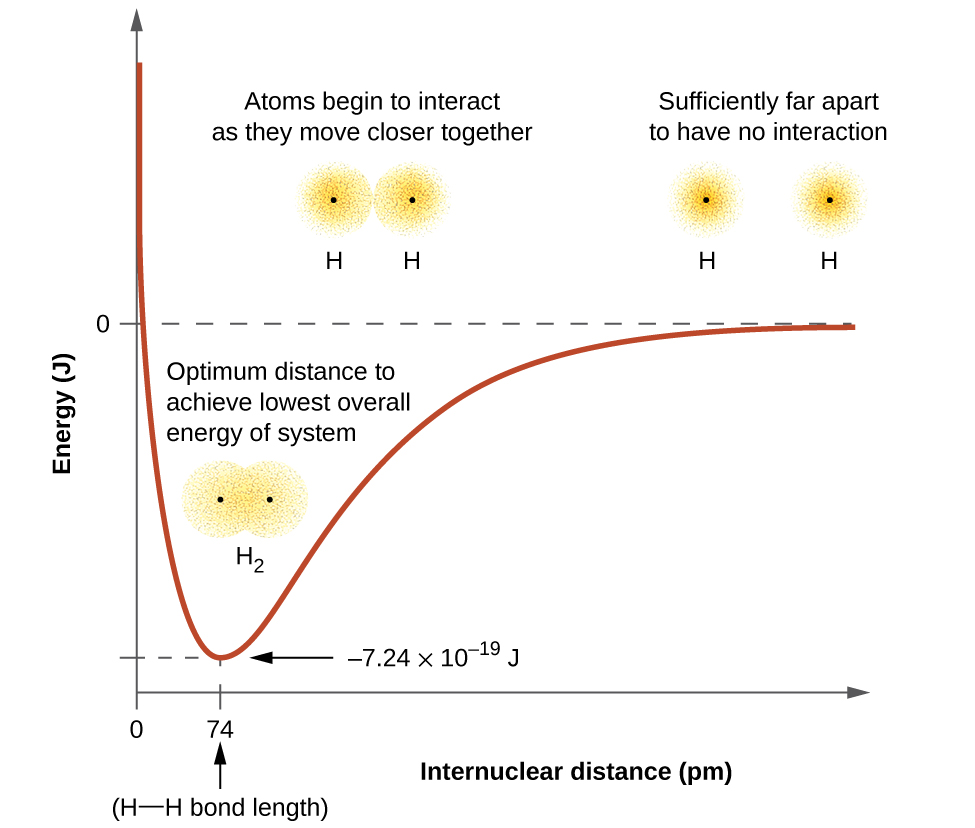
Figure 8.2図 8.2
(a) The interaction of two hydrogen atoms changes as a function of distance. (b) The energy of the system changes as the atoms interact. The lowest (most stable) energy occurs at a distance of 74 pm, which is the bond length observed for the H2 molecule.
英語のヒント
(a)二つの水素原子の相互作用は距離に応じて変化する。(b)原子が相互作用すると、系のエネルギーが変化する。エネルギーが最小となる(最も安定になる)距離は74 pmであり、これはH2分子で観測される結合長である。
The bond energy is the difference between the energy minimum (which occurs at the bond distance) and the energy of the two separated atoms. This is the quantity of energy released when the bond is formed. Conversely, the same amount of energy is required to break the bond. For the H2 molecule shown in Figure 8.2, at the bond distance of 74 pm the system is 7.24 10−19 J lower in energy than the two separated hydrogen atoms. This may seem like a small number. However, we know from our earlier description of thermochemistry that bond energies are often discussed on a per-mole basis. For example, it requires 7.24 10−19 J to break one H–H bond, but it takes 4.36 105 J to break 1 mole of H–H bonds. A comparison of some bond lengths and energies is shown in Table 8.1. We can find many of these bonds in a variety of molecules, and this table provides average values. For example, breaking the first C–H bond in CH4 requires 439.3 kJ/mol, while breaking the first C–H bond in H–CH2C6H5 (a common paint thinner) requires 375.5 kJ/mol.
英語のヒント
結合エネルギーは、エネルギーの最小値(結合距離でとる値)と、離れた二原子のエネルギーとの差である。これは結合が形成されるときに放出されるエネルギーの量である。逆に、結合を切断するには同じ量のエネルギーが必要となる。図8.2のH2分子では、結合距離74 pmにおける系のエネルギーは、離れた二つの水素原子より7.24 10−19 J低い。これは小さな値に見えるかもしれない。しかし、前に熱化学で述べたように、結合エネルギーは1モルあたりで論じられることが多い。たとえば、H–H結合を1本切断するには7.24 10−19 Jが必要だが、H–H結合を1モル切断するには4.36 105 Jが必要となる。いくつかの結合の長さとエネルギーを表8.1に比較している。これらの結合の多くはさまざまな分子に見られ、表の数値は平均値である。たとえばCH4の最初のC–H結合の切断には439.3 kJ/molが必要だが、H–CH2C6H5(よく使われる塗料用シンナー)の最初のC–H結合の切断には375.5 kJ/molが必要である。
Representative Bond Energies and Lengths 代表的な結合のエネルギーと長さ |
|||||
|---|---|---|---|---|---|
Bond 結合 |
Length (pm) 長さ(pm) |
Energy (kJ/mol) エネルギー(kJ/mol) |
Bond 結合 |
Length (pm) 長さ(pm) |
Energy (kJ/mol) エネルギー(kJ/mol) |
H–H |
74 |
436 |
C–O |
140.1 |
358 |
H–C |
106.8 |
413 |
119.7 |
745 |
|
H–N |
101.5 |
391 |
113.7 |
1072 |
|
H–O |
97.5 |
467 |
H–Cl |
127.5 |
431 |
C–C |
150.6 |
347 |
H–Br |
141.4 |
366 |
133.5 |
614 |
H–I |
160.9 |
298 |
|
120.8 |
839 |
O–O |
148 |
146 |
|
C–N |
142.1 |
305 |
120.8 |
498 |
|
130.0 |
615 |
F–F |
141.2 |
159 |
|
116.1 |
891 |
Cl–Cl |
198.8 |
243 |
|
In addition to the distance between two orbitals, the orientation of orbitals also affects their overlap (other than for two s orbitals, which are spherically symmetric). Greater overlap is possible when orbitals are oriented such that they overlap on a direct line between the two nuclei. Figure 8.3 illustrates this for two p orbitals from different atoms; the overlap is greater when the orbitals overlap end to end rather than at an angle.
英語のヒント
二つの軌道の間の距離に加えて、軌道の向きも重なりに影響する(球対称な二つのs軌道の場合を除く)。二つの原子核を直結する線上で重なる向きに軌道を配置すると、より大きな重なりが可能になる。図8.3は、異なる原子に属する二つのp軌道でこのことを示している。軌道は、互いに角度をなして重なるよりも、端と端を向かい合わせて重なるほうが、重なりが大きい。
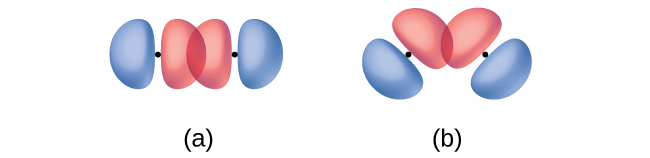
Figure 8.3図 8.3
(a) The overlap of two p orbitals is greatest when the orbitals are directed end to end. (b) Any other arrangement results in less overlap. The dots indicate the locations of the nuclei.
(a)二つのp軌道の重なりは、軌道の端と端を向かい合わせたときに最大になる。(b)それ以外の配置では重なりが小さくなる。点は原子核の位置を示す。
The overlap of two s orbitals (as in H2), the overlap of an s orbital and a p orbital (as in HCl), and the end-to-end overlap of two p orbitals (as in Cl2) all produce sigma bonds (σ bonds), as illustrated in Figure 8.4. A σ bond is a covalent bond in which the electron density is concentrated in the region along the internuclear axis; that is, a line between the nuclei would pass through the center of the overlap region. Single bonds in Lewis structures are described as σ bonds in valence bond theory.
英語のヒント
図8.4に示すように、二つのs軌道の重なり(H2の場合)、s軌道とp軌道の重なり(HClの場合)、二つのp軌道の端どうしの重なり(Cl2の場合)は、いずれもシグマ結合(σ結合)を生じる。σ結合は、原子核を結ぶ軸に沿った領域に電子密度が集中する共有結合である。つまり、原子核間を結ぶ線は重なりの領域の中心を通る。ルイス構造の単結合は、原子価結合理論ではσ結合として記述される。
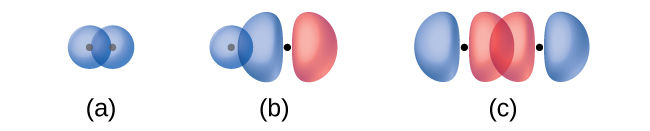
Figure 8.4図 8.4
Sigma (σ) bonds form from the overlap of the following: (a) two s orbitals, (b) an s orbital and a p orbital, and (c) two p orbitals. The dots indicate the locations of the nuclei.
シグマ(σ)結合は、(a)二つのs軌道、(b)s軌道とp軌道、(c)二つのp軌道の重なりによって形成される。点は原子核の位置を示す。
A pi bond (π bond) is a type of covalent bond that results from the side-by-side overlap of two p orbitals, as illustrated in Figure 8.5. In a π bond, the regions of orbital overlap lie on opposite sides of the internuclear axis. Along the axis itself, there is a node, that is, a plane with no probability of finding an electron.
英語のヒント
パイ結合(π結合)は、図8.5に示すように、二つのp軌道が横に並んで重なることによって生じる共有結合の一種である。π結合では、軌道の重なりの領域は、原子核を結ぶ軸を挟んで両側に位置する。軸そのものに沿っては節、すなわち電子が見つかる確率がゼロの平面がある。

Figure 8.5図 8.5
Pi (π) bonds form from the side-by-side overlap of two p orbitals. The dots indicate the location of the nuclei.
パイ(π)結合は、二つのp軌道が横に並んで重なることによって形成される。点は原子核の位置を示す。
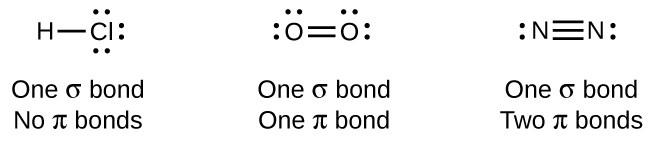
While all single bonds are σ bonds, multiple bonds consist of both σ and π bonds. As the Lewis structures below suggest, O2 contains a double bond, and N2 contains a triple bond. The double bond consists of one σ bond and one π bond, and the triple bond consists of one σ bond and two π bonds. Between any two atoms, the first bond formed will always be a σ bond, but there can only be one σ bond in any one location. In any multiple bond, there will be one σ bond, and the remaining one or two bonds will be π bonds. These bonds are described in more detail later in this chapter.
英語のヒント
単結合はすべてσ結合であるが、多重結合はσ結合とπ結合の両方からなる。以下のルイス構造が示すように、O2には二重結合があり、N2には三重結合がある。二重結合はσ結合1本とπ結合1本からなり、三重結合はσ結合1本とπ結合2本からなる。どの二原子の間でも、最初に形成される結合は必ずσ結合となるが、一つの場所にできるσ結合は1本だけである。どの多重結合にもσ結合が1本あり、残る1本または2本はπ結合となる。これらの結合は、この章の後半でさらに詳しく説明する。
As seen in Table 8.1, an average carbon-carbon single bond is 347 kJ/mol, while in a carbon-carbon double bond, the π bond increases the bond strength by 267 kJ/mol. Adding an additional π bond causes a further increase of 225 kJ/mol. We can see a similar pattern when we compare other σ and π bonds. Thus, each individual π bond is generally weaker than a corresponding σ bond between the same two atoms. In a σ bond, there is a greater degree of orbital overlap than in a π bond.
英語のヒント
表8.1に見られるように、炭素–炭素単結合の平均結合エネルギーは347 kJ/molである。一方、炭素–炭素二重結合では、π結合によって結合の強さが267 kJ/mol増す。さらにπ結合を1本加えると、225 kJ/mol増加する。他のσ結合とπ結合を比較しても、同様の傾向が見られる。したがって、個々のπ結合は一般に、同じ二原子間の対応するσ結合よりも弱い。σ結合では、π結合よりも軌道の重なりの程度が大きい。
Example 8.1例題 8.1
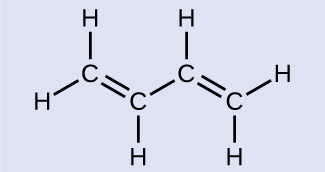
Butadiene, C4H6, is used to make synthetic rubber. Identify the number of σ and π bonds contained in this molecule.
英語のヒント
ブタジエンC4H6は合成ゴムの製造に使われる。この分子に含まれるσ結合とπ結合の本数を求めなさい。
Solution解法
There are six σ C–H bonds and one σ C–C bond, for a total of seven from the single bonds. There are two double bonds that each have a π bond in addition to the σ bond. This gives a total nine σ and two π bonds overall.
C–Hのσ結合が6本、C–Cのσ結合が1本あり、単結合から合計7本を数えられる。二重結合は2本あり、それぞれがσ結合に加えてπ結合を1本ずつもつ。したがって全体では、σ結合が合計9本、π結合が2本となる。
Check Your Learning理解を確かめよう
Identify each illustration as depicting a σ or π bond:
各図がσ結合とπ結合のどちらを表すか答えなさい。
(a) side-by-side overlap of a 4p and a 2p orbital
(a)4p軌道と2p軌道が横に並んで重なる
(b) end-to-end overlap of a 4p and 4p orbital
(b)4p軌道と4p軌道が端どうしで重なる
(c) end-to-end overlap of a 4p and a 2p orbital
(c)4p軌道と2p軌道が端どうしで重なる



