第8章共有結合の理論
The Diatomic Molecules of the Second Period第2周期の元素の二原子分子
Eight possible homonuclear diatomic molecules might be formed by the atoms of the second period of the periodic table: Li2, Be2, B2, C2, N2, O2, F2, and Ne2. However, we can predict that the Be2 molecule and the Ne2 molecule would not be stable. We can see this by a consideration of the molecular electron configurations (Table 8.3).
周期表の第2周期の原子からは、Li2、Be2、B2、C2、N2、O2、F2、Ne2という八つの等核二原子分子を考えられる。しかし、Be2分子とNe2分子は安定でないと予測できる。これは分子の電子配置を検討するとわかる(表8.3)。
We predict valence molecular orbital electron configurations just as we predict electron configurations of atoms. Valence electrons are assigned to valence molecular orbitals with the lowest possible energies. Consistent with Hund’s rule, whenever there are two or more degenerate molecular orbitals, electrons fill each orbital of that type singly before any pairing of electrons takes place.
原子価分子軌道の電子配置も、原子の電子配置と同じように予測する。原子価電子は、可能な限りエネルギーが低い原子価分子軌道へ割り当てる。フントの規則に従い、縮退した分子軌道が二つ以上あるときは、電子対ができる前に、その種類の各軌道に電子が一つずつ入る。
As we saw in valence bond theory, σ bonds are generally more stable than π bonds formed from degenerate atomic orbitals. Similarly, in molecular orbital theory, σ orbitals are usually more stable than π orbitals. However, this is not always the case. The MOs for the valence orbitals of the second period are shown in Figure 8.37. Looking at Ne2 molecular orbitals, we see that the order is consistent with the generic diagram shown in the previous section. However, for atoms with three or fewer electrons in the p orbitals (Li through N) we observe a different pattern, in which the σp orbital is higher in energy than the πp set. Obtain the molecular orbital diagram for a homonuclear diatomic ion by adding or subtracting electrons from the diagram for the neutral molecule.
英語のヒント
原子価結合理論で見たように、縮退した原子軌道からできる結合では、一般にσ結合はπ結合より安定である。同様に分子軌道理論でも、σ軌道は通常π軌道より安定である。しかし、いつもそうとは限らない。第2周期の原子価軌道に由来するMOを図8.37に示す。Ne2の分子軌道を見ると、その順序は前の節の一般的な図と一致している。しかし、p軌道の電子数が三つ以下の原子(LiからN)では異なる傾向が見られ、σp軌道のエネルギーが、一組のπp軌道より高くなる。等核二原子イオンの分子軌道図は、中性分子の図から電子を加えるか取り除くことで得られる。
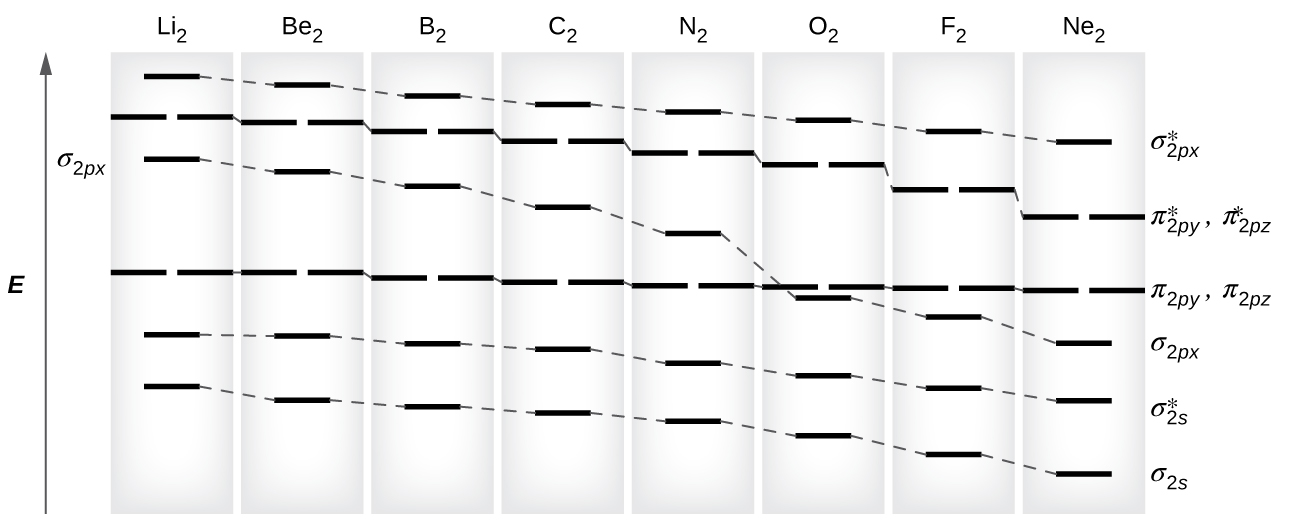
Figure 8.37図 8.37
This shows the MO diagrams for each homonuclear diatomic molecule in the second period. The orbital energies decrease across the period as the effective nuclear charge increases and atomic radius decreases. Between N2 and O2, the order of the orbitals changes.
英語のヒント
第2周期の各等核二原子分子のMO図。周期を右へ進むにつれ、有効核電荷が増加し原子半径が減少するので、軌道のエネルギーは低下する。N2とO2の間で軌道の順序が変わる。
This switch in orbital ordering occurs because of a phenomenon called s-p mixing. s-p mixing does not create new orbitals; it merely influences the energies of the existing molecular orbitals. The σs wavefunction mathematically combines with the σp wavefunction, with the result that the σs orbital becomes more stable, and the σp orbital becomes less stable (Figure 8.38). Similarly, the antibonding orbitals also undergo s-p mixing, with the σs* becoming more stable and the σp* becoming less stable.
英語のヒント
軌道順序のこの入れ替わりは、s–p混合と呼ばれる現象によって起こる。s–p混合は新たな軌道を作るのではなく、既存の分子軌道のエネルギーに影響するだけである。σsの波動関数がσpの波動関数と数学的に組み合わさり、その結果、σs軌道はより安定に、σp軌道はより不安定になる(図8.38)。同様に反結合性軌道もs–p混合を受け、σs*はより安定に、σp*はより不安定になる。
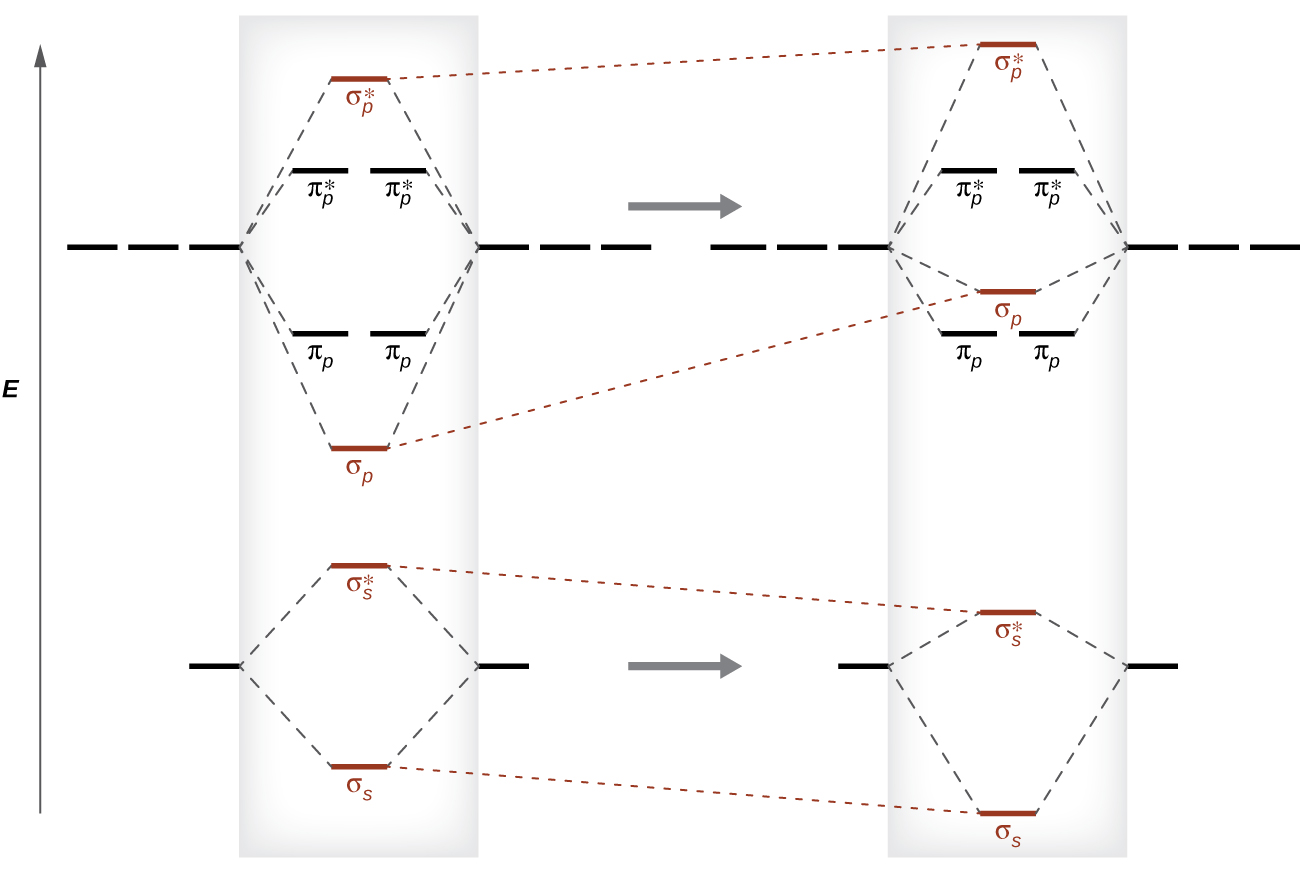
Figure 8.38図 8.38
Without mixing, the MO pattern occurs as expected, with the σp orbital lower in energy than the πp orbitals. When s-p mixing occurs, the orbitals shift as shown, with the σp orbital higher in energy than the πp orbitals.
混合がなければ、予想されるMOの並びとなり、σp軌道はπp軌道よりエネルギーが低い。s–p混合が起きると、図のように軌道が移動し、σp軌道はπp軌道よりエネルギーが高くなる。
s-p mixing occurs when the s and p orbitals have similar energies. The energy difference between 2s and 2p orbitals in O, F, and Ne is greater than that in Li, Be, B, C, and N. Because of this, O2, F2, and Ne2 exhibit negligible s-p mixing (not sufficient to change the energy ordering), and their MO diagrams follow the normal pattern, as shown in Figure 8.37. All of the other period 2 diatomic molecules do have s-p mixing, which leads to the pattern where the σp orbital is raised above the πp set.
英語のヒント
s–p混合は、s軌道とp軌道のエネルギーが近いときに起こる。O、F、Neの2s軌道と2p軌道のエネルギー差は、Li、Be、B、C、Nよりも大きい。そのため、O2、F2、Ne2のs–p混合は無視できるほど小さく(エネルギー順序を変えるほどではなく)、MO図は図8.37のように通常の並びとなる。他の第2周期二原子分子ではすべてs–p混合が起こり、σp軌道がπp軌道の組より上がる並びになる。
Using the MO diagrams shown in Figure 8.37, we can add in the electrons and determine the molecular electron configuration and bond order for each of the diatomic molecules. As shown in Table 8.3, Be2 and Ne2 molecules would have a bond order of 0, and these molecules do not exist.
Electron Configuration and Bond Order for Molecular Orbitals in Homonuclear Diatomic Molecules of Period Two Elements 第2周期元素の等核二原子分子における分子軌道の電子配置と結合次数 |
||
|---|---|---|
Molecule 分子 |
Electron Configuration 電子配置 |
Bond Order 結合次数 |
Li2 |
1 |
|
Be2 (unstable) Be2(不安定) |
0 |
|
B2 |
1 |
|
C2 |
2 |
|
N2 |
3 |
|
O2 |
2 |
|
F2 |
1 |
|
Ne2 (unstable) Ne2(不安定) |
0 |
|
The combination of two lithium atoms to form a lithium molecule, Li2, is analogous to the formation of H2, but the atomic orbitals involved are the valence 2s orbitals. Each of the two lithium atoms has one valence electron. Hence, we have two valence electrons available for the σ2s bonding molecular orbital. Because both valence electrons would be in a bonding orbital, we would predict the Li2 molecule to be stable. The molecule is, in fact, present in appreciable concentration in lithium vapor at temperatures near the boiling point of the element. All of the other molecules in Table 8.3 with a bond order greater than zero are also known.
英語のヒント
二つのリチウム原子が組み合わさりLi2分子を形成する過程は、H2の形成とよく似ているが、関与する原子軌道は原子価殻の2s軌道である。各リチウム原子は原子価電子を一つもつ。したがって、σ2s結合性分子軌道に入れられる原子価電子が二つある。どちらの原子価電子も結合性軌道に入るので、Li2分子は安定と予測される。実際、この分子は、リチウム単体の沸点近くの温度における蒸気中に、無視できない濃度で存在する。表8.3で結合次数がゼロより大きい他の分子も、すべて知られている。
The O2 molecule has enough electrons to half fill the level. We expect the two electrons that occupy these two degenerate orbitals to be unpaired, and this molecular electronic configuration for O2 is in accord with the fact that the oxygen molecule has two unpaired electrons (Figure 8.40). The presence of two unpaired electrons has proved to be difficult to explain using Lewis structures, but the molecular orbital theory explains it quite well. In fact, the unpaired electrons of the oxygen molecule provide a strong piece of support for the molecular orbital theory.
英語のヒント
O2分子には、準位を半分まで満たすだけの電子がある。この二つの縮退軌道を占有する二電子は、不対電子になると予測される。このO2の分子電子配置は、酸素分子に不対電子が二つあるという事実と一致する(図8.40)。二つの不対電子の存在をルイス構造で説明するのは難しかったが、分子軌道理論はこれを非常によく説明する。実際、酸素分子の不対電子は、分子軌道理論を強く裏付ける証拠となる。
Example 8.6例題 8.6
Molecular Orbital Diagrams, Bond Order, and Number of Unpaired Electrons分子軌道図、結合次数、不対電子数
Draw the molecular orbital diagram for the oxygen molecule, O2. From this diagram, calculate the bond order for O2. How does this diagram account for the paramagnetism of O2?
酸素分子O2の分子軌道図を描きなさい。その図からO2の結合次数を計算しなさい。この図はO2の常磁性をどのように説明するか。
Solution解法
We draw a molecular orbital energy diagram similar to that shown in Figure 8.37. Each oxygen atom contributes six electrons, so the diagram appears as shown in Figure 8.40.
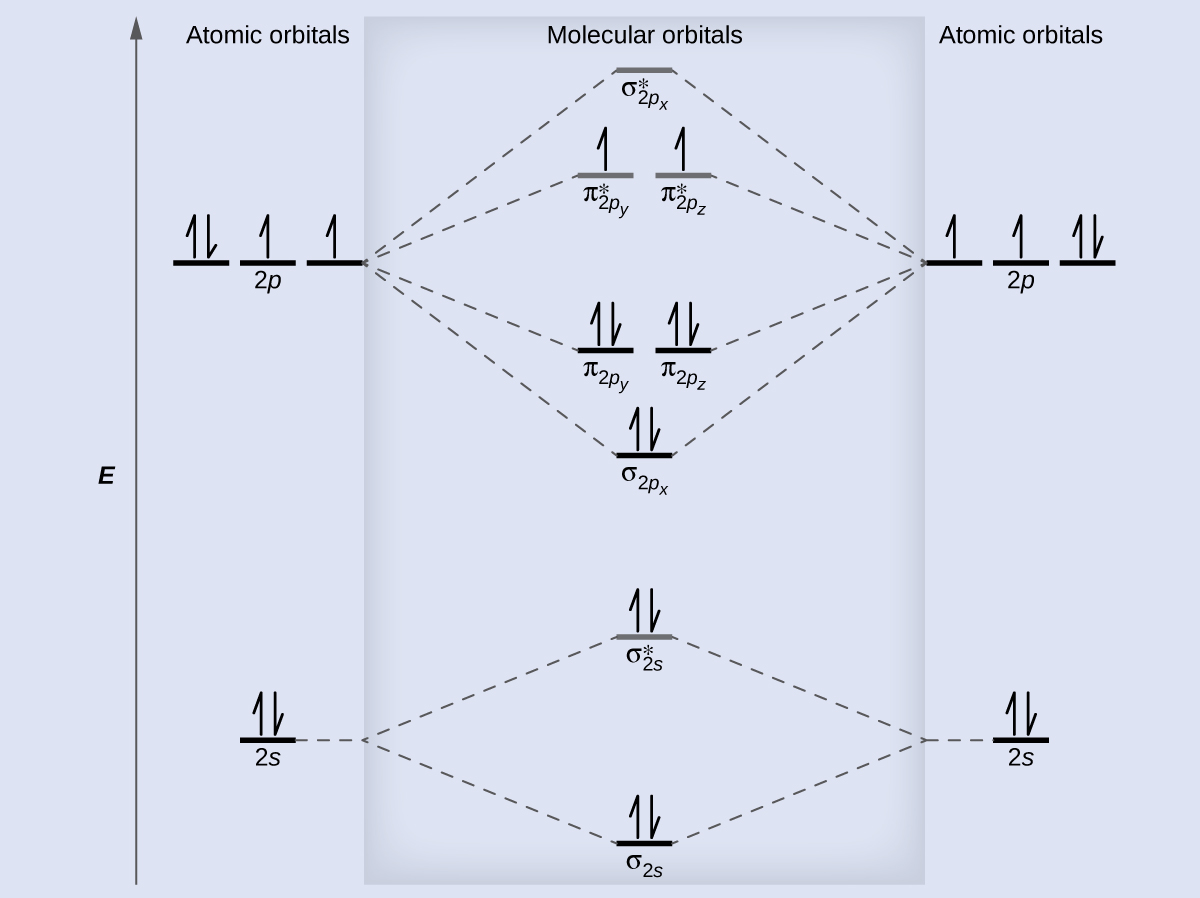


Figure 8.40図 8.40
The molecular orbital energy diagram for O2 predicts two unpaired electrons.
O2の分子軌道エネルギー図は、不対電子が二つあると予測する。
We calculate the bond order as
結合次数は次のように計算する。
Oxygen's paramagnetism is explained by the presence of two unpaired electrons in the (π2py, π2pz)* molecular orbitals.
酸素の常磁性は、(π2py、π2pz)*分子軌道に二つの不対電子があることによって説明される。
Check Your Learning理解を確かめよう
The main component of air is N2. From the molecular orbital diagram of N2, predict its bond order and whether it is diamagnetic or paramagnetic.
空気の主成分はN2である。N2の分子軌道図から、結合次数と、反磁性か常磁性かを予測しなさい。
Example 8.7例題 8.7
Ion Predictions with MO DiagramsMO図によるイオンの予測
Give the molecular orbital configuration for the valence electrons in Will this ion be stable?
の原子価電子の分子軌道配置を答えなさい。このイオンは安定か。
Solution解法
Looking at the appropriate MO diagram, we see that the π orbitals are lower in energy than the σp orbital. The valence electron configuration for C2 is Adding two more electrons to generate the anion will give a valence electron configuration of Since this has six more bonding electrons than antibonding, the bond order will be 3, and the ion should be stable.
英語のヒント
対応するMO図を見ると、π軌道はσp軌道よりエネルギーが低い。C2の原子価電子配置はである。電子をさらに二つ加えて陰イオンを作ると、原子価電子配置はとなる。結合性電子が反結合性電子より六つ多いので、結合次数は3となり、このイオンは安定であるはずである。
Check Your Learning理解を確かめよう
How many unpaired electrons would be present on a ion? Would it be paramagnetic or diamagnetic?
イオンには不対電子がいくつあるか。常磁性か、反磁性か。