第8章共有結合の理論
sp Hybridizationsp混成
The beryllium atom in a gaseous BeCl2 molecule is an example of a central atom with no lone pairs of electrons in a linear arrangement of three atoms. There are two regions of valence electron density in the BeCl2 molecule that correspond to the two covalent Be–Cl bonds. To accommodate these two electron domains, two of the Be atom’s four valence orbitals will mix to yield two hybrid orbitals. This hybridization process involves mixing of the valence s orbital with one of the valence p orbitals to yield two equivalent sp hybrid orbitals that are oriented in a linear geometry (Figure 8.8). In this figure, the set of sp orbitals appears similar in shape to the original p orbital, but there is an important difference. The number of atomic orbitals combined always equals the number of hybrid orbitals formed. The p orbital is one orbital that can hold up to two electrons. The sp set is two equivalent orbitals that point 180° from each other. The two electrons that were originally in the s orbital are now distributed to the two sp orbitals, which are half filled. In gaseous BeCl2, these half-filled hybrid orbitals will overlap with orbitals from the chlorine atoms to form two identical σ bonds.
英語のヒント
気体のBeCl2分子のベリリウム原子は、三原子が直線状に並び、中心原子に非共有電子対がない場合の例である。BeCl2分子には、二つの共有結合Be–Clに対応する二つの原子価電子密度の領域がある。この二つの電子領域を収めるため、Be原子の四つの原子価軌道のうち二つが混ざり合い、二つの混成軌道を生じる。この混成では、原子価殻のs軌道と一つのp軌道が混ざり合い、直線状に向く二つの等価なsp混成軌道が生じる(図8.8)。図では一組のsp軌道の形が元のp軌道と似て見えるが、重要な違いがある。組み合わせる原子軌道の数は、形成される混成軌道の数と必ず等しい。p軌道は、電子を最大2個収められる一つの軌道である。一組のsp軌道は、互いに180°反対の方向を向く二つの等価な軌道である。もともとs軌道にあった二つの電子は、今では二つのsp軌道に分かれて入り、各軌道は半分だけ占有されている。気体のBeCl2では、これらの半占有の混成軌道が塩素原子の軌道と重なり、同一のσ結合を2本形成する。
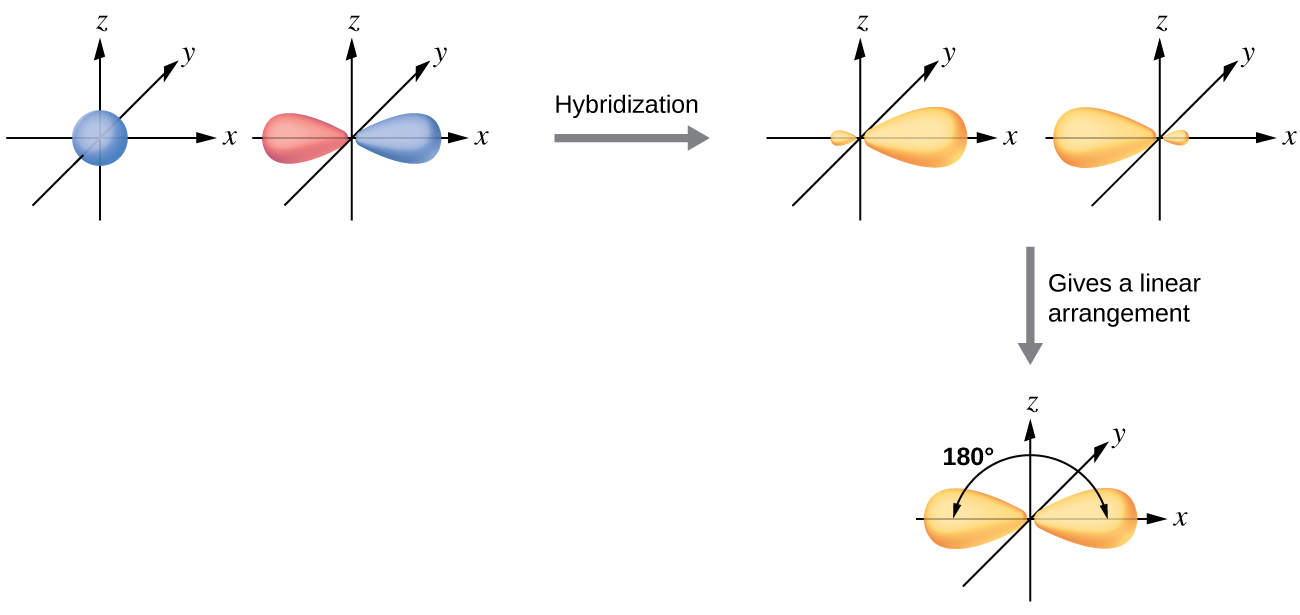
Figure 8.8図 8.8
Hybridization of an s orbital (blue) and a p orbital (red) of the same atom produces two sp hybrid orbitals (yellow). Each hybrid orbital is oriented primarily in just one direction. Note that each sp orbital contains one lobe that is significantly larger than the other. The set of two sp orbitals are oriented at 180°, which is consistent with the geometry for two domains.
英語のヒント
同一原子のs軌道(青)とp軌道(赤)の混成により、二つのsp混成軌道(黄)が生じる。各混成軌道は、主として一つの方向だけに向く。各sp軌道では、一方のローブが他方より著しく大きいことに注意しよう。二つのsp軌道は180°の向きをとり、二領域の場合の幾何学的配置と一致する。
We illustrate the electronic differences in an isolated Be atom and in the bonded Be atom in the orbital energy-level diagram in Figure 8.9. These diagrams represent each orbital by a horizontal line (indicating its energy) and each electron by an arrow. Energy increases toward the top of the diagram. We use one upward arrow to indicate one electron in an orbital and two arrows (up and down) to indicate two electrons of opposite spin.
英語のヒント
孤立したBe原子と、結合しているBe原子の電子の状態の違いを、図8.9の軌道エネルギー準位図に示す。この図では各軌道を水平線(そのエネルギーを示す)で、各電子を矢印で表す。エネルギーは上に行くほど高くなる。軌道内の電子1個を上向き矢印1本で示し、スピンが逆向きの電子2個を上下の矢印2本で示す。
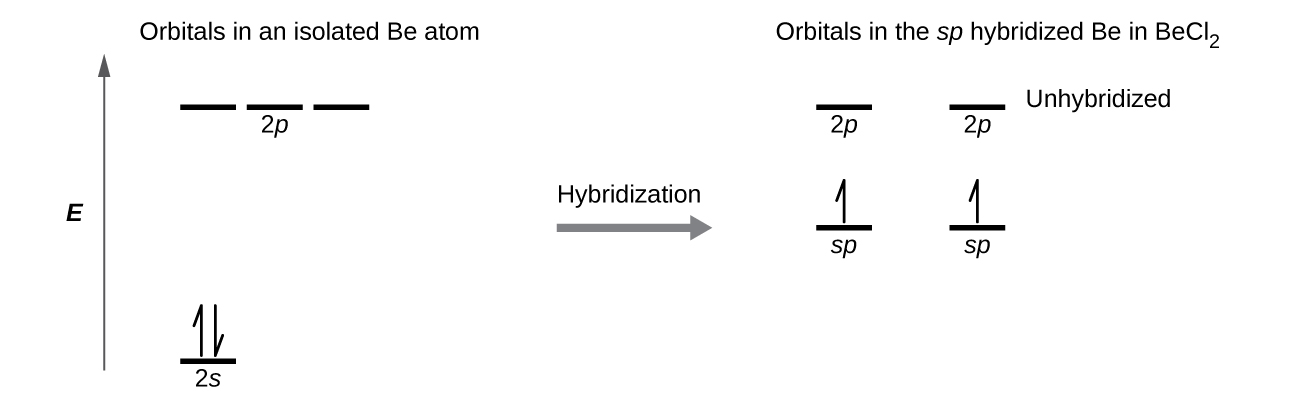
Figure 8.9図 8.9
This orbital energy-level diagram shows the sp hybridized orbitals on Be in the linear BeCl2 molecule. Each of the two sp hybrid orbitals holds one electron and is thus half filled and available for bonding via overlap with a Cl 3p orbital.
英語のヒント
この軌道エネルギー準位図は、直線形のBeCl2分子におけるBeのsp混成軌道を示す。二つのsp混成軌道にはそれぞれ電子が1個入り、半分だけ占有されているので、Clの3p軌道との重なりによって結合に参加できる。
When atomic orbitals hybridize, the valence electrons occupy the newly created orbitals. The Be atom had two valence electrons, so each of the sp orbitals gets one of these electrons. Each of these electrons pairs up with the unpaired electron on a chlorine atom when a hybrid orbital and a chlorine orbital overlap during the formation of the Be–Cl bonds.
英語のヒント
原子軌道が混成すると、原子価電子は新しくできた軌道を占有する。Be原子には原子価電子が2個あったので、各sp軌道にはその電子が1個ずつ入る。Be–Cl結合が形成される際、混成軌道と塩素の軌道が重なると、それぞれの電子が塩素原子上の不対電子と対を作る。
Any central atom surrounded by just two regions of valence electron density in a molecule will exhibit sp hybridization. Other examples include the mercury atom in the linear HgCl2 molecule, the zinc atom in Zn(CH3)2, which contains a linear C–Zn–C arrangement, and the carbon atoms in HCCH and CO2.
分子内で原子価電子密度の領域が二つだけ周囲にある中心原子は、いずれもsp混成を示す。他の例には、直線形のHgCl2分子の水銀原子、C–Zn–Cが直線状に並ぶZn(CH3)2の亜鉛原子、HCCHやCO2の炭素原子がある。
sp2 Hybridizationsp2混成
The valence orbitals of a central atom surrounded by three regions of electron density consist of a set of three sp2 hybrid orbitals and one unhybridized p orbital. This arrangement results from sp2 hybridization, the mixing of one s orbital and two p orbitals to produce three identical hybrid orbitals oriented in a trigonal planar geometry (Figure 8.10).
英語のヒント
三つの電子密度の領域に囲まれた中心原子の原子価軌道は、一組の三つのsp2混成軌道と、一つの混成していないp軌道からなる。この配置はsp2混成によって生じる。これは一つのs軌道と二つのp軌道を混ぜ合わせ、平面三角形の配置をとる三つの同一の混成軌道を作ることである(図8.10)。
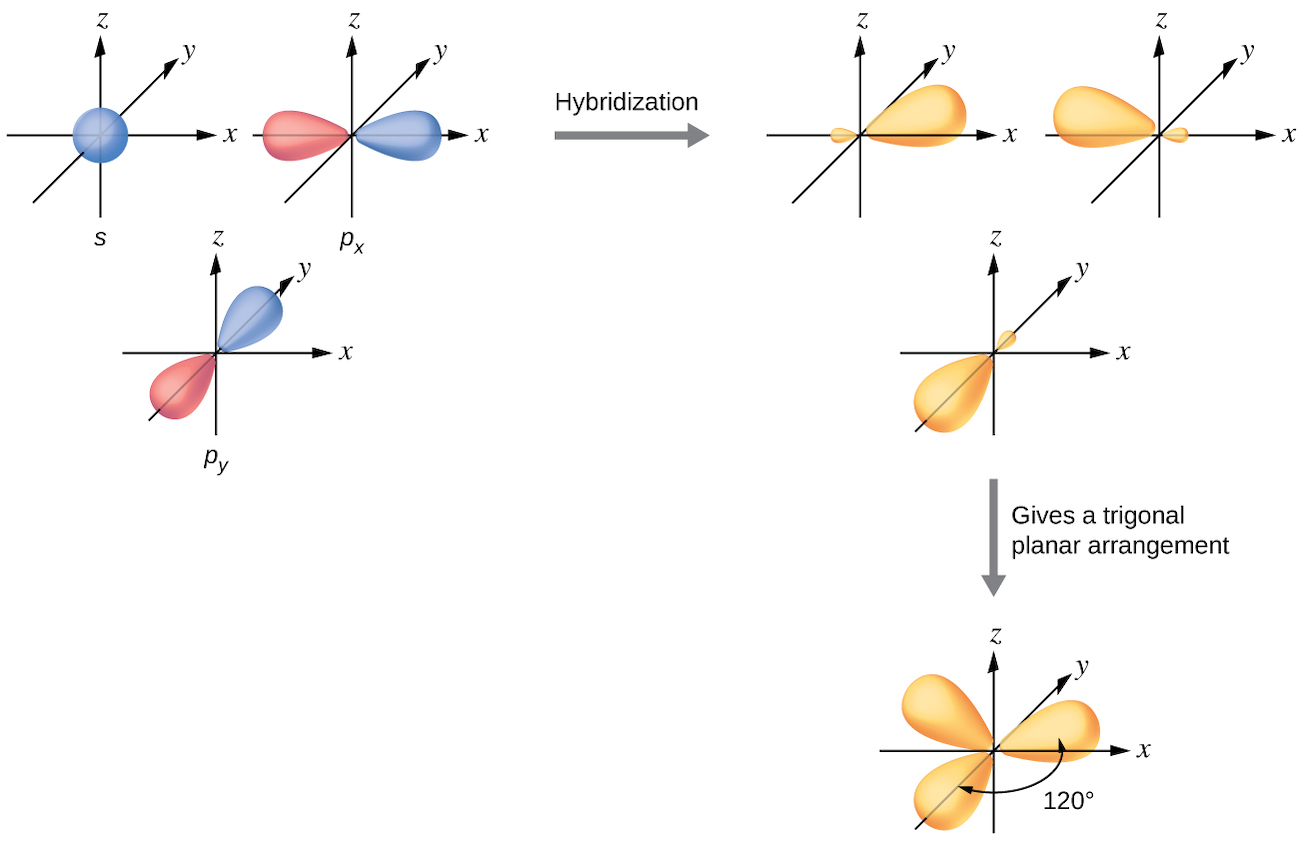
Figure 8.10図 8.10
The hybridization of an s orbital (blue) and two p orbitals (red) produces three equivalent sp2 hybridized orbitals (yellow) oriented at 120° with respect to each other. The remaining unhybridized p orbital is not shown here, but is located along the z axis.
英語のヒント
一つのs軌道(青)と二つのp軌道(赤)の混成により、互いに120°の向きをとる三つの等価なsp2混成軌道(黄)が生じる。残る混成していないp軌道はここには描かれていないが、z軸に沿って位置する。
Although quantum mechanics yields the “plump” orbital lobes as depicted in Figure 8.10, sometimes for clarity these orbitals are drawn thinner and without the minor lobes, as in Figure 8.11, to avoid obscuring other features of a given illustration. We will use these “thinner” representations whenever the true view is too crowded to easily visualize.
英語のヒント
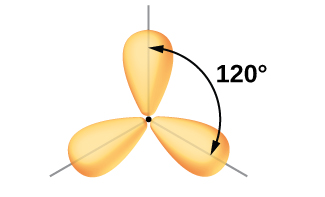
Figure 8.11図 8.11
This alternate way of drawing the trigonal planar sp2 hybrid orbitals is sometimes used in more crowded figures.
平面三角形のsp2混成軌道を示すこの別の描き方は、込み入った図で使うことがある。
The observed structure of the borane molecule, BH3, suggests sp2 hybridization for boron in this compound. The molecule is trigonal planar, and the boron atom is involved in three bonds to hydrogen atoms (Figure 8.12). We can illustrate the comparison of orbitals and electron distribution in an isolated boron atom and in the bonded atom in BH3 as shown in the orbital energy level diagram in Figure 8.13. We redistribute the three valence electrons of the boron atom in the three sp2 hybrid orbitals, and each boron electron pairs with a hydrogen electron when B–H bonds form.
英語のヒント
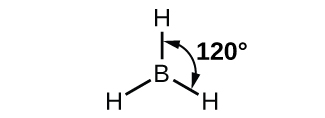
Figure 8.12図 8.12
BH3 is an electron-deficient molecule with a trigonal planar structure.
英語のヒント
BH3は、平面三角形構造をもつ電子不足の分子である。
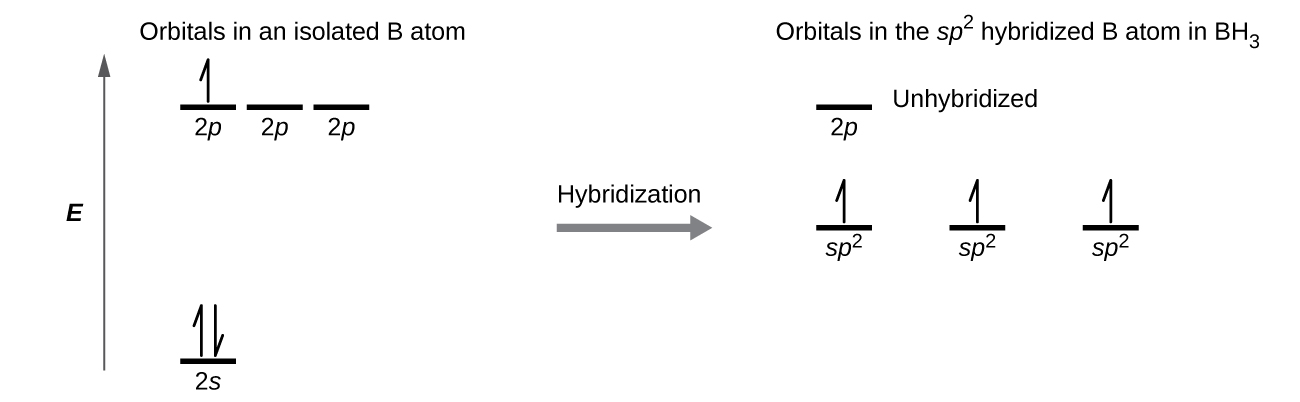
Figure 8.13図 8.13
In an isolated B atom, there are one 2s and three 2p valence orbitals. When boron is in a molecule with three regions of electron density, three of the orbitals hybridize and create a set of three sp2 orbitals and one unhybridized 2p orbital. The three half-filled hybrid orbitals each overlap with an orbital from a hydrogen atom to form three σ bonds in BH3.
孤立したB原子の原子価軌道は、一つの2s軌道と三つの2p軌道である。分子内でホウ素の周囲に三つの電子密度の領域がある場合、三つの軌道が混成し、一組の三つのsp2軌道と一つの混成していない2p軌道を生じる。半分だけ占有された三つの混成軌道が、それぞれ水素原子の軌道と重なり、BH3中で三つのσ結合を形成する。
Any central atom surrounded by three regions of electron density will exhibit sp2 hybridization. This includes molecules with a lone pair on the central atom, such as ClNO (Figure 8.14), or molecules with two single bonds and a double bond connected to the central atom, as in formaldehyde, CH2O, and ethene, H2CCH2.
三つの電子密度の領域に囲まれた中心原子は、いずれもsp2混成を示す。これにはClNO(図8.14)のように中心原子に非共有電子対をもつ分子や、ホルムアルデヒドCH2OおよびエテンH2CCH2のように、中心原子に二つの単結合と一つの二重結合がつながる分子が含まれる。
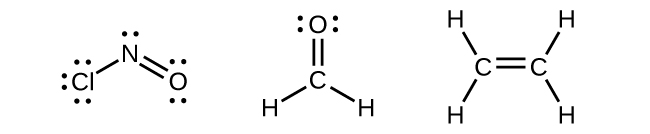


Figure 8.14図 8.14
The central atom(s) in each of the structures shown contain three regions of electron density and are sp2 hybridized. As we know from the discussion of VSEPR theory, a region of electron density contains all of the electrons that point in one direction. A lone pair, an unpaired electron, a single bond, or a multiple bond would each count as one region of electron density.
示した各構造の中心原子は、三つの電子密度の領域をもち、sp2混成している。VSEPR理論の説明からわかるように、一つの電子密度の領域には、一つの方向を向くすべての電子が含まれる。非共有電子対、不対電子、単結合、多重結合は、それぞれ一つの電子密度の領域として数える。