第8章共有結合の理論
Assignment of Hybrid Orbitals to Central Atoms中心原子の混成軌道を決める
The hybridization of an atom is determined based on the number of regions of electron density that surround it. The geometrical arrangements characteristic of the various sets of hybrid orbitals are shown in Figure 8.21. These arrangements are identical to those of the electron-pair geometries predicted by VSEPR theory. VSEPR theory predicts the shapes of molecules, and hybrid orbital theory provides an explanation for how those shapes are formed. To find the hybridization of a central atom, we can use the following guidelines:
英語のヒント
原子の混成は、その周囲にある電子密度の領域の数から決まる。各種の混成軌道の組に特徴的な幾何学的配置を図8.21に示す。これらの配置は、VSEPR理論が予測する電子対の配置と同じである。VSEPR理論は分子の形を予測し、混成軌道理論はその形がどのように生じるかを説明する。中心原子の混成を調べるには、次の手順を用いることができる。
- Determine the Lewis structure of the molecule.分子のルイス構造を求める。
- Determine the number of regions of electron density around an atom using VSEPR theory, in which single bonds, multiple bonds, radicals, and lone pairs each count as one region.VSEPR理論を用いて、原子の周囲にある電子密度の領域の数を求める。この際、単結合、多重結合、ラジカル、非共有電子対を、それぞれ一つの領域として数える。
- Assign the set of hybridized orbitals from Figure 8.21 that corresponds to this geometry.この配置に対応する混成軌道の組を、図8.21から割り当てる。
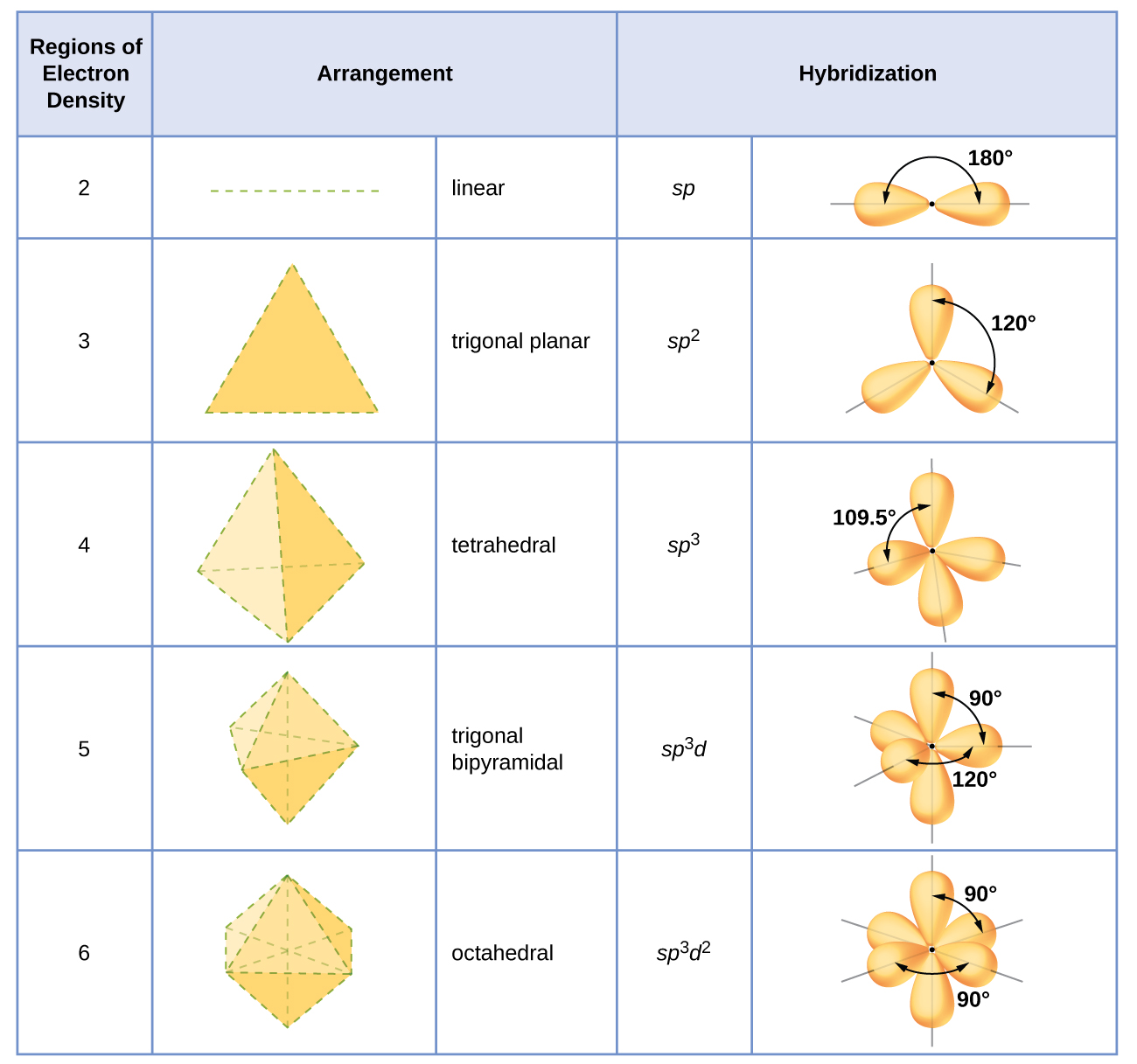
Figure 8.21図 8.21
The shapes of hybridized orbital sets are consistent with the electron-pair geometries. For example, an atom surrounded by three regions of electron density is sp2 hybridized, and the three sp2 orbitals are arranged in a trigonal planar fashion.
混成軌道の組の形は、電子対の幾何学的配置と一致する。たとえば、電子密度の三つの領域に囲まれた原子はsp2混成しており、三つのsp2軌道は平面三角形に配置される。
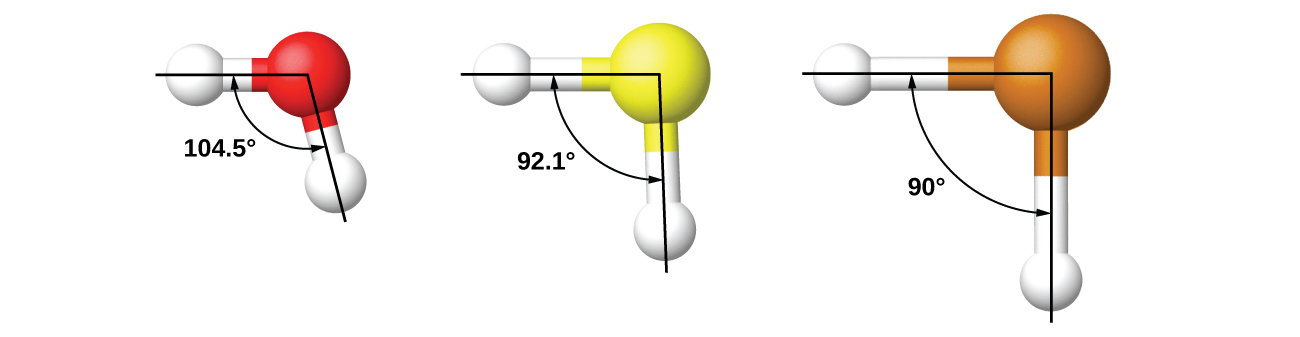
It is important to remember that hybridization was devised to rationalize experimentally observed molecular geometries. The model works well for molecules containing small central atoms, in which the valence electron pairs are close together in space. However, for larger central atoms, the valence-shell electron pairs are farther from the nucleus, and there are fewer repulsions. Their compounds exhibit structures that are often not consistent with VSEPR theory, and hybridized orbitals are not necessary to explain the observed data. For example, we have discussed the H–O–H bond angle in H2O, 104.5°, which is more consistent with sp3 hybrid orbitals (109.5°) on the central atom than with 2p orbitals (90°). Sulfur is in the same group as oxygen, and H2S has a similar Lewis structure. However, it has a much smaller bond angle (92.1°), which indicates much less hybridization on sulfur than oxygen. Continuing down the group, tellurium is even larger than sulfur, and for H2Te, the observed bond angle (90°) is consistent with overlap of the 5p orbitals, without invoking hybridization. We invoke hybridization where it is necessary to explain the observed structures.
英語のヒント
混成という考え方は、実験で観測される分子の形を合理的に説明するために考案されたものであることを覚えておこう。このモデルは、中心原子が小さく、原子価電子対が空間的に近接している分子ではうまく働く。しかし、中心原子が大きいと、原子価殻の電子対は原子核から遠くなり、反発は少なくなる。そのような化合物の構造はVSEPR理論と一致しないことが多く、観測データを説明するために混成軌道は必要ない。たとえば、H2OのH–O–H結合角104.5°について述べたが、これは中心原子の2p軌道(90°)よりもsp3混成軌道(109.5°)によく一致する。硫黄は酸素と同じ族に属し、H2Sのルイス構造も似ている。しかし、その結合角はずっと小さく(92.1°)、硫黄では酸素よりも混成の程度がはるかに小さいことを示す。同じ族をさらに下ると、テルルは硫黄よりも大きい。H2Teで観測される結合角(90°)は、混成を持ち出さなくても、5p軌道の重なりと一致する。混成という考え方は、観測される構造を説明するために必要な場合に用いる。
Example 8.2例題 8.2
Assigning Hybridization混成の種類を決める
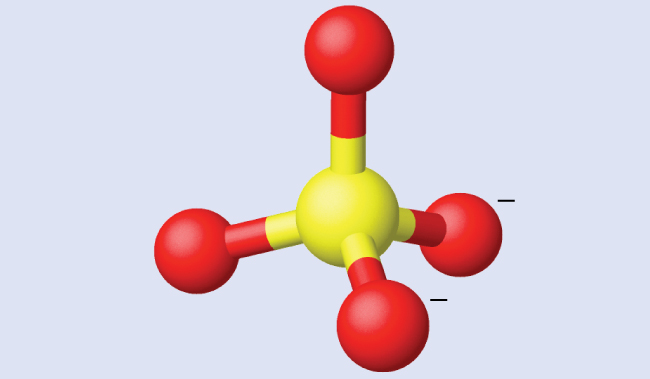
Ammonium sulfate is important as a fertilizer. What is the hybridization of the sulfur atom in the sulfate ion,
英語のヒント
硫酸アンモニウムは肥料として重要である。硫酸イオンの硫黄原子は、どのような混成をしているか。
Solution解法
The Lewis structure of sulfate shows there are four regions of electron density. The hybridization is sp3.
硫酸イオンのルイス構造から、電子密度の領域が四つあるとわかる。したがってsp3混成である。
Check Your Learning理解を確かめよう
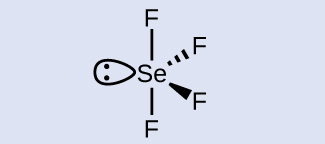
What is the hybridization of the selenium atom in SeF4?
SeF4のセレン原子は、どのような混成をしているか。
Example 8.3例題 8.3
Assigning Hybridization混成の種類を決める
Urea, NH2C(O)NH2, is sometimes used as a source of nitrogen in fertilizers. What is the hybridization of the carbon atom in urea?
英語のヒント
尿素NH2C(O)NH2は、肥料の窒素源として使われることがある。尿素の炭素原子は、どのような混成をしているか。
Solution解法
The Lewis structure of urea is
尿素のルイス構造は次のようになる。
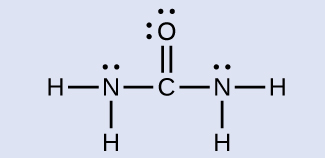
The carbon atom is surrounded by three regions of electron density, positioned in a trigonal planar arrangement. The hybridization in a trigonal planar electron pair geometry is sp2 (Figure 8.21), which is the hybridization of the carbon atom in urea.
炭素原子は、平面三角形に配置された三つの電子密度の領域に囲まれている。電子対が平面三角形に配置されるときの混成はsp2(図8.21)であり、これが尿素の炭素原子の混成である。
Check Your Learning理解を確かめよう
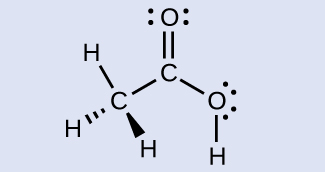
Acetic acid, H3CC(O)OH, is the molecule that gives vinegar its odor and sour taste. What is the hybridization of the two carbon atoms in acetic acid?
英語のヒント
酢酸H3CC(O)OHは、酢ににおいと酸味を与える分子である。酢酸の二つの炭素原子は、それぞれどのような混成をしているか。
Key Concepts and Summary重要概念とまとめ
We can use hybrid orbitals, which are mathematical combinations of some or all of the valence atomic orbitals, to describe the electron density around covalently bonded atoms. These hybrid orbitals either form sigma (σ) bonds directed toward other atoms of the molecule or contain lone pairs of electrons. We can determine the type of hybridization around a central atom from the geometry of the regions of electron density about it. Two such regions imply sp hybridization; three, sp2 hybridization; four, sp3 hybridization; five, sp3d hybridization; and six, sp3d2 hybridization. Pi (π) bonds are formed from unhybridized atomic orbitals (p or d orbitals).
英語のヒント
共有結合した原子の周囲の電子密度は、原子価軌道の一部またはすべてを数学的に組み合わせた混成軌道を使って記述できる。混成軌道は、分子の他の原子へ向くシグマ(σ)結合を形成するか、非共有電子対を収める。中心原子の周囲の電子密度の領域の幾何学的配置から、混成の種類を決めることができる。領域が二つならsp混成、三つならsp2混成、四つならsp3混成、五つならsp3d混成、六つならsp3d2混成である。パイ(π)結合は、混成していない原子軌道(p軌道またはd軌道)から形成される。
Chemistry End of Chapter Exercises章末演習
Exercises 9–22練習問題 9–22
Exercise 9問題 9
Why is the concept of hybridization required in valence bond theory?
原子価結合理論で混成の概念が必要なのはなぜか。
Solution解き方
Hybridization is introduced to explain the geometry of bonding orbitals in valence bond theory.
混成は、原子価結合理論において結合軌道の幾何学的配置を説明するために導入される。
Exercise 10問題 10
Give the shape that describes each hybrid orbital set:
次の各混成軌道の組の形を答えなさい。
(a) sp2
(a)sp2
(b) sp3d
(b)sp3d
(c) sp
(c)sp
(d) sp3d2
(d)sp3d2
Exercise 11問題 11
Explain why a carbon atom cannot form five bonds using sp3d hybrid orbitals.
炭素原子がsp3d混成軌道を使って五つの結合を形成できない理由を説明しなさい。
Solution解き方
There are no d orbitals in the valence shell of carbon.
炭素の原子価殻にはd軌道がない。
Exercise 12問題 12
What is the hybridization of the central atom in each of the following?
次の各物質の中心原子は、どのような混成をしているか。
(a) BeH2
(a)BeH2
(b) SF6
(b)SF6
(c)
(c)
(d) PCl5
(d)PCl5
Exercise 13問題 13
A molecule with the formula AB3 could have one of four different shapes. Give the shape and the hybridization of the central A atom for each.
式AB3で表される分子は、四つの異なる形のいずれかをとりうる。それぞれの形と、中心のA原子の混成の種類を答えなさい。
Solution解き方
trigonal planar, sp2; trigonal pyramidal (one lone pair on A) sp3; T-shaped (two lone pairs on A sp3d, or (three lone pairs on A) sp3d2
平面三角形、sp2。三角錐(Aに非共有電子対が一つ)、sp3。T字形では、Aに非共有電子対が二つの場合はsp3d、Aに非共有電子対が三つの場合はsp3d2。
Exercise 14問題 14
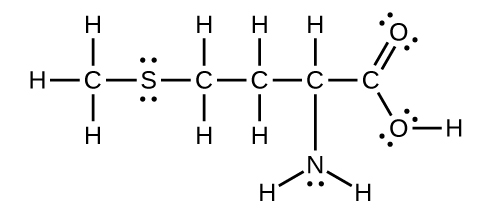
Methionine, CH3SCH2CH2CH(NH2)CO2H, is an amino acid found in proteins. The Lewis structure of this compound is shown below. What is the hybridization type of each carbon, oxygen, the nitrogen, and the sulfur?
英語のヒント
メチオニンCH3SCH2CH2CH(NH2)CO2Hは、タンパク質に含まれるアミノ酸である。この化合物のルイス構造を下に示す。各炭素原子、各酸素原子、窒素原子、硫黄原子は、それぞれどの種類の混成をしているか。
Exercise 15問題 15
Sulfuric acid is manufactured by a series of reactions represented by the following equations:
硫酸は、次の式で表される一連の反応によって製造される。
Draw a Lewis structure, predict the molecular geometry by VSEPR, and determine the hybridization of sulfur for the following:
次のそれぞれについてルイス構造を描き、VSEPR理論で分子の形を予測し、硫黄の混成の種類を求めなさい。
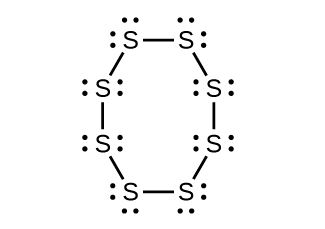
(a) circular S8 molecule
(a)環状のS8分子
(b) SO2 molecule
(b)SO2分子
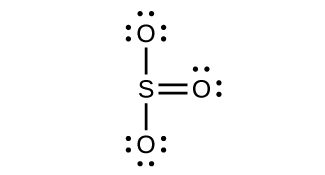
(c) SO3 molecule
(c)SO3分子
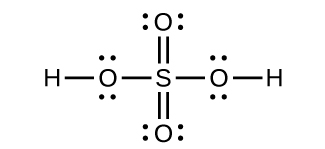
(d) H2SO4 molecule (the hydrogen atoms are bonded to oxygen atoms)
(d)H2SO4分子(水素原子は酸素原子に結合している)
Solution解き方
(a) Each S has a bent (109°) geometry, sp3
(a)各Sは折れ線形(109°)で、sp3混成。
(b) Bent (120°), sp2
(b)折れ線形(120°)、sp2。

(c) Trigonal planar, sp2
(c)平面三角形、sp2。
(d) Tetrahedral, sp3
(d)四面体形、sp3。
Exercise 16問題 16
Two important industrial chemicals, ethene, C2H4, and propene, C3H6, are produced by the steam (or thermal) cracking process:
英語のヒント
工業的に重要な二つの化学物質、エテンC2H4とプロペンC3H6は、水蒸気分解(または熱分解)によって製造される。
For each of the four carbon compounds, do the following:
四つの炭素化合物それぞれについて、以下を行いなさい。
(a) Draw a Lewis structure.
(a)ルイス構造を描く。
(b) Predict the geometry about the carbon atom.
(b)炭素原子の周囲の幾何学的配置を予測する。
(c) Determine the hybridization of each type of carbon atom.
(c)各種類の炭素原子の混成を求める。
Exercise 17問題 17
Analysis of a compound indicates that it contains 77.55% Xe and 22.45% F by mass.
ある化合物を分析したところ、質量比でXeを77.55%、Fを22.45%含むことがわかった。
(a) What is the empirical formula for this compound? (Assume this is also the molecular formula in responding to the remaining parts of this exercise).
英語のヒント
(a)この化合物の組成式は何か。(以後の設問では、この式が分子式でもあると仮定しなさい。)
(b) Write a Lewis structure for the compound.
(b)この化合物のルイス構造を書きなさい。
(c) Predict the shape of the molecules of the compound.
(c)この化合物の分子の形を予測しなさい。
(d) What hybridization is consistent with the shape you predicted?
(d)予測した形と一致する混成は何か。

Exercise 18問題 18
Consider nitrous acid, HNO2 (HONO).
英語のヒント
亜硝酸HNO2(HONO)を考える。
(a) Write a Lewis structure.
(a)ルイス構造を書きなさい。
(b) What are the electron pair and molecular geometries of the internal oxygen and nitrogen atoms in the HNO2 molecule?
(b)HNO2分子の内部にある酸素原子と窒素原子について、電子対の配置と分子の形はそれぞれ何か。
(c) What is the hybridization on the internal oxygen and nitrogen atoms in HNO2?
(c)HNO2の内部の酸素原子と窒素原子は、それぞれどのような混成をしているか。
Exercise 19問題 19
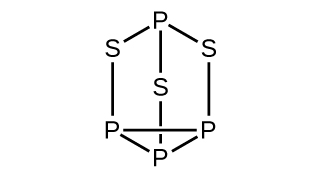
Strike-anywhere matches contain a layer of KClO3 and a layer of P4S3. The heat produced by the friction of striking the match causes these two compounds to react vigorously, which sets fire to the wooden stem of the match. KClO3 contains the ion. P4S3 is an unusual molecule with the skeletal structure.
英語のヒント
どこで擦っても着火するマッチには、KClO3の層とP4S3の層がある。マッチを擦る摩擦で生じる熱により、この二つの化合物が激しく反応し、マッチの木の軸に火がつく。KClO3にはイオンが含まれる。P4S3は、次の骨格構造をもつ珍しい分子である。
(a) Write Lewis structures for P4S3 and the ion.
(a)P4S3とイオンのルイス構造を書きなさい。
(b) Describe the geometry about the P atoms, the S atom, and the Cl atom in these species.
(b)これらの化学種のP原子、S原子、Cl原子の周囲の幾何学的配置を説明しなさい。
(c) Assign a hybridization to the P atoms, the S atom, and the Cl atom in these species.
(c)これらの化学種のP原子、S原子、Cl原子に、混成の種類を割り当てなさい。
(d) Determine the oxidation states and formal charge of the atoms in P4S3 and the ion.
(d)P4S3およびイオンの各原子の酸化数と形式電荷を求めなさい。
Solution解き方
(a)
(a)
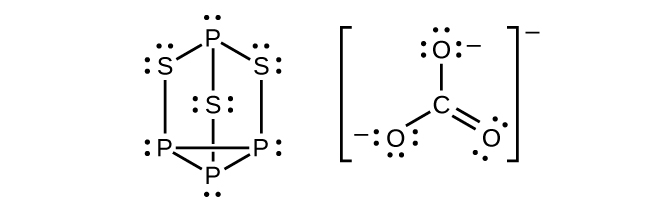
(b) P atoms, trigonal pyramidal; S atoms, bent, with two lone pairs; Cl atoms, trigonal pyramidal; (c) Hybridization about P, S, and Cl is, in all cases, sp3; (d) Oxidation states P +1, S Cl +5, O –2. Formal charges: P 0; S 0; Cl +2: O –1
(b)P原子:三角錐。S原子:非共有電子対を二つもつ折れ線形。Cl原子:三角錐。(c)P、S、Clの周囲の混成はすべてsp3。(d)酸化数はP:+1、S:、Cl:+5、O:−2。形式電荷はP:0、S:0、Cl:+2、O:−1。
Exercise 20問題 20
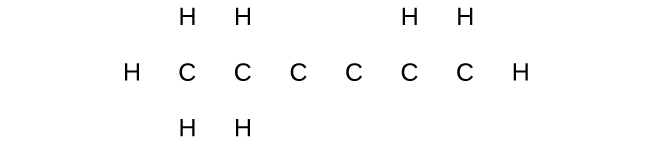
Identify the hybridization of each carbon atom in the following molecule. (The arrangement of atoms is given; you need to determine how many bonds connect each pair of atoms.)
次の分子の各炭素原子の混成を特定しなさい。(原子の並び方は与えられている。各原子対を何本の結合がつなぐかを求める必要がある。)
Exercise 21問題 21
Write Lewis structures for NF3 and PF5. On the basis of hybrid orbitals, explain the fact that NF3, PF3, and PF5 are stable molecules, but NF5 does not exist.
NF3とPF5のルイス構造を書きなさい。混成軌道に基づき、NF3、PF3、PF5が安定な分子である一方、NF5は存在しないことを説明しなさい。
Solution解き方
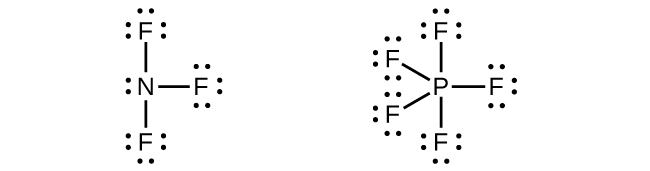


Phosphorus and nitrogen can form sp3 hybrids to form three bonds and hold one lone pair in PF3 and NF3, respectively. However, nitrogen has no valence d orbitals, so it cannot form a set of sp3d hybrid orbitals to bind five fluorine atoms in NF5. Phosphorus has d orbitals and can bind five fluorine atoms with sp3d hybrid orbitals in PF5.
英語のヒント
リンと窒素はsp3混成軌道を形成でき、それぞれPF3とNF3において三つの結合を形成し、一つの非共有電子対を収められる。しかし窒素には原子価殻のd軌道がないため、一組のsp3d混成軌道を形成して、NF5中で五つのフッ素原子を結び付けることはできない。リンにはd軌道があり、PF5中ではsp3d混成軌道によって五つのフッ素原子を結び付けることができる。
Exercise 22問題 22
In addition to NF3, two other fluoro derivatives of nitrogen are known: N2F4 and N2F2. What shapes do you predict for these two molecules? What is the hybridization for the nitrogen in each molecule?
英語のヒント
NF3以外にも、窒素のフッ素誘導体としてN2F4とN2F2の二つが知られている。この二分子はどのような形になると予測するか。それぞれの分子内の窒素は、どのような混成をしているか。
hybrid orbital
混成軌道
orbital created by combining atomic orbitals on a central atom
中心原子の原子軌道を組み合わせて作られる軌道。
hybridization
混成
model that describes the changes in the atomic orbitals of an atom when it forms a covalent compound
原子が共有結合性の化合物を形成するとき、その原子軌道に生じる変化を記述するモデル。
sp hybrid orbital
sp混成軌道
one of a set of two orbitals with a linear arrangement that results from combining one s and one p orbital
一つのs軌道と一つのp軌道を組み合わせて得られる、直線状に配置された二つ一組の軌道の一つ。
sp2 hybrid orbital
sp2混成軌道
one of a set of three orbitals with a trigonal planar arrangement that results from combining one s and two p orbitals
一つのs軌道と二つのp軌道を組み合わせて得られる、平面三角形に配置された三つ一組の軌道の一つ。
sp3 hybrid orbital
sp3混成軌道
one of a set of four orbitals with a tetrahedral arrangement that results from combining one s and three p orbitals
一つのs軌道と三つのp軌道を組み合わせて得られる、四面体状に配置された四つ一組の軌道の一つ。
sp3d hybrid orbital
sp3d混成軌道
one of a set of five orbitals with a trigonal bipyramidal arrangement that results from combining one s, three p, and one d orbital
一つのs軌道、三つのp軌道、一つのd軌道を組み合わせて得られる、三方両錐に配置された五つ一組の軌道の一つ。
sp3d2 hybrid orbital
sp3d2混成軌道
one of a set of six orbitals with an octahedral arrangement that results from combining one s, three p, and two d orbitals
一つのs軌道、三つのp軌道、二つのd軌道を組み合わせて得られる、八面体状に配置された六つ一組の軌道の一つ。