第10章三角法のさらなる応用Further Applications of Trigonometry
Finding Magnitude and Direction大きさと向きを求める
To work with a vector, we need to be able to find its magnitude and its direction. We find its magnitude using the Pythagorean Theorem or the distance formula, and we find its direction using the inverse tangent function.
ベクトルを扱うには、その大きさと向きが求められる必要がある。大きさはピタゴラスの定理か距離の公式で求め、向きは逆正接関数で求める。
Note重要事項
Magnitude and Direction of a Vectorベクトルの大きさと向き
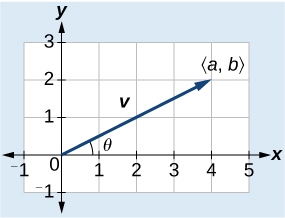
Given a position vector the magnitude is found by The direction is equal to the angle formed with the x-axis, or with the y-axis, depending on the application. For a position vector, the direction is found by as illustrated in Figure 5.
位置ベクトル が与えられたとき、大きさは で求まる。向きは、用途に応じて x軸または y軸となす角に等しい。位置ベクトルでは、図5に示すとおり、向きは で求まる。
Two vectors v and u are considered equal if they have the same magnitude and the same direction. Additionally, if both vectors have the same position vector, they are equal.
二つのベクトル v と u は、大きさが同じで向きも同じなら等しいとされる。さらに、両方のベクトルの位置ベクトルが同じなら、それらは等しい。
Example 3例3
Finding the Magnitude and Direction of a Vectorベクトルの大きさと向きを求める
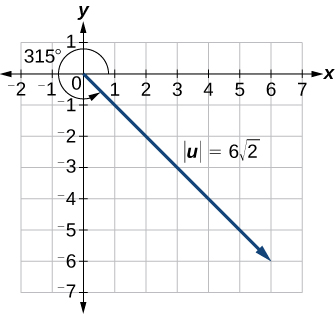
Find the magnitude and direction of the vector with initial point and terminal point Draw the vector.
始点 、終点 のベクトルの大きさと向きを求めよ。そのベクトルを描け。
Solution 解答
First, find the position vector.
まず、位置ベクトルを求める。
We use the Pythagorean Theorem to find the magnitude.
ピタゴラスの定理を使って大きさを求める。
The direction is given as
向きは次で与えられる。
However, the angle terminates in the fourth quadrant, so we add 360° to obtain a positive angle. Thus, See Figure 6.
だがこの角は第四象限で終わるので、360°を足して正の角にする。よって である。図6を見よ。
Example 4例4
Showing That Two Vectors Are Equal二つのベクトルが等しいことを示す
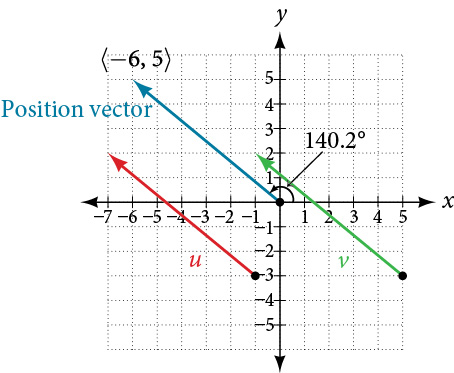
Show that vector v with initial point at and terminal point at is equal to vector u with initial point at and terminal point at Draw the position vector on the same grid as v and u. Next, find the magnitude and direction of each vector.
始点 、終点 のベクトル v が、始点 、終点 のベクトル u と等しいことを示せ。v と u と同じ格子に位置ベクトルを描け。次に、各ベクトルの大きさと向きを求めよ。
Solution 解答
As shown in Figure 7, draw the vector starting at initial and terminal point Draw the vector with initial point and terminal point Find the standard position for each.
図7に示すとおり、始点 、終点 からベクトル を描く。始点 、終点 のベクトル を描く。それぞれの標準位置を求める。
Next, find and sketch the position vector for v and u. We have
次に、v と u の位置ベクトルを求めて概形を描く。次を得る。
Since the position vectors are the same, v and u are the same.
位置ベクトルが同じなので、v と u は同じである。
An alternative way to check for vector equality is to show that the magnitude and direction are the same for both vectors. To show that the magnitudes are equal, use the Pythagorean Theorem.
ベクトルが等しいかを確かめる別のしかたは、両方のベクトルの大きさと向きが同じであることを示すことである。大きさが等しいことを示すには、ピタゴラスの定理を使う。
As the magnitudes are equal, we now need to verify the direction. Using the tangent function with the position vector gives
大きさが等しいので、次に向きを確かめる必要がある。位置ベクトルに正接関数を使うと次を得る。
However, we can see that the position vector terminates in the second quadrant, so we add Thus, the direction is
だが位置ベクトルが第二象限で終わることが分かるので、 を足す。よって向きは である。