第10章三角法のさらなる応用Further Applications of Trigonometry
Finding the Dot Product of Two Vectors二つのベクトルの内積を求める
As we discussed earlier in the section, scalar multiplication involves multiplying a vector by a scalar, and the result is a vector. As we have seen, multiplying a vector by a number is called scalar multiplication. If we multiply a vector by a vector, there are two possibilities: the dot product and the cross product. We will only examine the dot product here; you may encounter the cross product in more advanced mathematics courses.
この節の初めのほうで論じたとおり、スカラー倍はベクトルにスカラーを掛けることであり、結果はベクトルである。見てきたとおり、ベクトルに数を掛けることをスカラー倍という。ベクトルにベクトルを掛ける場合は、二通りある。内積と外積である。ここでは内積だけを調べる。外積はもっと進んだ数学の講義で出会うかもしれない。
The dot product of two vectors involves multiplying two vectors together, and the result is a scalar.
二つのベクトルの内積は、二つのベクトルを掛け合わせることであり、結果はスカラーである。
Note重要事項
Dot Product内積
The dot product of two vectors and is the sum of the product of the horizontal components and the product of the vertical components.
二つのベクトル と の内積は、水平成分の積と鉛直成分の積の和である。
To find the angle between the two vectors, use the formula below.
二つのベクトルのなす角を求めるには、下の公式を使う。
Example 14例14
Finding the Dot Product of Two Vectors二つのベクトルの内積を求める
Find the dot product of and
と の内積を求めよ。
Solution 解答
Using the formula, we have
公式を使うと、次を得る。
Example 15例15
Finding the Dot Product of Two Vectors and the Angle between Them二つのベクトルの内積と、そのなす角を求める
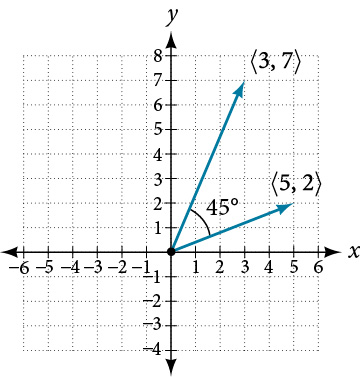
Find the dot product of v1 = 5i + 2j and v2 = 3i + 7j. Then, find the angle between the two vectors.
v1 = 5i + 2j と v2 = 3i + 7j の内積を求めよ。そして二つのベクトルのなす角を求めよ。
Solution 解答
Finding the dot product, we multiply corresponding components.
内積を求めるには、対応する成分どうしを掛ける。
To find the angle between them, we use the formula
なす角を求めるには、公式 を使う。
See Figure 17.
図17を見よ。
Example 16例16
Finding the Angle between Two Vectors二つのベクトルのなす角を求める
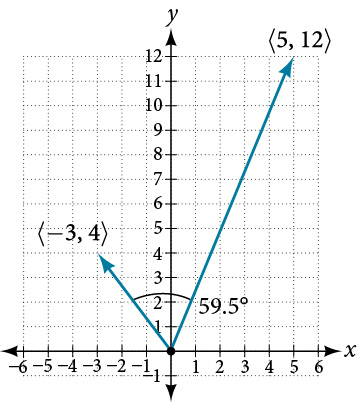
Find the angle between and
と のなす角を求めよ。
Example 17例17
Finding Ground Speed and Bearing Using Vectorsベクトルを使って対地速度と針路を求める
We now have the tools to solve the problem we introduced in the opening of the section.
これでこの節の初めに出した問題を解く道具がそろった。
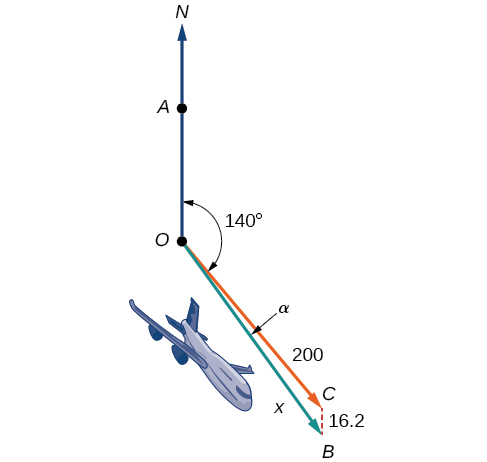
An airplane is flying at an airspeed of 200 miles per hour headed on a SE bearing of 140°. A north wind (from north to south) is blowing at 16.2 miles per hour. What are the ground speed and actual bearing of the plane? See Figure 19.
ある飛行機が、対気速度毎時200マイルで南東の針路140°に向けて飛んでいる。北の風(北から南へ)が毎時16.2マイルで吹いている。この飛行機の対地速度と実際の針路はいくらか。図19を見よ。
Solution 解答
The ground speed is represented by in the diagram, and we need to find the angle in order to calculate the adjusted bearing, which will be
対地速度は図の で表され、直した針路 を計算するには角 を求める必要がある。
Notice in Figure 19, that angle must be equal to angle by the rule of alternating interior angles, so angle is 140°. We can find by the Law of Cosines:
図19で、錯角の規則により角 は角 に等しいはずなので、角 は140°である。余弦定理により が求まる。
The ground speed is approximately 213 miles per hour. Now we can calculate the bearing using the Law of Sines.
対地速度はおよそ毎時213マイルである。これで正弦定理を使って針路が計算できる。
Therefore, the plane has a SE bearing of 140°+2.8°=142.8°. The ground speed is 212.7 miles per hour.
したがって、この飛行機の南東の針路は140°+2.8°=142.8°である。対地速度は毎時212.7マイルである。
Media関連教材
Access these online resources for additional instruction and practice with vectors.
ベクトルについての説明と練習をさらに求めるなら、次のオンライン教材にあたるとよい。
• Introduction to Vectors• Vector Operations• The Unit Vector
・ベクトル入門・ベクトルの演算・単位ベクトル
Verbal言葉で答える問題
2. How is a vector more specific than a line segment?
2. ベクトルは線分よりどう限定されているか。
4. What is component form?
4. 成分表示とは何か。
Algebraic代数の問題
6. Given a vector with initial point and terminal point find an equivalent vector whose initial point is Write the vector in component form
6. 始点 、終点 のベクトルが与えられたとき、始点が である同値なベクトルを求めよ。そのベクトルを成分表示 で書け。
8. Given a vector with initial point and terminal point find an equivalent vector whose initial point is Write the vector in component form
8. 始点 、終点 のベクトルが与えられたとき、始点が である同値なベクトルを求めよ。そのベクトルを成分表示 で書け。
For the following exercises, determine whether the two vectors and are equal, where has an initial point and a terminal point and has an initial point and a terminal point .
次の各問について、 が始点 、終点 を持ち、 が始点 、終点 を持つとして、二つのベクトル と が等しいかどうかを判定せよ。
10. and
10. と
12. and
12. と
14. Given initial point and terminal point write the vector in terms of and
14. 始点 と終点 が与えられたとき、ベクトル を と で書け。
For the following exercises, use the vectors u = i + 5j, v = −2i− 3j, and w = 4i − j.
次の各問では、ベクトル u = i + 5j、v = −2i− 3j、w = 4i − j を使え。
16. Find u + (v − w)
16. u + (v − w) を求めよ。
For the following exercises, use the given vectors to compute u + v, u − v, and 2u − 3v.
次の各問について、与えられたベクトルを使って u + v、u − v、2u − 3v を計算せよ。
20. Let v = −4i + 3j. Find a vector that is half the length and points in the same direction as
20. v = −4i + 3j とする。 の半分の長さで同じ向きを指すベクトルを求めよ。
For the following exercises, find a unit vector in the same direction as the given vector.
次の各問について、与えられたベクトルと同じ向きの単位ベクトルを求めよ。
For the following exercises, find the magnitude and direction of the vector,
次の各問について、ベクトル の大きさと向きを求めよ。
32. Given u = 3i − 4j and v = −2i + 3j, calculate
32. u = 3i − 4j かつ v = −2i + 3j のとき、 を計算せよ。
34. Given and calculate
34. かつ のとき、 を計算せよ。
Graphicalグラフの問題
For the following exercises, given draw 3v and
次の各問について、 が与えられたとき、、3v、 を描け。
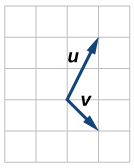
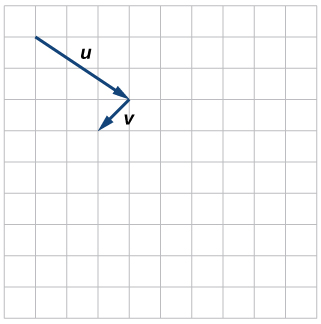
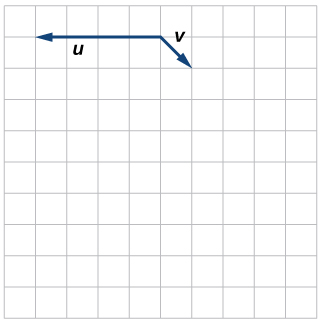
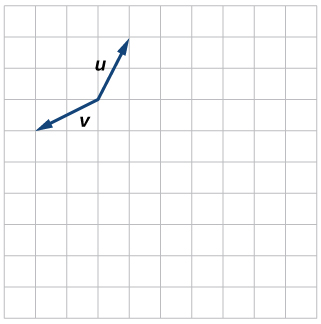
For the following exercises, use the vectors shown to sketch u + v, u − v, and 2u.
次の各問について、示されたベクトルを使って u + v、u − v、2u の概形を描け。
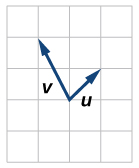
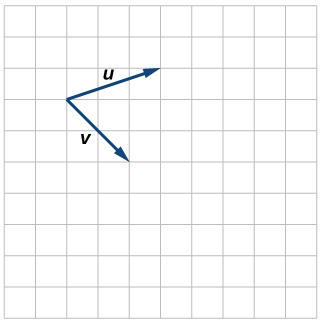
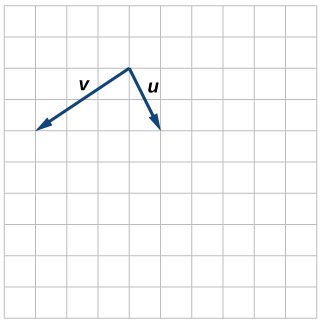
For the following exercises, use the vectors shown to sketch 2u + v.
次の各問について、示されたベクトルを使って 2u + v の概形を描け。
For the following exercises, use the vectors shown to sketch u − 3v.
次の各問について、示されたベクトルを使って u − 3v の概形を描け。
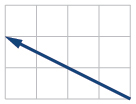
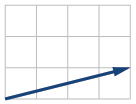
For the following exercises, write the vector shown in component form.
次の各問について、示されたベクトルを成分表示で書け。
48. Given initial point and terminal point write the vector in terms of and then draw the vector on the graph.
48. 始点 と終点 が与えられたとき、ベクトル を と で書き、そのベクトルをグラフに描け。
50. Given initial point and terminal point write the vector in terms of and Draw the points and the vector on the graph.
50. 始点 と終点 が与えられたとき、ベクトル を と で書け。点とベクトルをグラフに描け。
Extensions発展問題
For the following exercises, use the given magnitude and direction in standard position, write the vector in component form.
次の各問について、標準位置での与えられた大きさと向きを使い、そのベクトルを成分表示で書け。
55. A 60-pound box is resting on a ramp that is inclined 12°. Rounding to the nearest tenth,
55. 60ポンドの箱が、12°傾いた斜面の上に置かれている。小数第一位まで求めて、
ⓐFind the magnitude of the normal (perpendicular) component of the force.ⓑFind the magnitude of the component of the force that is parallel to the ramp.
ⓐ力の法線(垂直)成分の大きさを求めよ。ⓑ力の斜面に平行な成分の大きさを求めよ。
56. A 25-pound box is resting on a ramp that is inclined 8°. Rounding to the nearest tenth,
56. 25ポンドの箱が、8°傾いた斜面の上に置かれている。小数第一位まで求めて、
ⓐFind the magnitude of the normal (perpendicular) component of the force.ⓑFind the magnitude of the component of the force that is parallel to the ramp.
ⓐ力の法線(垂直)成分の大きさを求めよ。ⓑ力の斜面に平行な成分の大きさを求めよ。
58. Find the magnitude of the horizontal and vertical components of the vector with magnitude 4 pounds pointed in a direction of 127° above the horizontal. Round to the nearest hundredth.
58. 大きさ4ポンドで水平から127°上の向きを指すベクトルの、水平成分と鉛直成分の大きさを求めよ。小数第二位まで求めよ。
60. Find the magnitude of the horizontal and vertical components of the vector with magnitude 1 pound pointed in a direction of 8° above the horizontal. Round to the nearest hundredth.
60. 大きさ1ポンドで水平から8°上の向きを指すベクトルの、水平成分と鉛直成分の大きさを求めよ。小数第二位まで求めよ。
Real-World Applications現実世界への応用
62. A boat leaves the marina and sails 6 miles north, then 2 miles northeast. How far from the marina is the boat, and in what direction must it sail to head directly back to the marina?
62. ある船が停泊所を出て北へ6マイル進み、それから北東へ2マイル進む。船は停泊所からどれだけ離れているか。また、まっすぐ停泊所へ戻るにはどの向きへ進めばよいか。
63. A man starts walking from home and walks 4 miles east, 2 miles southeast, 5 miles south, 4 miles southwest, and 2 miles east. How far has he walked? If he walked straight home, how far would he have to walk?
63. ある男性が家から歩き出し、東へ4マイル、南東へ2マイル、南へ5マイル、南西へ4マイル、東へ2マイル歩く。彼は何マイル歩いたか。まっすぐ家へ歩くとしたら、何マイル歩くことになるか。
64. A woman starts walking from home and walks 4 miles east, 7 miles southeast, 6 miles south, 5 miles southwest, and 3 miles east. How far has she walked? If she walked straight home, how far would she have to walk?
64. ある女性が家から歩き出し、東へ4マイル、南東へ7マイル、南へ6マイル、南西へ5マイル、東へ3マイル歩く。彼女は何マイル歩いたか。まっすぐ家へ歩くとしたら、何マイル歩くことになるか。
65. A man starts walking from home and walks 3 miles at 20° north of west, then 5 miles at 10° west of south, then 4 miles at 15° north of east. If he walked straight home, how far would he have to the walk, and in what direction?
65. ある男性が家から歩き出し、西から北へ20°の向きに3マイル、南から西へ10°の向きに5マイル、東から北へ15°の向きに4マイル歩く。まっすぐ家へ歩くとしたら、何マイルをどの向きへ歩くことになるか。
66. A woman starts walking from home and walks 6 miles at 40° north of east, then 2 miles at 15° east of south, then 5 miles at 30° south of west. If she walked straight home, how far would she have to walk, and in what direction?
66. ある女性が家から歩き出し、東から北へ40°の向きに6マイル、南から東へ15°の向きに2マイル、西から南へ30°の向きに5マイル歩く。まっすぐ家へ歩くとしたら、何マイルをどの向きへ歩くことになるか。
67. An airplane is heading north at an airspeed of 600 km/hr, but there is a wind blowing from the southwest at 80 km/hr. How many degrees off course will the plane end up flying, and what is the plane’s speed relative to the ground?
67. ある飛行機が対気速度毎時600kmで北へ向かっているが、南西から毎時80kmの風が吹いている。この飛行機は結局進路から何度ずれて飛ぶことになるか。また、地面に対するこの飛行機の速さはいくらか。
68. An airplane is heading north at an airspeed of 500 km/hr, but there is a wind blowing from the northwest at 50 km/hr. How many degrees off course will the plane end up flying, and what is the plane’s speed relative to the ground?
68. ある飛行機が対気速度毎時500kmで北へ向かっているが、北西から毎時50kmの風が吹いている。この飛行機は結局進路から何度ずれて飛ぶことになるか。また、地面に対するこの飛行機の速さはいくらか。
69. An airplane needs to head due north, but there is a wind blowing from the southwest at 60 km/hr. The plane flies with an airspeed of 550 km/hr. To end up flying due north, how many degrees west of north will the pilot need to fly the plane?
69. ある飛行機は真北へ向かう必要があるが、南西から毎時60kmの風が吹いている。この飛行機は対気速度毎時550kmで飛ぶ。結局真北へ飛ぶには、操縦士は北から西へ何度の向きに飛ばす必要があるか。
70. An airplane needs to head due north, but there is a wind blowing from the northwest at 80 km/hr. The plane flies with an airspeed of 500 km/hr. To end up flying due north, how many degrees west of north will the pilot need to fly the plane?
70. ある飛行機は真北へ向かう必要があるが、北西から毎時80kmの風が吹いている。この飛行機は対気速度毎時500kmで飛ぶ。結局真北へ飛ぶには、操縦士は北から西へ何度の向きに飛ばす必要があるか。
72. As part of a video game, the point is rotated counterclockwise about the origin through an angle of 40°. Find the new coordinates of this point.
72. あるテレビゲームの一部として、点 が原点のまわりに40°の角だけ反時計回りに回される。この点の新しい座標を求めよ。
73. Two children are throwing a ball back and forth straight across the back seat of a car. The ball is being thrown 10 mph relative to the car, and the car is traveling 25 mph down the road. If one child doesn't catch the ball, and it flies out the window, in what direction does the ball fly (ignoring wind resistance)?
73. 二人の子どもが、車の後部座席をまっすぐ横切るように球を投げ合っている。球は車に対して毎時10マイルで投げられ、車は道を毎時25マイルで走っている。一方の子どもが球を捕り損ね、球が窓から飛び出したら、球はどの向きへ飛ぶか(空気の抵抗は無視する)。
74. Two children are throwing a ball back and forth straight across the back seat of a car. The ball is being thrown 8 mph relative to the car, and the car is traveling 45 mph down the road. If one child doesn't catch the ball, and it flies out the window, in what direction does the ball fly (ignoring wind resistance)?
74. 二人の子どもが、車の後部座席をまっすぐ横切るように球を投げ合っている。球は車に対して毎時8マイルで投げられ、車は道を毎時45マイルで走っている。一方の子どもが球を捕り損ね、球が窓から飛び出したら、球はどの向きへ飛ぶか(空気の抵抗は無視する)。
76. Suppose a body has a force of 10 pounds acting on it to the right, 25 pounds acting on it upward, and 5 pounds acting on it 45° from the horizontal. What single force is the resultant force acting on the body?
76. ある物体に、右向きに10ポンド、上向きに25ポンド、水平から45°の向きに5ポンドの力が働いているとする。この物体に働く合力は、単一の力としていくらか。
77. Suppose a body has a force of 10 pounds acting on it to the right, 25 pounds acting on it ─135° from the horizontal, and 5 pounds acting on it directed 150° from the horizontal. What single force is the resultant force acting on the body?
77. ある物体に、右向きに10ポンド、水平から─135°の向きに25ポンド、水平から150°の向きに5ポンドの力が働いているとする。この物体に働く合力は、単一の力としていくらか。
78. The condition of equilibrium is when the sum of the forces acting on a body is the zero vector. Suppose a body has a force of 2 pounds acting on it to the right, 5 pounds acting on it upward, and 3 pounds acting on it 45° from the horizontal. What single force is needed to produce a state of equilibrium on the body?
78. つり合いの条件とは、物体に働く力の和が零ベクトルになることである。ある物体に、右向きに2ポンド、上向きに5ポンド、水平から45°の向きに3ポンドの力が働いているとする。この物体につり合いの状態を生むには、単一の力としてどんな力が要るか。
79. Suppose a body has a force of 3 pounds acting on it to the left, 4 pounds acting on it upward, and 2 pounds acting on it 30° from the horizontal. What single force is needed to produce a state of equilibrium on the body? Draw the vector.
79. ある物体に、左向きに3ポンド、上向きに4ポンド、水平から30°の向きに2ポンドの力が働いているとする。この物体につり合いの状態を生むには、単一の力としてどんな力が要るか。そのベクトルを描け。
Key Terms重要語
altitude a perpendicular line from one vertex of a triangle to the opposite side, or in the case of an obtuse triangle, to the line containing the opposite side, forming two right triangles
高さ 三角形の一つの頂点から向かい合う辺へ下ろした垂線。鈍角三角形の場合は向かい合う辺を含む直線へ下ろした垂線で、二つの直角三角形を作る
ambiguous case a scenario in which more than one triangle is a valid solution for a given oblique SSA triangle
あいまいな場合 与えられた斜三角形のSSAに対して、二つ以上の三角形が正しい解になる筋書き
Archimedes’ spiral a polar curve given by When multiplied by a constant, the equation appears as As the curve continues to widen in a spiral path over the domain.
アルキメデスの渦巻き で与えられる極曲線。定数を掛けると式は の形になる。 につれて、この曲線は定義域上で渦を巻きながら広がり続ける。
argument the angle associated with a complex number; the angle between the line from the origin to the point and the positive real axis
偏角 複素数に結び付いた角。原点からその点への直線と、実軸の正の部分とのなす角
cardioid a member of the limaçon family of curves, named for its resemblance to a heart; its equation is given as and where
心臓形 リマソンの仲間の曲線の一つ。心臓に似ていることからこの名がある。式は として と で与えられる
convex limaҫon a type of one-loop limaçon represented by and such that
凸なリマソン を満たす と で表される、一重の輪のリマソンの一種
De Moivre’s Theorem formula used to find the power or nth roots of a complex number; states that, for a positive integer is found by raising the modulus to the power and multiplying the angles by
ド・モアブルの定理 複素数の 乗や n 乗根を求めるのに使う公式。正の整数 について、絶対値を 乗し、角に を掛ければ求まると述べる
dimpled limaҫon a type of one-loop limaçon represented by and such that
くぼんだリマソン を満たす と で表される、一重の輪のリマソンの一種
dot product given two vectors, the sum of the product of the horizontal components and the product of the vertical components
内積 二つのベクトルが与えられたとき、水平成分の積と鉛直成分の積の和
Generalized Pythagorean Theorem an extension of the Law of Cosines; relates the sides of an oblique triangle and is used for SAS and SSS triangles
一般化されたピタゴラスの定理 余弦定理の別名。斜三角形の辺どうしを結び付け、SASとSSSの三角形に使う
initial point the origin of a vector
始点 ベクトルの始まり
inner-loop limaçon a polar curve similar to the cardioid, but with an inner loop; passes through the pole twice; represented by and where
内側に輪を持つリマソン 心臓形に似ているが内側に輪を持つ極曲線。極を二度通る。 として と で表される
Law of Cosines states that the square of any side of a triangle is equal to the sum of the squares of the other two sides minus twice the product of the other two sides and the cosine of the included angle
余弦定理 三角形のどの辺の平方も、他の二辺の平方の和から、他の二辺の積とそのはさむ角の余弦との積の2倍を引いたものに等しいと述べる定理
Law of Sines states that the ratio of the measurement of one angle of a triangle to the length of its opposite side is equal to the remaining two ratios of angle measure to opposite side; any pair of proportions may be used to solve for a missing angle or side
正弦定理 三角形の一つの角の大きさと、その向かい合う辺の長さとの比が、残り二つの角と向かい合う辺の比に等しいと述べる定理。どの二つの比の組を使っても、未知の角や辺が求められる
lemniscate a polar curve resembling a figure 8 and given by the equation and
レムニスケート 数字の8に似た極曲線で、式 と で与えられる
magnitude the length of a vector; may represent a quantity such as speed, and is calculated using the Pythagorean Theorem
大きさ ベクトルの長さ。速さのような量を表すことがあり、ピタゴラスの定理で計算する
modulus the absolute value of a complex number, or the distance from the origin to the point also called the amplitude
絶対値 複素数の絶対値、すなわち原点から点 までの距離。振幅ともいう
oblique triangle any triangle that is not a right triangle
斜三角形 直角三角形でない三角形すべて
one-loop limaҫon a polar curve represented by and such that and may be dimpled or convex; does not pass through the pole
一重の輪のリマソン かつ を満たす と で表される極曲線。くぼんでいることも凸なこともある。極を通らない
parameter a variable, often representing time, upon which and are both dependent
媒介変数 しばしば時間を表す変数で、 と の両方がこれに依存する
polar axis on the polar grid, the equivalent of the positive x-axis on the rectangular grid
極軸 極座標の格子で、直交座標の格子の x軸の正の部分にあたるもの
polar coordinates on the polar grid, the coordinates of a point labeled where indicates the angle of rotation from the polar axis and represents the radius, or the distance of the point from the pole in the direction of
極座標 極座標の格子での点の座標 。 は極軸からの回転の角を示し、 は動径、すなわち の向きへの極からその点までの距離を表す
polar equation an equation describing a curve on the polar grid.
極方程式 極座標の格子の曲線を述べる式。
polar form of a complex number a complex number expressed in terms of an angle and its distance from the origin can be found by using conversion formulas and
複素数の極形式 角 と原点からの距離 で表した複素数。換算の公式 と を使えば求まる
pole the origin of the polar grid
極 極座標の格子の原点
resultant a vector that results from addition or subtraction of two vectors, or from scalar multiplication
合成ベクトル 二つのベクトルの加法引き算、またはスカラー倍から生まれるベクトル
rose curve a polar equation resembling a flower, given by the equations and when is even there are petals, and the curve is highly symmetrical; when is odd there are petals.
バラ曲線 花に似た極方程式で、式 と で与えられる。 が偶数のときは花びらが 枚あり、この曲線は対称性が高い。 が奇数のときは花びらが 枚ある。
scalar a quantity associated with magnitude but not direction; a constant
スカラー 大きさは持つが向きは持たない量。定数
scalar multiplication the product of a constant and each component of a vector
スカラー倍 定数とベクトルの各成分との積
standard position the placement of a vector with the initial point at and the terminal point represented by the change in the x-coordinates and the change in the y-coordinates of the original vector
標準位置 始点を に置いたベクトルの置き方。終点 は、元のベクトルの x座標の変化と y座標の変化で表される
terminal point the end point of a vector, usually represented by an arrow indicating its direction
終点 ベクトルの終わりの点。ふつうその向きを示す矢印で表される
unit vector a vector that begins at the origin and has magnitude of 1; the horizontal unit vector runs along the x-axis and is defined as the vertical unit vector runs along the y-axis and is defined as
単位ベクトル 原点から始まり大きさが1のベクトル。水平の単位ベクトルは x軸に沿って進み と定められる。鉛直の単位ベクトルは y軸に沿って進み と定められる
vector a quantity associated with both magnitude and direction, represented as a directed line segment with a starting point (initial point) and an end point (terminal point)
ベクトル 大きさと向きの両方に結び付いた量。始まりの点(始点)と終わりの点(終点)を持つ、向きを持つ線分として表される
vector addition the sum of two vectors, found by adding corresponding components
ベクトルの加法 二つのベクトルの和。対応する成分どうしを足せば求まる