第10章三角法のさらなる応用Further Applications of Trigonometry
10.2 Non-right Triangles: Law of Cosines10.2 一般の三角形と余弦定理
Learning Objectives 学習目標
In this section, you will:
この節を終えると、次のことができるようになる。
• Use the Law of Cosines to solve oblique triangles.• Solve applied problems using the Law of Cosines.• Use Heron’s formula to find the area of a triangle.
・余弦定理を使って一般の三角形の辺や角を求める。・余弦定理を使って応用問題を解く。・ヘロンの公式を使って三角形の面積を求める。
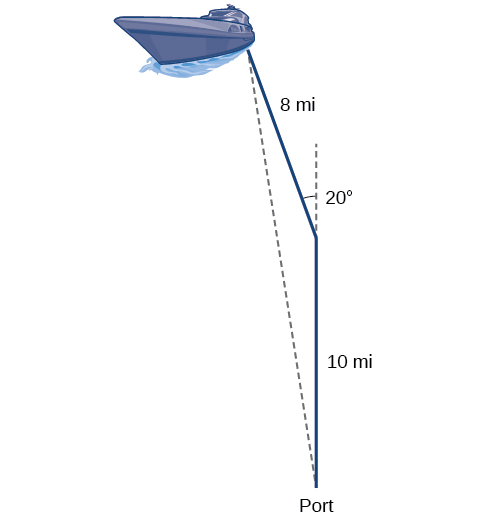
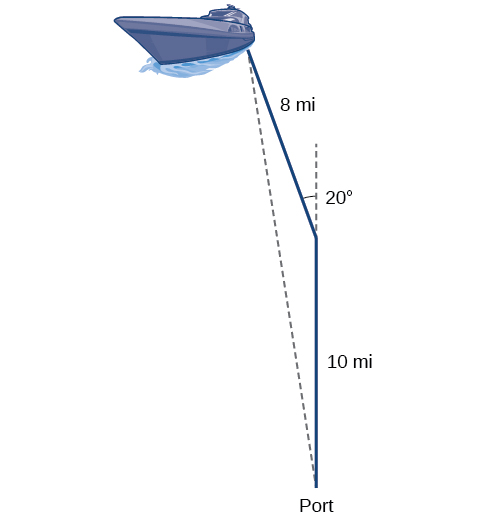
Suppose a boat leaves port, travels 10 miles, turns 20 degrees, and travels another 8 miles as shown in Figure 1. How far from port is the boat?
図1に示すとおり、ある船が港を出て10マイル進み、20度向きを変え、さらに8マイル進んだとする。この船は港からどれだけ離れているか。
Unfortunately, while the Law of Sines enables us to address many non-right triangle cases, it does not help us with triangles where the known angle is between two known sides, a SAS (side-angle-side) triangle, or when all three sides are known, but no angles are known, a SSS (side-side-side) triangle. In this section, we will investigate another tool for solving oblique triangles described by these last two cases.
残念ながら、正弦定理で直角でない三角形の多くの場合が扱えるとはいえ、分かっている角が分かっている二辺のあいだにある三角形、すなわち SAS(辺-角-辺)の三角形や、三辺すべてが分かっていて角が一つも分かっていない三角形、すなわち SSS(辺-辺-辺)の三角形には役立たない。この節では、この後者の二つの場合で述べられる一般の三角形の辺や角を求める、もう一つの道具を調べる。
Using the Law of Cosines to Solve Oblique Triangles余弦定理を使って一般の三角形の辺や角を求める
The tool we need to solve the problem of the boat’s distance from the port is the Law of Cosines, which defines the relationship among angle measurements and side lengths in oblique triangles. Three formulas make up the Law of Cosines. At first glance, the formulas may appear complicated because they include many variables. However, once the pattern is understood, the Law of Cosines is easier to work with than most formulas at this mathematical level.
船の港からの距離の問題を解くのに要る道具は余弦定理である。これは斜三角形の角の大きさと辺の長さの関係を定める。余弦定理は三つの公式からなる。一見すると、変数が多いので公式は込み入って見えるかもしれない。だが型が分かってしまえば、余弦定理はこの水準の数学のほとんどの公式より扱いやすい。
Understanding how the Law of Cosines is derived will be helpful in using the formulas. The derivation begins with the Generalized Pythagorean Theorem, which is an extension of the Pythagorean Theorem to non-right triangles. Here is how it works: An arbitrary non-right triangle is placed in the coordinate plane with vertex at the origin, side drawn along the x-axis, and vertex located at some point in the plane, as illustrated in Figure 2. Generally, triangles exist anywhere in the plane, but for this explanation we will place the triangle as noted.
余弦定理がどう導かれるかを理解しておくと、公式を使うのに役立つ。導出は、ピタゴラスの定理を直角でない三角形に広げた一般化ピタゴラスの定理から始まる。次のようにする。図2に示すとおり、直角でない任意の三角形 を座標平面に置き、頂点 を原点、辺 を x軸に沿わせ、頂点 を平面上のある点 に置く。三角形は一般に平面のどこにでもあるが、この説明では述べたとおりに置く。
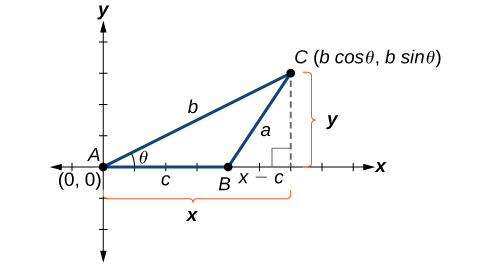
We can drop a perpendicular from to the x-axis (this is the altitude or height). Recalling the basic trigonometric identities, we know that
から x軸へ垂線を下ろせる(これが高さである)。基本の三角関数の恒等式を思い出せば、次が分かる。
In terms of and The point located at has coordinates Using the side as one leg of a right triangle and as the second leg, we can find the length of hypotenuse using the Pythagorean Theorem. Thus,
と で表すと、 にある の点の座標は である。辺 を直角三角形の一辺、 をもう一辺として、ピタゴラスの定理を使えば斜辺 の長さが求められる。したがって、
The formula derived is one of the three equations of the Law of Cosines. The other equations are found in a similar fashion.
導いた公式は、余弦定理の三つの式のうちの一つである。ほかの式も同じように求められる。
Keep in mind that it is always helpful to sketch the triangle when solving for angles or sides. In a real-world scenario, try to draw a diagram of the situation. As more information emerges, the diagram may have to be altered. Make those alterations to the diagram and, in the end, the problem will be easier to solve.
角や辺を求めるときは、三角形を描いておくとつねに役立つことを心にとめておこう。現実の筋書きでは、その状況の図を描いてみるとよい。情報が増えるにつれて、図を変えなければならないこともある。図にその変更を加えれば、最後には問題が解きやすくなる。
Law of Cosines 余弦定理
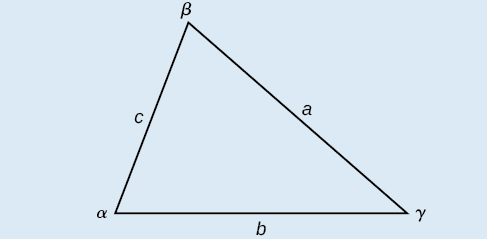
The Law of Cosines states that the square of any side of a triangle is equal to the sum of the squares of the other two sides minus twice the product of the other two sides and the cosine of the included angle. For triangles labeled as in Figure 3, with angles and and opposite corresponding sides and respectively, the Law of Cosines is given as three equations.
余弦定理は、三角形のどの辺の2乗も、ほかの二辺の2乗の和から、ほかの二辺の積とそのあいだの角の余弦の積の2倍を引いたものに等しいと述べる。図3のように名前を付け、角 と 、それぞれの向かいの辺 と を持つ三角形について、余弦定理は三つの式で与えられる。
To solve for a missing side measurement, the corresponding opposite angle measure is needed.
欠けている辺の大きさを求めるには、対応する向かいの角の大きさが要る。
When solving for an angle, the corresponding opposite side measure is needed. We can use another version of the Law of Cosines to solve for an angle.
角を求めるときは、対応する向かいの辺の大きさが要る。余弦定理の別の形を使えば角が求められる。
How To 手順
Given two sides and the angle between them (SAS), find the measures of the remaining side and angles of a triangle.
二辺とそのあいだの角(SAS)が与えられたとき、三角形の残りの辺と角の大きさを求める。
1. Sketch the triangle. Identify the measures of the known sides and angles. Use variables to represent the measures of the unknown sides and angles.2. Apply the Law of Cosines to find the length of the unknown side or angle.3. Apply the Law of Sines or Cosines to find the measure of a second angle.4. Compute the measure of the remaining angle.
1. 三角形を描く。分かっている辺と角の大きさを見分ける。未知の辺と角の大きさを変数で表す。2. 余弦定理を当てはめて、未知の辺の長さや角を求める。3. 正弦定理か余弦定理を当てはめて、二つ目の角の大きさを求める。4. 残りの角の大きさを計算する。
Example 1例1
Finding the Unknown Side and Angles of a SAS TriangleSAS の三角形の未知の辺と角を求める
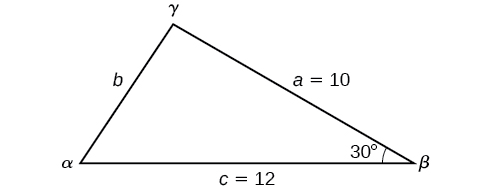
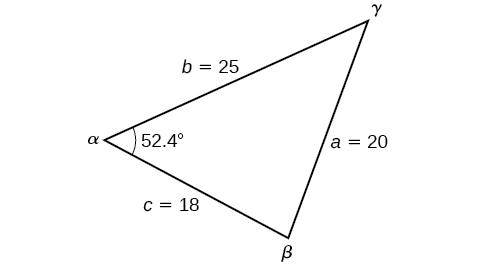
Find the unknown side and angles of the triangle in Figure 4.
図4の三角形の未知の辺と角を求めよ。
Solution 解答
First, make note of what is given: two sides and the angle between them. This arrangement is classified as SAS and supplies the data needed to apply the Law of Cosines.
まず、与えられているものを書き留めよう。二辺とそのあいだの角である。この配置は SAS に分けられ、余弦定理を当てはめるのに要る資料が揃っている。
Each one of the three laws of cosines begins with the square of an unknown side opposite a known angle. For this example, the first side to solve for is side as we know the measurement of the opposite angle
余弦定理の三つの法則はどれも、分かっている角の向かいにある未知の辺の2乗から始まる。この例では、向かいの角 の大きさが分かっているので、まず辺 について解く。
Because we are solving for a length, we use only the positive square root. Now that we know the length we can use the Law of Sines to fill in the remaining angles of the triangle. Solving for angle we have
長さを求めているので、正の平方根だけを使う。長さ が分かったので、正弦定理を使って三角形の残りの角を埋められる。角 について解くと、次が得られる。
The other possibility for would be In the original diagram, is adjacent to the longest side, so is an acute angle and, therefore, does not make sense. Notice that if we choose to apply the Law of Cosines, we arrive at a unique answer. We do not have to consider the other possibilities, as cosine is unique for angles between and Proceeding with we can then find the third angle of the triangle.
のもう一つの可能性は だろう。元の図で は最も長い辺に接しているので は鋭角であり、したがって は意味をなさない。余弦定理を当てはめることにすれば、ただ一つの答えにたどりつくことに注目しよう。余弦は と のあいだの角についてただ一つに定まるので、ほかの可能性を考える必要が無い。 として進めれば、三角形の三つ目の角が求められる。
The complete set of angles and sides is
角と辺の完全な組は次のとおりである。
Try It #1やってみよう1
Find the missing side and angles of the given triangle:
与えられた三角形 、、 の欠けている辺と角を求めよ。
Example 2例2
Solving for an Angle of a SSS TriangleSSS の三角形の角を求める
Find the angle for the given triangle if side side and side
辺 、辺 、辺 の三角形について、角 を求めよ。
Solution 解答
For this example, we have no angles. We can solve for any angle using the Law of Cosines. To solve for angle we have
この例では角が一つも無い。余弦定理を使えばどの角も求められる。角 について解くと、次が得られる。
See Figure 5.
図5を見よ。
Analysis 考察
Because the inverse cosine can return any angle between 0 and 180 degrees, there will not be any ambiguous cases using this method.
逆余弦は0度から180度までのどの角も返せるので、この方法ではあいまいな場合は生じない。
Try It #2やってみよう2
Given and find the missing angles.
と が与えられたとき、欠けている角を求めよ。
Solving Applied Problems Using the Law of Cosines余弦定理を使って応用問題を解く
Just as the Law of Sines provided the appropriate equations to solve a number of applications, the Law of Cosines is applicable to situations in which the given data fits the cosine models. We may see these in the fields of navigation, surveying, astronomy, and geometry, just to name a few.
正弦定理が数多くの応用を解くのにふさわしい式を与えたのと同じく、余弦定理は与えられた資料が余弦のモデルに合う状況に当てはまる。航海・測量・天文・幾何など、いくつも挙げられる分野でこれを見かける。
Example 3例3
Using the Law of Cosines to Solve a Communication Problem余弦定理を使って通信の問題を解く
On many cell phones with GPS, an approximate location can be given before the GPS signal is received. This is accomplished through a process called triangulation, which works by using the distances from two known points. Suppose there are two cell phone towers within range of a cell phone. The two towers are located 6000 feet apart along a straight highway, running east to west, and the cell phone is north of the highway. Based on the signal delay, it can be determined that the signal is 5,050 feet from the first tower and 2,420 feet from the second tower. Determine the position of the cell phone north and east of the first tower, and determine how far it is from the highway.
GPS 付きの携帯電話の多くでは、GPS の信号を受け取る前におおよその位置が示せる。これは三角測量と呼ばれる過程で行われ、分かっている二点からの距離を使う。ある携帯電話の圏内に、携帯電話の基地局が二つあるとしよう。この二つの基地局は、東西に走るまっすぐな幹線道路に沿って6000フィート離れており、携帯電話は道路の北にある。信号の遅れから、信号が一つ目の基地局から5,050フィート、二つ目の基地局から2,420フィートだと決められる。一つ目の基地局から見た携帯電話の北と東の位置を決め、道路からどれだけ離れているかを決めよ。
Solution 解答
For simplicity, we start by drawing a diagram similar to Figure 6 and labeling our given information.
話を簡単にするために、まず図6に似た図を描き、与えられた情報を書き入れる。
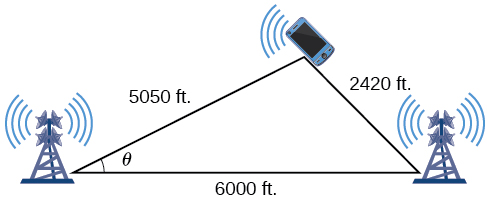
Using the Law of Cosines, we can solve for the angle Remember that the Law of Cosines uses the square of one side to find the cosine of the opposite angle. For this example, let and Thus, corresponds to the opposite side
余弦定理を使えば角 について解ける。余弦定理は、一辺の2乗を使って向かいの角の余弦を求めることを思い出そう。この例では 、 とおく。したがって が向かいの辺 に対応する。
To answer the questions about the phone’s position north and east of the tower, and the distance to the highway, drop a perpendicular from the position of the cell phone, as in Figure 7. This forms two right triangles, although we only need the right triangle that includes the first tower for this problem.
基地局から見た電話の北と東の位置、そして道路までの距離についての問いに答えるために、図7のように携帯電話の位置から垂線を下ろす。これで二つの直角三角形ができるが、この問題では一つ目の基地局を含む直角三角形だけが要る。
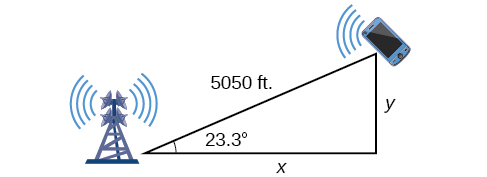
Using the angle and the basic trigonometric identities, we can find the solutions. Thus
角 と基本の三角関数の恒等式を使えば、解が求められる。したがって、
The cell phone is approximately 4,638 feet east and 1998 feet north of the first tower, and 1998 feet from the highway.
この携帯電話は、一つ目の基地局からおよそ東に4,638フィート、北に1998フィートのところにあり、道路から1998フィート離れている。
Example 4例4
Calculating Distance Traveled Using a SAS TriangleSAS の三角形を使って進んだ距離を計算する
Returning to our problem at the beginning of this section, suppose a boat leaves port, travels 10 miles, turns 20 degrees, and travels another 8 miles. How far from port is the boat? The diagram is repeated here in Figure 8.
この節の初めの問題に戻ろう。ある船が港を出て10マイル進み、20度向きを変え、さらに8マイル進んだとする。この船は港からどれだけ離れているか。図を図8に再び示す。
Solution 解答
The boat turned 20 degrees, so the obtuse angle of the non-right triangle is the supplemental angle, With this, we can utilize the Law of Cosines to find the missing side of the obtuse triangle—the distance of the boat to the port.
船は20度向きを変えたので、直角でない三角形の鈍角はその補角 である。これで、余弦定理を使って鈍角三角形の欠けている辺、すなわち船から港までの距離が求められる。
The boat is about 17.7 miles from port.
この船は港からおよそ17.7マイルである。
Using Heron’s Formula to Find the Area of a Triangleヘロンの公式を使って三角形の面積を求める
We already learned how to find the area of an oblique triangle when we know two sides and an angle. We also know the formula to find the area of a triangle using the base and the height. When we know the three sides, however, we can use Heron’s formula instead of finding the height. Heron of Alexandria was a geometer who lived during the first century A.D. He discovered a formula for finding the area of oblique triangles when three sides are known.
二辺と一つの角が分かっているときの一般の三角形の面積の求め方はすでに学んだ。底辺と高さを使って三角形の面積を求める公式も知っている。だが三辺が分かっているときは、高さを求める代わりにヘロンの公式が使える。アレクサンドリアのヘロンは、紀元1世紀に生きた幾何学者である。彼は三辺が分かっているときの一般の三角形の面積を求める公式を見いだした。
Heron’s Formula ヘロンの公式
Heron’s formula finds the area of oblique triangles in which sides and are known.
ヘロンの公式は、辺 と が分かっている一般の三角形の面積を求める。
where is one half of the perimeter of the triangle, sometimes called the semi-perimeter.
ここで は三角形の周の長さの半分で、しばしば半周長と呼ばれる。
Example 5例5
Using Heron’s Formula to Find the Area of a Given Triangleヘロンの公式を使って与えられた三角形の面積を求める
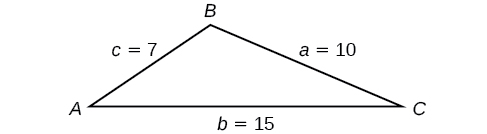
Find the area of the triangle in Figure 9 using Heron’s formula.
ヘロンの公式を使って、図9の三角形の面積を求めよ。
Solution 解答
First, we calculate
まず を計算する。
Then we apply the formula.
そして公式を当てはめる。
The area is approximately 29.4 square units.
面積はおよそ29.4平方単位である。
Try It #3やってみよう3
Use Heron’s formula to find the area of a triangle with sides of lengths and
ヘロンの公式を使って、辺の長さが と の三角形の面積を求めよ。
Example 6例6
Applying Heron’s Formula to a Real-World Problemヘロンの公式を現実の問題に当てはめる
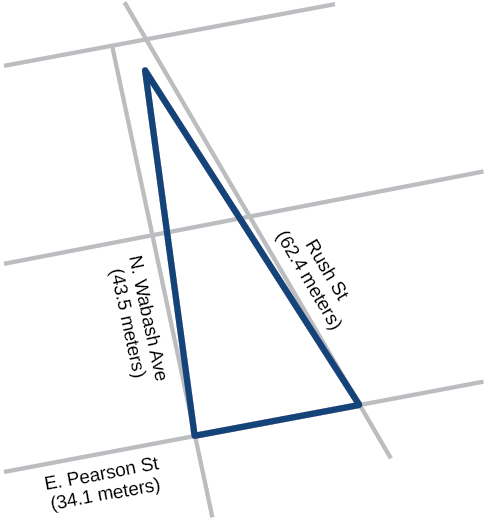
A Chicago city developer wants to construct a building consisting of artist’s lofts on a triangular lot bordered by Rush Street, Wabash Avenue, and Pearson Street. The frontage along Rush Street is approximately 62.4 meters, along Wabash Avenue it is approximately 43.5 meters, and along Pearson Street it is approximately 34.1 meters. How many square meters are available to the developer? See Figure 10 for a view of the city property.
シカゴのある都市開発者が、ラッシュ通り・ウォバッシュ大通り・ピアソン通りに囲まれた三角形の土地に、芸術家の仕事場からなる建物を建てたい。ラッシュ通りに面した幅はおよそ62.4メートル、ウォバッシュ大通りに沿ってはおよそ43.5メートル、ピアソン通りに沿ってはおよそ34.1メートルである。この開発者が使える面積は何平方メートルか。この市有地の眺めは図10を見よ。
Solution 解答
Find the measurement for which is one-half of the perimeter.
周の長さの半分である の値を求める。
Apply Heron’s formula.
ヘロンの公式を当てはめる。
The developer has about 711.4 square meters.
この開発者はおよそ711.4平方メートルを使える。
Try It #4やってみよう4
Find the area of a triangle given and
と が与えられた三角形の面積を求めよ。
Media 教材
Access these online resources for additional instruction and practice with the Law of Cosines.
余弦定理についての説明と練習をさらに求めるなら、次のオンライン教材にあたるとよい。
• Law of Cosines• Law of Cosines: Applications• Law of Cosines: Applications 2
・余弦定理・余弦定理: 応用・余弦定理: 応用 2
Verbal言葉で答える問題
2. If you are looking for a missing angle of a triangle, what do you need to know when using the Law of Cosines?
2. 三角形の欠けている角を求めるとき、余弦定理を使うには何が分かっている必要があるか。
4. Explain the relationship between the Pythagorean Theorem and the Law of Cosines.
4. ピタゴラスの定理と余弦定理の関係を説明せよ。
Algebraic代数の問題
For the following exercises, assume is opposite side is opposite side and is opposite side If possible, solve each triangle for the unknown side. Round to the nearest tenth.
次の各問では、 が辺 の向かい、 が辺 の向かい、 の向かいだとする。できるなら各三角形の未知の辺を求めよ。小数第一位まで丸めよ。
For the following exercises, use the Law of Cosines to solve for the missing angle of the oblique triangle. Round to the nearest tenth.
次の各問について、余弦定理を使って斜三角形の欠けている角を求めよ。小数第一位まで丸めよ。
16. find angle
16. のとき、角 を求めよ。
18. find angle
18. のとき、角 を求めよ。
20. find angle
20. のとき、角 を求めよ。
For the following exercises, solve the triangle. Round to the nearest tenth.
次の各問について、三角形を解け。小数第一位まで丸めよ。
For the following exercises, use Heron’s formula to find the area of the triangle. Round to the nearest hundredth.
次の各問について、ヘロンの公式を使って三角形の面積を求めよ。小数第二位まで丸めよ。
28. Find the area of a triangle with sides of length 20 cm, 26 cm, and 37 cm. Round to the nearest tenth.
28. 辺の長さが20cm、26cm、37cmの三角形の面積を求めよ。小数第一位まで丸めよ。
Graphicalグラフの問題
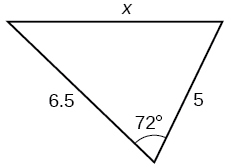
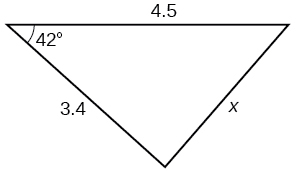
For the following exercises, find the length of side Round to the nearest tenth.
次の各問について、辺 の長さを求めよ。小数第一位まで丸めよ。
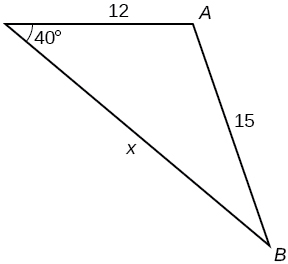
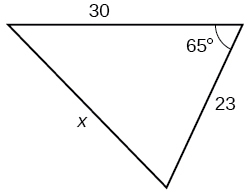
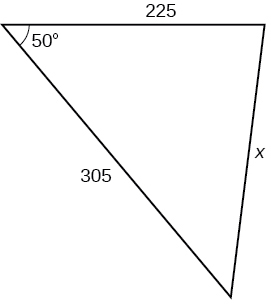
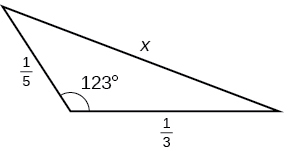
For the following exercises, find the measurement of angle
次の各問について、角 の大きさを求めよ。
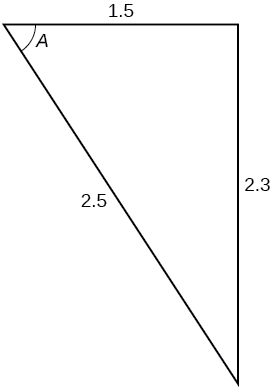
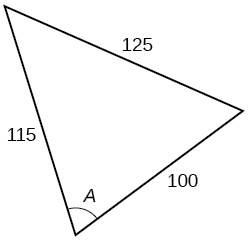
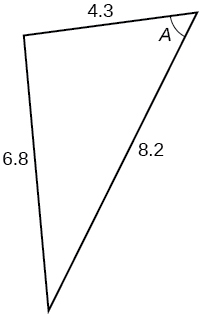
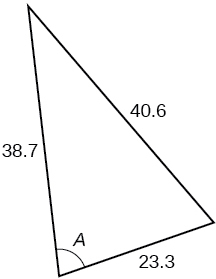
42. Find the measure of each angle in the triangle shown in Figure 11. Round to the nearest tenth.
42. 図11に示した三角形の各角の大きさを求めよ。小数第一位まで丸めよ。
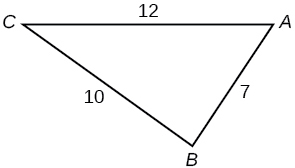
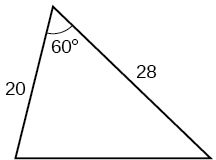
For the following exercises, solve for the unknown side. Round to the nearest tenth.
次の各問について、未知の辺を求めよ。小数第一位まで丸めよ。
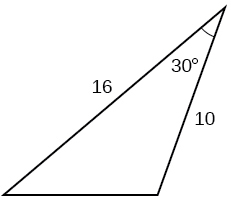
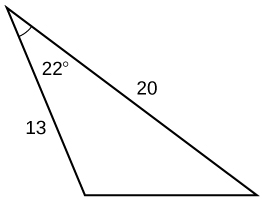
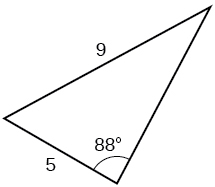
For the following exercises, find the area of the triangle. Round to the nearest hundredth.
次の各問について、三角形の面積を求めよ。小数第二位まで丸めよ。
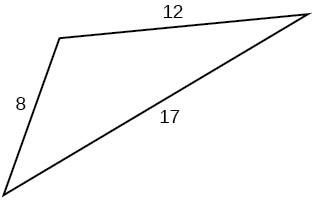
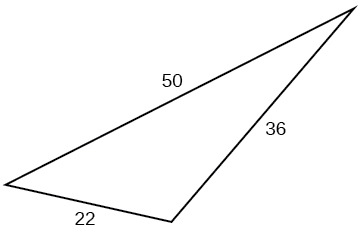
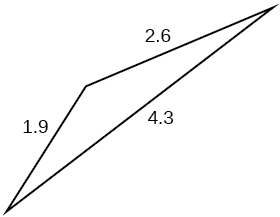
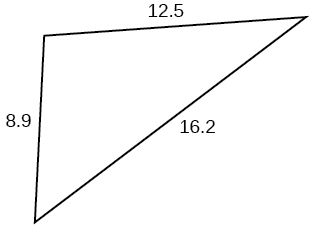
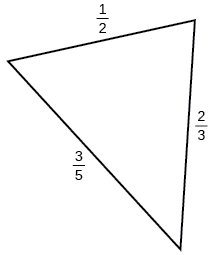
Extensions発展問題
52. A parallelogram has sides of length 16 units and 10 units. The shorter diagonal is 12 units. Find the measure of the longer diagonal.
52. ある平行四辺形の辺の長さは16単位と10単位である。短いほうの対角線は12単位である。長いほうの対角線の長さを求めよ。
54. The sides of a parallelogram are 28 centimeters and 40 centimeters. The measure of the larger angle is 100°. Find the length of the shorter diagonal.
54. ある平行四辺形の辺は28センチメートルと40センチメートルである。大きいほうの角の大きさは100°である。短いほうの対角線の長さを求めよ。
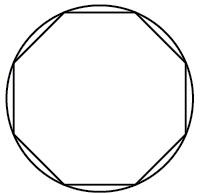
55. A regular octagon is inscribed in a circle with a radius of 8 inches. (See Figure 12.) Find the perimeter of the octagon.
55. 正八角形が半径8インチの円に内接している。(図12を見よ。)この八角形の周の長さを求めよ。
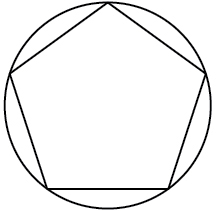
56. A regular pentagon is inscribed in a circle of radius 12 cm. (See Figure 13.) Find the perimeter of the pentagon. Round to the nearest tenth of a centimeter.
56. 正五角形が半径12cmの円に内接している。(図13を見よ。)この五角形の周の長さを求めよ。センチメートルの小数第一位まで丸めよ。
For the following exercises, suppose that represents the relationship of three sides of a triangle and the cosine of an angle.
次の各問では、 が三角形の三辺とある角の余弦の関係を表すとする。
58. Find the length of the third side.
58. 三つ目の辺の長さを求めよ。
For the following exercises, find the area of the triangle.
次の各問について、三角形の面積を求めよ。
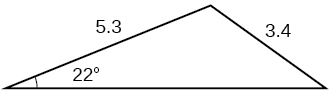
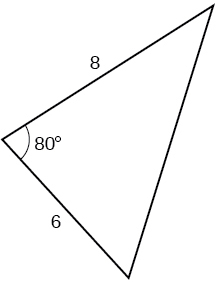
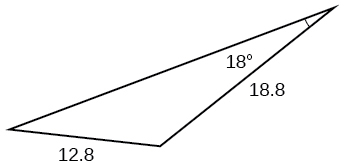
Real-World Applications応用問題
62. A surveyor has taken the measurements shown in Figure 14. Find the distance across the lake. Round answers to the nearest tenth.
62. ある測量士が図14に示す測量をした。湖を横切る距離を求めよ。答えは小数第一位まで丸めよ。
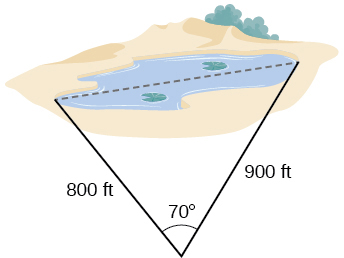
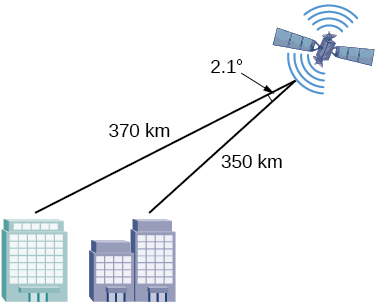
63. A satellite calculates the distances and angle shown in Figure 15 (not to scale). Find the distance between the two cities. Round answers to the nearest tenth.
63. ある人工衛星が図15(縮尺は正しくない)に示す距離と角を計算する。二つの都市のあいだの距離を求めよ。答えは小数第一位まで丸めよ。
64. An airplane flies 220 miles with a heading of 40°, and then flies 180 miles with a heading of 170°. How far is the plane from its starting point, and at what heading? Round answers to the nearest tenth.
64. ある飛行機が針路40°で220マイル飛び、それから針路170°で180マイル飛ぶ。この飛行機は出発点からどれだけ離れており、どの針路の向きにあるか。答えは小数第一位まで丸めよ。
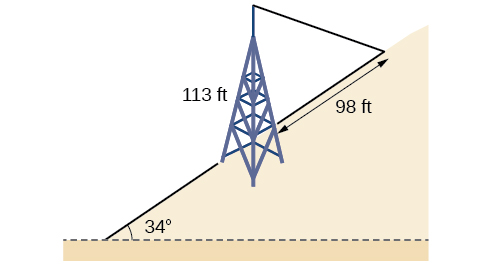
65. A 113-foot tower is located on a hill that is inclined 34° to the horizontal, as shown in Figure 16. A guy-wire is to be attached to the top of the tower and anchored at a point 98 feet uphill from the base of the tower. Find the length of wire needed.
65. 図16に示すとおり、高さ113フィートの塔が水平から34°傾いた丘の上にある。塔の頂上と、塔の根元から丘を98フィート上ったところに支線を張る。要る線の長さを求めよ。
66. Two ships left a port at the same time. One ship traveled at a speed of 18 miles per hour at a heading of 320°. The other ship traveled at a speed of 22 miles per hour at a heading of 194°. Find the distance between the two ships after 10 hours of travel.
66. 二隻の船が同時に港を出た。一隻は針路320°で毎時18マイルの速さで進んだ。もう一隻は針路194°で毎時22マイルの速さで進んだ。10時間進んだ後の二隻の距離を求めよ。
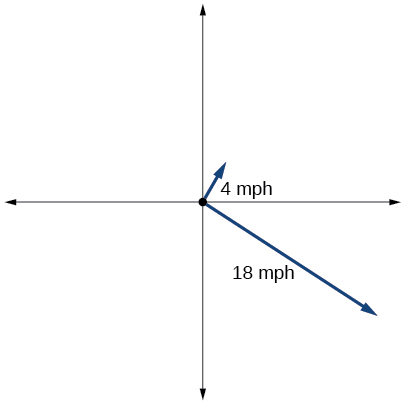
67. The graph in Figure 17 represents two boats departing at the same time from the same dock. The first boat is traveling at 18 miles per hour at a heading of 327° and the second boat is traveling at 4 miles per hour at a heading of 60°. Find the distance between the two boats after 2 hours.
67. 図17のグラフは、同じ桟橋から同時に出発する二隻の船を表している。一隻目は針路327°で毎時18マイル、二隻目は針路60°で毎時4マイルで進んでいる。2時間後の二隻の距離を求めよ。
68. A triangular swimming pool measures 40 feet on one side and 65 feet on another side. These sides form an angle that measures 50°. How long is the third side (to the nearest tenth)?
68. ある三角形のプールは、一辺が40フィート、もう一辺が65フィートである。この二辺は50°の角をなす。三つ目の辺の長さはいくらか(小数第一位まで)。
69. A pilot flies in a straight path for 1 hour 30 min. She then makes a course correction, heading 10° to the right of her original course, and flies 2 hours in the new direction. If she maintains a constant speed of 680 miles per hour, how far is she from her starting position?
69. ある操縦士が1時間30分まっすぐに飛ぶ。それから針路を元の針路の右10°に修正し、新しい向きに2時間飛ぶ。速さを毎時680マイルに保つとき、彼女は出発点からどれだけ離れているか。
70. Los Angeles is 1,744 miles from Chicago, Chicago is 714 miles from New York, and New York is 2,451 miles from Los Angeles. Draw a triangle connecting these three cities, and find the angles in the triangle.
70. ロサンゼルスはシカゴから1,744マイル、シカゴはニューヨークから714マイル、ニューヨークはロサンゼルスから2,451マイルである。この三つの都市を結ぶ三角形を描き、その三角形の角を求めよ。
71. Philadelphia is 140 miles from Washington, D.C., Washington, D.C. is 442 miles from Boston, and Boston is 315 miles from Philadelphia. Draw a triangle connecting these three cities and find the angles in the triangle.
71. フィラデルフィアはワシントンD.C.から140マイル、ワシントンD.C.はボストンから442マイル、ボストンはフィラデルフィアから315マイルである。この三つの都市を結ぶ三角形を描き、その三角形の角を求めよ。
72. Two planes leave the same airport at the same time. One flies at 20° east of north at 500 miles per hour. The second flies at 30° east of south at 600 miles per hour. How far apart are the planes after 2 hours?
72. 二機の飛行機が同時に同じ空港を発つ。一機は北から東へ20°の向きに毎時500マイルで飛ぶ。二機目は南から東へ30°の向きに毎時600マイルで飛ぶ。2時間後、この二機はどれだけ離れているか。
73. Two airplanes take off in different directions. One travels 300 mph due west and the other travels 25° north of west at 420 mph. After 90 minutes, how far apart are they, assuming they are flying at the same altitude?
73. 二機の飛行機が違う向きに飛び立つ。一機は毎時300マイルで真西に、もう一機は毎時420マイルで西から北へ25°の向きに進む。同じ高度で飛んでいるとして、90分後、この二機はどれだけ離れているか。
74. A parallelogram has sides of length 15.4 units and 9.8 units. Its area is 72.9 square units. Find the measure of the longer diagonal.
74. ある平行四辺形の辺の長さは15.4単位と9.8単位である。その面積は72.9平方単位である。長いほうの対角線の長さを求めよ。
76. The four sequential sides of a quadrilateral have lengths 5.7 cm, 7.2 cm, 9.4 cm, and 12.8 cm. The angle between the two smallest sides is 106°. What is the area of this quadrilateral?
76. ある四角形の順に並んだ四辺の長さは5.7cm、7.2cm、9.4cm、12.8cmである。最も小さい二辺のあいだの角は106°である。この四角形の面積はいくらか。
78. Find the area of a triangular piece of land that measures 110 feet on one side and 250 feet on another; the included angle measures 85°. Round to the nearest whole square foot.
78. 一辺が110フィート、もう一辺が250フィートで、そのあいだの角が85°の三角形の土地の面積を求めよ。平方フィートの整数に丸めよ。