第10章三角法のさらなる応用Further Applications of Trigonometry
10.6 Parametric Equations10.6 媒介変数表示
Learning Objectives 学習目標
In this section, you will:
この節を終えると、次のことができるようになる。
• Parameterize a curve.• Eliminate the parameter.• Find a rectangular equation for a curve defined parametrically.• Find parametric equations for curves defined by rectangular equations.
・曲線を媒介変数で表す。・媒介変数を消去する。・媒介変数で定められた曲線の直交座標での方程式を求める。・直交座標での方程式で定められた曲線の媒介変数表示を求める。
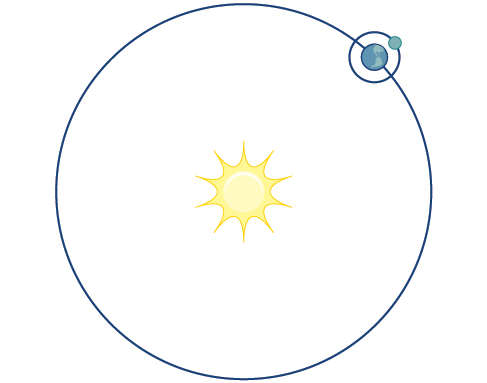
Consider the path a moon follows as it orbits a planet, which simultaneously rotates around the sun, as seen in Figure 1. At any moment, the moon is located at a particular spot relative to the planet. But how do we write and solve the equation for the position of the moon when the distance from the planet, the speed of the moon’s orbit around the planet, and the speed of rotation around the sun are all unknowns? We can solve only for one variable at a time.
図1に見るとおり、惑星のまわりを回りながら、その惑星が同時に太陽のまわりを回る、衛星のたどる道筋を考えよう。どの瞬間にも、衛星は惑星に対してある位置にある。だが、惑星からの距離、衛星が惑星を回る速さ、太陽のまわりを回る速さがどれも未知のとき、衛星の位置の式をどう書いて解けばよいのか。一度に一つの変数についてしか解けない。
In this section, we will consider sets of equations given by and where is the independent variable of time. We can use these parametric equations in a number of applications when we are looking for not only a particular position but also the direction of the movement. As we trace out successive values of the orientation of the curve becomes clear. This is one of the primary advantages of using parametric equations: we are able to trace the movement of an object along a path according to time. We begin this section with a look at the basic components of parametric equations and what it means to parameterize a curve. Then we will learn how to eliminate the parameter, translate the equations of a curve defined parametrically into rectangular equations, and find the parametric equations for curves defined by rectangular equations.
この節では、 と で与えられる式の組を考える。ここで は時間という独立変数である。この媒介変数表示は、ある位置だけでなく動きの向きも求めたいとき、数多くの応用で使える。 の値を次々にたどると、曲線の向きがはっきりしてくる。これが媒介変数表示を使う主な利点の一つである。時間に応じて物の道筋に沿った動きをたどれるのである。この節では、媒介変数表示の基本の成分と、曲線を媒介変数で表すとはどういうことかを見ることから始める。そして媒介変数を消し、媒介変数で定められた曲線の式を直交座標での方程式に移し、直交座標での方程式で定められた曲線の媒介変数表示を求める方法を学ぶ。
Parameterizing a Curve曲線を媒介変数で表す
When an object moves along a curve—or curvilinear path—in a given direction and in a given amount of time, the position of the object in the plane is given by the x-coordinate and the y-coordinate. However, both and vary over time and so are functions of time. For this reason, we add another variable, the parameter, upon which both and are dependent functions. In the example in the section opener, the parameter is time, The position of the moon at time, is represented as the function and the position of the moon at time, is represented as the function Together, and are called parametric equations, and generate an ordered pair Parametric equations primarily describe motion and direction.
物がある向きに、ある時間だけ曲線——すなわち曲がった道筋——に沿って動くとき、平面上のその物の位置は x座標と y座標で与えられる。だが も も時間とともに変わるので、どちらも時間の関数である。このため、もう一つの変数、すなわち媒介変数を加える。 も もこれに依る関数である。この節の初めの例では、媒介変数は時間 である。時刻 の衛星の の位置は関数 として表され、時刻 の衛星の の位置は関数 として表される。合わせて と を媒介変数表示といい、順序対 を生む。媒介変数表示は主に運動と向きを述べる。
When we parameterize a curve, we are translating a single equation in two variables, such as and into an equivalent pair of equations in three variables, and One of the reasons we parameterize a curve is because the parametric equations yield more information: specifically, the direction of the object’s motion over time.
曲線を媒介変数で表すとき、 と のような二変数の一つの式を、三変数 と の同値な二つの式に移している。曲線を媒介変数で表す理由の一つは、媒介変数表示のほうが多くの情報を生むからである。具体的には、時間とともに変わる物の動きの向きである。
When we graph parametric equations, we can observe the individual behaviors of and of There are a number of shapes that cannot be represented in the form meaning that they are not functions. For example, consider the graph of a circle, given as Solving for gives or two equations: and If we graph and together, the graph will not pass the vertical line test, as shown in Figure 2. Thus, the equation for the graph of a circle is not a function.
媒介変数表示のグラフを描くと、 と それぞれのふるまいが見てとれる。 の形で表せない形は数多くある。つまり関数でないということである。たとえば で与えられる円のグラフを考えよう。 について解くと 、すなわち二つの式 と が得られる。 と を一緒に描くと、図2に示すとおり、グラフは縦の直線の判定に落ちる。よって円のグラフの式は関数でない。
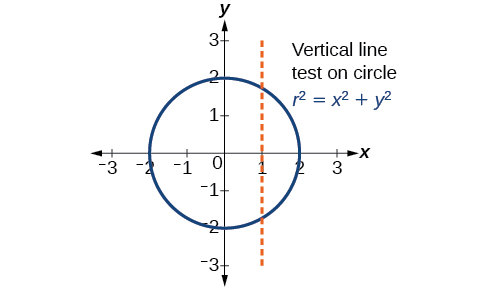
However, if we were to graph each equation on its own, each one would pass the vertical line test and therefore would represent a function. In some instances, the concept of breaking up the equation for a circle into two functions is similar to the concept of creating parametric equations, as we use two functions to produce a non-function. This will become clearer as we move forward.
だが、それぞれの式を単独で描けば、どちらも縦の直線の判定に通り、したがって関数を表す。円の式を二つの関数に分けるという考えは、二つの関数を使って関数でないものを生むという点で、媒介変数表示を作る考えに似ている場合がある。これは進むにつれてはっきりする。
Parametric Equations 媒介変数表示
Suppose is a number on an interval, The set of ordered pairs, where and forms a plane curve based on the parameter The equations and are the parametric equations.
を区間 上の数とする。 かつ である順序対の集合 が、媒介変数 にもとづく平面曲線をなす。式 と が媒介変数表示である。
Example 1例1
Parameterizing a Curve曲線を媒介変数で表す
Parameterize the curve letting Graph both equations.
とおいて、曲線 を媒介変数で表せ。両方の式のグラフを描け。
Solution 解答
If then to find we replace the variable with the expression given in In other words, Make a table of values similar to Table 1, and sketch the graph.
なら、 を求めるために変数 を で与えられた式に置き換える。言い換えれば である。表1のような値の表を作り、グラフの概形を描く。
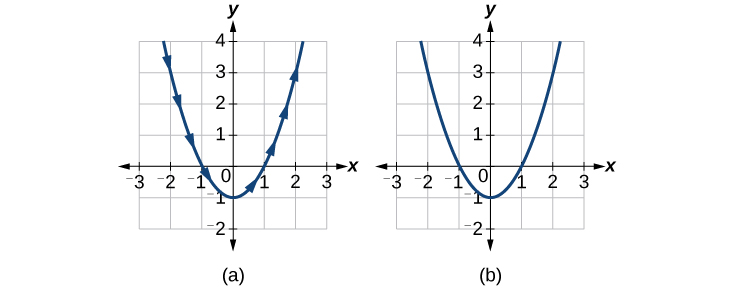
See the graphs in Figure 3. It may be helpful to use the TRACE feature of a graphing calculator to see how the points are generated as increases.
図3のグラフを見よ。グラフ電卓の TRACE 機能を使うと、 が増えるにつれて点がどう生まれるかが見てとれて役立つかもしれない。
Analysis 考察
The arrows indicate the direction in which the curve is generated. Notice the curve is identical to the curve of
矢印はこの曲線が生まれる向きを示す。この曲線が の曲線と同じであることに注目しよう。
Try It #1やってみよう1
Construct a table of values and plot the parametric equations:
値の表を作り、媒介変数表示 を打て。
Example 2例2
Finding a Pair of Parametric Equations媒介変数表示の組を求める
Find a pair of parametric equations that models the graph of using the parameter Plot some points and sketch the graph.
媒介変数 を使って、 のグラフのモデルとなる媒介変数表示の組を求めよ。いくつか点を打ち、グラフの概形を描け。
Solution 解答
If and we substitute for into the equation, then Our pair of parametric equations is
とし、 の式の に を代入すると となる。媒介変数表示の組は次のとおりである。
To graph the equations, first we construct a table of values like that in Table 2. We can choose values around from to The values in the column will be the same as those in the column because Calculate values for the column
この式のグラフを描くには、まず表2のような値の表を作る。 のまわりで から までの値を選べる。 なので、 列の値は 列と同じになる。 列の値を計算する。
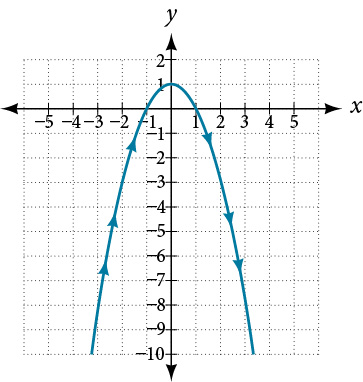
The graph of is a parabola facing downward, as shown in Figure 4. We have mapped the curve over the interval shown as a solid line with arrows indicating the orientation of the curve according to Orientation refers to the path traced along the curve in terms of increasing values of As this parabola is symmetric with respect to the line the values of are reflected across the y-axis.
図4に示すとおり、 のグラフは下に開く放物線である。区間 でこの曲線を描いてある。実線で示し、矢印が に応じた曲線の向きを示す。向きとは、 の値が増えるのに応じて曲線に沿ってたどる道筋のことである。この放物線は直線 に関して対称なので、 の値は y軸に関して折り返される。
Try It #2やってみよう2
Parameterize the curve given by
で与えられる曲線を媒介変数で表せ。
Example 3例3
Finding Parametric Equations That Model Given Criteria与えられた条件のモデルとなる媒介変数表示を求める
An object travels at a steady rate along a straight path to in the same plane in four seconds. The coordinates are measured in meters. Find parametric equations for the position of the object.
ある物が、同じ平面上を から までまっすぐな道筋を一定の割合で4秒で進む。座標はメートルで測る。この物の位置の媒介変数表示を求めよ。
Solution 解答
The parametric equations are simple linear expressions, but we need to view this problem in a step-by-step fashion. The x-value of the object starts at meters and goes to 3 meters. This means the distance x has changed by 8 meters in 4 seconds, which is a rate of or We can write the x-coordinate as a linear function with respect to time as In the linear function template and
媒介変数表示は単純な一次の式だが、この問題は一歩ずつ見ていく必要がある。この物の x の値は メートルから始まり、3メートルまで進む。つまり距離 x は4秒で8メートル変わり、割合は すなわち である。x座標は時間についての一次関数 として書ける。一次関数の雛形では 、 である。
Similarly, the y-value of the object starts at 3 and goes to which is a change in the distance y of −4 meters in 4 seconds, which is a rate of or We can also write the y-coordinate as the linear function Together, these are the parametric equations for the position of the object, where and are expressed in meters and represents time:
同じように、この物の y の値は3から始まり まで進む。これは距離 y が4秒で−4メートル変わることであり、割合は すなわち である。y座標も一次関数 として書ける。合わせて、これがこの物の位置の媒介変数表示である。ここで と はメートルで表され、 は時間を表す。
Using these equations, we can build a table of values for and (see Table 3). In this example, we limited values of to non-negative numbers. In general, any value of can be used.
この式を使えば、 と の値の表が作れる(表3を見よ)。この例では の値を0以上の数に限った。一般には、 のどの値も使える。
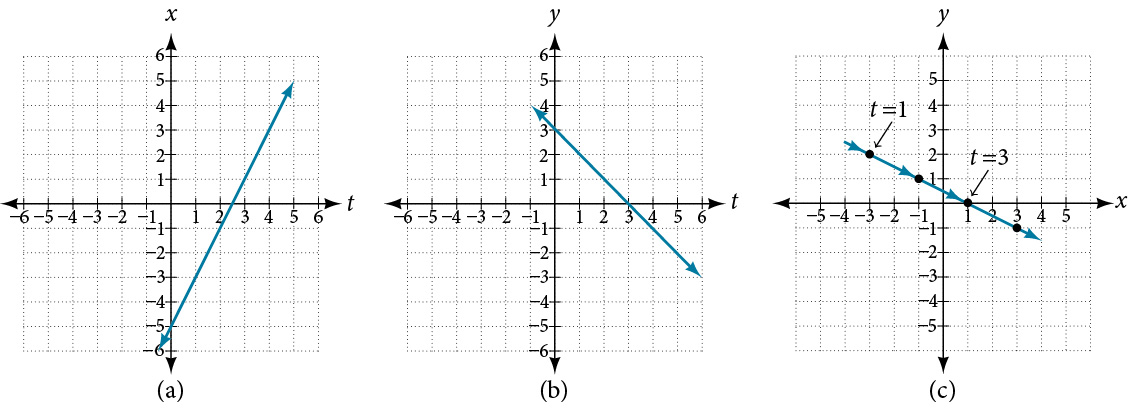
From this table, we can create three graphs, as shown in Figure 5.
この表から、図5に示す三つのグラフが作れる。
Analysis 考察
Again, we see that, in Figure 5(c), when the parameter represents time, we can indicate the movement of the object along the path with arrows.
ここでも、図5(c)で媒介変数が時間を表すとき、矢印で道筋に沿った物の動きが示せると分かる。
Eliminating the Parameter媒介変数を消去する
In many cases, we may have a pair of parametric equations but find that it is simpler to draw a curve if the equation involves only two variables, such as and Eliminating the parameter is a method that may make graphing some curves easier. However, if we are concerned with the mapping of the equation according to time, then it will be necessary to indicate the orientation of the curve as well. There are various methods for eliminating the parameter from a set of parametric equations; not every method works for every type of equation. Here we will review the methods for the most common types of equations.
多くの場合、媒介変数表示の組があっても、 と のように二変数だけを含む式のほうが曲線を描きやすいと気づく。媒介変数を消去するのは、曲線によってはグラフを描くのを楽にする方法である。だが時間に応じた式の描き方が問題なら、曲線の向きも示す必要がある。媒介変数表示の組から媒介変数 を消す方法はいくつもあり、どの方法もどの種類の式にも使えるわけではない。ここでは、最もよくある種類の式についての方法を振り返る。
Eliminating the Parameter from Polynomial, Exponential, and Logarithmic Equations多項式・指数・対数の式から媒介変数を消去する
For polynomial, exponential, or logarithmic equations expressed as two parametric equations, we choose the equation that is most easily manipulated and solve for We substitute the resulting expression for into the second equation. This gives one equation in and
二つの媒介変数表示として表された多項式・指数・対数の式では、最も変形しやすい式を選んで について解く。できあがった の式をもう一方の式に代入する。これで と の一つの式が得られる。
Example 4例4
Eliminating the Parameter in Polynomials多項式で媒介変数を消去する
Given and eliminate the parameter, and write the parametric equations as a Cartesian equation.
と が与えられたとき、媒介変数を消して、この媒介変数表示をデカルトの式として書け。
Solution 解答
We will begin with the equation for because the linear equation is easier to solve for
一次の式のほうが について解きやすいので、 の式から始める。
Next, substitute for in
次に の に を代入する。
The Cartesian form is
デカルト形式は である。
Analysis 考察
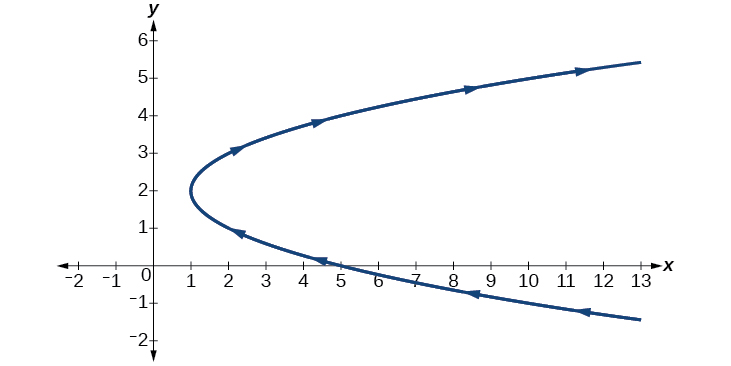
This is an equation for a parabola in which, in rectangular terms, is dependent on From the curve’s vertex at the graph sweeps out to the right. See Figure 6. In this section, we consider sets of equations given by the functions and where is the independent variable of time. Notice, both and are functions of time; so in general is not a function of
これは、直交の言い方では が に依る放物線の式である。 の曲線の頂点から、グラフは右へ広がる。図6を見よ。この節では、関数 と で与えられる式の組を考える。ここで は時間という独立変数である。 も も時間の関数であることに注目しよう。よって一般に は の関数ではない。
Try It #3やってみよう3
Given the equations below, eliminate the parameter and write as a rectangular equation for as a function of
次の式が与えられたとき、媒介変数を消し、 の関数としての の直交座標での方程式として書け。
Example 5例5
Eliminating the Parameter in Exponential Equations指数の式で媒介変数を消去する
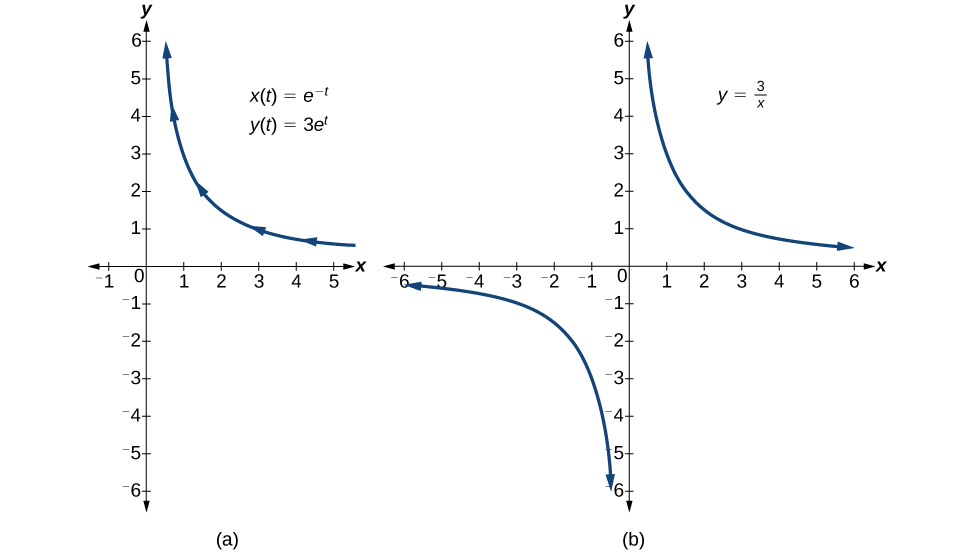
Eliminate the parameter and write as a Cartesian equation: and
媒介変数を消し、デカルトの式として書け: と
Solution 解答
Isolate
を取り出す。
Substitute the expression into
この式を に代入する。
The Cartesian form is
デカルト形式は である。
Example 6例6
Eliminating the Parameter in Logarithmic Equations対数の式で媒介変数を消去する
Eliminate the parameter and write as a Cartesian equation: and
媒介変数を消し、デカルトの式として書け: と
Solution 解答
Solve the first equation for
一つ目の式を について解く。
Then, substitute the expression for into the equation.
そして の式を の式に代入する。
The Cartesian form is
デカルト形式は である。
Analysis 考察
To be sure that the parametric equations are equivalent to the Cartesian equation, check the domains. The parametric equations restrict the domain on to we restrict the domain on to The domain for the parametric equation is restricted to we limit the domain on to
媒介変数表示がデカルトの式と同値であることを確かめるために、定義域を調べる。媒介変数表示は の定義域を に制限するので、 の定義域を に限る。媒介変数表示 の定義域は に制限されるので、 の定義域を に限る。
Try It #4やってみよう4
Eliminate the parameter and write as a rectangular equation.
媒介変数を消し、直交座標での方程式として書け。
Eliminating the Parameter from Trigonometric Equations三角関数の式から媒介変数を消去する
Eliminating the parameter from trigonometric equations is a straightforward substitution. We can use a few of the familiar trigonometric identities and the Pythagorean Theorem.
三角関数の式から媒介変数を消去するのは、まっすぐな置き換えである。よく知られた三角関数の恒等式のいくつかと、ピタゴラスの定理が使える。
First, we use the identities:
まず次の等式を使う。
Solving for and we have
と について解くと、次が得られる。
Then, use the Pythagorean Theorem:
そしてピタゴラスの定理を使う。
Substituting gives
代入すると次が得られる。
Example 7例7
Eliminating the Parameter from a Pair of Trigonometric Parametric Equations三角の媒介変数表示の組から媒介変数を消去する
Eliminate the parameter from the given pair of trigonometric equations where and sketch the graph.
である与えられた三角関数の式の組から媒介変数を消し、グラフの概形を描け。
Solution 解答
Solving for and we have
と について解くと、次が得られる。
Next, use the Pythagorean identity and make the substitutions.
次にピタゴラスの等式を使って置き換える。
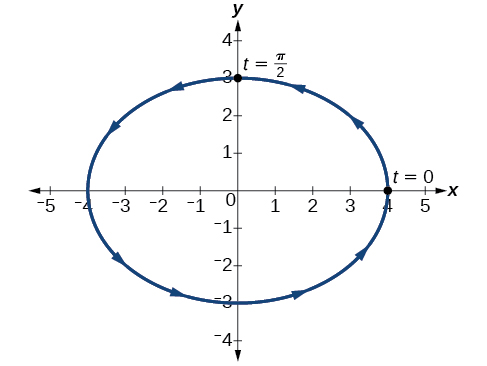
The graph for the equation is shown in Figure 8.
この式のグラフを図8に示す。
Analysis 考察
Applying the general equations for conic sections (introduced in Analytic Geometry, we can identify as an ellipse centered at Notice that when the coordinates are and when the coordinates are This shows the orientation of the curve with increasing values of
円錐曲線の一般の式(「解析幾何」で導入する)を当てはめれば、 が を中心とする楕円だと見分けられる。 のとき座標が であり、 のとき座標が であることに注目しよう。これは の値が増えるのに応じた曲線の向きを示している。
Try It #5やってみよう5
Eliminate the parameter from the given pair of parametric equations and write as a Cartesian equation: and
与えられた媒介変数表示の組から媒介変数を消し、デカルトの式として書け: と
Finding Cartesian Equations from Curves Defined Parametrically媒介変数で定められた曲線からデカルトの式を求める
When we are given a set of parametric equations and need to find an equivalent Cartesian equation, we are essentially “eliminating the parameter.” However, there are various methods we can use to rewrite a set of parametric equations as a Cartesian equation. The simplest method is to set one equation equal to the parameter, such as In this case, can be any expression. For example, consider the following pair of equations.
媒介変数表示の組が与えられ、同値なデカルトの式を求める必要があるとき、それは要するに「媒介変数を消去する」ことである。だが、媒介変数表示の組をデカルトの式に書き直す方法はいくつもある。最も単純な方法は、一方の式を媒介変数に等しいとおくことである。たとえば とする。この場合、 はどんな式でもよい。たとえば次の式の組を考えよう。
Rewriting this set of parametric equations is a matter of substituting for Thus, the Cartesian equation is
この媒介変数表示の組を書き直すのは、 に を代入することである。よってデカルトの式は である。
Example 8例8
Finding a Cartesian Equation Using Alternate Methods別の方法でデカルトの式を求める
Use two different methods to find the Cartesian equation equivalent to the given set of parametric equations.
二つの違う方法を使って、与えられた媒介変数表示の組と同値なデカルトの式を求めよ。
Solution 解答
Method 1. First, let’s solve the equation for Then we can substitute the result into the equation.
方法1。まず の式を について解こう。そしてその結果を の式に代入できる。
Now substitute the expression for into the equation.
次に の式を の式に代入する。
Method 2. Solve the equation for and substitute this expression in the equation.
方法2。 の式を について解き、この式を の式に代入する。
Make the substitution and then solve for
代入し、それから について解く。
Try It #6やってみよう6
Write the given parametric equations as a Cartesian equation: and
与えられた媒介変数表示をデカルトの式として書け: と
Finding Parametric Equations for Curves Defined by Rectangular Equations直交座標での方程式で定められた曲線の媒介変数表示を求める
Although we have just shown that there is only one way to interpret a set of parametric equations as a rectangular equation, there are multiple ways to interpret a rectangular equation as a set of parametric equations. Any strategy we may use to find the parametric equations is valid if it produces equivalency. In other words, if we choose an expression to represent and then substitute it into the equation, and it produces the same graph over the same domain as the rectangular equation, then the set of parametric equations is valid. If the domain becomes restricted in the set of parametric equations, and the function does not allow the same values for as the domain of the rectangular equation, then the graphs will be different.
媒介変数表示の組を直交座標での方程式として読む道が一つしかないことは今示したが、直交座標での方程式を媒介変数表示の組として読む道は何通りもある。同値になりさえすれば、媒介変数表示を求めるのにどんな手立てを使ってもよい。言い換えれば、 を表す式を選び、それを の式に代入して、直交座標での方程式と同じ定義域で同じグラフが得られるなら、その媒介変数表示の組は正しい。媒介変数表示の組で定義域が制限され、直交座標での方程式の定義域と同じ の値をその関数が許さないなら、グラフは違ってくる。
Example 9例9
Finding a Set of Parametric Equations for Curves Defined by Rectangular Equations直交座標での方程式で定められた曲線の媒介変数表示の組を求める
Find a set of equivalent parametric equations for
と同値な媒介変数表示の組を求めよ。
Solution 解答
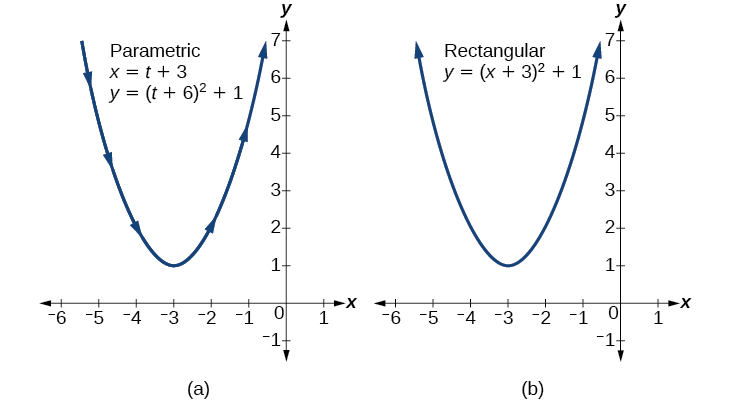
An obvious choice would be to let Then But let’s try something more interesting. What if we let Then we have
当たり前の選び方は とすることだろう。すると である。だがもっと面白いことを試してみよう。 としたらどうか。すると次が得られる。
The set of parametric equations is
媒介変数表示の組は次のとおりである。
See Figure 9.
図9を見よ。
Media 教材
Access these online resources for additional instruction and practice with parametric equations.
媒介変数表示についての説明と練習をさらに求めるなら、次のオンライン教材にあたるとよい。
• Introduction to Parametric Equations• Converting Parametric Equations to Rectangular Form
・媒介変数表示への導入・媒介変数表示を直交形式に直す
Verbal言葉で答える問題
2. Some examples of a third parameter are time, length, speed, and scale. Explain when time is used as a parameter.
2. 三つ目の媒介変数の例には、時間・長さ・速さ・尺度がある。時間が媒介変数として使われるのはどんなときかを説明せよ。
4. What is a benefit of writing a system of parametric equations as a Cartesian equation?
4. 媒介変数表示の組をデカルトの式として書く利点は何か。
6. Why are there many sets of parametric equations to represent on Cartesian function?
6. 一つのデカルトの関数を表す媒介変数表示の組が数多くあるのはなぜか。
Algebraic代数の問題
For the following exercises, eliminate the parameter to rewrite the parametric equation as a Cartesian equation.
次の各問について、媒介変数 を消して、媒介変数表示をデカルトの式に書き直せ。
For the following exercises, rewrite the parametric equation as a Cartesian equation by building an table.
次の各問について、 の表を作って、媒介変数表示をデカルトの式に書き直せ。
For the following exercises, parameterize (write parametric equations for) each Cartesian equation by setting or by setting
次の各問について、 とおくか とおいて、各デカルトの式を媒介変数で表せ(媒介変数表示を書け)。
For the following exercises, parameterize (write parametric equations for) each Cartesian equation by using and Identify the curve.
次の各問について、 と を使って、各デカルトの式を媒介変数で表せ(媒介変数表示を書け)。その曲線を見分けよ。
38. Parameterize the line from to so that the line is at at and at at
38. で 、 で になるように、 から までの直線を媒介変数で表せ。
40. Parameterize the line from to so that the line is at at and at at
40. で 、 で になるように、 から までの直線を媒介変数で表せ。
Technology機器を使う問題
For the following exercises, use the table feature in the graphing calculator to determine whether the graphs intersect.
次の各問について、グラフ電卓の表の機能を使って、グラフが交わるかどうかを判定せよ。
式中の英語:and:および
式中の英語:and:および
For the following exercises, use a graphing calculator to complete the table of values for each set of parametric equations.
次の各問について、グラフ電卓を使って、各媒介変数表示の組の値の表を埋めよ。
| –1 | ||
| 0 | ||
| 1 |
| 1 | ||
| 2 | ||
| 3 |
| -1 | ||
| 0 | ||
| 1 | ||
| 2 |