第10章三角法のさらなる応用Further Applications of Trigonometry
10.5 Polar Form of Complex Numbers10.5 複素数の極形式
Learning Objectives 学習目標
In this section, you will:
この節を終えると、次のことができるようになる。
• Plot complex numbers in the complex plane.• Find the absolute value of a complex number.• Write complex numbers in polar form.• Convert a complex number from polar to rectangular form.• Find products of complex numbers in polar form.• Find quotients of complex numbers in polar form.• Find powers of complex numbers in polar form.• Find roots of complex numbers in polar form.
・複素数を複素平面上の点として表す。・複素数の絶対値を求める。・複素数を極形式で書く。・複素数を極形式から直交形式に直す。・極形式で複素数の積を求める。・極形式で複素数の商を求める。・極形式で複素数の累乗を求める。・極形式で複素数の根を求める。
“God made the integers; all else is the work of man.” This rather famous quote by nineteenth-century German mathematician Leopold Kronecker sets the stage for this section on the polar form of a complex number. Complex numbers were invented by people and represent over a thousand years of continuous investigation and struggle by mathematicians such as Pythagoras, Descartes, De Moivre, Euler, Gauss, and others. Complex numbers answered questions that for centuries had puzzled the greatest minds in science.
「神は整数を作った。ほかはすべて人の業である。」19世紀ドイツの数学者レオポルト・クロネッカーのこのかなり有名な言葉が、複素数の極形式についてのこの節の舞台を整える。複素数は人が生み出したもので、ピタゴラス、デカルト、ド・モアブル、オイラー、ガウスらの数学者による千年を超える絶え間ない探究と苦闘を表している。複素数は、何世紀ものあいだ科学の最も優れた頭脳を悩ませてきた問いに答えた。
We first encountered complex numbers in Complex Numbers. In this section, we will focus on the mechanics of working with complex numbers: translation of complex numbers from polar form to rectangular form and vice versa, interpretation of complex numbers in the scheme of applications, and application of De Moivre’s Theorem.
複素数には「複素数」で初めて出会った。この節では、複素数を扱う仕組みに絞る。複素数を極形式から直交形式へ、またその逆に移すこと、応用の枠組みでの複素数の読み解き、そしてド・モアブルの定理の当てはめである。
Plotting Complex Numbers in the Complex Plane複素数を複素平面上の点として表す
Plotting a complex number is similar to plotting a real number, except that the horizontal axis represents the real part of the number, and the vertical axis represents the imaginary part of the number,
複素数 を打つのは実数を打つのに似ているが、横軸がその数の実部 を、縦軸がその数の虚部 を表す点が違う。
How To 手順
Given a complex number plot it in the complex plane.
複素数 が与えられたとき、それを複素平面に打つ。
1. Label the horizontal axis as the real axis and the vertical axis as the imaginary axis.2. Plot the point in the complex plane by moving units in the horizontal direction and units in the vertical direction.
1. 横軸を実軸、縦軸を虚軸と名づける。2. 横向きに 単位、縦向きに 単位動いて、複素平面に点を打つ。
Example 1例1
Plotting a Complex Number in the Complex Plane複素数を複素平面上の点として表す
Plot the complex number in the complex plane.
複素数 を複素平面に打て。
Solution 解答
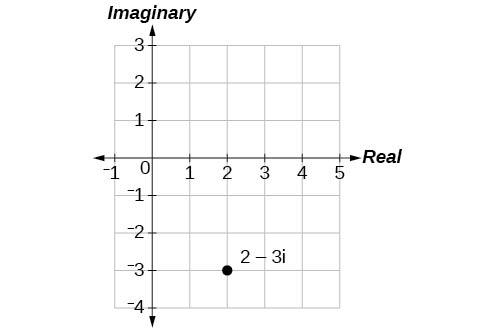
From the origin, move two units in the positive horizontal direction and three units in the negative vertical direction. See Figure 1.
原点から、横の正の向きに2単位、縦の負の向きに3単位動く。図1を見よ。
Try It #1やってみよう1
Plot the point in the complex plane.
点 を複素平面に打て。
Finding the Absolute Value of a Complex Number複素数の絶対値を求める
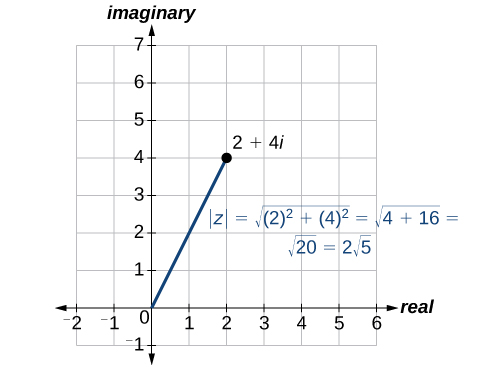
The first step toward working with a complex number in polar form is to find the absolute value. The absolute value of a complex number is the same as its magnitude, or It measures the distance from the origin to a point in the plane. For example, the graph of in Figure 2, shows
複素数を極形式で扱うための最初の一歩は、絶対値を求めることである。複素数の絶対値は、その大きさすなわち と同じである。これは原点から平面上の点までの距離を測る。たとえば図2の のグラフは を示している。
Absolute Value of a Complex Number 複素数の絶対値
Given a complex number, the absolute value of is defined as
複素数 が与えられたとき、 の絶対値は次のように定められる。
It is the distance from the origin to the point
これは原点から点 までの距離である。
Notice that the absolute value of a real number gives the distance of the number from 0, while the absolute value of a complex number gives the distance of the number from the origin,
実数の絶対値がその数の0からの距離を与えるのに対し、複素数の絶対値はその数の原点 からの距離を与えることに注目しよう。
Example 2例2
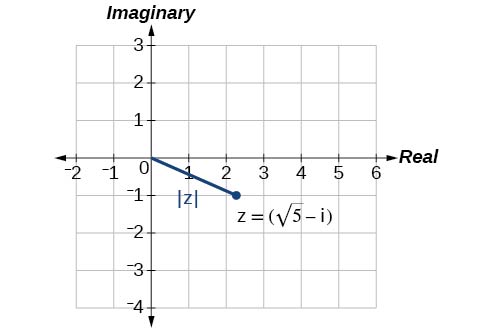
Finding the Absolute Value of a Complex Number with a Radical根号を含む複素数の絶対値を求める
Find the absolute value of
の絶対値を求めよ。
Try It #2やってみよう2
Find the absolute value of the complex number
複素数 の絶対値を求めよ。
Example 3例3
Finding the Absolute Value of a Complex Number複素数の絶対値を求める
Given find
が与えられたとき、 を求めよ。
Solution 解答
Using the formula, we have
この公式を使うと、次が得られる。
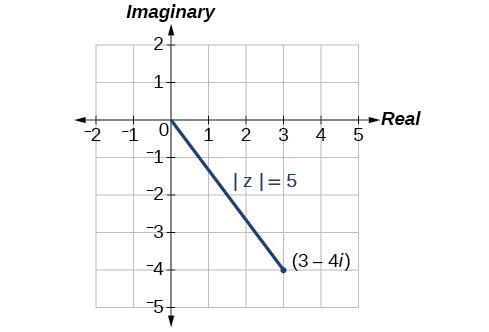
The absolute value is 5. See Figure 4.
絶対値 は5である。図4を見よ。
Try It #3やってみよう3
Given find
が与えられたとき、 を求めよ。
Writing Complex Numbers in Polar Form複素数を極形式で書く
The polar form of a complex number expresses a number in terms of an angle and its distance from the origin Given a complex number in rectangular form expressed as we use the same conversion formulas as we do to write the number in trigonometric form:
複素数の極形式は、その数を角 と原点からの距離 で表す。直交形式で と表された複素数が与えられたとき、この数を三角の形で書くのと同じ変換の公式を使う。
We review these relationships in Figure 5.
この関係を図5で振り返る。
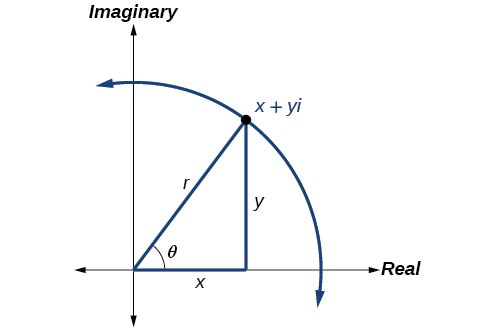
We use the term modulus to represent the absolute value of a complex number, or the distance from the origin to the point The modulus, then, is the same as the radius in polar form. We use to indicate the angle of direction (just as with polar coordinates). Substituting, we have
複素数の絶対値、すなわち原点から点 までの距離を表すのに、絶対値(モジュラス)という語を使う。よって絶対値は、極形式の半径 と同じである。向きの角を示すのに(極座標と同じく) を使う。代入すると、次が得られる。
Note重要事項
Polar Form of a Complex Number複素数の極形式
Writing a complex number in polar form involves the following conversion formulas:
複素数を極形式で書くには、次の変換の公式を使う。
Making a direct substitution, we have
直接代入すると、次が得られる。
where is the modulus and is the argument. We often use the abbreviation to represent
ここで は絶対値、 は偏角である。 を表すのに、しばしば略記 を使う。
Example 4例4
Expressing a Complex Number Using Polar Coordinates極座標を使って複素数を表す
Express the complex number using polar coordinates.
極座標を使って複素数 を表せ。
Solution 解答
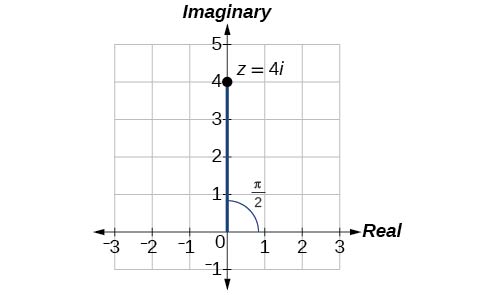
On the complex plane, the number is the same as Writing it in polar form, we have to calculate first.
複素平面で、数 は と同じである。極形式で書くには、まず を計算しなければならない。
Next, we look at If and then In polar coordinates, the complex number can be written as or See Figure 6.
次に を見る。 かつ なら である。極座標では、複素数 は すなわち と書ける。図6を見よ。
Try It #4やってみよう4
Express as in polar form.
極形式で を として表せ。
Example 5例5
Finding the Polar Form of a Complex Number複素数の極形式を求める
Find the polar form of
の極形式を求めよ。
Solution 解答
First, find the value of
まず の値を求める。
Find the angle using the formula:
次の公式で角 を求める。
Thus, the solution is
よって解は である。
Try It #5やってみよう5
Write in polar form.
を極形式で書け。
Converting a Complex Number from Polar to Rectangular Form複素数を極形式から直交形式に直す
Converting a complex number from polar form to rectangular form is a matter of evaluating what is given and using the distributive property. In other words, given first evaluate the trigonometric functions and Then, multiply through by
複素数を極形式から直交形式に直すのは、与えられたものの値を求め、分配法則を使うことである。言い換えれば、 が与えられたら、まず三角関数 と の値を求める。そして を掛ける。
Example 6例6
Converting from Polar to Rectangular Form極形式から直交形式に直す
Convert the polar form of the given complex number to rectangular form:
与えられた複素数の極形式を直交形式に直せ。
Solution 解答
We begin by evaluating the trigonometric expressions.
まず三角関数の式の値を求めることから始める。
After substitution, the complex number is
代入すると、この複素数は次のようになる。
We apply the distributive property:
分配法則を当てはめる。
The rectangular form of the given point in complex form is
複素形式で与えられたこの点の直交形式は である。
Example 7例7
Finding the Rectangular Form of a Complex Number複素数の直交形式を求める
Find the rectangular form of the complex number given and Assume the number is in the first quadrant.
と が与えられた複素数の直交形式を求めよ。この数は第1象限にあるとする。
Solution 解答
If and we first confirm We then find and
かつ なら、まず を確かめる。そして と を求める。
The rectangular form of the given number in complex form is
複素形式で与えられたこの数の直交形式は である。
Try It #6やってみよう6
Convert the complex number to rectangular form:
この複素数を直交形式に直せ。
Finding Products of Complex Numbers in Polar Form極形式で複素数の積を求める
Now that we can convert complex numbers to polar form we will learn how to perform operations on complex numbers in polar form. For the rest of this section, we will work with formulas developed by French mathematician Abraham De Moivre (1667-1754). These formulas have made working with products, quotients, powers, and roots of complex numbers much simpler than they appear. The rules are based on multiplying the moduli and adding the arguments.
複素数を極形式に直せるようになったので、極形式の複素数の演算のしかたを学ぼう。この節の残りでは、フランスの数学者アブラーム・ド・モアブル(1667-1754)が組み立てた公式を扱う。この公式のおかげで、複素数の積・商・累乗・根を扱うのは、見かけよりずっと簡単になった。この規則は、絶対値を掛け、偏角を足すことにもとづく。
Products of Complex Numbers in Polar Form 極形式による複素数の積
If and then the product of these numbers is given as:
かつ なら、この数の積は次で与えられる。
Notice that the product calls for multiplying the moduli and adding the angles.
積では絶対値を掛け、角を足すことに注目しよう。
Example 8例8
Finding the Product of Two Complex Numbers in Polar Form極形式で二つの複素数の積を求める
Find the product of given and
と が与えられたとき、 の積を求めよ。
Solution 解答
Follow the formula
次の公式に従う。
Finding Quotients of Complex Numbers in Polar Form極形式で複素数の商を求める
The quotient of two complex numbers in polar form is the quotient of the two moduli and the difference of the two arguments.
極形式の二つの複素数の商は、二つの絶対値の商と、二つの偏角の差である。
Quotients of Complex Numbers in Polar Form 極形式による複素数の商
If and then the quotient of these numbers is
かつ なら、この数の商は次のとおりである。
Notice that the moduli are divided, and the angles are subtracted.
絶対値は割られ、角は引かれることに注目しよう。
How To 手順
Given two complex numbers in polar form, find the quotient.
極形式の二つの複素数が与えられたとき、その商を求める。
1. Divide 2. Find 3. Substitute the results into the formula: Replace with and replace with 4. Calculate the new trigonometric expressions and multiply through by
1. を割る。2. を求める。3. 結果を公式 に代入する。 を に、 を に置き換える。4. 新しい三角関数の式の値を求め、 を掛ける。
Example 9例9
Finding the Quotient of Two Complex Numbers二つの複素数の商を求める
Find the quotient of and
と の商を求めよ。
Solution 解答
Using the formula, we have
この公式を使うと、次が得られる。
Try It #7やってみよう7
Find the product and the quotient of and
と の積と商を求めよ。
Finding Powers of Complex Numbers in Polar Form極形式で複素数の累乗を求める
Finding powers of complex numbers is greatly simplified using De Moivre’s Theorem. It states that, for a positive integer is found by raising the modulus to the power and multiplying the argument by It is the standard method used in modern mathematics.
ド・モアブルの定理を使えば、複素数の累乗を求めるのはとても簡単になる。この定理は、正の整数 について、絶対値を 乗し、偏角を 倍すれば求まると述べる。これは今日の数学で使われる標準の方法である。
De Moivre’s Theorem ド・モアブルの定理
If is a complex number, then
が複素数なら、次が成り立つ。
where is a positive integer.
ここで は正の整数である。
Example 10例10
Evaluating an Expression Using De Moivre’s Theoremド・モアブルの定理を使って式の値を求める
Evaluate the expression using De Moivre’s Theorem.
ド・モアブルの定理を使って式 の値を求めよ。
Solution 解答
Since De Moivre’s Theorem applies to complex numbers written in polar form, we must first write in polar form. Let us find
ド・モアブルの定理は極形式で書かれた複素数に当てはまるので、まず を極形式で書かなければならない。 を求めよう。
Then we find Using the formula gives
そして を求める。公式 を使うと次が得られる。
Use De Moivre’s Theorem to evaluate the expression.
ド・モアブルの定理を使って式の値を求めよ。
Finding Roots of Complex Numbers in Polar Form極形式で複素数の根を求める
To find the nth root of a complex number in polar form, we use the Root Theorem or De Moivre’s Theorem and raise the complex number to a power with a rational exponent. There are several ways to represent a formula for finding roots of complex numbers in polar form.
極形式の複素数の n乗根を求めるには、 乗根の定理すなわちド・モアブルの定理を使い、有理数の指数でその複素数を累乗する。極形式の複素数の 乗根を求める公式の表し方は何通りかある。
Note重要事項
The nth Root Theoremn乗根の定理
To find the root of a complex number in polar form, use the formula given as
極形式の複素数の 乗根を求めるには、次で与えられる公式を使う。
where We add to in order to obtain the periodic roots.
ここで である。周期的な根を得るために に を足す。
Example 11例11
Finding the nth Root of a Complex Number複素数の n乗根を求める
Evaluate the cube roots of
の三乗根を求めよ。
Solution 解答
We have
次が得られる。
There will be three roots: When we have
根は三つある。 である。 のとき、次が得られる。
When we have
のとき、次が得られる。
When we have
のとき、次が得られる。
Remember to find the common denominator to simplify fractions in situations like this one. For the angle simplification is
このような場合は、分数を簡単にするために通分するのを忘れないでほしい。 では、角は次のように簡単になる。
Try It #8やってみよう8
Find the four fourth roots of
の四つの四乗根を求めよ。
Media 教材
Access these online resources for additional instruction and practice with polar forms of complex numbers.
複素数の極形式についての説明と練習をさらに求めるなら、次のオンライン教材にあたるとよい。
• The Product and Quotient of Complex Numbers in Trigonometric Form• De Moivre’s Theorem
・三角の形での複素数の積と商・ド・モアブルの定理
Verbal言葉で答える問題
2. What does the absolute value of a complex number represent?
2. 複素数の絶対値は何を表すか。
4. How do we find the product of two complex numbers?
4. 二つの複素数の積はどう求めるか。
Algebraic代数の問題
For the following exercises, find the absolute value of the given complex number.
次の各問について、与えられた複素数の絶対値を求めよ。
For the following exercises, write the complex number in polar form.
次の各問について、複素数を極形式で書け。
For the following exercises, convert the complex number from polar to rectangular form.
次の各問について、複素数を極形式から直交形式に直せ。
For the following exercises, find in polar form.
次の各問について、 を極形式で求めよ。
For the following exercises, find in polar form.
次の各問について、 を極形式で求めよ。
For the following exercises, find the powers of each complex number in polar form.
次の各問について、各複素数の累乗を極形式で求めよ。
36. Find when
36. のとき を求めよ。
38. Find when
38. のとき を求めよ。
40. Find when
40. のとき を求めよ。
For the following exercises, evaluate each root.
次の各問について、各根の値を求めよ。
42. Evaluate the square root of when
42. のとき の平方根を求めよ。
44. Evaluate the square root of when
44. のとき の平方根を求めよ。
Graphicalグラフの問題
For the following exercises, plot the complex number in the complex plane.
次の各問について、複素数を複素平面に打て。
Technology機器を使う問題
For the following exercises, find all answers rounded to the nearest hundredth.
次の各問について、答えをすべて小数第二位まで丸めて求めよ。
56. Use the rectangular to polar feature on the graphing calculator to change to polar form.
56. グラフ電卓の直交から極への機能を使って、 を極形式に変えよ。
58. Use the rectangular to polar feature on the graphing calculator to change to polar form.
58. グラフ電卓の直交から極への機能を使って、 を極形式に変えよ。
60. Use the polar to rectangular feature on the graphing calculator to change to rectangular form.
60. グラフ電卓の極から直交への機能を使って、 を直交形式に変えよ。