第2章方程式と不等式Equations and Inequalities
2.4 Complex Numbers2.4 複素数
Learning Objectives 学習目標
In this section, you will:
この節を終えると、次のことができるようになる。
• Add and subtract complex numbers.• Multiply and divide complex numbers.• Simplify powers of
・複素数を足し引きする。・複素数を掛け、割る。・ の累乗を簡単にする。
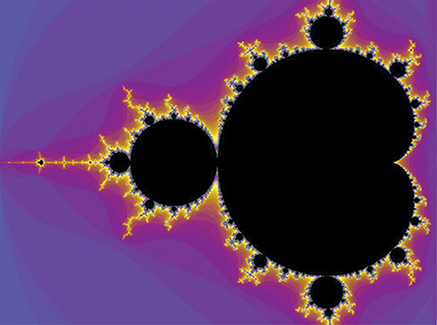
Discovered by Benoit Mandelbrot around 1980, the Mandelbrot Set is one of the most recognizable fractal images. The image is built on the theory of self-similarity and the operation of iteration. Zooming in on a fractal image brings many surprises, particularly in the high level of repetition of detail that appears as magnification increases. The equation that generates this image turns out to be rather simple.
1980年ごろに Benoit Mandelbrot が見つけたマンデルブロ集合は、もっともよく知られたフラクタルの図の一つである。この図は自己相似の理論と、繰り返しという操作の上に成り立っている。フラクタルの図を拡大していくと驚きが次々に現れる。とりわけ、拡大するにつれて細部が高い度合いで繰り返される様子が目を引く。この図を生む方程式は、実のところかなり単純である。
In order to better understand it, we need to become familiar with a new set of numbers. Keep in mind that the study of mathematics continuously builds upon itself. Negative integers, for example, fill a void left by the set of positive integers. The set of rational numbers, in turn, fills a void left by the set of integers. The set of real numbers fills a void left by the set of rational numbers. Not surprisingly, the set of real numbers has voids as well. In this section, we will explore a set of numbers that fills voids in the set of real numbers and find out how to work within it.
それをよりよく理解するには、新しい数の集合に慣れる必要がある。数学の学びは、つねにそれまでの上に積み上がっていくことを心に留めておこう。たとえば負の整数は、正の整数の集合が残した空隙を埋める。有理数の集合は、今度は整数の集合が残した空隙を埋める。実数の集合は有理数の集合が残した空隙を埋める。当然ながら、実数の集合にもまた空隙がある。この節では、実数の集合の空隙を埋める数の集合を調べ、その中でどう計算するかを学ぶ。
Expressing Square Roots of Negative Numbers as Multiples of 負の数の平方根を の定数倍として表す
We know how to find the square root of any positive real number. In a similar way, we can find the square root of any negative number. The difference is that the root is not real. If the value in the radicand is negative, the root is said to be an imaginary number. The imaginary number is defined as the square root of
正の実数の平方根の求め方は分かっている。同じようにして、どんな負の数の平方根も求められる。違うのは、その根が実数でないことである。根号の中身が負なら、その根は虚数であるという。虚数 は の平方根として定義される。
So, using properties of radicals,
よって、根号の性質を使うと、
We can write the square root of any negative number as a multiple of Consider the square root of
どんな負の数の平方根も の定数倍として書ける。 の平方根を考えよう。
We use and not because the principal root of is the positive root.
ではなく を使うのは、 の正の根が正の方だからである。
A complex number is the sum of a real number and an imaginary number. A complex number is expressed in standard form when written where is the real part and is the imaginary part. For example, is a complex number. So, too, is
複素数とは、実数と虚数の和である。複素数を と書いたとき、これを標準形という。ここで が実部、 が虚部である。たとえば は複素数である。 も複素数である。

Imaginary numbers differ from real numbers in that a squared imaginary number produces a negative real number. Recall that when a positive real number is squared, the result is a positive real number and when a negative real number is squared, the result is also a positive real number. Complex numbers consist of real and imaginary numbers.
虚数が実数と違うのは、虚数を二乗すると負の実数になる点である。正の実数を二乗すれば正の実数になり、負の実数を二乗してもやはり正の実数になったことを思い出そう。複素数は実数と虚数からなる。
Imaginary and Complex Numbers 虚数と複素数
A complex number is a number of the form where
複素数とは の形の数である。ここで
• is the real part of the complex number.• is the imaginary part of the complex number.
・ はその複素数の実部である。・ はその複素数の虚部である。
If then is a real number. If and is not equal to 0, the complex number is called a pure imaginary number. An imaginary number is an even root of a negative number.
なら は実数である。 で が0でないなら、その複素数を純虚数という。虚数とは、負の数の偶数乗根のことである。
How To 手順
Given an imaginary number, express it in the standard form of a complex number.
虚数が与えられたとき、それを複素数の標準形で表す。
1. Write as 2. Express as 3. Write in simplest form.
1. を と書く。2. を と表す。3. を最も簡単な形で書け。
Example 1例1
Expressing an Imaginary Number in Standard Form虚数を標準形で表す
Express in standard form.
を標準形で表せ。
Solution 解答
In standard form, this is
標準形で書くと である。
Try It #1やってみよう1
Express in standard form.
を標準形で表せ。
Plotting a Complex Number on the Complex Plane複素数を複素平面上の点として表す
We cannot plot complex numbers on a number line as we might real numbers. However, we can still represent them graphically. To represent a complex number, we need to address the two components of the number. We use the complex plane, which is a coordinate system in which the horizontal axis represents the real component and the vertical axis represents the imaginary component. Complex numbers are the points on the plane, expressed as ordered pairs where represents the coordinate for the horizontal axis and represents the coordinate for the vertical axis.
実数のように数直線の上に複素数を打つことはできない。それでも図で表すことはできる。複素数を表すには、その数の二つの成分を扱う必要がある。そこで複素平面を使う。これは横の軸が実部を、縦の軸が虚部を表す座標系である。複素数はこの平面上の点であり、順序対 として表す。ここで が横の軸の座標、 が縦の軸の座標である。
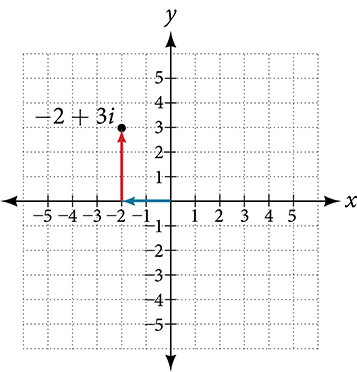
Let’s consider the number The real part of the complex number is and the imaginary part is 3. We plot the ordered pair to represent the complex number as shown in Figure 2.
数 を考えよう。この複素数の実部は 、虚部は3である。図2のように、複素数 を表すために順序対 を打つ。
Complex Plane 複素平面
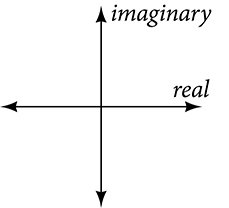
In the complex plane, the horizontal axis is the real axis, and the vertical axis is the imaginary axis, as shown in Figure 3.
図3のように、複素平面では横の軸を実軸、縦の軸を虚軸という。
How To 手順
Given a complex number, represent its components on the complex plane.
複素数が与えられたとき、その成分を複素平面上に表す。
1. Determine the real part and the imaginary part of the complex number.2. Move along the horizontal axis to show the real part of the number.3. Move parallel to the vertical axis to show the imaginary part of the number.4. Plot the point.
1. その複素数の実部と虚部を決める。2. 横の軸に沿って動き、数の実部を示す。3. 縦の軸に平行に動き、数の虚部を示す。4. その点を打つ。
Example 2例2
Plotting a Complex Number on the Complex Plane複素数を複素平面上の点として表す
Plot the complex number on the complex plane.
複素数 を複素平面に打て。
Solution 解答
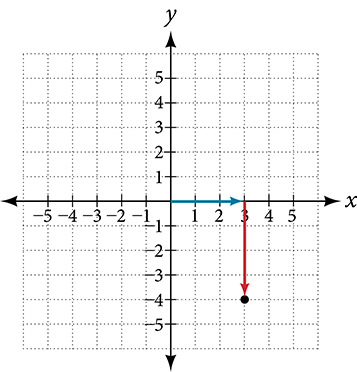
The real part of the complex number is and the imaginary part is –4. We plot the ordered pair as shown in Figure 4.
この複素数の実部は 、虚部は–4である。図4のように順序対 を打つ。
Try It #2やってみよう2
Plot the complex number on the complex plane.
複素数 を複素平面に打て。
Adding and Subtracting Complex Numbers複素数を足し引きする
Just as with real numbers, we can perform arithmetic operations on complex numbers. To add or subtract complex numbers, we combine the real parts and then combine the imaginary parts.
実数と同じように、複素数にも計算ができる。複素数を足し引きするには、実部どうしをまとめ、次に虚部どうしをまとめる。
Complex Numbers: Addition and Subtraction 複素数の加法と減法
Adding complex numbers:
複素数を足す。
Subtracting complex numbers:
複素数を引く。
How To 手順
Given two complex numbers, find the sum or difference.
二つの複素数が与えられたとき、その和または差を求める。
1. Identify the real and imaginary parts of each number.2. Add or subtract the real parts.3. Add or subtract the imaginary parts.
1. それぞれの数の実部と虚部を見分ける。2. 実部どうしを足し引きする。3. 虚部どうしを足し引きする。
Example 3例3
Adding and Subtracting Complex Numbers複素数を足し引きする
Add or subtract as indicated.
指示されたとおりに足し引きせよ。
Solution 解答
We add the real parts and add the imaginary parts.
実部どうしを足し、虚部どうしを足す。
Try It #3やってみよう3
Subtract from
から を引け。
Multiplying Complex Numbers複素数を掛ける
Multiplying complex numbers is much like multiplying binomials. The major difference is that we work with the real and imaginary parts separately.
複素数の掛け算は、二項式どうしの掛け算とよく似ている。大きく違うのは、実部と虚部を別々に扱う点である。
Multiplying a Complex Number by a Real Number複素数と実数を掛ける
Lets begin by multiplying a complex number by a real number. We distribute the real number just as we would with a binomial. Consider, for example, :
まず複素数と実数の掛け算から始めよう。二項式のときと同じように、実数を配る。たとえば を考えよう。

How To 手順
Given a complex number and a real number, multiply to find the product.
複素数と実数が与えられたとき、掛けて積を求める。
1. Use the distributive property.2. Simplify.
1. 分配法則を使う。2. 簡単にする。
Example 4例4
Multiplying a Complex Number by a Real Number複素数と実数を掛ける
Find the product
積 を求めよ。
Solution 解答
Distribute the 4.
4を配る。
Try It #4やってみよう4
Find the product:
積 を求めよ。
Multiplying Complex Numbers Together複素数どうしを掛ける
Now, let’s multiply two complex numbers. We can use either the distributive property or more specifically the FOIL method because we are dealing with binomials. Recall that FOIL is an acronym for multiplying First, Outer, Inner, and Last terms together. The difference with complex numbers is that when we get a squared term, it equals
次は複素数どうしを掛けよう。扱っているのは二項式なので、分配法則を使ってもよいし、より具体的に FOIL 法を使ってもよい。FOIL が First、Outer、Inner、Last の項どうしを掛けることの頭字語だったのを思い出そう。複素数で違うのは、二乗の項 が出てきたとき、それが に等しくなる点である。
How To 手順
Given two complex numbers, multiply to find the product.
二つの複素数が与えられたとき、掛けて積を求める。
1. Use the distributive property or the FOIL method.2. Remember that 3. Group together the real terms and the imaginary terms
1. 分配法則または FOIL 法を使う。2. であることを忘れないこと。3. 実部の項どうし、虚部の項どうしをまとめる。
Example 5例5
Multiplying a Complex Number by a Complex Number複素数と複素数を掛ける
Multiply:
を掛けよ。
Solution 解答
Try It #5やってみよう5
Multiply:
を掛けよ。
Dividing Complex Numbers複素数を割る
Dividing two complex numbers is more complicated than adding, subtracting, or multiplying because we cannot divide by an imaginary number, meaning that any fraction must have a real-number denominator to write the answer in standard form We need to find a term by which we can multiply the numerator and the denominator that will eliminate the imaginary portion of the denominator so that we end up with a real number as the denominator. This term is called the complex conjugate of the denominator, which is found by changing the sign of the imaginary part of the complex number. In other words, the complex conjugate of is For example, the product of and is
複素数どうしの割り算は、足し算・引き算・掛け算より込み入っている。虚数で割ることはできないからだ。つまり、答えを標準形 で書くには、どの分数も分母が実数でなければならない。分子と分母に掛けることで分母の虚部を消し、分母が実数になるような項を見つける必要がある。この項を分母の共役複素数といい、複素数の虚部の符号を変えれば得られる。言い換えると、 の共役複素数は である。たとえば と の積は次のようになる。
The result is a real number.
結果は実数である。
Note that complex conjugates have an opposite relationship: The complex conjugate of is and the complex conjugate of is Further, when a quadratic equation with real coefficients has complex solutions, the solutions are always complex conjugates of one another.
共役複素数は互いに相手の共役になっていることに注意せよ。 の共役複素数は であり、 の共役複素数は である。さらに、実数の係数を持つ二次方程式が複素数の解を持つとき、その解どうしはつねに互いに共役複素数である。
Suppose we want to divide by where neither nor equals zero. We first write the division as a fraction, then find the complex conjugate of the denominator, and multiply.
を で割りたいとしよう。ここで も も0でないとする。まず割り算を分数として書き、次に分母の共役複素数を求めて掛ける。
Multiply the numerator and denominator by the complex conjugate of the denominator.
分子と分母に、分母の共役複素数を掛ける。
Apply the distributive property.
分配法則を使う。
Simplify, remembering that
であることを忘れずに簡単にする。
The Complex Conjugate 共役複素数
The complex conjugate of a complex number is It is found by changing the sign of the imaginary part of the complex number. The real part of the number is left unchanged.
複素数 の共役複素数は である。複素数の虚部の符号を変えれば得られる。実部はそのままにしておく。
• When a complex number is multiplied by its complex conjugate, the result is a real number.• When a complex number is added to its complex conjugate, the result is a real number.
・複素数にその共役複素数を掛けると、結果は実数になる。・複素数にその共役複素数を足すと、結果は実数になる。
Example 6例6
Finding Complex Conjugates共役複素数を求める
Find the complex conjugate of each number.
次の各数の共役複素数を求めよ。
Solution 解答
ⓐThe number is already in the form The complex conjugate is or ⓑWe can rewrite this number in the form as The complex conjugate is or This can be written simply as
ⓐこの数はすでに の形になっている。共役複素数は すなわち である。ⓑこの数は の形に と書き直せる。共役複素数は すなわち である。これは単に と書ける。
Analysis 考察
Although we have seen that we can find the complex conjugate of an imaginary number, in practice we generally find the complex conjugates of only complex numbers with both a real and an imaginary component. To obtain a real number from an imaginary number, we can simply multiply by
虚数の共役複素数も求められることを見たが、実際に共役複素数を求めるのは、たいてい実部と虚部の両方を持つ複素数についてだけである。虚数から実数を得たいだけなら、単に を掛ければよい。
Try It #6やってみよう6
Find the complex conjugate of
の共役複素数を求めよ。
How To 手順
Given two complex numbers, divide one by the other.
二つの複素数が与えられたとき、一方を他方で割る。
1. Write the division problem as a fraction.2. Determine the complex conjugate of the denominator.3. Multiply the numerator and denominator of the fraction by the complex conjugate of the denominator.4. Simplify.
1. 割り算の問題を分数として書く。2. 分母の共役複素数を求める。3. 分数の分子と分母に、分母の共役複素数を掛ける。4. 簡単にする。
Example 7例7
Dividing Complex Numbers複素数を割る
Divide: by
を で割れ。
Solution 解答
We begin by writing the problem as a fraction.
まず問題を分数として書く。
Then we multiply the numerator and denominator by the complex conjugate of the denominator.
それから分子と分母に、分母の共役複素数を掛ける。
To multiply two complex numbers, we expand the product as we would with polynomials (using FOIL).
複素数どうしを掛けるには、多項式のときと同じように(FOIL を使って)積を展開する。
Note that this expresses the quotient in standard form.
これで商が標準形で表せていることに注意せよ。
Simplifying Powers of ii の累乗を簡単にする
The powers of are cyclic. Let’s look at what happens when we raise to increasing powers.
の累乗は循環する。 の乗数を上げていくとどうなるか見てみよう。
We can see that when we get to the fifth power of it is equal to the first power. As we continue to multiply by increasing powers, we will see a cycle of four. Let’s examine the next four powers of
の5乗が1乗に等しくなることが分かる。 を掛けて乗数を上げ続けると、四つで一巡することが見えてくる。 の次の四つの累乗を調べよう。
The cycle is repeated continuously: every four powers.
という巡りが、四つの累乗ごとに何度も繰り返される。
Example 8例8
Simplifying Powers of の累乗を簡単にする
Evaluate:
の値を求めよ。
Solution 解答
Since we can simplify the problem by factoring out as many factors of as possible. To do so, first determine how many times 4 goes into 35:
なので、 の因数をできるだけ多くくくり出せば問題を簡単にできる。そのためにまず、35の中に4が何回入るかを求める。
Try It #7やってみよう7
Evaluate:
の値を求めよ。
Q&A 疑問と答え
Can we write in other helpful ways?
を、ほかの役に立つ形に書けるだろうか。
As we saw in Example 8, we reduced to by dividing the exponent by 4 and using the remainder to find the simplified form. But perhaps another factorization of may be more useful. Table 1 shows some other possible factorizations.
例8で見たように、指数を4で割り、その余りを使って簡単な形を求めることで を に直した。しかし を別の形に分解した方が役に立つこともある。表1に、ほかにありうる分解の仕方をいくつか示す。
| Factorization of の分解 | ||||
| Reduced form直した形 | ||||
| Simplified form簡単にした形 |
Each of these will eventually result in the answer we obtained above but may require several more steps than our earlier method.
どれも最後には上で得た答えにたどり着くが、先ほどの方法より手順が何段か多くなることがある。
Media 教材
Access these online resources for additional instruction and practice with complex numbers.
複素数についての説明と練習をさらに求めるなら、次のオンライン教材にあたるとよい。
• Adding and Subtracting Complex Numbers• Multiply Complex Numbers• Multiplying Complex Conjugates• Raising i to Powers
・複素数を足し引きする・複素数を掛ける・共役複素数を掛ける・i を累乗する
Verbal言葉で答える問題
2. What is the basic principle in multiplication of complex numbers?
2. 複素数の掛け算における基本の考えは何か。
4. What is a characteristic of the plot of a real number in the complex plane?
4. 複素平面に実数を打ったとき、その点にはどんな特徴があるか。
Algebraic代数の問題
For the following exercises, evaluate the algebraic expressions.
次の各問について、代数式の値を求めよ。
6. If evaluate given
6. のとき、 として の値を求めよ。
8. If evaluate given
8. のとき、 として の値を求めよ。
10. If evaluate given
10. のとき、 として の値を求めよ。
Graphicalグラフの問題
For the following exercises, plot the complex numbers on the complex plane.
次の各問について、複素数を複素平面に打て。
Numeric数値の問題
For the following exercises, perform the indicated operation and express the result as a simplified complex number.
次の各問について、指示された計算を行い、結果を簡単にした複素数として表せ。
Technology機器を使う問題
For the following exercises, use a calculator to help answer the questions.
次の各問について、電卓を使って答えよ。
42. Evaluate for and . Predict the value if
42. と について の値を求めよ。 のときの値を予想せよ。
44. Evaluate for and . Predict the value for
44. と について の値を求めよ。 のときの値を予想せよ。
46. Show that a solution of is
46. が の解であることを示せ。
Extensions発展問題
For the following exercises, evaluate the expressions, writing the result as a simplified complex number.
次の各問について、式の値を求め、結果を簡単にした複素数として書け。